Clean, dependable production sound can make the difference between a polished film and a costly reshoot. The right recorder helps you capture dialogue, room tone, and backup tracks with less risk in demanding locations.
We compare 10 field recorders for film production across input count, 32-bit float recording, timecode support, portability, and workflow flexibility so you can choose the best fit for your crew and budget.
Best 10 Field Recorder for Film Production Picks for 2026
Best Professional Multitrack Choice

- 32-bit float recording helps prevent clipping
- Six XLR inputs and up to 14 tracks
- Timecode I/O for frame-accurate sync
Best For: Professional location crews recording multiple microphones
Best Compact Timecode Recorder

- 32-bit float recording with dual ADCs
- Built-in timecode generation and sync
- Two XLR/TRS inputs plus 3.5 mm input
Best For: Mobile videographers needing compact synchronized audio
Best Handheld All-Purpose Recorder

- Built-in stereo microphones for quick recording
- Two XLR/TRS inputs for external gear
- 32-bit float recording and USB-C connectivity
Best For: Independent creators and small film crews
Best Lavalier Recorder for Talent

- Includes a matched clip-on lavalier microphone
- 32-bit float mono recording
- LTC Jam Sync and up to 512GB microSDXC support
Best For: Discreet personal audio for actors and interview subjects
Compact Production Pick
- Four-track simultaneous recording
- Two XLR/TRS inputs with phantom power
- Interchangeable capsules and USB interface
Best For: Independent filmmakers and lightweight location kits
Professional Location Workhorse
- Eight inputs and 10-track recording
- 32-bit float with dual SD redundancy
- 0.2 ppm timecode accuracy
Best For: Professional crews and complex synchronized shoots
Flexible Handheld Upgrade

- Six-track 32-bit float recording
- Four XLR/TRS inputs plus X/Y microphones
- Interchangeable capsules and USB backup workflow
Best For: Small crews needing multiple inputs in a handheld recorder
Pro Run-and-Gun Pick

- 32-bit float recording for changing levels
- Dual locking XLR/TRS inputs
- Low-noise preamps and flexible power
Best For: Run-and-gun filmmakers using external XLR microphones
Compact Value Pick

- Two XLR/TRS combo inputs
- 32-bit/96kHz recording
- Waveform display and SDXC support
Best For: Interviews and small two-source production setups
Multitrack Location Pick

- Large 19.4mm X/Y stereo microphones
- Up to four tracks at 192kHz
- Dedicated gain knobs and 32-bit float
Best For: Location crews needing stereo capture and multitrack flexibility
Best Professional Multitrack Choice – Zoom F6
The Zoom F6 is a strong field recorder for film production when you need multiple microphone inputs, wide dynamic range, and reliable synchronization. Its 32-bit float recording, six XLR inputs, and timecode I/O suit demanding location workflows.
Best For: Filmmakers and production sound teams recording multiple sources on location.
Pros:
- 32-bit float recording with dual A/D converters helps capture quiet dialogue and loud sounds without clipping.
- Six XLR inputs and up to 14 tracks support larger recording setups.
- Timecode I/O enables frame-accurate audio and video synchronization.
- Compact, rugged construction and multiple power options support location work.
Cons:
- At 2.4 pounds, it is less lightweight than simpler handheld recorders.
- Its larger input and timecode feature set may be more than small shoots require.
The F6 is the most production-oriented option here, especially for crews that need several microphones and dependable sync. It can also function as a USB audio interface when the workflow extends beyond standalone recording.
Best Compact Timecode Recorder – TASCAM FR-AV2
The TASCAM FR-AV2 is a compact field recorder for film production aimed at videographers who want no-clip capture and built-in timecode generation. Dual 32-bit float ADCs, two combo inputs, and a 3.5 mm input provide a flexible setup in a small body.
Best For: Videographers who prioritize compact size, internal timecode, and quick setup.
Pros:
- 32-bit float recording with dual ADCs supports worry-free capture.
- Built-in timecode generation plus timecode input and output simplifies synchronization.
- Two XLR/TRS combo inputs use Ultra HDDA preamps.
- Supports 48, 96, and 192 kHz recording formats.
Cons:
- It has only two XLR/TRS combo inputs, limiting larger microphone setups.
- Wireless monitoring requires the optional AK-BT2 adapter.
With a listed weight of 9.5 ounces and a compact 3.9-by-3.15-by-1.57-inch design, the FR-AV2 is well suited to mobile video rigs. Its built-in timecode features are a notable advantage when minimizing external equipment.
Best Handheld All-Purpose Recorder – Zoom H4 Essential
The Zoom H4 Essential is a versatile field recorder for film production when you want built-in stereo microphones alongside external input options. It records in 32-bit float, offers two XLR/TRS inputs, and can connect to a phone, tablet, or computer through USB-C.
Best For: Independent filmmakers, interviewers, and creators who need a portable recorder for varied projects.
Pros:
- Built-in stereo microphones make it ready for quick ambient or location recording.
- Two XLR/TRS inputs accommodate external microphones, instruments, mixers, or soundboards.
- 32-bit float recording helps reduce concern about distorted takes.
- USB-C supports recording or streaming while audio can also be saved to an SD card.
Cons:
- Its four-track design is less suited to larger multichannel productions than the Zoom F6.
- It uses two AA batteries, so extended shoots may require spares.
The H4 Essential balances portability and flexibility for smaller crews. It is particularly convenient when you may switch between built-in microphones, external sources, and direct USB workflows during a project.
Best Lavalier Recorder for Talent – TASCAM DR-10L Pro
The TASCAM DR-10L Pro is a specialized field recorder for film production that pairs a compact body with an included lavalier microphone. Its 32-bit float recording, high-capacity microSDXC support, and LTC Jam Sync make it useful for discreet personal audio and streamlined post-production.
Best For: Recording individual performers, interview subjects, or presenters with a discreet lavalier setup.
Pros:
- Includes a matched TM-10L clip-on lavalier microphone.
- 32-bit float recording captures quiet speech and loud sounds with reduced clipping concerns.
- Supports microSDXC cards up to 512GB for extended storage.
- LTC Jam Sync and optional Atomos wireless timecode support multi-device workflows.
Cons:
- It records mono audio and is designed for a single lavalier source.
- The AK-BT1 Bluetooth adapter is sold separately for Atomos wireless timecode.
- Its feature set is less appropriate for multi-microphone recording.
At just 65 grams, the DR-10L Pro is easy to place on talent and practical for situations where a larger recorder would be intrusive. The included lavalier and timecode options make it a focused solution rather than a general-purpose multitrack recorder.
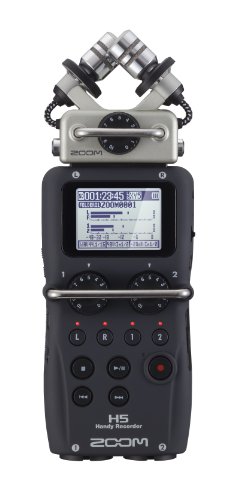
Compact Production Pick – Zoom H5
The Zoom H5 is a practical field recorder for film production when you need a compact setup with interchangeable microphones and two external inputs. Its four-track recording, XLR/TRS connectivity, and battery-powered design suit small crews, interviews, and location work.
Best For: Independent filmmakers, interviews, and lightweight production kits.
Pros:
- Interchangeable input capsules provide flexible microphone options.
- Two XLR/TRS combo inputs include phantom power and a -20 dB pad.
- Records up to four tracks simultaneously and includes an audio safety net.
- Works as a multichannel or stereo USB audio interface.
Cons:
- Two external inputs offer less expansion than larger field recorders.
- Recording capacity is limited to SD/SDHC cards up to 32GB.
The H5 balances portability and production flexibility, making it a strong choice when a full-size mixer-recorder would be excessive. Its capsule system is especially useful for filmmakers who want to adapt the recorder to different shooting situations.
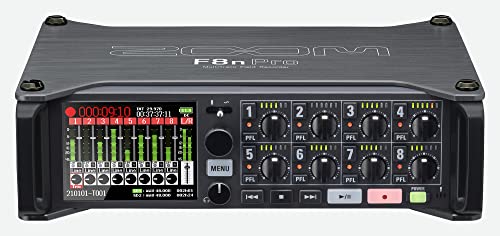
Professional Location Workhorse – Zoom F8n Pro
The Zoom F8n Pro is a professional field recorder for film production built for multi-source setups, demanding locations, and synchronized production audio. It combines eight inputs, 10-track recording, 32-bit float capture, precise timecode, and redundant dual-card recording.
Best For: Professional film crews, complex dialogue setups, and productions requiring timecode and backup recording.
Pros:
- 32-bit float recording and dual AD converters help provide clip-free audio.
- Eight inputs support larger microphone and line-level setups.
- Timecode accuracy is specified down to 0.2 ppm.
- Dual SD slots support redundant recording, with cards up to 1TB each.
Cons:
- At 1.8 kg, it is substantially less portable than a handheld recorder.
- Its professional feature set may be more than a small or simple production needs.
- Battery life is listed at approximately 8.5 hours.
For productions where track count, synchronization, and recording redundancy matter most, the F8n Pro is the most capable option in this lineup. Its 8-in/4-out USB interface also supports flexible monitoring and computer-based workflows.
Flexible Handheld Upgrade – Zoom H6 Essential
The Zoom H6 Essential is a versatile field recorder for film production for filmmakers who need more external inputs than a compact two-input recorder. Six-track 32-bit float recording, four XLR/TRS inputs, built-in X/Y microphones, and capsule support make it adaptable for interviews, events, and multi-source shoots.
Best For: Filmmakers needing four external inputs, clip-free recording, and handheld portability.
Pros:
- 32-bit float recording helps capture distortion-free audio across six tracks.
- Four XLR/TRS inputs complement the built-in X/Y microphones.
- Interchangeable capsules support stereo and mid-side recording options.
- Can record to SD while operating as a USB audio interface.
Cons:
- It records fewer tracks than the F8n Pro.
- It requires four AAA batteries.
- Optional capsules may be needed for some specialized recording scenarios.
The H6 Essential sits between a basic handheld recorder and a larger professional mixer-recorder. Its four external inputs and 32-bit float workflow give small production teams useful flexibility without moving to the F8n Pro’s larger form factor.
Pro Run-and-Gun Pick – Zoom F3 Field Recorder
The Zoom F3 is a dependable field recorder for film production when changing sound levels and demanding locations make manual adjustments impractical. Its 32-bit float recording, dual A/D converters, and locking inputs are well suited to dialogue capture on professional sets and mobile rigs.
Best For: Run-and-gun filmmakers, dialogue recordists, and crews using external XLR microphones.
Pros:
- 32-bit float recording helps capture quiet dialogue and sudden peaks without stopping to adjust levels.
- Dual locking XLR/TRS inputs help secure microphone connections in complex or mounted setups.
- Ultra-low-noise preamps, flexible power options, and USB or standalone workflows support location recording.
Cons:
- It relies on external microphones rather than offering a built-in stereo microphone setup.
- The compact 2-inch screen may provide less at-a-glance control than a larger recorder.
Choose the F3 when reliable, clip-resistant recording and secure XLR connections matter more than built-in microphones or extensive onboard controls.
Compact Value Pick – Zoom H1 XLR Recorder
The Zoom H1 XLR is a practical field recorder for film production when you need a straightforward two-channel setup with modern recording flexibility. It records at 32-bit/96kHz, includes two XLR/TRS combo inputs, and provides a waveform display for quick level checks.
Best For: Interviews, small film crews, podcasters, and filmmakers who need a compact recorder for two external sources.
Pros:
- Two XLR/TRS combo inputs support microphones, instruments, and other sources.
- 32-bit float recording at up to 96kHz supports detailed, clip-resistant capture.
- Waveform display, 3.5mm stereo input, and headphone output simplify monitoring and connections.
- SDXC support up to 1TB provides substantial storage for extended sessions.
Cons:
- Its two-channel design is less suitable for larger multitrack production setups.
- Battery life is listed at about 10 hours, which may require planning for long shoots.
The H1 XLR is a sensible choice for compact productions that want flexible inputs and easy monitoring without moving to a larger multitrack recorder.
Multitrack Location Pick – Zoom H5 Studio Recorder
The Zoom H5 Studio is a versatile field recorder for film production when you want built-in stereo microphones, hands-on gain control, and more multitrack capacity. Its large 19.4mm X/Y microphones, 32-bit float recording, and support for up to four simultaneous tracks make it suited to varied location work.
Best For: Filmmakers who need built-in stereo capture, dedicated gain knobs, and multitrack recording on location.
Pros:
- Large 19.4mm X/Y microphones are designed to deliver detailed stereo sound and a wide dynamic range.
- 32-bit float recording helps reduce the risk of clipped takes in changing environments.
- Dedicated gain knobs allow quick, hands-on level adjustments.
- Records up to four tracks simultaneously at up to 192kHz in WAV format.
Cons:
- Its four-AA-battery requirement may add weight and power-management demands for extended shoots.
- At 14.4 ounces, it is heavier than the compact F3 and H1 XLR.
The H5 Studio is the stronger fit when a production benefits from onboard stereo microphones, tactile controls, and higher track capacity rather than the smallest possible recorder.
How We Picked the Best Field Recorder for Film Production
We focused on recorders suited to real production workflows rather than general-purpose music recording alone. Key considerations included microphone and line inputs, preamp performance, 32-bit float capability, timecode options, storage support, battery practicality, monitoring, and ease of use on location.
The selection covers several use cases: solo filmmakers recording a single microphone, interview crews working with lavaliers, and sound professionals managing multiple sources. Features matter only when they improve reliability or reduce setup time, so we also considered size, mounting flexibility, controls, and the ability to create useful backup tracks.
Quick Comparison
| Best For | What to Prioritize | Recommended Type |
|---|---|---|
| Solo filmmakers | Simple operation and portability | Compact handheld recorder |
| Interviews and lavaliers | Small size, locking connection, 32-bit float | Lavalier or two-channel recorder |
| Small narrative crews | Multiple inputs and timecode | Professional field mixer-recorder |
| High-dynamic-range locations | Clipping protection and dependable preamps | 32-bit float field recorder |
Key Buying Factors for a Field Recorder for Film Production
Input Count and Connectivity
Count every source you may record at once, including boom microphones, wireless receivers, plant microphones, and scratch feeds. XLR inputs are the standard choice for professional microphones, while combo XLR/TRS connections can accommodate line-level gear. More inputs provide flexibility, but they usually increase size, cost, and power demands.
32-Bit Float Recording
32-bit float recording provides substantial protection against poorly set gain levels, which is valuable when sound levels change quickly or the recorder is operated by one person. It does not fix microphone overload, background noise, poor placement, or bad monitoring, so proper mic technique still matters.
Timecode and Synchronization
For multicamera productions, timecode can reduce alignment work during editing. If your cameras or other audio devices support timecode, check whether the recorder offers built-in generation, LTC input or output, or a compatible synchronization workflow. For simple one-camera shoots, this feature may not justify the extra cost.
Power, Storage, and Monitoring
Check battery type and runtime, especially for outdoor or all-day work. Use reliable, sufficiently sized microSD media and confirm the recorder’s supported capacity. A clear headphone output, responsive meters, limiters, and accessible gain or trim controls can be just as important as headline specifications.
Who Should Buy Which Field Recorder for Film Production?
Choose a compact handheld model if you are a solo filmmaker, student, or run-and-gun creator who values low weight and fast setup. These recorders are convenient for interviews, ambient sound, and scratch audio.
Choose a lavalier-focused recorder for discreet interview and documentary work where the subject needs freedom of movement. Confirm connector compatibility with your microphone and wireless system before buying.
Choose a multi-input professional recorder if you regularly record boom, wireless, and additional microphones simultaneously. More channels, stronger routing, and timecode support make these models better for narrative sets and larger crews.
Choose 32-bit float when unpredictable levels, limited crew support, or fast-moving locations make gain management difficult. Finally, prioritize the recorder that matches your microphone collection and production workflow—not simply the one with the highest track count.