Great outdoor footage can still fall flat when wind, handling noise, or clipped dialogue ruins the soundtrack. The right field recorder gives filmmakers cleaner, more flexible audio in locations where cameras and wireless systems may struggle.
We compared 10 standout options for different production needs, including compact lavalier recorders, on-camera shotgun solutions, and professional multitrack units. Use the guide below to match features, workflow, and budget to your next shoot.
Best 10 Field Recorder for Outdoor Filming Picks for 2026
Best for Timecode-Synced Shoots

- 32-bit float recording for no-clip capture
- Dual XLR/TRS inputs plus 3.5 mm input
- Built-in timecode generation and I/O
Best For: Videographers needing compact, synchronized production audio
Best for Interchangeable Mic Setups
- Swappable input capsule system
- Four-track simultaneous recording
- Two XLR/TRS inputs and USB interface
Best For: Mobile creators who want a flexible handheld recorder
Best for Wearable Dialogue Recording

- Wearable 32-bit float recorder
- Includes lavalier microphone and windscreen
- Up to 15 hours on two AAA batteries
Best For: Interviews, vlogs, and discreet on-camera dialogue
Best for Multi-Mic Location Production

- Six XLR inputs and up to 14 tracks
- 32-bit float recording with dual A/D converters
- Timecode I/O and multiple power options
Best For: Professional crews recording complex location audio
Best All-Around Choice

- 32-bit float recording with built-in X/Y microphones
- Dual combo inputs with phantom power
- Up to 10 hours of battery life and 1TB microSDXC support
Best For: Flexible outdoor filming audio kits
Best for Professional Location Audio

- 32-bit float recording for unpredictable sound levels
- Two locking XLR/TRS inputs
- Low-noise preamps and flexible power options
Best For: External-microphone dialogue recording
Best Camera-Mounted Option

- Camera-mounted shotgun recorder with shock mount
- Mono, 90-degree, and 120-degree pickup modes
- Up to 12 hours of battery life and 1TB SDXC support
Best For: Lightweight solo filming rigs
Flagship Field Audio

- Large 19.4mm X/Y stereo microphones
- 32-bit float, clip-free recording
- Two XLR/TRS inputs and up to four tracks
Best For: Outdoor filmmakers needing detailed stereo sound and flexible inputs
Versatile Production Pick

- 32-bit float recording for clip-free takes
- Two XLR/TRS inputs for external gear
- USB-C recording with SD-card backup
Best For: Creators needing flexible inputs and dependable field backups
Compact Soundscape Pick

- Three microphones with nine recording patterns
- 32-bit float recording without gain adjustment
- Lightweight design with up to 20-hour battery life
Best For: Solo creators capturing portable ambience, interviews, and soundscapes
Best for Timecode-Synced Shoots – TASCAM FR-AV2
For videographers seeking a field recorder for outdoor filming, the TASCAM FR-AV2 combines compact dual-input recording with built-in timecode generation. Its 32-bit float workflow is designed to make fast setups and changing sound levels easier to manage.
Best For: Videographers who need timecode synchronization and two professional microphone inputs in a compact recorder.
Pros:
- 32-bit float recording with dual ADCs helps support no-clip capture.
- Dual XLR/TRS combo inputs feature Ultra HDDA preamps, plus a 3.5 mm input.
- Built-in timecode IN/OUT and generation reduce the need for an external timecode device.
- Supports 48, 96, and 192 kHz recording.
Cons:
- The optional AK-BT2 Bluetooth adapter is required for wireless monitoring and is the only compatible adapter.
- Requires three AA batteries.
The FR-AV2 is a strong fit when synchronized production audio matters as much as portability. Its input flexibility and 32-bit float recording make it a practical choice for demanding location work.
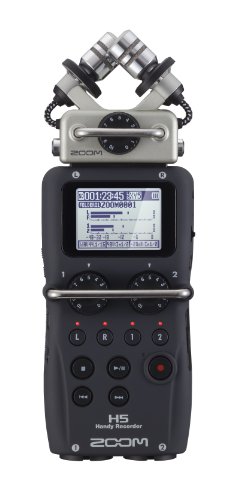
Best for Interchangeable Mic Setups – Zoom H5
The Zoom H5 is a versatile field recorder for outdoor filming when you want interchangeable microphone options and straightforward multitrack recording. Its detachable X/Y capsule, dual combo inputs, and battery-powered design suit mobile production kits.
Best For: Filmmakers and musicians who want a flexible handheld recorder with interchangeable capsules and two external inputs.
Pros:
- Interchangeable input capsules can be swapped for different recording approaches.
- Detachable shock-mounted X/Y microphones help reduce handling noise.
- Records four tracks simultaneously with two XLR/TRS combo inputs.
- Works as a multichannel or stereo USB audio interface for PC, Mac, and iPad.
Cons:
- Included recording media support is limited to SD/SDHC cards up to 32GB.
- Runs on two AA batteries.
The H5 offers a useful balance of portability and expansion. Choose it when capsule flexibility and familiar physical inputs are more important than 32-bit float recording.
Best for Wearable Dialogue Recording – Zoom F2
The Zoom F2 is a compact field recorder for outdoor filming that prioritizes discreet, wearable dialogue capture. It includes a lavalier microphone and 32-bit float recording, so it is well suited to interviews, vlogs, and on-camera work where adjusting gain is inconvenient.
Best For: Solo creators, journalists, and videographers recording spoken audio with a body-worn lavalier setup.
Pros:
- 32-bit float recording is designed to capture audio without clipping across changing volume levels.
- Includes an omnidirectional lavalier microphone with windscreen and lapel clip.
- Runs for up to 15 hours on two AAA batteries.
- Supports microSD cards up to 512GB and includes a REC Hold switch.
Cons:
- Its lavalier-focused design is less suited to multi-microphone recording.
- Recording is limited to 44.1 or 48 kHz.
The F2 is the simplest option here for hands-free speech recording. Its included lav mic, long battery life, and 32-bit float workflow make it especially convenient for lightweight outdoor shoots.
Best for Multi-Mic Location Production – Zoom F6
The Zoom F6 is a professional field recorder for outdoor filming when a production needs several microphones and a wide dynamic range. It combines six XLR inputs, 32-bit float recording, timecode I/O, and multiple power options in a portable location-oriented design.
Best For: Film crews and location recordists managing multiple microphones, frame-accurate sync, and multitrack production workflows.
Pros:
- Six XLR inputs support simultaneous recording from multiple microphones.
- 32-bit float recording with dual A/D converters helps handle quiet and loud sources without clipping.
- Supports up to 14 tracks and includes timecode I/O for video synchronization.
- Can operate as a standalone recorder or USB audio interface.
Cons:
- At 2.4 pounds, it is heavier than the other recorders in this roundup.
- Requires four AA batteries, though the design supports multiple power options.
The F6 is the most capable choice for complex location audio among these options. Its six inputs and timecode support justify the larger size when a shoot demands production-level flexibility.
Best All-Around Choice – Zoom H4essential
If you need a versatile field recorder for outdoor filming, the Zoom H4essential combines built-in X/Y microphones, dual combo inputs, and 32-bit float recording in a portable design. It can handle dialogue, ambience, music, and other unpredictable outdoor sound sources while offering USB-C interface functionality for a broader production workflow.
Best For: Filmmakers and content creators who want one portable recorder for camera-free ambient capture, external microphones, and USB-C recording workflows.
Pros:
- 32-bit float recording and microphones rated for up to 130 dB SPL help preserve detail across changing levels.
- Dual XLR-1/4-inch combo inputs include clean preamps and +48V phantom power.
- Up to 10 hours of battery life, microSDXC support up to 1TB, and tripod mounting suit field work.
- Spoken menus and multilingual accessibility features add flexibility for more users.
Cons:
- The supplied bundle is relatively substantial at 2.9 pounds.
- Its wider feature set may be more than needed for simple on-camera microphone recording.
The H4essential is the most flexible option here if your outdoor filming kit may include multiple microphones, live monitoring, or longer-form recording. The included accessories also make the bundle convenient for getting started, though its larger feature set favors adaptable setups over the lightest possible rig.
Best for Professional Location Audio – Zoom F3
The Zoom F3 is a focused field recorder for outdoor filming when clean dialogue and dependable external microphone connections matter most. Its 32-bit float recording, dual A/D converters, low-noise preamps, and locking XLR inputs are designed for unpredictable levels and demanding location setups.
Best For: Filmmakers using professional microphones who need compact, clip-resistant recording for run-and-gun shoots and larger field rigs.
Pros:
- 32-bit float recording helps capture quiet dialogue and sudden peaks without repeated level adjustments.
- Dual locking XLR/TRS inputs help secure microphone connections in complex or out-of-reach setups.
- Ultra-low-noise preamps support clean recordings in less controlled environments.
- Flexible battery-powered and USB workflows support long location days.
Cons:
- It relies on external microphones rather than offering built-in microphones for immediate ambience capture.
- The recorder has a compact 2-inch screen and a focused control set rather than an all-in-one feature layout.
The F3 is the strongest fit when your sound workflow centers on external microphones and reliable gain handling. It is especially practical for dialogue-heavy outdoor shoots, but less convenient if you want built-in microphones or a camera-mounted shotgun solution.
Best Camera-Mounted Option – Zoom M3 MicTrak
For lightweight shoots, the Zoom M3 MicTrak is a convenient field recorder for outdoor filming because its shotgun microphone and built-in shock mount attach directly to a camera. It offers 32-bit float recording, selectable pickup patterns, and a camera safety output without requiring a separate recorder-and-microphone combination.
Best For: Solo filmmakers and content creators who want a camera-mounted microphone that can capture dialogue, stereo ambience, or wider sound effects.
Pros:
- Built-in shock mount and camera mounting help keep a moving rig lightweight.
- Mono, 90-degree stereo, and 120-degree stereo modes adapt to different scenes.
- 32-bit float recording reduces concerns about clipping and manual gain adjustment.
- Up to 12 hours of battery life, 1TB SDXC support, and USB-C microphone mode add flexibility.
Cons:
- Its single-channel shotgun design is less suited to multi-microphone setups than the H4essential or F3.
- The camera-mounted format may provide less placement flexibility for separately miked dialogue.
The M3 MicTrak is the simplest choice for fast-moving, camera-centered production. Its selectable coverage modes make it more adaptable than a basic shotgun microphone, while the saved Mid-Side RAW backup provides additional control over stereo width in post.
Flagship Field Audio – Zoom H5 Studio
The Zoom H5 Studio is a strong field recorder for outdoor filming when you need detailed stereo sound, flexible inputs, and reliable clip-free capture. Its large X/Y microphones, 32-bit float recording, and dedicated gain controls suit demanding location work.
Best For: Filmmakers who need high-quality stereo ambience, multiple inputs, and hands-on level control outdoors.
Pros:
- Large 19.4mm X/Y microphones capture rich stereo detail.
- 32-bit float recording helps prevent clipped takes.
- Two XLR/TRS inputs and up to four-track recording support expanded setups.
- Battery operation and a lightweight 14.4-ounce design suit location recording.
Cons:
- Requires four AA batteries.
- Its broader feature set may be more than casual users need.
Choose the H5 Studio if sound quality and hands-on control matter more than keeping the setup as simple as possible. It is the most production-focused option in this group.
Versatile Production Pick – Zoom H4 Essential
The Zoom H4 Essential is a versatile field recorder for outdoor filming, interviews, and live sound. It combines built-in stereo microphones with two XLR/TRS inputs, 32-bit float recording, and USB-C connectivity for recording or streaming.
Best For: Filmmakers and creators who want one recorder for camera audio, interviews, instruments, and backup recording.
Pros:
- 32-bit float recording helps protect against distorted takes.
- Two XLR/TRS inputs accept external microphones, instruments, mixers, or soundboards.
- Can record to a device while saving a backup to an SD card.
- Spoken menu guidance can make operation easier and more accessible.
Cons:
- Its two-AA battery setup offers less stated recording time than the H2 Essential.
- The 243-gram body is heavier than the H2 Essential.
The H4 Essential is a practical middle ground for outdoor productions. It offers more connection flexibility than a basic stereo recorder without requiring a larger multi-track rig.
Compact Soundscape Pick – Zoom H2 Essential
The Zoom H2 Essential is a compact field recorder for outdoor filming when portability and adaptable microphone coverage are priorities. Three built-in microphones provide nine recording patterns, while 32-bit float capture removes the need to adjust gain during recording.
Best For: Solo filmmakers, journalists, and creators recording interviews, ambience, or wide outdoor soundscapes.
Pros:
- Three microphones and nine patterns support mono, stereo, and surround recording.
- 32-bit float recording enables clip-free capture without manual gain adjustment.
- Lightweight 6.72-ounce design and up to 20 hours of battery life suit field use.
- Works as a USB microphone while recording a backup to an SD card.
Cons:
- The supplied notes do not list XLR/TRS inputs for connecting external microphones.
- Its 1.3-inch screen is smaller than those on the H5 Studio and H4 Essential.
The H2 Essential is the easiest pick when you want broad built-in microphone coverage in a very portable package. It is especially useful for creators who prefer simple, gain-free operation.
How We Picked the Best Field Recorder for Outdoor Filming
We focused on recording quality, portability, input flexibility, reliability, and how easily each model fits a real outdoor filmmaking workflow. Particular attention went to 32-bit float recording, which can provide useful protection against unexpected volume changes, plus timecode support, microphone compatibility, monitoring, battery practicality, and controls that are manageable on location.
The lineup covers several categories rather than treating every recorder as interchangeable. Some models are designed for a single subject wearing a lavalier, while others are better suited to a boom microphone, camera-mounted shotgun, or multiple professional inputs.
Quick Comparison
| Best For | What to Prioritize | Likely Pick |
|---|---|---|
| Professional production audio | Multiple inputs, timecode, durable controls | TASCAM FR-AV2 or Zoom F6 |
| Compact two-channel recording | Small size, 32-bit float, simple operation | Zoom F3 |
| One-person dialogue capture | Lavalier connection, wearable design | Zoom F2 |
| Camera-mounted audio | Shotgun microphone integration, low setup time | Zoom M3 MicTrak |
| General-purpose recording | Built-in microphones and flexible inputs | Zoom H4essential or H5 |
| Ambience and immersive sound | Convenient stereo capture, easy handling | Zoom H2essential |
Key Buying Factors for a Field Recorder for Outdoor Filming
Recording Format and Headroom
32-bit float recording is valuable when sound levels are difficult to predict, such as during documentary work, events, or changing outdoor conditions. It does not replace careful microphone placement, but it can make level management more forgiving. Standard 24-bit recording remains perfectly capable when gain is set carefully.
Inputs and Microphone Compatibility
Check whether you need one lavalier input, two XLR/TRS inputs, or a larger multitrack setup. Professional XLR inputs offer broader microphone compatibility and often provide phantom power. A camera-mounted recorder can reduce cabling, while a separate recorder may give the operator better placement and isolation.
Timecode and Synchronization
For multicamera shoots, timecode can significantly reduce editing time. If you are recording a single camera or short-form content, this feature may not justify extra cost. Confirm that the recorder’s timecode system works with your cameras and post-production workflow.
Wind Protection, Monitoring, and Power
Outdoor audio depends heavily on wind protection, so budget for an appropriate furry windshield or blimp when using exposed microphones. Headphone monitoring, a visible level display, locking connectors, battery life, and accessible controls also matter when conditions are noisy, bright, cold, or difficult to reach.
Who Should Buy Which Field Recorder for Outdoor Filming?
Choose the Zoom F2 for discreet, single-person dialogue and the Zoom M3 MicTrak when you want a practical camera-mounted shotgun solution. The Zoom F3 suits creators who need excellent two-channel capture in a small package.
For more inputs and a wider production workflow, consider the TASCAM FR-AV2 or Zoom F6. The Zoom H4essential and Zoom H5 are versatile choices for creators who want built-in microphones alongside external inputs, while the Zoom H2essential is a convenient option for ambience, rehearsals, and portable stereo recording.
Before buying, confirm the recorder’s connector layout, microphone requirements, mounting method, storage media, and power accessories. The best Field Recorder for Outdoor Filming is the one that matches your crew size and microphone plan without adding unnecessary setup or editing complexity.