The best laptops for photo editing combine a color-accurate display, enough memory for large RAW files, fast storage, and a processor that stays responsive during demanding edits.
We compared 10 laptops across screen quality, RAM, storage, processing power, portability, and overall value to help you choose the right system for Lightroom, Photoshop, and similar workflows.
Best 10 Laptops for Photo Editing Picks for 2026
Large-Screen Creator Pick

- 17.3-inch IPS touchscreen with 100% sRGB
- 32GB memory and 1TB SSD
- Thunderbolt 4 and HDMI 2.1 connectivity
Best For: Large-screen photo editing and creator multitasking
Portable Mac Pick

- Lightweight 2.71-pound aluminum design
- Liquid Retina display with 1 billion colors
- Up to 16 hours of stated battery life
Best For: Mobile photo review and light editing in macOS
Windows Workflow Pick

- 16-inch 16:10 IPS touchscreen
- 32GB DDR5 RAM and 1TB NVMe SSD
- HDMI 2.1 and dual USB-C ports
Best For: Windows-based editing and multitasking
Best Workstation Value

- 32GB RAM for heavy multitasking
- 1TB SSD and Quadro P620 graphics
- 15.6-inch matte 400-nit display
Best For: Budget-conscious editors needing memory, storage, and dedicated graphics
Large-Screen Value Pick

- 17.3-inch Full HD anti-glare IPS display
- Ryzen 5 7520U, 8GB LPDDR5 RAM, and 512GB SSD
- Windows 11 Pro with Wi-Fi 6 and privacy camera
Best For: Beginners and casual photo editors who want a large display
Multitasking Pick
HP 15.6-inch Ryzen 7 Touchscreen
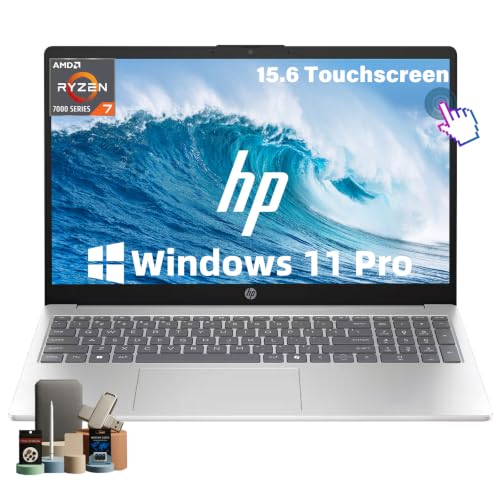
- 32GB RAM and 1TB NVMe SSD
- Eight-core Ryzen 7 7730U processor
- Full HD IPS touchscreen with Windows 11 Pro
Best For: Hobbyist photographers who need memory and storage for multitasking
Office-Friendly Budget Pick

- 16GB LPDDR5 RAM and 1TB SSD
- 15.6-inch Full HD display with integrated Radeon graphics
- Ethernet, HDMI, USB-C, and privacy-shutter camera
Best For: Students and casual photographers handling basic edits and office tasks
Large-Screen Creator Pick – HP OmniBook 7
For shoppers comparing laptops for photo editing, the HP OmniBook 7 stands out with a spacious 17.3-inch IPS touchscreen, 100% sRGB coverage, and 32GB of memory. Its integrated Intel Arc graphics and 1TB SSD make it a practical choice for organizing photo libraries and handling everyday creative work.
Best For: Creators who want a large, color-focused display and generous memory for photo workflows.
Pros:
- 17.3-inch FHD IPS touchscreen with 100% sRGB coverage and 400 nits brightness
- 32GB LPDDR5x memory and a 1TB SSD provide useful multitasking and storage capacity
- Intel Core Ultra 7 processor includes Intel AI Boost with 47 NPU TOPS
- Broad connectivity includes Thunderbolt 4, HDMI 2.1, three USB-A ports, and USB-C
Cons:
- At 5.2 pounds, it is less convenient for frequent travel
- The 1920 x 1080 resolution gives less workspace than higher-resolution editing displays
- Graphics are integrated rather than dedicated
The OmniBook 7 is a strong fit when screen size and sRGB coverage matter more than portability or discrete graphics. Its substantial memory and storage also reduce the need for immediate upgrades.
Portable Mac Pick – Apple MacBook Neo 13-inch
The Apple MacBook Neo is a compact option among laptops for photo editing, pairing a lightweight aluminum design with an A18 Pro chip and a Liquid Retina display supporting 1 billion colors. Its 512GB SSD and up to 16 hours of stated battery life suit mobile photo organization, review, and light editing.
Best For: Students and mobile users who prioritize portability, battery life, and the macOS ecosystem.
Pros:
- Lightweight 2.71-pound aluminum design is easy to carry
- Liquid Retina display supports 1 billion colors for vibrant photo viewing
- A18 Pro chip supports everyday creative and AI-enabled tasks
- Up to 16 hours of battery life is useful for work away from an outlet
Cons:
- 8GB unified memory is modest for demanding multitasking
- The 13-inch display provides less workspace for detailed editing
- 512GB storage may fill quickly with large photo libraries
The MacBook Neo makes the most sense for photographers who value a small, durable computer and already use Apple devices. It is less suited to extensive local photo archives or heavy, sustained editing workloads.
Windows Workflow Pick – HP OmniBook 16
For photo editors who need workspace without carrying a very large laptop, the HP OmniBook 16 combines a 16-inch 1920 x 1200 IPS touchscreen with 32GB of DDR5 RAM and a 1TB PCIe NVMe SSD. Its Ryzen AI processor and integrated Radeon graphics support creative multitasking, while the 16:10 panel offers extra vertical room for editing interfaces.
Best For: Windows users who need plentiful memory, storage, and a practical 16:10 touchscreen workspace.
Pros:
- 16-inch 16:10 IPS touchscreen provides useful vertical workspace
- 32GB DDR5 RAM supports multiple open applications and large projects
- 1TB PCIe NVMe SSD offers fast access to photo files and project data
- Two USB-C ports, HDMI 2.1, and two USB-A ports support external displays and accessories
Cons:
- Integrated Radeon 840M graphics are not a dedicated GPU
- The listed 1920 x 1200 resolution may be less detailed than higher-resolution photo displays
- Windows is listed without a more specific edition in the supplied details
This OmniBook 16 is a balanced choice for photographers who want a roomy Windows workspace and substantial system memory. Consider an external calibrated display if color-critical work requires more specialized screen specifications.
High-Capacity Budget Workhorse – ASUS Vivobook 15
The ASUS Vivobook 15 is aimed at shoppers who want laptops for photo editing with substantial local storage and memory. Its Intel Core i9-13900H processor, 48GB of DDR4 RAM, and 2TB SSD provide ample capacity for photo catalogs and multitasking, though the 15.6-inch FHD display and integrated graphics are better suited to general editing than specialized color-critical work.
Best For: Users who prioritize processor performance, large storage, and high memory capacity in a Windows laptop.
Pros:
- 48GB RAM and a 2TB PCIe SSD provide extensive capacity for apps and photo files
- 14-core Intel Core i9-13900H processor is suited to demanding multitasking
- Includes a backlit keyboard, fingerprint reader, and physical webcam shield
- HDMI supports a 4K external display, and the bundle includes a PCO cooler
Cons:
- 15.6-inch FHD display is listed at 1920 x 1080 and does not specify wide-gamut coverage
- Integrated Intel UHD graphics are less suitable for GPU-intensive editing
- The product has an opened seal for RAM and SSD upgrades, with coverage split between the seller and manufacturer
The Vivobook 15 is compelling when storage and system memory take priority over display refinement. For professional color work, plan to connect a more capable external monitor and verify the included upgrade warranty terms.
Best Value Touchscreen Pick – HP OmniBook 3 16
The HP OmniBook 3 is a practical option among laptops for photo editing if you want a large touchscreen, modern connectivity, and everyday performance at a modest weight. Its 16-inch 2K IPS display provides useful workspace for organizing and adjusting images, though the listed 62.5% sRGB coverage makes it better suited to casual and general-purpose editing than color-critical professional work.
Best For: Students, home users, and casual photo editors who want a large touchscreen and balanced everyday performance.
Pros:
- 16-inch 1920 x 1200 IPS touchscreen offers a spacious editing workspace.
- 512GB PCIe NVMe SSD provides fast storage for applications and photo libraries.
- Up to 14 hours and 15 minutes of claimed battery life, plus fast charging.
- Wi-Fi 6, two USB-C ports, HDMI 2.1, and a 1080p HDR camera support flexible use.
Cons:
- 8GB of onboard RAM may limit heavier multitasking and larger editing projects.
- 62.5% sRGB coverage is less suitable for demanding color-accurate workflows.
- Integrated Radeon 610M graphics are aimed at everyday use rather than intensive creative workloads.
The OmniBook 3 covers the basics well, especially if screen size, touch input, portability, and battery life matter more than professional color coverage or high-end graphics performance.
Best Workstation Value – Dell Precision 3551
The renewed Dell Precision 3551 is a workstation-style choice among laptops for photo editing, pairing a six-core Core i7 processor with 32GB of RAM, a 1TB SSD, and dedicated NVIDIA Quadro P620 graphics. It offers useful headroom for larger photo catalogs and multitasking, while its 15.6-inch matte Full HD screen keeps the display practical for office and editing environments.
Best For: Budget-conscious photographers and creators who prioritize memory, storage, and workstation-class dedicated graphics.
Pros:
- 32GB DDR4 RAM supports demanding multitasking and larger editing workflows.
- 1TB SSD provides substantial space for applications and image files.
- Dedicated NVIDIA Quadro P620 graphics include 4GB of graphics memory.
- Matte 400-nit Full HD display helps reduce reflections in bright workspaces.
Cons:
- The 1920 x 1080 display provides less workspace than higher-resolution editing panels.
- This is a renewed 2019 model with a listed 90-day warranty.
- The supplied specifications do not identify wide-gamut color coverage.
For editors who value system memory and storage over a newer, thinner design, the Precision 3551 offers a strong configuration on paper. Its renewed status and standard Full HD display should be weighed against the workstation hardware.
Best Portable Creative Pick – Acer Aspire AI 14
The Acer Aspire AI 14 is a strong fit among laptops for photo editing when portability and modern creative features are priorities. Its Core Ultra 7 processor, 32GB of RAM, 1TB SSD, Intel Arc 140V graphics, and 14-inch touchscreen create a capable setup for Lightroom work, photo retouching, and other everyday content-creation tasks.
Best For: Mobile photographers, freelancers, and creators who want a lightweight touchscreen laptop with ample memory and storage.
Pros:
- 32GB LPDDR5X RAM and a 1TB PCIe SSD support demanding multitasking and large files.
- Intel Arc 140V graphics are designed to accelerate photo editing and GPU-accelerated effects.
- 14-inch 1920 x 1200 IPS touchscreen supports intuitive retouching and stylus use.
- At about 3.09 pounds and 0.7 inches thin, it is convenient for mobile work.
Cons:
- The 14-inch screen offers less physical workspace than larger 15- or 16-inch laptops.
- Integrated graphics are capable for photo editing but are not a dedicated professional GPU.
- The supplied notes do not specify color-gamut coverage or stylus inclusion.
The Aspire AI 14 balances creative capability and mobility particularly well. Its display resolution, touchscreen, large memory capacity, and Intel Arc graphics make it an appealing portable option, provided its unspecified color coverage meets your workflow needs.
Large-Screen Value Pick – HP 17 Ryzen 5 Laptop
If you want a roomy workspace among laptops for photo editing, this HP model offers a 17.3-inch Full HD IPS display with an anti-glare finish. Its Ryzen 5 7520U processor, 8GB of LPDDR5 memory, and 512GB SSD are better suited to light photo adjustments, organization, and everyday productivity than demanding professional editing workloads.
Best For: Beginners and casual editors who prioritize a large screen, Windows 11 Pro, and a full-size keyboard with numeric keypad.
Pros:
- Large 17.3-inch 1920×1080 anti-glare IPS display
- Ryzen 5 processor with up to 4.3GHz boost speed
- Fast 512GB NVMe SSD and Wi-Fi 6 connectivity
- Privacy-shutter camera and included mouse and tablet stand
Cons:
- 8GB RAM may limit heavier multitasking and larger editing projects
- Integrated AMD Radeon graphics are not intended for demanding creative workloads
- Display is Full HD with a listed 45% color gamut, so color-critical editing may require an external monitor
This is a practical entry-level option when screen size matters more than advanced color coverage or graphics power. For occasional photo editing, storage and connectivity are useful, but serious creators should look for more memory, stronger graphics, and a wider-gamut display.
Multitasking Pick – HP 15.6-inch Ryzen 7 Touchscreen
For photographers who keep editing software, reference tabs, and file storage open together, this HP is one of the more capable laptops for photo editing in the group. It combines a Ryzen 7 7730U processor with 32GB of RAM, a 1TB SSD, and a Full HD IPS touchscreen for responsive everyday creative work.
Best For: Students, remote workers, and hobbyist photographers who need substantial memory and storage for multitasking and photo libraries.
Pros:
- 32GB RAM supports extensive multitasking
- 1TB NVMe SSD provides generous fast storage for photos and applications
- Eight-core Ryzen 7 7730U processor with 16 threads
- 15.6-inch Full HD IPS touchscreen with anti-glare treatment
Cons:
- Integrated AMD Radeon graphics are better suited to moderate editing than demanding GPU-accelerated work
- The 1920×1080 display is listed with a 45% color gamut
- Touch input may be less useful than a higher-resolution or wider-gamut panel for color-critical workflows
The strong memory and storage configuration makes this the most flexible choice here for managing multiple applications and sizable photo collections. Its display is convenient for general editing, but photographers who require precise color work should plan on using a calibrated external monitor.
Office-Friendly Budget Pick – Lenovo V15 G4 Ryzen 3
This Lenovo V15 G4 is a straightforward choice among laptops for photo editing when the priority is office productivity with occasional basic image work. The 15.6-inch Full HD display, 16GB of LPDDR5 memory, and 1TB SSD provide a practical foundation for organizing photos and making light adjustments.
Best For: Students, business users, and casual photographers who want plentiful storage, a numeric keypad, and Ethernet connectivity.
Pros:
- 16GB LPDDR5 RAM and a 1TB SSD
- 15.6-inch 1920×1080 display for general photo and office use
- Useful selection of USB, HDMI, Ethernet, Wi-Fi, and Bluetooth connections
- Camera privacy shutter and full-size keyboard with numeric keypad
Cons:
- Four-core Ryzen 3 7320U is the least powerful processor in this roundup
- Integrated shared-memory Radeon graphics limit demanding editing performance
- Display specifications do not indicate a wide color gamut for color-critical work
The V15 G4 makes sense for basic editing, photo organization, and school or business tasks where storage and connectivity are more important than rendering speed. It is not the strongest option for intensive creative applications, but 16GB of memory and a 1TB SSD keep everyday workflows practical.
How We Picked These Laptops for Photo Editing
We focused on the components that have the greatest effect on real-world editing: display quality, processor performance, memory, storage, graphics capability, and upgrade or connectivity potential. Models with 16GB of RAM or more and at least a 512GB SSD generally provide a better starting point for photo libraries and creative applications. We also considered screen size and resolution, since a larger, sharper workspace can make detailed retouching more comfortable.
Specifications can vary by configuration, so confirm the exact display coverage, panel type, operating system, and included accessories before purchasing. A listed processor or memory capacity does not guarantee professional-level color accuracy.
Quick Comparison
| What You Need | Recommended Specification | Best Fit |
|---|---|---|
| Basic photo organization and light edits | Modern Core i5/Ryzen 5, 16GB RAM, 512GB SSD | Students and casual photographers |
| Regular RAW editing | Core Ultra 7/Ryzen 7 or similar, 32GB RAM, 1TB SSD | Enthusiasts and freelancers |
| Large files and multitasking | 32GB or more RAM, fast 1TB-plus SSD, strong cooling | High-volume creators |
| Color-critical professional work | Verified wide-gamut display or external calibrated monitor | Commercial photographers and studios |
Key Buying Factors for Laptops for Photo Editing
Display and Color
Prioritize an IPS or OLED panel with reliable sRGB coverage for general editing. If you work for print, advertising, or professional delivery, look for verified coverage of wider color spaces such as DCI-P3 or Adobe RGB, plus calibration controls. A 2K or 4K screen offers more detail, while a larger 16- or 17-inch display provides more room for panels and timelines.
Processor and Memory
Photo applications benefit from strong single-core responsiveness as well as multiple cores for exports, batch processing, and AI tools. Choose at least 16GB of RAM; 32GB is a more comfortable target for large RAW catalogs, panoramas, layered files, and simultaneous applications. Newer AI-capable processors can help with supported features, but software compatibility matters.
Storage, Graphics, and Ports
A 1TB SSD is preferable if you keep an active photo library on the laptop. Fast integrated graphics are sufficient for many still-image workflows, while a dedicated GPU becomes more valuable for advanced AI masking, video, 3D work, and high-resolution displays. Check for USB-C, USB-A, HDMI, and memory-card support, or budget for a reliable hub and external SSD.
Who Should Buy Which Laptops for Photo Editing?
For Beginners and Budget-Conscious Buyers
Choose a model with 16GB of memory, an SSD, and a screen that offers dependable Full HD resolution. These systems are suitable for organizing collections, web images, and moderate Lightroom or Photoshop work.
For Enthusiasts and Freelancers
A laptop with 32GB RAM, a 1TB SSD, and a modern Core Ultra 7 or Ryzen 7-class processor offers a strong balance for frequent RAW editing and multitasking. Favor verified color coverage over extra memory if your work is color-sensitive.
For Professionals
Prioritize a calibrated wide-gamut display, consistent sustained performance, strong warranty support, and easy access to external storage or a color-managed monitor. A business workstation can be worthwhile for specialized software, but confirm that its display meets your color requirements.