When you’re out in the field capturing audio for your film, having the right equipment can make all the difference. You need field recorders that not only deliver high-quality sound but are also user-friendly and portable. Each model comes with unique features tailored for filmmakers. Let’s explore some of the best options available, so you can find the perfect fit for your audio needs.
Zoom F3 2-Input Field Recorder

The Zoom F3 2-Input Field Recorder is an ideal choice for filmmakers who demand high-quality audio without the hassle. With 32-bit float recording at 96kHz, you’ll capture every detail of your sound. It features two XLR inputs, allowing you to connect multiple microphones easily. Weighing just 8.48 ounces, it’s compact and portable, perfect for on-the-go shoots. You can enjoy up to 73 hours of digital recording time on a 512 GB MicroSD card. Plus, its Bluetooth compatibility and built-in preamps enhance your recording experience. With a solid 4.7-star rating from customers, it’s a reliable choice for any project.
Best For: Filmmakers and content creators seeking a portable, high-quality audio recording solution for their projects.
Pros:
- Compact and lightweight design makes it easy to carry for on-the-go recording.
- 32-bit float recording at 96kHz ensures high audio fidelity and detail.
- Bluetooth compatibility allows for easy connectivity with wireless devices.
Cons:
- Limited to 2 XLR inputs, which may not suffice for larger productions.
- Requires 2 AA batteries, which may need frequent replacement depending on usage.
- Small screen size may make it challenging to navigate settings in bright conditions.
Zoom F2 Lavalier Body-Pack Recorder for Filmmaking & Content Creation

For filmmakers and content creators seeking high-quality audio without the risk of clipping, the Zoom F2 Lavalier Body-Pack Recorder stands out with its innovative 32-Bit Float technology. You can record WAV files at 44.1kHz or 48kHz in 32-bit, ensuring pristine sound. With storage for up to 512 GB on micro SD and SDHC cards, you won’t run out of space during long shoots. Plus, its impressive battery life of up to 14 hours on just two AAA batteries means you stay powered throughout the day. The Rec Hold function prevents accidental button presses, making it user-friendly and reliable.
Best For: Filmmakers and content creators looking for high-quality, reliable audio recording without the risk of clipping.
Pros:
- 32-Bit Float technology ensures clip-free recording for pristine audio quality.
- Long battery life of up to 14 hours allows for extended filming sessions without interruptions.
- User-friendly features like Rec Hold function prevent accidental button operation.
Cons:
- Limited internal storage requires the use of micro SD or SDHC cards for extended recordings.
- Requires AAA batteries, which may need frequent replacement or recharging.
- Potential learning curve for users unfamiliar with audio recording equipment and settings.
Zoom H1essential Portable Recorder

Ideal for filmmakers and content creators who need high-quality audio on the go, the Zoom H1essential Portable Recorder offers a remarkable recording capability of 32-bit/96kHz. Weighing just 92 grams, its compact design guarantees easy portability. With onboard XY stereo microphones, you’ll capture rich, detailed sound. It records in WAV format to an SD card with a memory capacity of 1 TB, giving you plenty of space. The OLED screen and soft-touch controls make it user-friendly, while the built-in speaker allows for quick playback. Plus, it’s compatible with cameras, PCs, and smartphones, making it a versatile choice for your audio needs.
Best For: The Zoom H1essential Portable Recorder is best for filmmakers, podcasters, musicians, and content creators seeking high-quality audio recording on the go.
Pros:
- High-quality recording with 32-bit/96kHz capability for professional sound.
- Lightweight and compact design, making it highly portable.
- User-friendly interface with an OLED screen and built-in speaker for easy playback.
Cons:
- Limited battery life with a digital recording time of only 10 hours.
- Requires an SD card for storage, which is not included.
- May not have advanced features found in higher-end recording devices.
FEELWORLD CUT6 6 Inch Recording Monitor for DSLR

Looking to enhance your filmmaking experience? The FEELWORLD CUT6 6 Inch Recording Monitor is a game-changer for DSLR users. With a stunning 1920×1080 touch screen, you’ll enjoy crystal-clear visuals while filming. Its USB2.0 recording function captures up to 1080p30 video in MP4 format, making editing a breeze with built-in LUT capabilities. Plus, professional tools like waveform and focus peaking guarantee your shots are spot on. Weighing just 1.23 pounds and compact in size, it’s perfect for on-the-go filmmakers. Remember, it doesn’t come with a battery or power adapter, so be sure to grab those separately!
Best For: Filmmakers and content creators looking for a portable and high-quality recording monitor to enhance their DSLR shooting experience.
Pros:
- High-resolution 1920×1080 touch screen offers clear visuals for precise framing and monitoring.
- Built-in LUT capabilities streamline the editing process by allowing real-time LUT recording.
- Compact and lightweight design makes it easy to carry and use on-the-go.
Cons:
- Does not include battery or power adapter, requiring additional purchases for complete functionality.
- Customer reviews indicate mixed satisfaction, with an average rating of only 3.2 out of 5 stars.
- Limited to 1080p recording, which may not meet the needs of users looking for higher resolution options.
TASCAM 4-Channel Portable Audio Recorder (DR-70D)
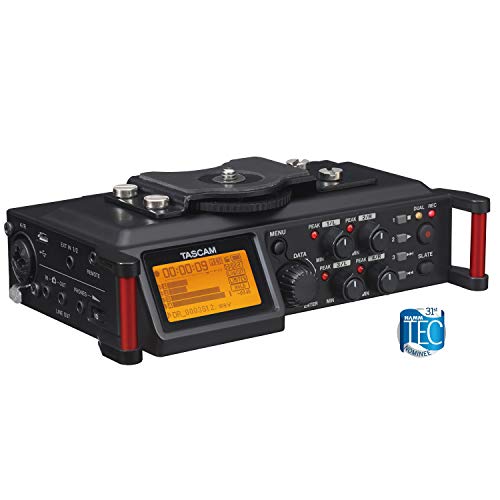
The TASCAM 4-Channel Portable Audio Recorder (DR-70D) stands out as a must-have tool for filmmakers, television producers, and documentarians who demand high-quality audio in a compact design. With four balanced XLR/TRS inputs featuring phantom power, you’ll have the flexibility to capture professional sound. Each input has individual gain controls and high-quality HDDA mic preamps, ensuring clarity even in quiet environments. The dual recording mode prevents distortion by creating a safety copy at a lower level. Plus, the built-in microphones enhance versatility, making it easy to adapt to various recording scenarios, all while supporting SD cards up to 128GB.
Best For: Filmmakers, television producers, advertisers, and documentarians seeking high-quality audio recording in a compact format.
Pros:
- High-quality HDDA mic preamps with 64dB gain for clear audio capture, even in quiet settings.
- Dual recording mode provides a safety copy at a lower level to prevent distortion.
- Compact design allows for easy mounting on cameras, enhancing portability.
Cons:
- Limited to four channels, which may not be sufficient for larger productions requiring more inputs.
- Some users may find the user interface less intuitive compared to other audio recorders.
- Battery life may be shorter than desired during extended recording sessions without external power.
TASCAM 4-Channel Portable Audio Recorder (DR-60DmkII)

For filmmakers seeking a reliable audio solution, the TASCAM 4-Channel Portable Audio Recorder (DR-60DmkII) stands out with its ability to record up to four channels simultaneously. Weighing just 1.12 pounds and measuring 3.1D x 5.2W x 3.7H inches, it’s easy to carry on location. You’ll appreciate the upgraded HDDA preamps, providing up to 64dB gain and low noise levels. With dual XLR/TRS inputs and compatibility with various devices, it accommodates diverse setups. Powered by 4 AA batteries, it offers a maximum recording time of 25.6 minutes, ensuring you capture every essential sound for your project.
Best For: The TASCAM 4-Channel Portable Audio Recorder (DR-60DmkII) is best for filmmakers and content creators who require high-quality audio recording in a portable format.
Pros:
- Up to 96kHz/24-bit WAV recording for professional sound quality.
- Dual XLR/TRS inputs with 48V phantom power, ideal for various microphones.
- Lightweight and compact design makes it easy to transport for on-location shoots.
Cons:
- Limited recording time of up to 25.6 minutes may not be sufficient for longer sessions.
- Requires 4 AA batteries, which can be an inconvenience for extended use.
- Memory storage capacity of 64 MB may limit extensive recording needs.
Olympus WS-883 Digital Voice Recorder

Filmmakers seeking a compact yet powerful recording solution will find the Olympus WS-883 Digital Voice Recorder an excellent choice. Weighing just 77 grams, it’s easy to carry on any shoot. With 8GB of built-in memory, you can capture up to 2,080 hours of audio in high-quality Linear PCM or MP3 formats. Its true stereo microphones and low-cut filter guarantee crisp sound. Features like USB direct charging, playback speed adjustment, and file indexing enhance usability. Plus, you’ll appreciate the 68-hour battery life. With a solid 4.3-star rating from users, it’s a reliable tool for your filmmaking needs.
Best For: Filmmakers and content creators looking for a compact, high-quality audio recording solution.
Pros:
- High recording capacity of up to 2,080 hours with 8GB built-in memory.
- True stereo microphones and low-cut filter for crisp and clear sound quality.
- Lightweight design (77 grams) and USB direct charging for convenience on-the-go.
Cons:
- Limited built-in memory compared to the maximum digital recording time.
- Battery life may vary based on usage, with an average of 68 hours.
- The interface may be less intuitive for users unfamiliar with digital recorders.
Digital Voice Recorder with Playback (136GB)

With a whopping 136GB of storage, the L87 Digital Voice Recorder is perfect for those who need extensive recording capability without constantly managing files. You can record up to 9900 hours in HD quality, making it ideal for long shoots. The omnidirectional microphone captures clear audio, while voice activation helps save memory. Plus, its simple three-button interface makes recording and playback a breeze. Enjoy features like A-B repeat and variable speed playback to refine your audio. Compatible with laptops and PCs, this recorder also includes a 1-year warranty and a solid return policy, ensuring peace of mind with your purchase.
Best For: Those who need extensive recording capabilities for interviews, lectures, or personal notes without the hassle of frequent file management.
Pros:
- Large storage capacity of 136GB allows for recording up to 9900 hours of audio.
- High-definition audio quality with advanced noise reduction technology ensures clear sound capture.
- User-friendly interface with simple three-button operation makes it easy to record and playback.
Cons:
- Limited battery life for playback at 24 hours may require frequent recharging.
- Voice activation feature may occasionally miss low-volume sounds, leading to gaps in recordings.
- No wireless connectivity options may limit integration with smartphones or other devices.
FEELWORLD CUT6S 6 Inch Recording Monitor for DSLR

The FEELWORLD CUT6S 6 Inch Recording Monitor stands out as an excellent choice for those who need a reliable and portable solution for monitoring and recording on the go. With a 1920×1080 touchscreen, it offers sharp visuals and essential monitoring tools like waveform and RGB histogram for precise exposure. You can easily record in MP4 format at up to 1080p30 by plugging in a USB flash disk. Its HDMI and SDI connectivity allows for versatile setups, making multi-person monitoring a breeze. Lightweight and compact, this monitor is perfect for any filmmaker looking to enhance their shooting experience.
Best For: Filmmakers and content creators looking for a portable and reliable monitor to enhance their recording and monitoring capabilities.
Pros:
- High-resolution 1920×1080 touchscreen for sharp visuals.
- Versatile connectivity with HDMI and SDI inputs for multi-person monitoring.
- Compact and lightweight design, making it easy to transport.
Cons:
- Customer rating of 3.7 out of 5 stars suggests mixed feedback.
- Limited recording format options, only supporting MP4.
- Potentially cumbersome setup for some users due to multiple connection types.
PHILIPS DVT7500 VoiceTracer Audio Recorder

For those seeking a reliable audio solution in their filmmaking journey, the PHILIPS DVT7500 VoiceTracer Audio Recorder stands out with its exceptional 24bit/96kHz sampling rate. This recorder features high-quality microphones that deliver excellent audio fidelity, ensuring your recordings sound professional. With 16 GB of storage, you can capture up to 20.54 hours of audio in formats like MP3 and WAV. Plus, its XLR and line-in connectors let you record from external instruments easily. Compatible with PCs, laptops, and tablets, the DVT7500 is a versatile tool, backed by a one-year warranty and a 30-day return policy for peace of mind.
Best For: Filmmakers and audio professionals seeking high-quality recordings with versatile connectivity options.
Pros:
- High-quality microphones with 24bit/96kHz sampling rate for professional audio fidelity.
- Multi-source recording capability, allowing for versatile recording from various external instruments.
- Ample storage of 16 GB, providing up to 20.54 hours of recording time in popular audio formats like MP3 and WAV.
Cons:
- Customer reviews indicate an average rating of 3.6 out of 5 stars, suggesting some users may have experienced issues.
- Limited to 16 GB of internal storage, which may not be sufficient for extensive recording needs.
- Requires a USB connection for compatibility with devices, potentially limiting mobility during use.
Factors to Consider When Choosing Field Recorders for Filmmaking
When choosing field recorders for your filmmaking needs, you’ll want to contemplate several key factors. Audio quality standards, portability, battery life, storage options, and connectivity all play a vital role in ensuring you capture the best sound possible. Taking the time to evaluate these elements can make a significant difference in your production.
Audio Quality Standards
Choosing the right field recorder for filmmaking hinges on understanding audio quality standards, as these can make or break your project. Aim for a recorder that supports at least 24-bit/96kHz audio resolution for detailed sound capture. Consider models with 32-bit float recording technology, which prevents clipping and manages dynamic ranges without distortion—crucial for unpredictable environments. Dual AD converters enhance audio fidelity, allowing for clearer handling of complex soundscapes while reducing noise. High-quality preamps with low noise levels are essential for clean amplification, avoiding unwanted artifacts. Finally, verify your recorder is compatible with WAV file formats to maintain audio integrity during post-production, preserving the original recording quality without compression artifacts.
Portability and Weight
Audio quality standards set the foundation for your recording choices, but portability and weight play an essential role in practical filmmaking scenarios. When you’re out in the field, lighter models enhance your mobility and ease of use. Compact designs, especially those under one pound, reduce fatigue during long recording sessions, letting you focus on capturing sound. Look for devices about 3 inches in height or width; they fit easily into tight spaces and are simple to carry around. Battery-powered options offer flexibility in outdoor settings where power sources may be scarce, ensuring uninterrupted recording. Striking a balance between robust build quality and lightweight structure can greatly improve durability without sacrificing portability. Choose wisely, and your shoots will be smoother.
Battery Life Duration
Battery life is an essential factor in your selection of field recorders, directly impacting how long you can capture audio on a shoot. You’ll want to contemplate models that use standard batteries like AA or AAA, as some can record for up to 14 hours on a single set. Higher-end recorders with rechargeable lithium batteries can extend your recording sessions, reducing the hassle of frequent changes. Keep in mind the power consumption of your chosen model; additional features may drain batteries faster. It’s also wise to look for recorders with battery life indicators or estimates, helping you manage your recording time effectively and avoid unexpected shutdowns during filming. Choose wisely to guarantee uninterrupted audio capture.
Storage Capacity Options
When selecting a field recorder, storage capacity is an essential consideration that can greatly influence your recording experience. Options typically range from built-in memory of 8GB to external support for microSD and SDHC cards up to 512GB. Larger storage allows for extensive recording time; some recorders can capture up to 2080 hours of audio with just 8GB. Keep in mind that higher-quality formats like WAV at 32-bit float consume more space than compressed formats like MP3. Additionally, recording resolution and bit depth matter—24-bit/96kHz recordings take up more space than lower quality settings. Assess your project’s recording duration needs; greater storage lets you record longer without frequently managing or transferring files.
Input/Output Connectivity
Selecting a field recorder with the right input and output connectivity is vital for achieving high-quality sound in your filmmaking projects. Look for multiple input options like XLR and TRS connectors, as these allow you to connect various microphone types and external audio sources seamlessly. If you plan to use condenser microphones, check for phantom power capabilities to guarantee you get the best audio quality. USB interfaces are also valuable for easy file transfer to your computer. Additionally, HDMI or SDI outputs are essential for syncing audio with video signals, especially in multi-camera setups. Finally, consider recorders with wireless connectivity options like Bluetooth, which offer added flexibility for remote control and monitoring during recordings.
User-Friendly Interface
How can a user-friendly interface enhance your filmmaking experience? A user-friendly interface lets you adjust settings quickly, helping you maintain your creative flow during recording. Look for field recorders with soft-touch controls and clear display screens, especially in fast-paced environments. Features like a Rec Hold function can prevent accidental button presses, ensuring your important recordings stay uninterrupted. An interface that provides quick access to essential functions—like gain adjustments and recording mode selection—can greatly improve your efficiency. Additionally, visual monitoring tools such as waveforms and audio meters help you visualize audio levels, contributing to better sound quality and management. By prioritizing usability, you can focus more on your project and less on maneuvering complicated controls.
Durability and Build Quality
A user-friendly interface is only part of the equation; durability and build quality play an essential role in the performance of field recorders during filmmaking. You’ll often find yourself in harsh weather, dealing with drops and vibrations, so choosing a robust model is crucial. Look for materials like metal or high-grade plastics that can withstand impact and wear. Weather-sealed designs are a must to protect against moisture and dust, which can compromise sound quality. Features like shock mounts or rubberized grips enhance handling and reduce damage from accidental falls. Finally, consider the weight and size; a portable recorder will make your dynamic filming environment much easier to navigate without sacrificing sound quality.