SDR receivers with HF coverage are a smart way to explore shortwave, ham radio, aviation, and more with one flexible device. The right model can deliver better sensitivity, cleaner tuning, and far more bands than a traditional receiver.
In this roundup, we focused on practical picks that balance performance, software support, portability, and value for different listening goals.
Best 10 SDR Receivers with HF Coverage Picks for 2026
Premium HF SDR Dongle

- 100kHz to 1.75GHz coverage
- Improved HF SNR over v3
- Works with Windows, Mac, Linux, and Android
Best For: computer-based listeners who want a budget SDR with HF support
Portable Shortwave Receiver
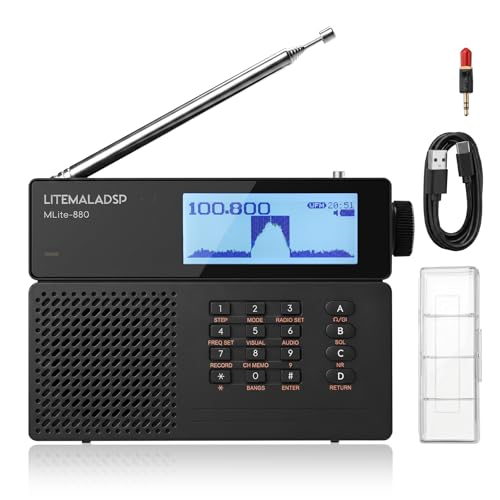
- Covers FM, MW, LW, SW, and airband
- 2.3-inch spectrum and waterfall display
- 5000mAh replaceable battery with USB-C charging
Best For: portable shortwave and airband listening on the go
Beginner HF SDR Kit

- 500kHz to 1.7GHz coverage
- Includes dipole antenna kit
- Built-in HF upconverter and TCXO
Best For: beginners who want a wide-coverage SDR kit for terrestrial and satellite use
Feature-Rich Portable SDR

- FM, MW, LW, SW, and AIR coverage
- Bluetooth plus microSD recording support
- DSP noise reduction and spectrum display
Best For: users who want a portable all-band receiver with recording and Bluetooth
Budget SDR Starter

- 500 kHz to 1.7 GHz tuning range
- HF below 24 MHz via direct sampling
- Includes dipole antenna kit and bias tee
Best For: Beginners who want broad receive coverage with light HF use
Portable Shortwave Pick
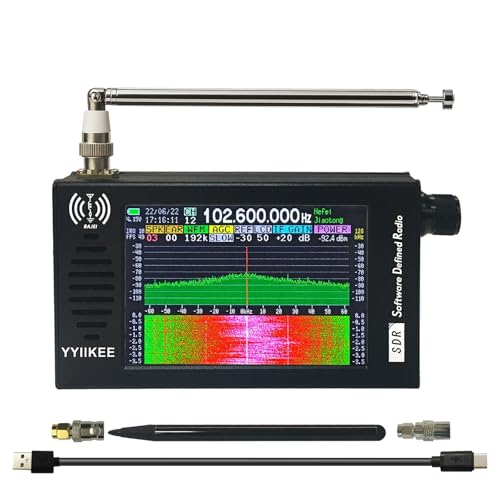
- 100 kHz to 149 MHz coverage
- 4.3-inch touchscreen with waterfall display
- Rechargeable aluminum-alloy handheld design
Best For: Portable shortwave and ham listening in one handheld unit
HF Performance Bundle

- 300 Hz to 2.3 GHz coverage with a gap near 1.1 GHz
- HF via Ham It Up Plus v2 upconverter
- Includes antennas, balun, adapters, and cables
Best For: Listeners who want a stronger HF-focused SDR bundle
Portable Touchscreen SDR
Portable DSP SDR Radio Receiver 4.3 Inch Touchscreen 100KHz-149MHz Full Bands

- 100KHz-149MHz coverage with 1Hz steps
- Touchscreen, rotary encoder, and waterfall display
- 5000mAh battery for up to 12 hours
Best For: Portable listeners who want a touchscreen SDR for HF through VHF monitoring
HF Direct-Sampling SDR
Nooelec RTL-SDR v5 Bundle HF/VHF/UHF 100kHz-1.75GHz
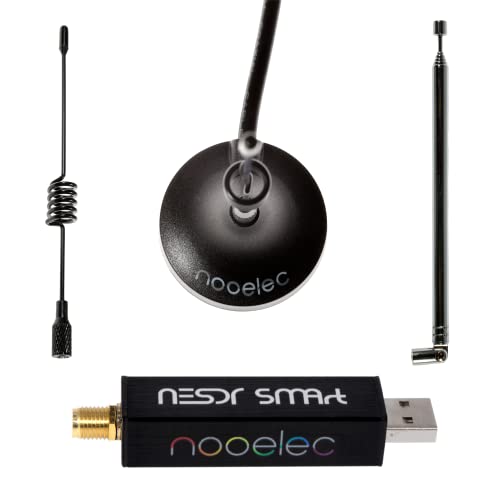
- Tunes from 100kHz to 1.75GHz
- Improved HF SNR over RTL-SDR v3
- Works with Windows, Mac, Linux, and Android
Best For: Beginners and experimenters who want a broad-coverage SDR bundle with better HF performance
Upconverter HF SDR Bundle
Nooelec NESDR Smart HF Bundle 100kHz-1.7GHz

- Ham It Up upconverter for HF reception
- Includes SDR, antennas, balun, and adapters
- Covers 100kHz to 1.7GHz
Best For: Users who want an upconverter-based HF setup with broad-band SDR coverage
Premium HF SDR Dongle – Nooelec NESDR SMArt v5
If you want SDR receivers with HF coverage that stay affordable but still deliver serious flexibility, the Nooelec NESDR SMArt v5 is a strong computer-based option. It covers 100kHz to 1.75GHz, adds direct-sampling HF reception below 25MHz, and is built for use with Windows, Mac, Linux, and Android.
Best For: Buyers who want a low-cost SDR dongle for HF, VHF, and UHF listening on a computer or mobile device.
Pros:
- HF coverage down to 100kHz with improved HF SNR over the v3 model
- Wide tuning range from 100kHz to 1.75GHz with up to 3.2MHz instantaneous bandwidth
- 0.5 PPM TCXO and aluminum enclosure for better frequency stability
- Supports many uses, including shortwave, air traffic, ADS-B, AIS, and weather satellites
Cons:
- HF reception below 25MHz requires a suitable antenna for direct sampling
- For a more fulfilling HF experience, an upconverter is still recommended by the maker
This is a practical all-round SDR dongle for users who want broad radio coverage in a compact package. Its biggest strength is versatility, while its HF performance improves further with the right antenna setup.
Portable Shortwave Receiver – Raddy MLite-880 Portable SDR
For shoppers comparing SDR receivers with HF coverage in a self-contained portable radio, the Raddy MLite-880 focuses on shortwave listening and everyday monitoring. It covers FM, MW, LW, SW, and airband, with SSB, AM, CW, SAM, NFM, and WFM modes plus a spectrum and waterfall display for easier tuning.
Best For: Travelers and hobbyists who want a handheld-style receiver for shortwave, airband, and general monitoring.
Pros:
- 2.3-inch real-time spectrum and waterfall display for visual signal tracking
- Supports SSB, AM, CW, SAM, NFM, and WFM demodulation
- DSP noise reduction, notch filtering, and AGC help clean up difficult signals
- 5000mAh battery with USB-C rechargeability and replaceable design
Cons:
- Its HF coverage is part of a portable radio, not a USB dongle for PC software
- Best suited to manual tuning and field use rather than advanced computer integration
This is a good fit if you want a portable receiver with built-in display tools and long battery life. It leans more toward convenient listening and scanning than software-defined experimentation.
Beginner HF SDR Kit – RTL-SDR Blog V4 Starter Kit
If you are shopping for SDR receivers with HF coverage and want an easy starter kit, the RTL-SDR Blog V4 is aimed at beginners who want broad receive-only monitoring. It tunes from 500kHz to 1.7GHz, includes a built-in HF upconverter, and ships with a dipole antenna kit for portable VHF/UHF and general experimentation.
Best For: Beginners who want a starter SDR kit with wide coverage and included antenna hardware.
Pros:
- 500kHz to 1.7GHz tuning range with up to 3.2MHz instantaneous bandwidth
- Built-in HF upconverter and 1 PPM TCXO for better stability
- Includes a multipurpose dipole antenna kit for easier setup
- Aluminum shielded case, improved filtering, and activatable bias tee
Cons:
- The notes explicitly say it is not suitable for HF reception despite the upconverter
- Requires a driver update, and setup mistakes can lead to no-signal complaints
This bundle is most useful as an entry-level SDR package for terrestrial and satellite use. It is less compelling if your main goal is direct HF listening, since the supplied notes caution against using it for HF reception.
Feature-Rich Portable SDR – MLite-880 Bluetooth Portable
Among SDR receivers with HF coverage, the MLite-880 stands out as a feature-heavy portable radio with spectrum display, recording, and Bluetooth support. It covers FM, MW, LW, SW, and AIR bands, and offers AM, SAM, CW, USB, LSB, NFM, and WFM modes for flexible monitoring.
Best For: Listeners who want a portable all-band receiver with modern convenience features and recording support.
Pros:
- Full-band coverage including SW and airband with multiple demodulation modes
- 2.3-inch real-time spectrum analyzer with 40kHz slice view
- Advanced DSP noise reduction, noise blanking, AGC, and bandwidth control
- Bluetooth, microSD storage, firmware updates, and WAV/FLAC recording support
Cons:
- Designed as a portable standalone receiver, not a USB SDR dongle
- The notes emphasize manual controls and keypad entry over touchscreen convenience
This model is a strong choice if you want an easy-to-carry receiver with modern signal tools and recording options. It is especially appealing for users who value tactile controls and a self-contained listening setup.
Budget SDR Starter – RTL-SDR Blog V3 VHF/UHF Kit
If you want one of the most accessible SDR receivers with HF coverage, this RTL-SDR Blog V3 kit is best viewed as a beginner-friendly VHF/UHF receiver with limited HF capability. It tunes from 500 kHz to 1.7 GHz, and HF reception below 24 MHz is available in direct sampling mode, though performance is reduced. The included dipole antenna kit makes it easy to get started quickly for portable and temporary outdoor use.
Best For: Beginners who want a low-cost SDR for general scanning, VHF/UHF listening, and only light HF experimentation.
Pros:
- R860 tuner, 1 PPM TCXO, and aluminum shielded case for improved stability
- Activatable bias tee supports compatible setups
- Includes a multipurpose dipole antenna kit
- Wide tuning range from 500 kHz to 1.7 GHz
Cons:
- HF reception below 24 MHz uses direct sampling with reduced performance
- The included antenna set is not suitable for HF reception
- RX only, so it cannot transmit
For buyers focused on SDR receivers with HF coverage, this is a solid entry point if you mainly want broad receive coverage and simple setup. Just note that its HF use is limited compared with models built specifically for shortwave listening.
Portable Shortwave Pick – Touchscreen DSP SDR Receiver
This handheld unit is aimed at listeners who want SDR receivers with HF coverage in a self-contained portable radio. It covers 100 kHz to 149 MHz, supports CW, AM, SSB, WFM, and FM stereo, and adds a 192 kHz real-time spectrum and waterfall display for easier tuning. The CNC aluminum alloy case and rechargeable battery make it practical for field use.
Best For: Portable shortwave and amateur radio listening in a compact all-in-one receiver.
Pros:
- 100 kHz to 149 MHz coverage includes shortwave and ham bands
- 4.3-inch 800×480 touchscreen with rotary encoder control
- 192 kHz spectrum and waterfall display
- Rechargeable, compact, and housed in an aluminum alloy case
Cons:
- Single-battery portable design may not suit extended use without charging
- Frequency range is much narrower than wideband USB dongles
- Best viewed as a receiver, not a general-purpose SDR platform
As a practical portable choice, it stands out for integrated controls and a display that makes tuning straightforward. If you want an easy way to listen to HF and nearby bands without building a separate SDR setup, it fits that role well.
HF Performance Bundle – NESDR Smart XTR HF Set
For shoppers comparing SDR receivers with HF coverage, this Nooelec bundle is built around a proper upconverter rather than a direct-sampling workaround. The package pairs the NESDR SMArt XTR v2 with the Ham It Up Plus v2, giving you 300 Hz to 2.3 GHz coverage and a stronger HF listening experience while keeping gain control available. It also includes antennas, a balun, adapters, and cables for a more complete setup.
Best For: Users who want a more serious HF-focused SDR bundle with better receive performance than basic low-cost dongles.
Pros:
- Uses a dedicated Ham It Up Plus v2 upconverter for HF reception
- Wide 300 Hz to 2.3 GHz frequency range, with a gap near 1.1 GHz
- Includes 3 antennas, a balun, adapters, and cables
- Backed by a 2-year warranty and technical support
Cons:
- Not recommended for ADS-B because of the frequency gap
- More complex than a simple plug-and-play dongle
- Limited-time bundle availability
If HF performance matters more than the simplest setup, this bundle is the strongest option here. The upconverter-based design is the key advantage, especially for listeners who want a better shortwave experience and a fuller accessory package.
Portable Touchscreen SDR – Portable DSP SDR Radio Receiver 4.3 Inch Touchscreen 100KHz-149MHz Full Bands
If you want one of the more portable SDR receivers with HF coverage, this model is built for easy on-the-go listening with a touchscreen interface and a wide tuning range from 100KHz to 149MHz. It supports CW, AM, SSB, WFM, and FM stereo, so it works well as a compact all-band receiver for casual monitoring, ham use, and travel.
Best For: Portable listeners who want a touchscreen SDR for HF through VHF monitoring
Pros:
- Covers 100KHz-149MHz with 1Hz step resolution
- Supports CW, AM, SSB USB/LSB, WFM, and FM stereo
- 4.3-inch touchscreen plus rotary encoder for flexible control
- Built-in 5000mAh battery for up to 12 hours of use
Cons:
- HF coverage is broad, but the supplied notes do not mention external antenna options or accessories beyond the included basics
- Best suited to portable use rather than a full desktop station
This is a practical pick if you want a self-contained SDR receiver that can handle shortwave and higher bands without extra setup. The aluminum alloy CNC shell and preset channel memory add convenience, especially for travel or field listening.
HF Direct-Sampling SDR – Nooelec RTL-SDR v5 Bundle HF/VHF/UHF 100kHz-1.75GHz
Among SDR receivers with HF coverage, this Nooelec bundle is a strong low-cost option for users who want broad frequency coverage and computer-based receiving. It tunes from 100kHz to 1.75GHz, adds improved HF performance over the previous version, and supports direct sampling below 25MHz for shortwave use with a suitable antenna.
Best For: Beginners and experimenters who want a broad-coverage SDR bundle with better HF performance
Pros:
- Coverage from 100kHz to 1.75GHz with up to 3.2MHz instantaneous bandwidth
- Improved HF SNR and tuning accuracy versus the v3 model
- Includes a magnetic antenna base and three antenna masts
- Compatible with Windows, Mac OS, Linux, and Android
Cons:
- HF reception below 25MHz requires a suitable antenna
- For a more complete HF setup, Nooelec still recommends an external upconverter sold separately
This bundle makes sense if you want a versatile SDR receiver that can cover shortwave, VHF, and UHF from one USB device. The included antenna pack helps you get started, but the HF side benefits from careful antenna planning.
Upconverter HF SDR Bundle – Nooelec NESDR Smart HF Bundle 100kHz-1.7GHz
If your priority is stronger HF performance in SDR receivers with HF coverage, this Nooelec bundle is designed around an included Ham It Up upconverter instead of direct sampling. That approach is meant to deliver a different HF experience with better performance and preserved gain control, while still covering up to 1.7GHz for VHF and UHF use.
Best For: Users who want an upconverter-based HF setup with broad-band SDR coverage
Pros:
- Uses the Ham It Up upconverter for HF reception, not direct sampling hacks
- Includes an NESDR SMArt RTL-SDR, upconverter, 3 antennas, balun, and adapters
- Wide coverage from 100kHz to 1.7GHz
- Backed by a 2-year warranty and technical support
Cons:
- More parts in the bundle mean a more involved setup than a simple USB dongle
- Enclosure colors may vary based on availability
This is the better fit if you specifically want an HF-oriented bundle rather than a barebones receiver. The included upconverter and matching accessories make it a well-rounded starting point for shortwave and wider-band listening.
How We Picked These SDR Receivers with HF Coverage
We prioritized models that offer useful HF reception, stable frequency control, solid software compatibility, and features that matter in real use, such as bias tee support, upconversion for HF, spectrum display, SSB capability, and portable operation. We also looked for options that fit both desktop and grab-and-go listening.
Quick Comparison
If you want the simplest path into SDR, a USB dongle with a strong software ecosystem is usually the best value. If you want an all-in-one listening experience without a computer, a portable DSP radio with a built-in screen and battery is more convenient. For users who want better HF performance out of a dongle-based setup, bundles with antennas or upconverters can make a meaningful difference.
Key Buying Factors for SDR Receivers with HF Coverage
HF Performance and Frequency Range
Check the lower end of the tuning range first, since that determines how well the receiver handles shortwave and other HF signals. Some SDR Receivers with HF Coverage rely on direct sampling or an included upconverter, while others are designed to cover HF more natively.
Software and Mode Support
Make sure the receiver works with the software you plan to use and supports the modes you need, especially SSB, CW, and spectrum/waterfall viewing. For ham and utility listening, software flexibility matters as much as raw hardware specs.
Antenna and Accessory Needs
HF listening is often limited by the antenna more than the receiver. Bundles that include a dipole, bias tee, or HF upconverter can save time and improve results, especially for indoor or starter setups.
Portability Vs. Desktop Use
Choose a compact USB SDR if you want to use a laptop, tablet, or desktop setup. Choose a portable touchscreen radio if you want an independent receiver for travel, field use, or casual listening without extra gear.
Who Should Buy Which SDR Receivers with HF Coverage?
Beginners should look for a user-friendly bundle with a strong software community and included antenna support. Experimenters and ham operators may prefer a dongle with broader frequency coverage, better frequency stability, and accessory flexibility. If you want an easy standalone radio, pick a portable DSP model with HF, SSB, and waterfall features built in. For most shoppers comparing SDR Receivers with HF Coverage, the best choice comes down to whether you want convenience, portability, or maximum software-driven flexibility.