If you’re serious about elevating your sound quality, choosing the right audio interface is essential. The right interface can transform your recordings with exceptional clarity and professional-grade features. With options like the Focusrite Scarlett 2i2 and Universal Audio Volt series, you’ve got various choices to fit different needs and budgets. Let’s explore the top contenders that can enhance your setup and give your recordings the edge they deserve.
Focusrite Scarlett 2i2 4th Gen USB Audio Interface for Recording

If you’re looking for a reliable audio interface that elevates your recording game, the Focusrite Scarlett 2i2 4th Gen is an exceptional choice. With a 120dB dynamic range and studio-grade converters, it delivers high-fidelity sound that rivals flagship models. The Auto Gain feature optimizes levels for your mic or guitar, while Clip Safe prevents unwanted distortion. Plus, Air mode enhances vocal and guitar presence, adding depth to your recordings. Included software like Pro Tools Intro+ and Auto-Tune Access guarantees you have everything you need to create professional-quality tracks. Lightweight and compatible with various devices, it’s perfect for any setup.
Best For: Musicians, podcasters, and streamers seeking a high-quality audio interface for professional recording and streaming.
Pros:
- High-fidelity sound with a 120dB dynamic range and studio-grade converters.
- User-friendly features like Auto Gain and Clip Safe for optimal recording levels.
- Comprehensive software bundle including Pro Tools Intro+, Ableton Live Lite, and Auto-Tune Access.
Cons:
- Limited connectivity options with only USB-C and USB 2.0 interfaces.
- No MIDI input/output, which may restrict some users’ setups.
- Price point may be higher compared to entry-level interfaces.
M-AUDIO M-Track Duo USB Audio Interface for Recording and Streaming
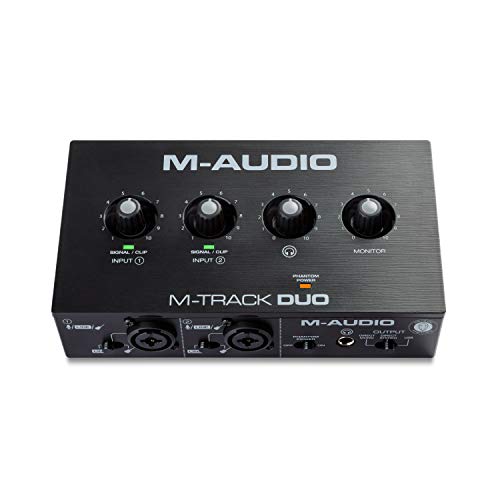
The M-AUDIO M-Track Duo USB Audio Interface is perfect for musicians and content creators seeking a reliable solution for recording and streaming. With dual XLR, line, and DI inputs, it adapts easily to various audio applications. You’ll enjoy high-quality recordings thanks to its 48 kHz audio resolution and transparent Crystal Preamps, ensuring ideal sound from your microphones, including condensers. The interface also features two combo XLR/Line/Instrument inputs with phantom power, perfect for capturing vocals and instruments. Plus, with zero latency monitoring via the USB/Direct switch, you can hear yourself in real time, making your recording experience seamless and enjoyable.
Best For: Musicians and content creators looking for a versatile and high-quality audio interface for recording and streaming.
Pros:
- High-quality 48 kHz audio resolution ensures clear and professional recordings.
- Dual XLR, line, and DI inputs provide flexibility for various audio applications.
- Zero latency monitoring allows for real-time audio feedback during recording.
Cons:
- Limited to two inputs, which may not be sufficient for larger setups.
- Some users may find the included software basic for advanced production needs.
- USB-powered, which may limit mobility if a power source is not available.
Universal Audio Volt 2 USB Recording Studio Audio Interface
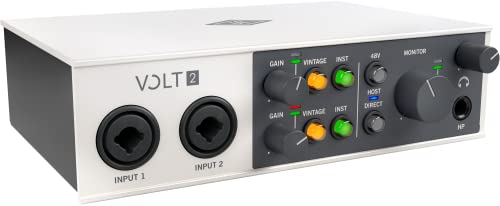
For musicians and producers seeking professional-quality recordings, the Universal Audio Volt 2 USB Recording Studio Audio Interface stands out with its classic 610 preamps and high-performance converters. You’ll capture every detail of your performance with up to 24-bit/192 kHz audio quality. Plus, you can record and mix seamlessly using the award-winning LUNA Digital Audio Workstation, mimicking an analog studio workflow. With access to UAD plug-ins and instruments, you’ll achieve a polished sound that recalls your favorite records. And if you’re looking to sharpen your skills, you’ll find valuable tips and tutorials for beginners and advanced users alike.
Best For: Musicians and producers looking for a professional-quality audio interface that combines classic sound with modern technology.
Pros:
- High-quality audio capture with up to 24-bit/192 kHz resolution.
- Seamless integration with the award-winning LUNA Digital Audio Workstation for an analog workflow experience.
- Access to UAD plug-ins and instruments used by industry professionals for a polished sound.
Cons:
- Limited to USB connectivity, which may not suit all setups.
- Some users may find the learning curve steep when using LUNA and UAD plugins.
- Price point may be higher compared to entry-level audio interfaces.
Universal Audio Volt 1 USB Recording Studio Audio Interface
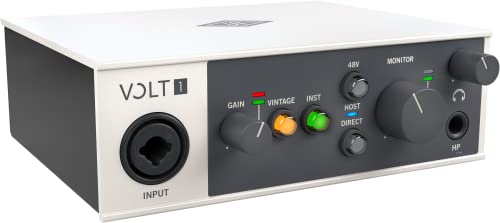
Looking to elevate your recording game? The Universal Audio Volt 1 USB Recording Studio Audio Interface is your gateway to high-quality sound. With UA’s classic 610 preamps and professional-grade converters, it captures every nuance of your performance at up to 24-bit / 192 kHz. Plus, you’ll love the seamless integration with the award-winning LUNA Digital Audio Workstation, giving you an analog studio feel. Access top-tier UAD plug-ins and instruments used by industry pros. Whether you’re a beginner or a seasoned pro, the Volt 1 provides essential resources, tips, and tutorials to enhance your recording and mixing skills.
Best For: Home studio enthusiasts looking to achieve professional-quality recordings and mixdowns.
Pros:
- High audio quality with 24-bit / 192 kHz recording capabilities.
- Classic UA 610 preamps provide a warm, rich sound.
- Seamless integration with LUNA Digital Audio Workstation and access to UAD plug-ins.
Cons:
- May require some learning curve for beginners unfamiliar with recording software.
- Limited to one input, which may not suffice for larger projects.
- USB-powered, which might be less convenient for mobile setups compared to battery-operated interfaces.
Solid State Logic SSL 2 MKII – 2×2 USB Audio Interface

Producers, podcasters, and musicians will find the Solid State Logic SSL 2 MKII 2×2 USB Audio Interface to be an exceptional choice for high-end recording. With two XLR mic preamps and versatile 1/4″ inputs, it caters to various audio needs. You’ll appreciate the 32-bit/192 kHz AD/DA converters for pristine sound quality and the Legacy 4K analog enhancement for that classic warmth. Plus, zero-latency monitoring guarantees you stay in the moment while recording. The included SSL Production Pack software bundle rounds out this impressive interface, making it a powerful tool in any audio setup.
Best For: Producers, podcasters, and musicians looking for a high-quality audio interface for recording and mixing.
Pros:
- High-quality audio: 32-bit/192 kHz AD/DA converters ensure exceptional sound clarity.
- Versatile connectivity: Features two XLR mic preamps and multiple input options for various recording needs.
- Included software bundle: Comes with the SSL Production Pack, enhancing your production capabilities.
Cons:
- Limited inputs: Only two XLR mic preamps may restrict larger recording setups.
- Price point: Higher cost compared to some entry-level audio interfaces may not suit all budgets.
- No built-in effects: Lacks onboard effects processing, requiring external software for audio enhancements.
Behringer UMC202HD Audiophile USB Audio Interface

The Behringer UMC202HD Audiophile USB Audio Interface stands out for musicians and podcasters seeking high-quality recordings without breaking the bank. With 24-Bit/192 kHz audio resolution, it guarantees exceptional sound quality. Its Midas-designed mic preamps deliver industry-standard performance, enhancing your recordings considerably. You’ll appreciate the zero-latency direct monitoring feature, letting you hear your performance in real-time. The independent level control on the headphone output is a nice touch. Plus, the USB 2.0 connectivity and +48V phantom power switch make it easy to connect and power condenser microphones. With 2 inputs and outputs, it’s perfect for your recording needs.
Best For: Musicians and podcasters looking for an affordable solution to achieve high-quality audio recordings.
Pros:
- Exceptional audio quality with 24-Bit/192 kHz resolution.
- Midas-designed mic preamps ensure industry-standard sound performance.
- Zero-latency direct monitoring allows for real-time listening during recordings.
Cons:
- Limited to 2 inputs and outputs, which may not suffice for larger setups.
- USB 2.0 connectivity may not be as fast as newer USB standards.
- Phantom power may not be sufficient for all condenser microphones.
Solid State Logic SSL 2 Plus MKII USB Audio Interface
For anyone seeking a versatile and high-quality audio solution, the Solid State Logic SSL 2 Plus MKII USB Audio Interface stands out as an exceptional choice. It’s designed for producers, podcasters, and live-studio musicians, featuring two XLR mic preamps and two line/Hi-Z inputs. You’ll appreciate its 32-bit/192 kHz AD/DA converters and legacy 4K analog enhancement for superior audio quality. With zero-latency monitoring, stereo loopback functionality, and MIDI I/O, it meets all your connectivity needs. Plus, it comes bundled with the SSL Production Pack software, ensuring you have everything to elevate your projects to professional standards.
Best For: The Solid State Logic SSL 2 Plus MKII USB Audio Interface is best for producers, podcasters, and live-studio musicians seeking high-quality audio solutions.
Pros:
- High-quality audio with 32-bit/192 kHz AD/DA converters and legacy 4K analog enhancement.
- Versatile connectivity options including two XLR mic preamps, line/Hi-Z inputs, and MIDI I/O.
- Zero-latency monitoring and stereo loopback functionality for seamless recording and playback.
Cons:
- Limited number of inputs may not be sufficient for larger recording setups.
- Bus powered may require reliable USB power source, potentially limiting portability.
- Software bundle may not meet all users’ specific needs depending on their workflow.
MOTU M2 USB-C Audio Interface

Offering exceptional audio resolution of 24-bit/192kHz, the MOTU M2 USB-C Audio Interface stands out as an ideal choice for musicians and audio engineers seeking high-fidelity recordings. Weighing just 1.35 pounds and measuring 7.5 x 4.25 x 1.75 inches, it’s portable yet powerful. With two preamps and hardware monitoring, you can achieve precise sound quality during recordings. The interface is compatible with macOS, Windows, and iOS, making it versatile for any setup. Plus, it includes over 6 GB of free content and has earned an impressive 4.5-star rating from users. Elevate your recordings with the MOTU M2 today!
Best For: Musicians and audio engineers seeking high-fidelity recordings in a portable format.
Pros:
- Exceptional audio resolution of 24-bit/192kHz for superior sound quality.
- Lightweight and compact design, making it easy to transport and set up.
- Compatible with macOS, Windows, and iOS, providing versatility across different platforms.
Cons:
- Limited number of inputs and outputs (2-in/2-out) may not meet the needs of larger recording setups.
- Some users may prefer additional software or plugins that are not included.
- Requires USB-C connection, which may necessitate adapters for older devices.
Universal Audio Volt 176 USB Recording Studio Audio Interface

With its built-in analog compressor and classic 610 preamps, the Universal Audio Volt 176 USB Recording Studio Audio Interface stands out as an ideal choice for musicians and podcasters seeking professional-quality sound. You’ll enjoy up to 24-bit/192 kHz audio quality, capturing every detail with its professional-grade converters. This 1-in/2-out interface weighs just 1.44 pounds, making it portable for any setup. It’s compatible with Mac, PC, iPad, and iPhone, and includes award-winning LUNA software and UAD plug-ins. Whether you’re a beginner or an advanced user, the Volt 176 elevates your recording experience effortlessly.
Best For: Musicians, singers, songwriters, livestreamers, and podcasters seeking professional-quality recording with a user-friendly interface.
Pros:
- High audio quality with up to 24-bit/192 kHz resolution for detailed sound capture.
- Built-in analog compressor and classic 610 preamps provide professional-grade audio processing.
- Compatibility with various devices and software, ensuring flexibility for different setups.
Cons:
- Limited input/output options with only 1-in/2-out configuration, which may not suit larger setups.
- Weight of 1.44 pounds might be heavier compared to other portable interfaces.
- Learning curve for beginners unfamiliar with advanced recording software and features.
PreSonus Studio 24c USB Audio Interface

The PreSonus Studio 24c USB Audio Interface stands out for its impressive 192 kHz sampling rate, making it an excellent choice for musicians and producers who demand high-fidelity recordings. With two XMAX-L mic preamps, you can easily connect your instruments or microphones for superior sound. The interface features balanced ¼-inch TRS outputs for studio monitors and MIDI In/Out for added versatility. You’ll appreciate the high-power headphone output and low-latency direct monitoring through the mixer knob. Plus, it comes with Studio One 6 Artist Edition software, ensuring you have everything you need to elevate your recording experience.
Best For: Musicians and producers seeking high-fidelity recordings with versatile connectivity options.
Pros:
- High sampling rate of 192 kHz for superior audio quality.
- Includes Studio One 6 Artist Edition software for seamless recording and production.
- Low-latency direct monitoring via the mixer knob for real-time audio feedback.
Cons:
- Limited to 2 inputs and 2 outputs, which may not suffice for larger setups.
- No onboard effects or processing capabilities, requiring additional software or hardware for enhancements.
- MIDI In/Out may not be sufficient for users with extensive MIDI gear setups.
Factors to Consider When Choosing Audio Interfaces for High End Recording
When you’re choosing an audio interface for high-end recording, several key factors come into play. You’ll want to take into account audio resolution quality, input and output options, and monitoring features to guarantee exceptional performance. Additionally, think about software compatibility, support, and the overall build quality to make the best choice for your setup.
Audio Resolution Quality
Choosing an audio interface with high resolution quality is essential for achieving professional-grade recordings, especially if you’re aiming for intricate details and dynamic range. Look for interfaces that offer at least 24-bit/192 kHz resolution, which is the standard for capturing the subtleties of your performances. Higher audio resolutions provide a dynamic range of up to 144 dB, reducing distortion and allowing for more expressive recordings. If you want even more headroom, consider interfaces with 32-bit converters. While 44.1 kHz is sufficient for CD-quality audio, higher sampling rates like 96 kHz or 192 kHz are preferred for studio work. Don’t forget the importance of quality A/D converters—they play a significant role in accurately capturing and reproducing sound.
Input and Output Options
As you explore audio interfaces for high-end recording, input and output options play a critical role in determining how well your setup meets your specific needs. Look for interfaces with multiple XLR, line, and instrument inputs, allowing you to record various sources simultaneously. Balanced outputs are essential for connecting studio monitors, while independent headphone outputs with volume controls enable effective monitoring during sessions. MIDI I/O capabilities are also a plus, helping you integrate synthesizers and controllers seamlessly. Don’t forget phantom power for condenser microphones, ensuring exceptional audio capture. Finally, consider features like zero-latency monitoring and stereo loopback to enhance your recording experience with real-time feedback and multi-source streaming options.
Monitoring Features and Latency
Monitoring features and latency are significant factors that can considerably impact your recording experience with audio interfaces. Zero-latency monitoring allows you to hear your performance in real-time, essential for accurate recordings and live performances. High-quality interfaces often come with headphone outputs and direct monitoring capabilities, keeping you focused and in control during sessions. Low latency is critical to prevent sync issues, so look for interfaces that minimize this delay. Features like a USB/Direct switch let you toggle between software and direct monitoring, adding flexibility. Additionally, mixer knobs for low-latency direct input monitoring help you achieve ideal levels in real-time, ensuring that your audio quality meets high standards while recording.
Software Compatibility and Support
When investing in a high-end audio interface, software compatibility and support play an important role in enhancing your recording capabilities. Make certain the interface works seamlessly with various operating systems like macOS, Windows, iOS, and ChromeOS. This flexibility guarantees you can use it across different devices. Look for interfaces that bundle popular digital audio workstation (DAW) software, as this can streamline your workflow and improve your recording experience. Additionally, check for included plugins and virtual instruments, which expand your creative options. Access to learning resources, tutorials, and solid customer support is vital for mastering your skills. Finally, verify robust driver updates are available to maintain peak performance as technology evolves.
Build Quality and Design
Choosing the right audio interface means paying close attention to build quality and design, since these factors greatly impact your recording experience. High-end interfaces typically boast a robust construction, weighing between 1.35 to 1.73 pounds, ensuring durability for extensive use. Look for user-friendly layouts with clearly labeled inputs and outputs, which simplify connecting microphones, instruments, and monitors. Features like zero-latency monitoring demonstrate thoughtful design, minimizing signal delay to enhance your recording process. A compact size—often around 7 inches long and 4 inches wide—offers easy portability without compromising functionality. Additionally, versatile connectivity options, such as USB-C and MIDI I/O, are essential for accommodating various setups and ensuring compatibility with your devices.
Connectivity and Portability
Connectivity and portability are crucial factors in selecting an audio interface for high-end recording. When you’re choosing, consider the connectivity options like USB-C or traditional USB, as they impact compatibility with your devices. For mobile recording, look for lightweight interfaces that fit easily in your backpack and are bus-powered, eliminating the need for an external power source. It’s also essential to have multiple input options, including XLR and line inputs, to accommodate various microphones and instruments. Additionally, check for zero-latency monitoring features, allowing real-time audio feedback during recording. Finally, review the dimensions and weight; compact designs are ideal for travel without sacrificing the essential features for high-quality recordings. This way, you’ll always be ready to capture the moment.