If you’re a MacBook producer looking to enhance your audio quality, you’ll want to explore the top audio interfaces available in 2026. These devices not only promise superior sound fidelity but also offer seamless integration with your Apple gear. Whether you’re recording at home or on the go, the right interface can make all the difference. Curious about which options stand out? Let’s take a closer look at the best choices for your setup.
Universal Audio Apollo Twin X DUO Gen 2 Thunderbolt 3 Audio Interface

The Universal Audio Apollo Twin X DUO Gen 2 Thunderbolt 3 Audio Interface stands out as an exceptional choice for MacBook producers who prioritize high-quality audio recording and mixing. With its Unison preamps, you’ll capture analog tones and enjoy real-time emulations from legendary brands like Neve and API. Plus, you gain access to over 200 UAD DSP and Native plug-ins, enhancing your creative options. The Apollo Monitor Correction powered by Sonarworks guarantees accurate mixing, while the Auto-Gain feature simplifies level setting across inputs. This interface delivers convenience and professional sound quality, making it a must-have for any serious producer.
Best For: The Universal Audio Apollo Twin X DUO Gen 2 is best for MacBook producers seeking high-quality audio recording and mixing with professional-grade features.
Pros:
- Exceptional analog tone capture with Unison preamps and real-time emulations from renowned brands.
- Access to a comprehensive library of over 200 UAD DSP and Native plug-ins for enhanced creativity.
- Convenient Auto-Gain feature for quick and optimal level setting across multiple inputs.
Cons:
- Requires Thunderbolt 3 connectivity, limiting compatibility with some older devices.
- High price point may not be suitable for entry-level producers on a budget.
- Some users may find the learning curve steep when using advanced features and plug-ins.
Universal Audio Volt 2 USB Audio Interface
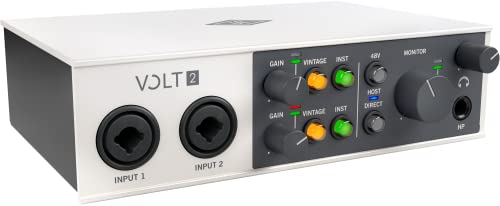
For musicians and producers looking for a portable yet powerful solution, the Universal Audio Volt 2 USB Audio Interface stands out with its impressive 24-bit/192 kHz audio quality. Weighing just 650 grams and measuring 5.12D x 6.85W x 2.09H inches, it’s easy to take anywhere. Its vintage mode delivers a rich, album-ready sound, thanks to UA’s classic 610 preamps. You’ll appreciate the included software like LUNA Digital Audio Workstation and UAD plug-ins for enhanced recording. Plus, it’s compatible with MacOS, Windows, and iOS devices. With a 4.6-star rating, it’s a solid choice for any audio project!
Best For: Musicians, songwriters, livestreamers, and podcasters seeking a portable audio interface with high-quality sound and versatile software options.
Pros:
- High Audio Quality: Offers up to 24-bit/192 kHz sound quality for professional-grade recordings.
- Vintage Mode: Provides a rich and warm sound reminiscent of classic preamps, perfect for album-ready tracks.
- Included Software: Comes with LUNA DAW and UAD plug-ins, enhancing the recording and mixing experience for users.
Cons:
- Power Requirements: Requires an external power supply and an adapter for certain devices, which may hinder portability.
- Limited Compatibility: Not all devices are supported, particularly older iOS versions and non-Apple products.
- Weight: While portable, some users may find the weight (650 grams) slightly heavier compared to other compact interfaces.
Universal Audio Apollo Solo Heritage Edition, APLS-HE

Designed for discerning producers, the Universal Audio Apollo Solo Heritage Edition (APLS-HE) stands out with its UAD SOLO Core Processing, enabling you to track through vintage compressors and EQs with near-zero latency. You’ll enjoy a premium suite of five award-winning plug-ins, valued at $1,300, featuring renowned brands like Teletronix and Pultec. With its Unison mic preamp technology, you can emulate exceptional gear from Neve and API seamlessly. Plus, it’s compatible with LUNA and major DAWs. Its bus-powered design makes it portable, and you’ll appreciate the best-in-class headphone amplifier for detailed monitoring during your sessions.
Best For: The Universal Audio Apollo Solo Heritage Edition is best for discerning producers and musicians seeking high-quality audio processing with near-zero latency.
Pros:
- Premium plug-in suite valued at $1,300, providing access to award-winning audio tools.
- Unison mic preamp technology allows for realistic emulation of renowned gear from top brands.
- Bus-powered design enhances portability and reduces cable clutter for easy setup.
Cons:
- Mac-only compatibility for LUNA Recording System may limit users on other operating systems.
- Price point may be higher compared to entry-level audio interfaces.
- Limited number of inputs/outputs could be restrictive for larger recording setups.
Yamaha USB-C Audio/MIDI Interface (URX22C)

With its 32-bit integer support and 192 kHz sample rate, the Yamaha USB-C Audio/MIDI Interface (URX22C) is an excellent choice for MacBook producers seeking high-quality audio capture and playback. You’ll appreciate the two combo inputs with Class-A D-PRE mic preamps and MIDI I/O. The rugged full-metal housing guarantees durability, making it perfect for on-the-go sessions. Plus, you get latency-free DSP-powered monitoring with built-in effects. Compatible with Windows, macOS, and iOS, it also comes with a Steinberg software suite for easy mixing and control. With a stellar 5-star rating, it’s a reliable addition to your audio setup.
Best For: The Yamaha USB-C Audio/MIDI Interface (URX22C) is best for MacBook producers and musicians looking for high-quality audio capture and playback in a durable and portable design.
Pros:
- High-quality audio with 32-bit integer support and 192 kHz sample rate.
- Durable design with a rugged full-metal housing, ideal for mobility.
- Comprehensive software bundle including Steinberg’s Cubase AI for easy mixing and control.
Cons:
- Limited number of inputs with only 2 combo inputs available.
- Potential compatibility issues with older versions of operating systems.
- No onboard effects for live performance without a computer connection.
Universal Audio Volt 1 USB Audio Interface
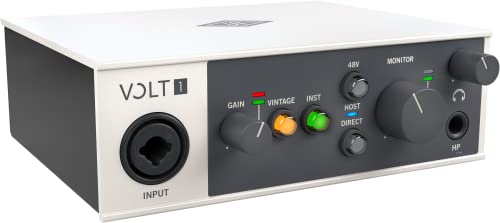
The Universal Audio Volt 1 USB Audio Interface stands out as an ideal choice for singers, songwriters, and podcasters looking to elevate their sound quality. With its rich, album-ready audio from UA’s classic 610 preamps in Vintage mode, you’ll enjoy professional sound. This 1-in/2-out interface supports a maximum sample rate of 24-bit/192 kHz, ensuring clarity in every note. It’s compatible with Mac, PC, and iOS devices, allowing for seamless integration. Plus, you’ll get access to award-winning software like LUNA and essential UAD plug-ins to enhance your recordings. With a 4.6-star rating, it’s a reliable choice for any creator.
Best For: The Universal Audio Volt 1 USB Audio Interface is best for singers, songwriters, guitarists, livestreamers, and podcasters seeking professional-quality sound.
Pros:
- Rich, full album-ready sound with UA’s classic 610 preamps for enhanced audio quality.
- Includes award-winning software such as LUNA and UAD plug-ins, providing valuable tools for recording and mixing.
- Compatible with multiple devices including Mac, PC, iPad, and iPhone, ensuring versatility for different setups.
Cons:
- Requires an external power supply, which may add to setup complexity.
- Limited to 1-in/2-out channels, which may not suffice for users needing more inputs.
- Weight and dimensions may be less portable for some users looking for a compact interface.
Focusrite Scarlett Solo 3rd Gen USB Audio Interface

For guitarists and vocalists seeking a reliable audio interface, the Focusrite Scarlett Solo 3rd Gen stands out as an excellent choice. It features high-performance mic pre-amps and switchable Air mode to enhance clarity in your recordings. With two high-headroom instrument inputs, you won’t have to worry about clipping or distortion. Plus, the Gain Halos make setting input levels a breeze. You’ll enjoy studio-quality recording at 24-bit/192kHz, ensuring your sound stays pristine. Compact and USB-powered, it’s perfect for your MacBook setup. With included software and a three-year warranty, the Scarlett Solo is a fantastic investment for any producer.
Best For: Guitarists, vocalists, podcasters, and producers seeking a compact and high-quality audio interface for recording.
Pros:
- High-performance mic pre-amps and switchable Air mode for enhanced clarity.
- Studio-quality recording at 24-bit/192kHz, ensuring pristine sound quality.
- USB-powered and compact design, making it ideal for mobile setups.
Cons:
- Limited to two inputs, which may not suffice for larger setups.
- Some users may find the bundled software insufficient for advanced production needs.
- Requires a USB connection, which could be limiting for some users without available ports.
Fender Quantum LT 16 USB-C Audio Interface for Music Production

Designed specifically for music producers, the Fender Quantum LT 16 USB-C Audio Interface offers an impressive 16-in 8-out configuration that makes it perfect for recording multiple instruments or vocals simultaneously. With 8 MAX-HD mic preamps providing +75 dB gain, you’ll enjoy crystal-clear sound. Its low-latency drivers guarantee responsive monitoring, while advanced standalone modes let you use it as an analog mixer or outboard mic preamp. Compatible with Mac and PC, it supports Fender Studio Pro and all major audio software. Plus, its loopback functionality is great for streaming or podcasting, making it a versatile choice for any producer.
Best For: Music producers looking for a high-performance audio interface with extensive input capabilities and low-latency monitoring.
Pros:
- 16-in 8-out configuration allows for simultaneous recording of multiple instruments or vocals.
- 8 MAX-HD mic preamps provide +75 dB gain for exceptional sound clarity.
- Advanced standalone modes enable use as an analog mixer or outboard mic preamp.
Cons:
- Weighs 4.8 pounds, which may be less portable for some users.
- Limited to USB-C connectivity, potentially requiring adapters for older devices.
- Some users may find the advanced features complex if they are not experienced with audio interfaces.
Universal Audio Apollo x4 Gen 2 Thunderbolt 3 Audio Interface
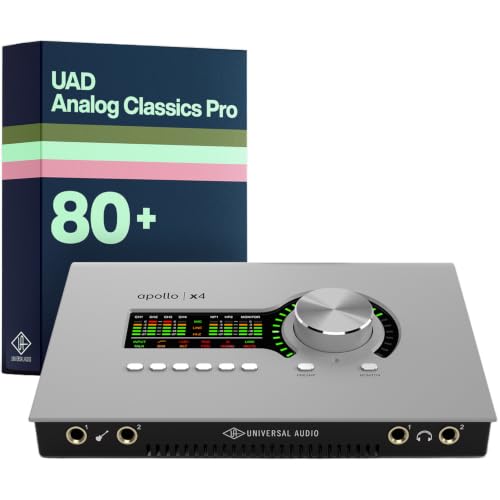
When you’re looking to elevate your music production, the Universal Audio Apollo x4 Gen 2 Thunderbolt 3 Audio Interface stands out with its four Unison mic preamps that deliver rich, analog tones. With next-gen audio conversion, you’ll enjoy the widest dynamic range and lowest distortion. The Apollo x4 supports a maximum sample rate of 192 kHz and features QUAD Core DSP processing for real-time recording with UAD plug-ins. You’ll benefit from accurate monitoring and an auto-gain feature that sets levels seamlessly. Plus, it’s compatible with popular DAWs, making it an ideal choice for your MacBook setup.
Best For: Musicians and producers seeking high-quality audio recording with advanced features for professional music production.
Pros:
- Exceptional audio quality with next-generation conversion, offering the widest dynamic range and lowest distortion.
- Four Unison mic preamps allow for rich, analog tones and real-time recording with famous preamp emulations.
- Full access to a library of 200+ UAD DSP and Native plug-ins, enhancing creativity and sound quality.
Cons:
- Higher price point compared to entry-level audio interfaces, which may not suit all budgets.
- Limited portability due to weight and reliance on Thunderbolt 3 connectivity, which might restrict compatibility with some devices.
- Complexity for beginners, as advanced features and settings may require a learning curve for new users.
Universal Audio Volt 276 USB Audio Interface

The Universal Audio Volt 276 USB Audio Interface stands out as an exceptional choice for MacBook producers seeking high-quality sound without a steep learning curve. It features classic UA 610 preamps with a Vintage mode, delivering rich, album-ready sound. The built-in analog compressor, inspired by the renowned 1176, adds clarity and punch to your recordings. Compatible with UAD plug-ins and industry-standard tools, it enhances your workflow. Plus, the included LUNA Digital Audio Workstation gives you an authentic analog studio experience. With support for MacOS and iOS devices, it’s portable and versatile, making it perfect for any producer on the go.
Best For: The Universal Audio Volt 276 USB Audio Interface is best for MacBook producers seeking high-quality sound and an intuitive recording experience.
Pros:
- Classic UA 610 preamps with Vintage mode for rich sound quality.
- Built-in analog compressor for enhanced clarity and punch in recordings.
- Portable and compatible with various devices, including MacOS and iOS.
Cons:
- Requires an external power supply and specific adapters for iOS devices.
- Might be an investment for beginners on a tight budget.
- Limited functionality without UAD plug-ins for advanced audio processing.
Fender AudioBox GO USB Audio Interface for Musicians
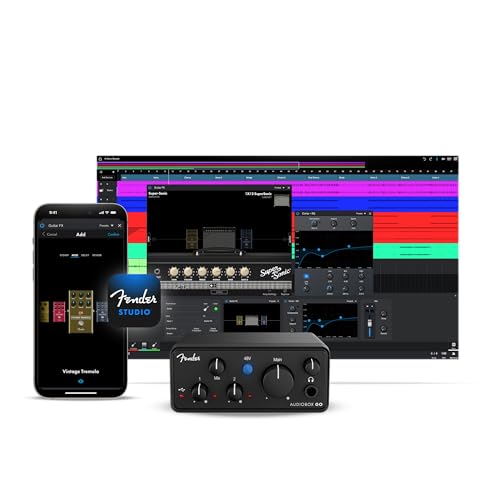
If you’re a musician on the go, the Fender AudioBox GO USB Audio Interface is an excellent choice for your MacBook setup. This ultra-compact 2×2 USB-C interface packs a punch with 24-bit/96 kHz converters, ensuring pristine sound quality for guitarists, vocalists, and podcasters alike. It features an XLR mic/line combo input with +48V phantom power and a dedicated TS instrument input, perfect for your gear. The bus-powered design makes it easy to transport, fitting right into your backpack. Plus, with included software like Fender Studio, you’re set for studio-quality recordings wherever you are.
Best For: The Fender AudioBox GO USB Audio Interface is best for musicians, podcasters, and content creators seeking a portable and high-quality audio solution for their recording needs.
Pros:
- Compact and portable design makes it easy to transport and fits in a backpack.
- High-quality audio with 24-bit/96 kHz converters ensures clear and pristine sound.
- Includes useful software like Fender Studio for enhanced recording capabilities.
Cons:
- Limited number of channels (2 channels may not suffice for larger projects).
- Requires USB-C connection, which may necessitate an adapter for some devices.
- Customer rating of 3.9 stars suggests mixed feedback from users.
Factors to Consider When Choosing Audio Interfaces for Macbook Producers
When you’re choosing an audio interface for your MacBook, you need to contemplate several key factors. Audio quality, connectivity options, and the number of inputs and outputs can greatly impact your production experience. Don’t forget to take into account software compatibility and how portable the design is for your workflow.
Audio Quality Standards
Choosing the right audio interface for your MacBook production setup involves understanding several key audio quality standards. Look for interfaces that support high-resolution sound quality, ideally offering up to 24-bit/192 kHz conversion rates for detailed audio reproduction. Quality mic preamps can enhance the warmth and character of your recordings, so choose interfaces that emulate classic studio equipment. Low-latency monitoring is essential for real-time audio processing, allowing you to hear your input without delay. Pay attention to dynamic range and distortion levels; superior interfaces provide wider dynamic ranges and lower total harmonic distortion (THD) for clearer sound. Finally, guarantee compatibility with industry-standard software and plug-ins for seamless integration into your workflow.
Connectivity Options Available
Audio quality standards set the stage for your production, but the connectivity options you select can make or break your setup. When choosing an audio interface for your MacBook, consider USB-C for faster data transfer and compatibility with the latest models. You’ll find interfaces with either USB Type-A or Type-C connections, which can impact your compatibility with other devices—older ports may require adapters. If you’re aiming for professional quality, look into Thunderbolt connections for lower latency and higher bandwidth. MIDI I/O ports are also valuable, allowing easy connections for your MIDI controllers and instruments. Finally, bus-powered interfaces are a game-changer for portability, as they eliminate the need for external power, making on-the-go recording a breeze.
Number of Inputs/Outputs
The number of inputs and outputs on your audio interface plays an essential role in how effectively you can capture your sound. If you’re a solo musician or podcaster, a 1-in/2-out interface might be all you need. However, if you’re in a band or running a studio, look for interfaces with multiple inputs to accommodate various instruments and vocalists. Many models come with combo inputs for both XLR and TRS connections, enhancing flexibility. Outputs also matter; balanced TRS outputs for studio monitors and headphone outputs streamline your workflow during recording and mixing. Consider interfaces that allow for expansion through additional mixers or interfaces, so you can adapt your setup as your production needs grow.
Software Compatibility Requirements
When selecting an audio interface for your MacBook, it’s essential to guarantee it’s compatible with your preferred Digital Audio Workstation (DAW) software. Make sure the interface supports popular formats like VST, AU, and AAX for seamless integration. Check compatibility with your macOS version, as some interfaces may have specific requirements or limitations. Look for included software bundles that enhance your recording and mixing capabilities, giving you access to valuable DAW and plugin collections. Additionally, verify that the interface can handle high sample rates—ideally up to 192 kHz—for high-resolution audio. Finally, consider interfaces that offer learning resources or support for various software applications, making your adjustment smoother, no matter your experience level.
Portability and Design
Choosing the right audio interface for your MacBook isn’t just about software compatibility; portability and design play a significant role too. For producers on the go, lightweight and compact interfaces are essential. Look for bus-powered options that eliminate the need for an external power supply, minimizing cable clutter. Durability is another key factor; rugged housing materials guarantee your gear withstands frequent travel and diverse environments. An interface with a small footprint—around 5 inches in width and under 2 inches in height—will easily fit into your backpack alongside your MacBook. Additionally, features like zero-latency monitoring and simple connectivity enhance the user experience, making it easier to set up and record wherever inspiration strikes.
Built-in Processing Features
While selecting an audio interface for your MacBook, built-in processing features can make a significant difference in your recording quality. These features allow you to track in real-time with emulations of classic analog gear, enhancing your sound without extra hardware. Many interfaces come with DSP processing capabilities, letting you apply effects and plug-ins with minimal latency for a smoother recording experience. Dedicated preamps and onboard effects help you achieve professional-grade sound effortlessly. Some interfaces even offer vintage modes that mimic the warmth of classic studio equipment, perfect for various genres. Integrated monitoring options, including zero-latency monitoring, provide immediate feedback during recording sessions, ensuring your performance stays sharp and engaging.
Preamp Quality and Emulation
Understanding preamp quality is essential for achieving pristine audio recordings on your MacBook. The right preamp amplifies your microphone signal before it’s converted to digital, ensuring clean and clear audio. High-end interfaces often include Unison technology, letting you record in real-time with preamp emulations from prestigious brands, adding that coveted analog warmth. Some interfaces feature vintage modes, providing a rich, full sound that mimics classic recording equipment, perfect for professional tracks. Low noise and distortion levels are crucial for maintaining audio integrity, especially when capturing subtle details in dynamic environments. Additionally, look for interfaces with various mic preamp options to cater to diverse recording needs, from vocals to acoustic instruments, allowing you to customize your sound effectively.
Price and Warranty Options
When selecting an audio interface for your MacBook, the price and warranty options can greatly impact your decision. Prices can range widely, so consider your budget and how much you’re willing to invest in production equipment. Don’t forget to check warranty options, as many manufacturers offer 1 to 3 years of coverage for peace of mind against defects. A solid return policy, ideally 30 days or more, lets you test the interface to guarantee it fits your needs before committing. Also, watch for additional costs like software bundles or plug-in access that can increase your total investment. Finally, think about resale value; some brands maintain their worth better, which can be vital for your long-term strategy.