If you’re looking to elevate your audio experience, choosing the right calibration microphone is essential for room correction. With so many options available, it can be challenging to pinpoint which models offer the best features and performance. From precise measurements to compatibility with popular software, there’s a lot to take into account. Let’s explore the top 10 calibration microphones that can help you optimize your sound system like a pro.
Audyssey Official ACM1HB Replacement Calibration Microphone for AVRs

If you’re looking to enhance your home audio experience, the Audyssey Official ACM1HB Replacement Calibration Microphone is the perfect tool for you. Designed specifically for Audyssey-enabled AV receivers like Denon and Marantz, this omnidirectional microphone captures sound from all directions, ensuring precise calibration. With a frequency response of up to 20 KHz and a signal-to-noise ratio of 78 dB, it restores ideal sound quality in your space. Weighing just 0.09 kg, it’s easy to handle. Trust Audyssey’s research-backed solutions to elevate your home theater or music setup, making every note and dialogue crystal clear.
Best For: Audiophiles and home theater enthusiasts looking to optimize their sound system with precise calibration for Audyssey-enabled AV receivers.
Pros:
- Omnidirectional Design: Captures sound from all directions for accurate calibration.
- High Quality Performance: Frequency response up to 20 KHz and a signal-to-noise ratio of 78 dB enhance sound clarity.
- Lightweight and Easy to Handle: Weighing only 0.09 kg, it’s convenient for use during calibration.
Cons:
- Limited Compatibility: Only works with specific Audyssey-enabled AV receivers.
- Not for General Use: Designed solely for calibration, not for other microphone applications.
- Plastic Build: May not have the same durability as microphones made from more robust materials.
Audyssey ACM1-X Individually Calibrated Microphone for AV Receivers

The Audyssey ACM1-X Individually Calibrated Microphone is the ideal choice for audiophiles and home theater enthusiasts who demand precise sound calibration for their AV receivers. This omnidirectional microphone pairs seamlessly with the Audyssey MultEQ-X app, allowing you to achieve accurate room acoustics measurement. Each microphone is individually calibrated, ensuring measurements match Type 1 reference standards for professional-grade precision. Its ability to capture sound from all directions makes it highly effective for room correction. Trust in Audyssey’s reputation for quality audio solutions, and elevate your sound system to new heights with the ACM1-X microphone’s advanced capabilities.
Best For: Audiophiles and home theater enthusiasts seeking precise sound calibration for their AV receivers.
Pros:
- Individually calibrated for professional-grade precision matching Type 1 reference standards.
- Omnidirectional design captures sound from all directions, enhancing room acoustics correction.
- Seamless integration with the Audyssey MultEQ-X app allows for enhanced control over calibration settings.
Cons:
- Requires an in-app purchase for the Audyssey MultEQ-X app, adding to overall costs.
- Limited to use with MultiEQ-X supported AV receivers, reducing compatibility with other systems.
- Calibration file is unique to each microphone, which may complicate setup if multiple microphones are used.
miniDSP UMIK-1 USB Measurement Calibrated Microphone

For audiophiles and sound engineers seeking precision in their acoustic measurements, the miniDSP UMIK-1 USB Measurement Calibrated Microphone stands out as an exceptional choice. Its unique calibration file guarantees accuracy, while the impressive sensitivity and frequency response cater to your monitoring needs. Plus, the plug-and-play installation makes it compatible with Windows, Mac, Linux, and iDevices without hassle. You can use it seamlessly with all acoustic software, including Dirac Live and REW. Included accessories, like the mini tripod, USB cable, windscreen, and sturdy transport case, enhance your experience, making it a versatile tool for any serious sound professional.
Best For: Audiophiles and sound engineers who require precise and reliable acoustic measurements.
Pros:
- Unique calibration file for enhanced accuracy in measurements.
- Plug-and-play installation compatible with multiple operating systems and acoustic software.
- Includes useful accessories like a mini tripod and sturdy transport case for convenience.
Cons:
- May be more expensive than non-calibrated microphones.
- Limited to USB connectivity, which may not suit all setups.
- Some users might find the sensitivity too high for certain applications.
Superlux ECM999 Measurement Microphone

Engineers and audio enthusiasts seeking precise sound analysis will find the Superlux ECM999 Measurement Microphone an invaluable tool. This omnidirectional condenser mic delivers an accurate frequency response of 20 Hz to 20 kHz, making it perfect for room calibration and audio testing. It handles high sound pressure levels up to 132 dB SPL, so you can use it in quiet or loud environments. Compatible with various audio interfaces and calibration software, it’s ideal for both home and professional applications. Plus, it comes with a carrying case, mic clip, and windscreen for easy transport and protection.
Best For: Engineers, audio technicians, and home audio enthusiasts seeking precise sound analysis and room calibration.
Pros:
- Omnidirectional design captures true room acoustics for accurate sound measurement.
- High sound pressure level handling (up to 132 dB SPL) makes it suitable for a variety of environments.
- Portable accessories like a carrying case, mic clip, and windscreen facilitate easy transport and protection.
Cons:
- Requires phantom power (12V–52V) and XLR cable, which are not included.
- Limited to an omnidirectional pattern, which may not suit all recording situations.
- May require calibration software for optimal performance, adding to setup complexity.
Dayton Audio iMM-6C Calibrated Measurement USB-C Microphone for iPhone and Android

With its precision condenser design, the Dayton Audio iMM-6C Calibrated Measurement USB-C Microphone is perfect for audiophiles and sound engineers who demand accuracy in their recordings. This microphone features a true omnidirectional pattern and a calibrated flat frequency response, ensuring your measurements are spot-on. You’ll appreciate the headphone/line-out pass-through jack, which allows you to listen to test signals directly. The convenient kickstand elevates and angles the microphone for ideal placement. Plus, its rugged construction makes it a reliable choice for any smartphone or tablet with a USB-C port. Get ready to elevate your sound system like a pro!
Best For: Audiophiles and sound engineers seeking a precise and reliable measurement microphone for their USB-C compatible devices.
Pros:
- High accuracy with a calibrated flat frequency response for precise recordings.
- True omnidirectional pattern captures sound evenly from all directions.
- Convenient kickstand allows for optimal positioning and hands-free use.
Cons:
- Limited to USB-C devices, which may exclude some older smartphones and tablets.
- Requires additional software for full functionality in certain applications.
- Price point may be higher than non-calibrated alternatives on the market.
Measurement Microphone, Professional Calibrated USB-C Mic for Audio Tuning
Designed for audio enthusiasts and professionals, the Measurement Microphone stands out with its individual calibration file, ensuring you get precise frequency response tailored specifically to your setup. This plug-and-play USB-C mic is compatible with MiniDSP, REW, and Dirac Live, making it easy to integrate into your audio projects. Each microphone comes with a unique calibration file for accurate SPL monitoring and professional-grade measurements. Built with a robust die-cast metal body, it handles high sound pressure levels while delivering a 20Hz-20kHz frequency response. Plus, it includes essential accessories for convenient use, perfect for optimizing your sound system.
Best For: Audio enthusiasts and professionals looking for precise acoustic measurements and tuning solutions.
Pros:
- High Accuracy: Each microphone includes a unique calibration file for tailored frequency response and accurate SPL monitoring.
- Wide Compatibility: Compatible with popular audio software like MiniDSP, REW, and Dirac Live for seamless integration.
- Durable Design: Built with a robust die-cast metal body, ensuring long-term performance and reliability in various environments.
Cons:
- USB-C Only: Limited to devices with USB-C ports, which may require adapters for older equipment.
- Professional Use Required: Best suited for users with knowledge of audio tuning and measurement, which may be overwhelming for casual users.
- Price Point: May be more expensive compared to basic microphones, which could be a consideration for budget-conscious consumers.
Bluesound Omnidirectional Microphone Room Calibration Kit

The Bluesound Omnidirectional Microphone Room Calibration Kit is perfect for audiophiles who want to optimize their listening environment. This high-performance microphone captures sound from all directions, measuring frequencies from 20 Hz to 20 kHz for impressive accuracy. It’s engineered for precision and certified by Dirac, ensuring reliable calibration results that enhance your system’s performance in any room. With effortless Plug & Play setup, you’ll connect it to the USB-A port of your Bluesound Dirac Live Ready player, enjoying driverless compatibility with both Windows and macOS. Experience balanced, natural sound that truly reflects the artist’s intent with this essential kit.
Best For: Audiophiles looking to enhance their listening experience through precise room calibration and sound optimization.
Pros:
- High-performance omnidirectional microphone captures sound accurately from all directions.
- Effortless Plug & Play setup with driverless compatibility for both Windows and macOS.
- Certified by Dirac, ensuring reliable calibration results that improve system performance.
Cons:
- Compatibility limited to Bluesound Dirac Live Ready players.
- Requires the use of Dirac Live software for optimal performance.
- May not be necessary for casual listeners or less critical audio setups.
Sony Calibration Microphone ECM-AC2

If you’re looking to enhance your home theater experience, the Sony Calibration Microphone ECM-AC2 is an essential tool for achieving ideal audio performance. This genuine Sony product works seamlessly with around 150 Sony receiver models, ensuring accurate speaker output levels. The auto calibration process fine-tunes your system, but make sure your speakers and microphone are properly connected to avoid errors. If calibration fails, check for common error codes to troubleshoot effectively. With the ECM-AC2, you’ll optimize your sound system like a pro, immersing yourself in a truly cinematic audio experience. Don’t miss out on this key component for your setup!
Best For: Home theater enthusiasts seeking to optimize audio performance in their Sony receiver systems.
Pros:
- Compatible with approximately 150 Sony receiver models, ensuring broad usability.
- Auto calibration process simplifies speaker setup for ideal output levels.
- Genuine Sony product guarantees quality and reliability for audio calibration.
Cons:
- Calibration may fail if speakers or microphone are not properly connected.
- Limited to Sony receivers, not suitable for non-Sony audio systems.
- Troubleshooting error codes may require additional effort and knowledge.
Calibration Microphone for Onkyo and Pioneer Series (3.5mm Plug, 6m)

For audiophiles using Onkyo or Pioneer receivers, the Calibration Microphone with a 3.5mm plug and a generous 6m cable is a game-changer. This mic captures high-precision audio measurements, allowing you to optimize EQ and balance your speakers effortlessly. Its noise-cancelling condenser design minimizes interference, ensuring cleaner results for your home theater system. Thanks to the extended cable length, you can place the mic exactly where you need it for accurate calibration. Plus, it’s compatible with various models, making it a versatile tool for enhancing your listening experience. Elevate your sound setup to professional standards with this essential accessory.
Best For: Audiophiles and home theater enthusiasts seeking precise audio calibration for Onkyo and Pioneer receivers.
Pros:
- High-precision audio measurement for detailed EQ adjustment and speaker balancing.
- Noise-cancelling condenser design reduces interference for clearer measurement results.
- Flexible 6m cable length allows for ideal microphone placement at the listening position.
Cons:
- Limited compatibility primarily with Onkyo and Pioneer receivers, which may not suit all users.
- 3.5mm plug may require an adapter for certain receiver models.
- Professional calibration knowledge may be needed to fully utilize its capabilities.
IK Multimedia ARC X Room Correction System
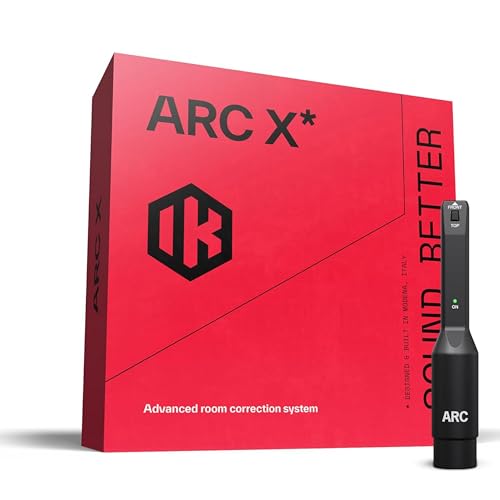
Engineers and producers seeking precise audio fidelity will find the IK Multimedia ARC X Room Correction System indispensable. With Volumetric Response Modelling (VRM), it measures room acoustics and applies intelligent, phase-coherent corrections, ensuring a flat monitoring environment. You can easily calibrate your monitors in real-time or through the ARC X plug-in, supporting both IK and third-party systems without latency. The virtual monitoring feature allows instant switching between over 20 iconic speakers, enhancing mix translation. Plus, customizable tuning options let you achieve your desired sound. Setup is quick with a high-quality mic and guided analysis, making it perfect for any studio.
Best For: Engineers and producers seeking to achieve precise audio fidelity in their studio environments.
Pros:
- Advanced Volumetric Response Modelling (VRM) ensures accurate room acoustic corrections for a balanced monitoring experience.
- Real-time monitor calibration with support for both IK and third-party systems eliminates latency issues.
- Virtual monitoring feature allows users to emulate over 20 iconic speakers, enhancing mix translation across various playback systems.
Cons:
- Initial setup may require time and understanding of acoustic principles for optimal results.
- The reliance on a high-quality measurement mic might necessitate an additional investment for some users.
- Customizable tuning options may be overwhelming for beginners unfamiliar with audio calibration techniques.
Factors to Consider When Choosing Calibration Microphones for Room Correction
When you’re selecting a calibration microphone for room correction, it’s crucial to take into account several key factors. Think about the type of microphone you need, its compatibility with your devices, and the accuracy required for your calibration. Also, pay attention to its frequency response range and cable length to guarantee it meets your setup requirements.
Microphone Type Selection
Selecting the right calibration microphone is essential for achieving accurate room correction. Consider using an omnidirectional microphone, as it captures sound from all directions, ensuring precise measurements of your room’s acoustics. Look for a microphone that includes a unique calibration file, which tailors the frequency response specifically to that mic, enhancing accuracy. A frequency response range of 20 Hz to 20 kHz is ideal for capturing the full spectrum of audible sounds relevant to room correction. Additionally, assess the microphone’s sensitivity and signal-to-noise ratio (SNR); a higher SNR, like 78 dB, indicates better performance in noisy environments, leading to clearer measurements. Taking these factors into account will help you select the best microphone for your calibration needs.
Compatibility With Devices
Verifying compatibility with your audio devices is vital when choosing a calibration microphone for room correction. Different microphones are designed for specific AV receivers or audio systems, so you need to confirm that your chosen microphone works with your setup. Additionally, many microphones require specific calibration software or apps, making it important to check for seamless integration. Pay attention to the connection type—whether USB, 3.5mm TRS, or XLR—to make sure it matches your device’s input options. Also, consider the microphone’s directional characteristics, as this can impact its effectiveness depending on your environment. Finally, look for any unique calibration files associated with the microphone to guarantee accurate measurements tailored to its specifications.
Calibration Accuracy Requirements
To achieve ideal room correction, you need to take into account calibration accuracy as a key factor in choosing your microphone. Precision in sound measurement guarantees your acoustic corrections meet professional standards. Look for microphones with unique calibration files tailored to your specific performance needs. A high signal-to-noise ratio (SNR) of around 78 dB or more is essential, as it reduces background noise, boosting clarity during calibration. Opt for omnidirectional microphones—they capture sound from all directions, giving you a thorough analysis of your room’s acoustics. Finally, make certain your chosen microphone is compatible with your room correction software or AV receiver, guaranteeing seamless integration for effective calibration results.
Frequency Response Range
When calibrating your audio system, the frequency response range of your microphone plays an essential role in capturing sound accurately across the audible spectrum. Most calibration microphones cover a range from 20 Hz to 20 kHz, which is critical for capturing low bass and high-frequency details. A wider frequency response allows for better measurements, ensuring your room acoustics correction is spot on. It’s important to choose a microphone with a flat frequency response, as this means it captures sound without altering the audio, providing precise data for your calibration software. Keep in mind that variations in frequency response can lead to inaccuracies, so always select a microphone that aligns with your system’s audio range for ideal performance.
Cable Length Considerations
While selecting a calibration microphone, cable length is an important factor that can influence your setup’s effectiveness. Longer cables, around 6 meters, provide you with the flexibility to position the microphone ideally at your listening location, accommodating various room configurations without relocating your audio receiver. On the other hand, shorter cables might limit your placement options, forcing you to keep the mic closer to the AVR and potentially affecting the accuracy of your room acoustics measurements. It’s vital to choose a cable length that suits your room’s dimensions, allowing the mic to effectively capture sound from the best listening area. A properly sized cable not only facilitates the calibration process but also minimizes interference from obstacles, enhancing your room correction efforts.
Included Accessories Quality
Quality accessories can greatly enhance your calibration microphone setup for room correction. When selecting a microphone, look for essential accessories like windshields and tripods. These tools improve measurement precision by minimizing unwanted noise and stabilizing the microphone’s position. A sturdy carrying case is also important, as it protects your microphone during transport and guarantees its longevity. High-quality USB cables are a must for stable connectivity, preventing signal loss during your measurements. Additionally, a user-friendly setup guide can make installation straightforward and optimize your calibration process. Finally, mini tripods help you position the microphone ideally at the listening spot, which is crucial for accurate sound measurements and effective room correction.