The best cassette recorders for musicians make it easy to capture quick ideas, rehearse away from a computer, or create the saturated character of analog tape. This roundup compares portable cassette machines with built-in microphones, auxiliary inputs, radio features, and digital conversion options.
Before choosing one, consider whether you need simple voice recording, direct instrument or mixer input, cassette-to-digital conversion, or a battery-powered recorder for portable songwriting.
Best 10 Cassette Recorders for Musicians Picks for 2026
Best Digital Conversion Pick
SEMIER Cassette-to-MP3 Recorder

- Converts tapes through SD card or USB
- Records to cassette, SD card, or computer
- Includes 16GB SD card and USB reader
Best For: Musicians digitizing tapes while making portable recordings
Best Connected Shoebox Model
QFX RETRO-39BT Cassette Recorder

- Records USB audio directly to cassette
- Captures multiple sources to USB
- Adds Bluetooth, FM, speaker, and line connections
Best For: Musicians working with varied audio sources
Best Simple Mic Recorder
PROSCAN Cassette Player and Recorder

- Provides one-touch cassette recording
- Includes built-in and external mic options
- Adds automatic level control and AUX input
Best For: Musicians making simple voice or idea recordings
Best Pocket Stereo Option
TOMASHI Portable Cassette Recorder

- Provides stereo playback through earphones
- Records voice directly to blank cassette
- Runs on AA batteries or Type-C power
Best For: Mobile listening and quick analog idea capture
Best All-Around Choice
Coby CVR42BK Cassette Recorder
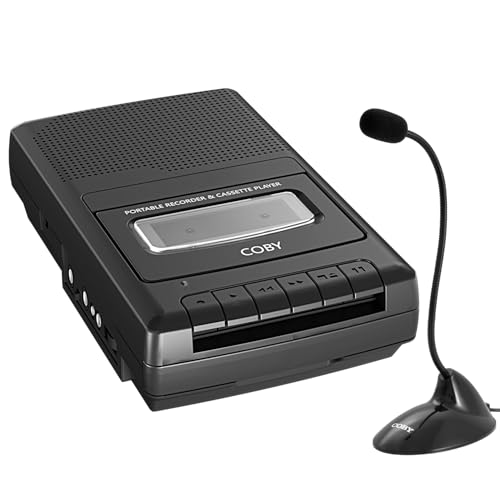
- Detachable tabletop microphone included
- Aux, headphone, and built-in speaker options
- AC or 4 C-battery power
Best For: Flexible home, classroom, and casual music recording
Best Radio-Recording Combo
Mersoco T201BUS Cassette Recorder
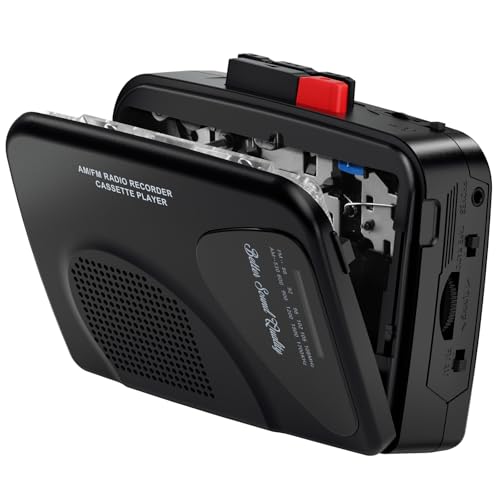
- Records external sounds or AM/FM broadcasts
- Compact design with AM/FM tuner
- 2 AA batteries or 5V DC power
Best For: Portable recording with radio listening
Best for Easy One-Touch Recording
JENSEN MCR-100 Cassette Recorder

- One-touch recording with automatic level control
- Built-in condenser mic and external mic jack
- Aux input for phones, tablets, and audio sources
Best For: Quick musical ideas and simple portable recording
Simple Voice Capture
Coby Cassette Player and Recorder

- Cassette playback and recording
- Built-in microphone for quick captures
- AC or four-C-battery operation
Best For: Simple voice notes, musical ideas, and cassette listening
Source-to-Cassette Recording
Deluxe Products Portable Cassette Recorder

- External and built-in microphones
- Aux input records compatible devices
- AC adapter, speaker, and handle included
Best For: Musicians recording voices, music, or device audio to cassette
Radio and Rehearsal Companion
G Keni AM/FM Cassette Recorder

- Records voice, music, and radio
- AM/FM tuner with telescopic antenna
- Speaker, headphone jack, and carry handle
Best For: Portable cassette recording with radio listening
Best Digital Conversion Pick – SEMIER Cassette-to-MP3 Recorder
For musicians and creators seeking cassette recorders for musicians with digital archiving features, the SEMIER combines cassette playback, recording, SD card support, and USB conversion in a compact design. It supports Type I tapes and includes a 16GB SD card, USB reader, and Audacity software.
Best For: Musicians who want a portable recorder that can preserve cassette material as MP3 files and capture new audio through its built-in microphone.
Pros:
- Converts cassette audio to MP3 through an SD card or USB connection.
- Records to cassette, SD card, or computer using the built-in microphone.
- Compact 6.3-inch design with LCD, USB-C power, AA battery support, speaker, and headphone jack.
Cons:
- Does not support Type IV or metal tapes.
- Built-in speaker output is limited to 2W.
The SEMIER is especially versatile when a musician needs both basic cassette recording and straightforward digital transfer. Its included storage and software make it a practical choice for organizing older recordings.
Best Connected Shoebox Model – QFX RETRO-39BT Cassette Recorder
The QFX RETRO-39BT stands out among cassette recorders for musicians who need several input and playback options. It can record USB audio to cassette, capture cassette, Bluetooth, FM radio, microphone, or line-in audio to USB, and operate from AC power or C batteries.
Best For: Musicians who want a larger portable unit for experimenting with USB, Bluetooth, line-in, microphone, and cassette sources.
Pros:
- Records digital audio from a USB drive directly onto cassette.
- Supports recording from cassette, Bluetooth, FM radio, microphone, or line-in to USB.
- Includes a built-in 3.5-inch speaker, external mic support, line-in/out, and a carrying handle.
Cons:
- At 1.7 pounds, it is less compact than pocket-style cassette recorders.
- Requires four C batteries for battery operation, which are not included.
With its unusually broad connectivity, the QFX is a flexible practice and demo tool. Choose it when source variety matters more than a minimalist, pocketable design.
Best Simple Mic Recorder – PROSCAN Cassette Player and Recorder
PROSCAN Cassette Player & Recorder with Microphone, Headphone Jack, Aux in, Black
Check Price On AmazonThe PROSCAN is a straightforward option among cassette recorders for musicians, with one-touch recording, a built-in free-standing microphone, and an external microphone jack. Its automatic level control is designed to help keep recordings clear, while AUX input and headphone output add basic flexibility.
Best For: Musicians who want an uncomplicated cassette recorder for voice notes, interviews, classes, or simple analog ideas.
Pros:
- Offers convenient one-touch recording.
- Includes a free-standing microphone and external microphone input.
- Provides automatic level control, AUX input, headphone jack, fast-forward, and rewind.
Cons:
- Uses an analog signal format and does not list USB or MP3 conversion.
- At about 1.8 pounds, it is not the lightest portable option.
The PROSCAN favors ease of use over digital features. It makes sense for musicians who want to capture spoken ideas or basic performances directly to cassette without navigating computer-based workflows.
Best Pocket Stereo Option – TOMASHI Portable Cassette Recorder
The TOMASHI is a pocket-sized choice for musicians comparing cassette recorders for musicians who value private listening and simple voice capture. Its stereo playback head provides left/right separation through earphones, while the built-in microphone records directly to blank cassette.
Best For: Musicians who want an ultra-portable cassette player and voice recorder for commuting, travel, or capturing quick ideas.
Pros:
- Offers stereo playback through the 3.5mm headphone connection.
- Records voice or ambient sound to cassette with its built-in microphone.
- Supports an external microphone and runs on two AA batteries or Type-C power.
Cons:
- Has no built-in speaker.
- Type-C cable and external microphone are not included.
- Included earbuds are intended for basic everyday use.
The TOMASHI is best viewed as a personal, portable recorder rather than a full production machine. Its stereo headphone playback and small size are useful for mobile listening and quick analog sketches.
Best All-Around Choice – Coby CVR42BK Cassette Recorder
For musicians seeking cassette recorders for musicians that are simple to operate, the Coby CVR42BK combines cassette playback and recording with a detachable tabletop microphone. Its built-in speaker, headphone jack, aux input, and dual AC/battery power make it flexible for home use or portable recording.
Best For: Musicians, students, teachers, and everyday users who want straightforward voice or cassette recording with flexible listening options.
Pros:
- Includes a detachable standing microphone for hands-free recording.
- Supports cassette playback and recording, with aux input for external devices.
- Offers built-in speaker, 3.5mm headphone jack, and AC or 4 C-battery operation.
- Large controls and a compact retro shoebox design are easy to use.
Cons:
- Uses 4 C batteries, which are larger than the AA batteries used by some portable models.
- Mono and stereo microphone operation is listed, but the supplied notes do not specify advanced music-recording controls.
The Coby is a practical pick when convenience matters more than specialized studio features. The included microphone and multiple power options make it especially adaptable for quick demos, voice notes, and casual analog recording.
Best Radio-Recording Combo – Mersoco T201BUS Cassette Recorder
The Mersoco T201BUS is a useful option for anyone comparing cassette recorders for musicians who also want AM/FM listening. It can record external sounds or AM/FM broadcasts to cassette, while its compact design, included earphones, and two power methods support portable use.
Best For: Musicians and listeners who want cassette recording alongside portable AM/FM radio and simple battery-powered operation.
Pros:
- Records external audio and AM/FM broadcasts to cassette.
- Includes AM/FM tuning with a built-in antenna.
- Runs on 2 AA batteries or a 5V DC supply via the included USB-to-DC cable.
- Package includes 3.5mm headphones and a user manual.
Cons:
- 5V operation requires an adapter, which is not included.
- Does not list an external microphone or aux input for connecting instruments or other audio sources.
- Its listed frequency response is 125–6.3 kHz, so it may be better suited to basic recording than detailed music capture.
The T201BUS stands out for combining a cassette recorder with an AM/FM radio in a lightweight package. Choose it when broadcast recording and portability are priorities, rather than dedicated musician-focused inputs.
Best for Easy One-Touch Recording – JENSEN MCR-100 Cassette Recorder
The JENSEN MCR-100 is a convenient choice among cassette recorders for musicians who want quick operation and flexible source connections. One-touch recording, automatic level control, a built-in condenser microphone, and an auxiliary input make it suitable for capturing ideas, notes, or connected audio.
Best For: Musicians and mobile users who value simple controls, consistent recording levels, and a portable shoebox-style design.
Pros:
- One-touch recording simplifies capturing music, lectures, or personal notes.
- Automatic level control helps maintain consistent recording volume.
- Built-in condenser microphone plus external microphone jack offers recording flexibility.
- Auxiliary input supports smartphones, tablets, and other audio sources.
Cons:
- The supplied notes describe a mono microphone operation, rather than stereo recording.
- Only a 90-day limited warranty is listed.
- The notes do not specify the power source or battery requirements.
The MCR-100 is appealing for musicians who want a low-fuss recorder for spontaneous ideas and connected audio. Its automatic level control and one-touch design reduce setup work, while the retractable handle helps with carrying.
Simple Voice Capture – Coby Cassette Player and Recorder
For musicians seeking cassette recorders for musicians with straightforward controls, the Coby CVR-22 combines cassette playback and recording in a compact unit. Its built-in microphone is useful for quick voice notes, rehearsal ideas, or interviews, while battery or AC operation supports both portable and desk use.
Best For: Musicians who want an uncomplicated recorder for capturing voice notes and replaying cassette tapes.
Pros:
- Plays cassettes and records audio in one device.
- Built-in microphone enables self-contained recording.
- Runs on AC power or four C batteries.
- Includes a headphone jack and auxiliary input for flexible listening.
Cons:
- Four C batteries are required for portable use.
- The built-in microphone is intended for general audio capture rather than specialized studio recording.
The Coby is a practical choice when ease of operation matters more than advanced recording controls. Clear labels, simple buttons, and multiple power options make it convenient for basic musical sketches and cassette listening.
Source-to-Cassette Recording – Deluxe Products Portable Cassette Recorder
The Deluxe Products DP-CASR-101 is a versatile option for musicians comparing cassette recorders for musicians. Along with its built-in condenser microphone, it includes an external microphone and aux-in cable, allowing recordings from a compatible smartphone, laptop, or tablet with a headphone output.
Best For: Musicians who want to record voices, music, or external device audio directly onto cassette.
Pros:
- Records through either the included external microphone or built-in microphone.
- Aux-in cable supports recording from compatible phones, laptops, and tablets.
- Includes an AC adapter and built-in carrying handle.
- Built-in speaker and 3.5mm headphone jack support convenient playback.
Cons:
- Four C batteries are not included.
- Source devices need a headphone-out jack for aux recording.
With more input flexibility than a basic voice recorder, this model suits musicians who want to transfer or create material from several sources. Its included accessories make it ready for experimenting with cassette-based recording without buying a separate microphone or cable.
Radio and Rehearsal Companion – G Keni AM/FM Cassette Recorder
The G Keni KT-3B adds AM/FM radio to the core playback and recording features expected from cassette recorders for musicians. Its built-in microphone can capture voice, music, or radio broadcasts, while AC or battery operation and an integrated handle make it suitable for use around the home or on the go.
Best For: Musicians who want cassette recording alongside radio listening and portable playback.
Pros:
- Records voice, music, or radio broadcasts onto cassette.
- Includes AM/FM tuning with a telescopic antenna.
- Offers AC operation or portable use with four C batteries.
- Provides a built-in stereo speaker and 3.5mm headphone jack.
Cons:
- Four C batteries are not included.
- Its built-in microphone and cassette format are better suited to casual recording than advanced production.
This G Keni model is a useful all-purpose option for musicians who enjoy broadcast audio as well as cassette recording. Choose it when a radio tuner, headphone listening, and portable design are more important than dedicated studio features.
How We Picked the Best Cassette Recorders for Musicians
We focused on the features that matter in actual songwriting and practice workflows: cassette playback and recording, microphone quality and placement, auxiliary input support, speaker and headphone options, power flexibility, portability, and ease of operation. Models with USB or SD conversion can also suit musicians who want to archive tapes or move rough ideas into a computer.
These products cover several categories rather than one identical use case. Some are basic voice recorders, while others are better suited to portable demos, cassette-based experimentation, or listening to finished tapes. Always confirm the current listing for included accessories, power requirements, and input compatibility.
Quick Comparison
| Best For | Features to Prioritize | Product Types in This Roundup |
|---|---|---|
| Song ideas and lyrics | Built-in microphone, one-touch recording, speaker | Compact portable recorders |
| Instrument or mixer demos | Auxiliary input, microphone input, recording control | Recorder/player combinations |
| Lo-fi cassette projects | Reliable tape recording, portable power, headphone output | Basic cassette decks and stereo players |
| Archiving old tapes | USB or SD conversion, computer connectivity | Digital-converter cassette players |
Key Buying Factors for Cassette Recorders for Musicians
Recording Inputs
A built-in microphone is convenient for vocals, rehearsals, field notes, and quick acoustic sketches. For cleaner demos or electronic instruments, choose a model with an auxiliary input. Check whether the input accepts the level produced by your mixer, keyboard, phone, or other source; a cassette recorder is not automatically a substitute for a dedicated audio interface.
Tape and Sound Features
Look for straightforward transport controls, dependable recording operation, and a headphone jack when monitoring privately matters. Built-in speakers are useful for checking ideas, but they are rarely accurate enough for final mixing. If stereo playback or recording is important, verify that the product specifically supports it rather than assuming it from the word “portable.”
Power and Portability
Battery operation helps with songwriting sessions, rehearsals, and recording in places without an outlet. AC or USB power is more practical for a fixed studio setup. Also consider handle design, size, and whether the controls are easy to use while holding the unit.
Digital Conversion
USB or SD recording can simplify tape archiving and let you transfer cassette material to a computer. These features are especially useful for musicians sampling old recordings, preserving demos, or combining cassette textures with modern production. Confirm the supported file format and whether conversion records the full tape or only selected sections.
Who Should Buy Which Cassette Recorders for Musicians?
Choose a simple portable cassette recorder with a built-in microphone if your priority is capturing melodies, lyrics, rehearsals, or spoken notes quickly. Pick a model with an auxiliary input if you plan to record from a mixer, keyboard, phone, or other external source. For deliberate lo-fi production, prioritize reliable cassette recording, headphone monitoring, and flexible power over radio extras. If your main goal is preserving existing tapes, choose a USB- or SD-capable converter instead of a basic voice recorder.