The best compact audio mixers give you hands-on control over microphones, instruments, playback, and monitoring without taking over your desk or gig bag.
We compared these 10 models across inputs, preamps, effects, recording features, connectivity, and ease of use to help you choose the right fit for your setup.
Best 10 Compact Audio Mixers Picks for 2026
Effects-Ready Compact Mixer

- 6 inputs with two microphone preamps
- Four stereo line channels and EQ
- Built-in digital effects
Best For: Small live setups and rehearsals
Clip-Free Recording Mixer

- Records 10 tracks plus stereo to SD
- 32-bit float USB audio interface
- Battery powered with MIDI and effects
Best For: Mobile multitrack recording and streaming
Ultra-Compact Broadcast Mixer

- Two Onyx microphone preamps
- Four line inputs plus two mic inputs
- 1/4-inch and RCA main outputs
Best For: Podcasts, broadcasts, and desktop mixing
USB Streaming Mixer

- 8-input analog mixer
- Stereo USB audio interface
- Mixes PC and gaming audio into streams
Best For: Streaming, podcasting, and home recording
Simple Signal Control

- Five channels in a lightweight 1.4-pound design
- Phantom power for condenser microphones
- RCA and 1/4-inch connectivity for playback and recording
Best For: Basic home recording and small playback systems
Rugged Analog Performance

- Six inputs with D-PRE preamps
- Three-band EQ, high-pass filters, and one-knob compressors
- Rugged metal chassis with XLR outputs
Best For: Small performances, lectures, and analog recording
Ultra-Compact Audio Routing
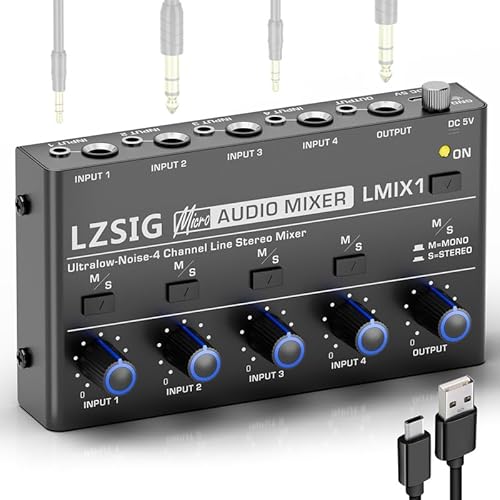
- Combines four inputs into one mono or stereo output
- Supports 3.5mm and 6.35mm TS/TRS connections
- Compact low-noise design for line-level sources
Best For: Sub-mixing instruments, computers, consoles, and other line sources
Versatile Value Pick
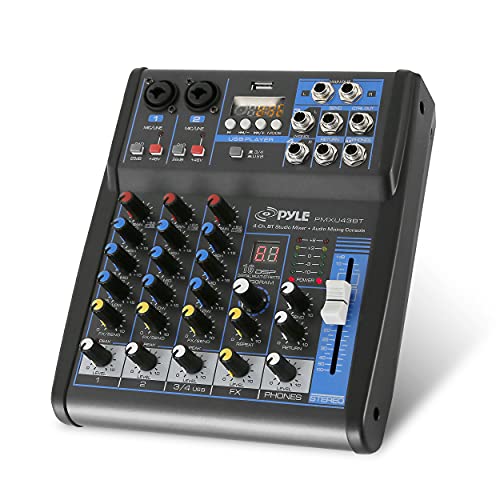
- Bluetooth, USB, flash, and MP3 playback
- 48V phantom power with 3-band EQ
- Rugged, compact steel chassis
Best For: Small performances, karaoke, and casual DJ setups
PC Recording Choice

- Plug-and-play USB-B computer recording
- Three XLR inputs plus 1/4-inch and RCA inputs
- Bluetooth, USB playback, effects, and monitoring
Best For: Podcasting, livestreaming, and small events
Effects-Focused Pick

- 99 DSP effects with reverb and delay
- PAD and 80Hz high-pass filter
- USB recording and Bluetooth 5.0 streaming
Best For: Podcasting, vocal streaming, and home studios
Effects-Ready Compact Mixer – Yamaha MG06X
The Yamaha MG06X is a straightforward choice among compact audio mixers for small setups that need two microphone preamps, dedicated stereo line inputs, EQ, and built-in digital effects. Its compact 6-input design and XLR output make it practical for basic live sound, rehearsals, and small recording setups.
Best For: Small live performances, rehearsals, and users who want onboard effects without a larger mixer.
Pros:
- Includes two microphone preamps with 48V phantom power.
- Offers four dedicated stereo line channels.
- Built-in digital effects add flexibility for vocals and instruments.
- Compact 5.9-by-7.9-by-2.4-inch design.
Cons:
- Limited to six channels.
- Uses corded electric power rather than battery operation.
The MG06X favors simple, hands-on analog mixing over extensive routing or recording features. It is a sensible fit when core inputs, EQ, and effects matter more than multitrack recording or advanced computer integration.
Clip-Free Recording Mixer – Zoom LiveTrak L6
The Zoom LiveTrak L6 stands out among compact audio mixers for musicians and podcasters who want mixing, recording, and computer connectivity in one battery-powered unit. It records 10 discrete tracks plus a stereo mix to SD cards and also works as a 32-bit float USB audio interface.
Best For: Musicians, podcasters, streamers, and mobile recording setups needing multitrack capture.
Pros:
- Records 10 tracks plus a stereo mix to SD cards up to 1TB.
- 32-bit float operation is designed for clip-free recording without traditional gain setting.
- Can record to an SD card and computer simultaneously.
- Includes EQ, AUX sends, effects, MIDI, USB, and four assignable sound pads.
Cons:
- More feature-rich than necessary for basic analog mixing.
- Its 1.4-pound design and battery power may not suit every fixed installation.
The L6 is the most recording-focused option in this group. Choose it when integrated multitrack capture, portable operation, and flexible digital connectivity are priorities rather than choosing a mixer solely for simple live sound.
Ultra-Compact Broadcast Mixer – Mackie 402VLZ4
The Mackie 402VLZ4 is a compact audio mixer built for simple podcast, broadcast, desktop, and small studio applications. It provides two Onyx microphone preamps with phantom power, four line inputs, and both 1/4-inch and RCA main outputs in a lightweight 2.5-pound format.
Best For: Podcasts, broadcasts, and small desktop setups that need dependable microphone preamps and basic line mixing.
Pros:
- Two Onyx microphone preamps offer high headroom and low noise.
- Includes phantom power for compatible microphones.
- Provides four line inputs alongside the two microphone inputs.
- Lightweight design uses an included external power adapter.
Cons:
- Only four channels are available.
- It does not include a built-in USB interface in the supplied specifications.
- External power adapter adds a separate component to the setup.
The 402VLZ4 keeps the control layout and connections focused on essential mixing. It is a practical pick for voice-centered work and compact desktop systems, but users seeking integrated USB recording may prefer a model designed around computer connectivity.
USB Streaming Mixer – Behringer XENYX 802S
Behringer XENYX 802S Premium Analog 8-Input Mixer with USB Streaming Interface
Check Price On AmazonThe Behringer XENYX 802S is a practical choice among compact audio mixers for streaming, podcasting, and recording setups that need analog mixing with USB connectivity. Its 8-input configuration supports computer or mobile-device connection, while the design allows PC and gaming audio to be mixed directly into the streaming output.
Best For: Streamers, podcasters, and home recording users who need USB audio alongside analog mixing.
Pros:
- Provides eight inputs for a broader range of sources than smaller four-channel mixers.
- Includes a stereo USB audio interface for computer or mobile connection.
- Supports direct mixing of PC and gaming sounds into the streaming output.
- Offers XLR, TRS, and RCA output connections.
Cons:
- Requires corded electric power.
- The supplied specifications do not list onboard effects or multitrack recording.
The XENYX 802S is aimed at accessible analog control with convenient USB streaming integration. It makes the most sense for content creators who need several sources and computer audio in one mixer, without requiring the recording features of a dedicated multitrack unit.
Simple Signal Control – Mackie Mix5
The Mackie Mix5 is a straightforward choice for compact audio mixers when you need a small setup for a microphone, stereo playback, or basic recording. Its five-channel layout combines low-noise performance with useful connections in a lightweight 1.4-pound chassis.
Best For: Home recording, small playback systems, and simple microphone setups.
Pros:
- Five-channel design with one mic/line input and two stereo 1/4-inch line inputs.
- Two-band EQ provides clean, precise tone shaping.
- Phantom power supports studio condenser microphones.
- Dedicated stereo RCA inputs and outputs suit playback or recording.
Cons:
- Provides only one mic/line input.
- Two-band EQ is less adjustable than a three-band design.
- Uses corded electric power rather than a battery-powered setup.
The Mix5 favors simplicity and portability over extensive channel control. It is a practical compact mixer for users who need dependable basic routing without a larger console.
Rugged Analog Performance – Yamaha MG06
The Yamaha MG06 is a compact audio mixer for users who want six analog inputs, studio-grade D-PRE preamps, and more hands-on tone control. Its three-band EQ, high-pass filters, and metal chassis make it suited to recording, lectures, and small performances.
Best For: Small performances, lectures, and analog recording setups that need XLR outputs.
Pros:
- Six-channel configuration with studio-grade discrete Class A D-PRE preamps.
- Three-band EQ and high-pass filters provide flexible control over the mix.
- One-knob compressors help shape guitars, bass, snare, and vocals.
- Rugged, impact-resistant powder-coated metal chassis.
Cons:
- No USB connectivity.
- Heavier and larger than some smaller compact mixers at 2 pounds.
- Requires corded electric power.
The MG06 is a strong fit when sound-shaping features and durable construction matter more than USB convenience. Its analog-only design keeps the workflow focused on direct mixer connections.
Ultra-Compact Audio Routing – LZSIG Mini 4-Channel Mixer
The LZSIG Mini Audio Mixer is a highly compact option among compact audio mixers, combining four inputs into one output for sources such as electronic drums, keyboards, guitars, computers, and gaming consoles. Its mono/stereo switching and support for both 1/8-inch and 1/4-inch cables make it useful for simple audio routing.
Best For: Sub-mixing multiple line-level sources in a compact home, gaming, or instrument setup.
Pros:
- Four-in-one line mixing supports multiple electronic and consumer audio sources.
- Ultra-low-noise design uses power management and low-noise op-amps.
- Switches between mono mixer and stereo line mixer modes.
- Accepts both 3.5mm and 6.35mm TS/TRS connections without adapters.
Cons:
- Power adapter is sold separately.
- Provides one mixed output rather than multiple output channels.
- Designed for line mixing rather than microphone preamp control.
With its small 3.14-by-5.39-by-1.77-inch footprint, the LZSIG is best viewed as a dedicated line sub-mixer. It offers flexible connection options for expanding a basic setup, provided you supply a compatible 5V power source.
Versatile Value Pick – Pyle PMXU43BT 4-Channel Mixer
The Pyle PMXU43BT is a practical choice among compact audio mixers for small live setups, karaoke, home studios, and basic DJ use. It combines four channels with Bluetooth streaming, USB/flash-drive playback, a built-in MP3 player, 48V phantom power, and 3-band EQ controls.
Best For: Small performances, karaoke, casual DJ setups, and users who want wireless playback in a compact mixer.
Pros:
- Bluetooth, USB, flash-reader, and MP3 playback options support flexible source mixing.
- Provides XLR and 1/4-inch inputs, 48V phantom power, and 3-band EQ on all channels.
- Rugged steel chassis with sealed rotary controls and a compact 2.9-pound design.
- Includes XLR output and a multi-voltage power supply for 100V–240V use.
Cons:
- Four channels may be limiting for larger bands or more complex installations.
- The supplied notes do not specify a built-in computer recording interface.
Choose this mixer when straightforward controls, wireless music playback, and broad input flexibility matter more than a larger channel count or advanced recording features.
PC Recording Choice – Aveek 5-Channel USB Mixer
The Aveek 5-channel mixer is one of the more connectivity-focused compact audio mixers in this group. It supports three XLR inputs, stereo 1/4-inch and RCA connections, plug-and-play USB-B computer recording, USB-drive playback and recording, Bluetooth streaming, and headphone monitoring.
Best For: Podcasters, livestreamers, small events, and users who need several input types plus basic computer recording.
Pros:
- Offers three XLR inputs alongside stereo 1/4-inch and RCA inputs.
- Built-in recording chip enables plug-and-play recording through USB-B.
- Includes Bluetooth streaming, USB-drive playback and recording, and a 3.5mm headphone jack.
- Provides 48V phantom power, 2-band EQ, gain controls, echo, and delay effects.
Cons:
- Bluetooth, USB, and 4/5-channel functions cannot be used simultaneously.
- Bluetooth output-device connections are not supported, and the mixer is intended for active equipment.
- The supplied notes specify a 15-foot Bluetooth operating range.
This is a useful fit for flexible home recording and streaming workflows, provided you can work within its source-function limitations and use compatible active output equipment.
Effects-Focused Pick – 4-Channel Podcast Audio Mixer
This four-channel podcast mixer stands out among compact audio mixers for its processing options and recording-oriented features. It includes 48V phantom power, a -26dB PAD, an 80Hz high-pass filter, 3-band EQ, 99 DSP effects, USB recording, and Bluetooth 5.0 streaming.
Best For: Podcasting, home-studio recording, vocal streaming, and users who want extensive onboard effects and input cleanup.
Pros:
- Offers 99 selectable DSP effects, including reverb and delay.
- PAD and 80Hz high-pass filter help manage strong signals and low-frequency rumble.
- Supports 48V condenser microphones, USB recording, OTG connections, and Bluetooth 5.0 streaming.
- Each channel includes 3-band EQ, with two XLR microphone inputs and stereo line inputs.
Cons:
- Four channels may not suit larger multi-microphone or band setups.
- Bluetooth streaming is specified for operation within 15 feet.
For creators who want more control over vocal processing and unwanted noise, this model offers a strong feature set in a particularly compact 6.29-inch-wide chassis.
How We Picked the Best Compact Audio Mixers
We evaluated these Compact Audio Mixers for the features that matter in real-world setups: usable input counts, microphone preamp quality, stereo and mono routing, output flexibility, monitoring controls, and overall portability. We also considered whether each model is best suited to live sound, home recording, podcasting, streaming, rehearsal, or simple source mixing.
Models with USB connectivity, built-in recording, Bluetooth, or onboard effects received extra consideration where those features add genuine convenience. We also looked at controls and layout, since a small mixer should remain easy to operate when your desk or stage space is limited.
Quick Comparison
- Best for flexible live mixing: Yamaha MG06X
- Best for multitrack recording: Zoom LiveTrak L6
- Best for compact analog control: Mackie 402VLZ4
- Best for USB streaming on a budget: Behringer XENYX 802S
- Best simple five-channel option: Mackie Mix5
- Best no-effects Yamaha alternative: Yamaha MG06
- Best for basic four-source mixing: LZSIG Mini Audio Mixer
- Best for Bluetooth and media playback: Pyle 4 Channel Mixer
- Best for entry-level PC recording: Aveek 5 Channel Mixer
- Best for built-in vocal effects: 4 Channel Podcast Audio Mixer
Key Buying Factors for Compact Audio Mixers
Inputs and Signal Types
Count the sources you need now, then leave room for one or two additions. XLR inputs support microphones, while quarter-inch line inputs handle keyboards, instruments, phones, and other external devices. Check whether channels are mono, stereo, or shared through combination jacks.
USB, Recording, and Streaming
A USB interface can send mixer audio to a computer for recording, video calls, or livestreaming. If you need independent tracks for later editing, choose a mixer designed for multitrack recording rather than a basic stereo USB output.
Effects and Phantom Power
Built-in reverb and other effects can simplify vocals and live performances, but they are not essential for every setup. Phantom power is important for condenser microphones; verify whether it is available globally or only on particular inputs.
Monitoring and Connectivity
Look for a dedicated headphone output, clear level meters, main and monitor outputs, and controls that let you hear sources without creating feedback. Bluetooth and media playback are convenient, but they should not replace the wired inputs you rely on for primary audio.
Size, Build, and Controls
Compact equipment saves space, but very small mixers may have shared controls or limited headroom. Prioritize solid knobs, a logical layout, and enough room to make adjustments without bumping adjacent channels.
Who Should Buy Which Compact Audio Mixers?
Choose the Yamaha MG06X if you want dependable analog mixing with onboard effects for vocals, rehearsals, or small performances. The Zoom LiveTrak L6 is the stronger choice for musicians and podcasters who need integrated recording and more production flexibility.
For a straightforward analog desk, consider the Mackie 402VLZ4 or Mackie Mix5. The Behringer XENYX 802S suits budget-conscious streamers who need USB connectivity and more inputs. Choose the Yamaha MG06 when you want similar compact construction without built-in effects.
The LZSIG, Pyle, Aveek, and 4 Channel Podcast models are best for simpler or feature-led setups. They can work well for casual streaming, media playback, home practice, and beginner recording, but confirm driver support, routing options, and input requirements before buying.