The best DMX controllers for bands make it easier to coordinate stage lights, fog effects, and programmed scenes without distracting the performers. The right console depends on your fixture count, venue size, setup style, and whether you need wireless control.
Below, we compare 10 options ranging from simple controllers for small gigs to higher-capacity units with MIDI, sound activation, wireless operation, and rack-friendly designs.
Best 10 Dmx Controllers for Bands Picks for 2026
Creative Stage Control

- 384 channels for up to 24 fixtures
- 30 banks of programmable scenes
- Compact design with LED gooseneck light
Best For: Bands programming detailed, repeatable stage-lighting scenes
Full-Featured Show Control

- 384 channels for 24 intelligent lights
- MIDI and built-in microphone modes
- Metal housing with LED gooseneck lamp
Best For: Live shows using manual, MIDI, and music-triggered lighting
Accessible Scene Programming

- Controls up to 12 fixtures
- Voice control and up to 240 scenes
- Adjustable timing for customized transitions
Best For: Smaller bands wanting straightforward scene control
Rack-Friendly Fog and Light Control
- 192 channels across 12 scanners
- Sound-activated lighting effects
- Controls compatible lights and fog systems
Best For: Moderate band rigs using lighting and fog effects
Best Wireless Starter

- Built-in wireless DMX transmitter
- Eight sliders with 24-channel access
- Compact 2.65-pound design
Best For: Small bands and portable wireless lighting setups
Best Wireless Scene Control

- 192 channels for 12 fixtures
- Wireless 2.4GHz transmitter
- Music-triggered scenes and chases
Best For: Bands needing programmable wireless live-show control
Best Complete Kit

- Controls 12 fixtures with 240 scenes
- Sound-activated, auto, and manual modes
- Includes cable, power cord, and two-year warranty
Best For: Bands building a versatile wired DMX lighting system
Wireless-Wired Stage Control

- 384 channels for up to 12 intelligent lights
- 2.4G wireless and 3-pin wired operation
- 240 scenes with sound and MIDI control
Best For: Bands needing flexible wireless control and programmable live-show lighting
Beginner-Friendly Show Programming
- Controls 12 devices across 192 channels
- Stores up to 240 scenarios and six chases
- Eight sliders and beginner-oriented controls
Best For: Small bands and events using compact DMX lighting setups
Compact Manual Dimmer Control
MAD OWL 12-Channel DMX Controller

- Six sub-control faders plus a master fader
- Portable aluminum design with one-key blackout
- Standard 3-pin DMX output for up to 12 channels
Best For: Small-stage bands using simple, compatible DMX dimming rigs
Creative Stage Control – 384-Channel DMX512 Controller
For bands seeking dmx controllers for bands with plenty of programming room, this 384-channel console supports up to 24 fixtures and offers 30 banks of programmable scenes. Its compact design and LED gooseneck light suit live-stage use.
Best For: Bands and performers building repeatable, multi-fixture stage-lighting shows.
Pros:
- 384 channels support up to 24 fixtures.
- 30 banks of 8 programmable scenes provide substantial programming capacity.
- Compact, lightweight design includes side handles and an LED gooseneck light.
- 110–240V power compatibility supports varied setups.
Cons:
- The supplied notes do not specify built-in MIDI, microphone, or music-triggered control.
- Its larger channel capacity may be more than needed for very small rigs.
This is a practical choice when your band’s lighting system may grow beyond a basic fixture setup. It emphasizes channel capacity and scene programming in a portable console.
Full-Featured Show Control – Rockville ROCKFORCE 384
The Rockville ROCKFORCE 384 is a strong option among dmx controllers for bands that want manual programming plus music-responsive operation. It combines 384 channels, MIDI control, a built-in microphone, and durable metal construction.
Best For: Bands, DJs, and clubs needing flexible scene, chase, MIDI, and music-mode control.
Pros:
- Controls up to 24 intelligent lights with 16 channels each.
- Stores 30 banks of 8 scenes and 6 programmable chases.
- Built-in microphone enables music-triggered lighting modes.
- Includes MIDI control, manual override, reversible channels, and power-failure memory.
Cons:
- The supplied notes describe a traditional slider-based interface rather than software control.
- Its extensive feature set may require more setup time than a simpler controller.
Choose this model if your live show benefits from both hands-on control and automated musical response. The included LED lamp and metal housing are useful additions for dark, active performance environments.
Accessible Scene Programming – 192-Channel DMX Console
This 192-channel console is an approachable pick among dmx controllers for bands that need control for a modest lighting rig. It handles up to 12 fixtures, supports voice control, and provides adjustable scene timing for customized transitions.
Best For: Smaller bands and amateur operators who want organized controls and flexible scene programming.
Pros:
- Controls up to 12 intelligent lights with up to 16 channels each.
- Supports up to 240 scenes and up to 40 steps per scene.
- Voice control can switch between lighting scenes.
- Three-pin DMX output supports compatible lights, fog machines, and other equipment.
Cons:
- Its 192-channel capacity is lower than the 384-channel models in this roundup.
- The supplied notes do not mention MIDI control or a built-in microphone.
This controller makes sense when ease of operation matters as much as programming flexibility. Its clearly organized control areas and adjustable pause and fade speeds give smaller live setups room to develop.
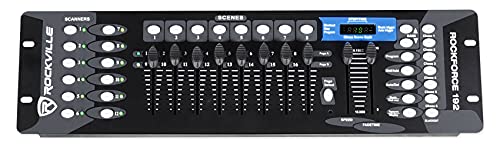
Rack-Friendly Fog and Light Control – Rockville ROCKFORCE 192
The Rockville ROCKFORCE 192 is a practical choice among dmx controllers for bands that need lighting and fog control in a rack-oriented setup. It provides 192 channels, sound-activated effects, and programmable scenes for repeatable performances.
Best For: Bands and event operators running up to 12 scanners with compatible DMX lighting and fog equipment.
Pros:
- Manages 192 channels across 12 scanners with 16 channels each.
- Offers 23 banks of 8 scenes and 6 chases.
- Built-in microphone enables sound-activated effects.
- Designed for compatibility with most DMX-512 lighting and fog systems.
Cons:
- It supports fewer channels and scanners than the 384-channel options.
- The supplied dimensions indicate a relatively substantial 3U rack-format unit.
- The notes do not specify MIDI control.
For a band with a moderate rig, this controller balances programmable scenes with music-triggered operation. Its compatibility with lighting and fog systems makes it especially useful for shows needing more than fixtures alone.
Best Wireless Starter – 24-Channel DMX Controller
For bands seeking compact dmx controllers for bands, this 24-channel console emphasizes portability and wireless setup. Its built-in transmitter, eight sliders, adjustable speed and fade controls, strobe, and blackout functions support straightforward live lighting control.
Best For: Small bands, DJs, parties, and compact stage setups that use compatible wireless DMX fixtures.
Pros:
- Built-in wireless DMX transmitter helps reduce cable clutter.
- Master and channel sliders provide direct manual control across 24 channels.
- Power-failure memory, strobe, blackout, speed, and fade controls add useful show-management features.
- Compact 2.65-pound design is easy to transport.
Cons:
- The 24-channel layout is less suitable for larger, fixture-heavy productions.
- Wireless operation requires compatible wireless DMX lights.
- Its compact handheld-style format may offer less programming depth than larger consoles.
This is a practical choice when portability and wireless convenience matter more than extensive scene capacity. Confirm that your fixtures use compatible wireless DMX or plan to connect through standard 3-pin DMX cables.
Best Wireless Scene Control – Rockville ROCKFORCE W2
The Rockville ROCKFORCE W2 is a stronger fit for bands that need more programming room in their dmx controllers for bands. It combines 192 channels, programmable scenes and chases, wireless 2.4GHz control, music triggering, and support for up to 12 fixtures with 16 channels each.
Best For: Mobile bands, DJs, and theater users who want wireless control, music-triggered effects, and extensive scene programming.
Pros:
- 192 channels support up to 12 fixtures with 16 channels each.
- Stores 23 banks of eight programmable scenes and six chases with 184 scenes.
- Built-in 2.4GHz transmitter enables wireless operation with compatible receivers or lights.
- Microphone-based sound activation, adjustable speed and fade sliders, and manual override support live use.
Cons:
- Wireless control is limited to compatible Rockville receivers or fixtures with built-in receivers.
- The larger 19-inch form factor is less compact than small handheld-style controllers.
- Its broader programming feature set may require more setup time for beginners.
Choose this model if your band’s show uses multiple fixtures and benefits from stored scenes, chases, and beat-synchronized operation. Its one-year warranty and 110–240V support also suit mobile use.
Best Complete Kit – 192-Channel DMX Console
This 192-channel console is a well-rounded option among dmx controllers for bands, offering control for up to 12 fixtures, 240 programmable scenes, sound activation, and manual, auto, and scene modes. Its included DMX cable, power cord, and two-year warranty make it convenient for a new or expanding lighting rig.
Best For: Bands, DJs, churches, clubs, and mobile setups that want broad fixture support and multiple operating modes.
Pros:
- Controls up to 12 fixtures with 16 channels each and stores up to 240 scenes.
- Built-in microphone supports sound-activated lighting synchronized to music.
- Works with moving heads, par lights, beam lights, strobes, and fog machines through 3-pin XLR output.
- Includes a DMX cable, power cord, manual, two-year manufacturer warranty, and lifetime technical support.
Cons:
- At 18.9 inches long and 3.74 pounds, it is designed more for console-style setups than handheld portability.
- Its many controls and programming sections may take time for complete beginners to learn.
- It requires corded power for operation.
This controller balances capacity, sound-reactive operation, and included accessories. It is especially appealing when you want a conventional 192-channel workflow with substantial scene storage and manufacturer support.
Wireless-Wired Stage Control – 384-Channel DMX Controller
For bands comparing DMX controllers for bands, this 384-channel console offers flexible wired or 2.4G wireless operation. Its microphone, MIDI support, programmable scenes, and blackout control make it suitable for building repeatable lighting looks for live performances.
Best For: Bands and DJs needing wireless flexibility, sound-reactive control, and saved lighting scenes for indoor stages, bars, weddings, or events.
Pros:
- 384 channels can control up to 12 intelligent lights.
- Supports both 2.4G wireless transmission and 3-pin XLR wired connections.
- Stores 240 static scenes across 30 banks and supports programmable show editing.
- Offers sound-activated, MIDI, automatic, and manual control modes.
Cons:
- Its feature set may be more than needed for very small lighting rigs.
- Requires a 9V battery according to the listed specifications.
This is the most versatile option of the three for bands that want room to expand and multiple ways to trigger lighting. The wireless mode is especially useful when a wired layout is inconvenient, while the scene memory helps streamline recurring gigs.
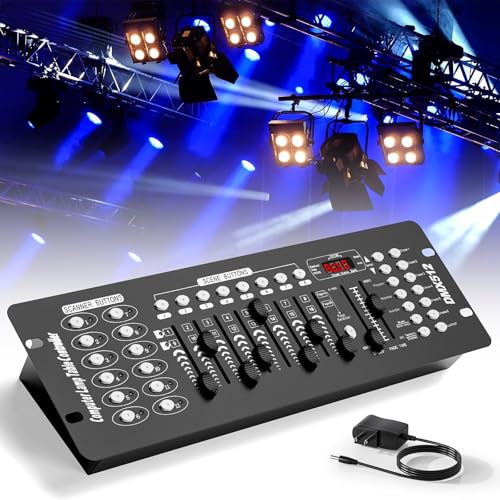
Beginner-Friendly Show Programming – 192-Channel DMX Console
This 192-channel console is a practical starting point for bands seeking DMX controllers for bands without an overly complex setup. It provides manual sliders, programmable scenes and chases, and a straightforward layout for controlling small stage-lighting systems.
Best For: Small bands, concerts, festivals, and rehearsal or party setups using up to 12 DMX devices with 16 channels each.
Pros:
- Controls up to 12 smart devices and offers 192 total channels.
- Supports up to 240 scenarios, six programmable chases, and 23 sets of scenes.
- Eight sliders provide direct manual channel control.
- Includes a 3-pin cable and is designed for beginner-friendly operation.
Cons:
- It has fewer channels than the 384-channel alternative.
- Operation is corded electric rather than wireless.
- The listed manufacturer warranty description is 90 days, despite separate after-sale service notes mentioning repair coverage.
For smaller rigs, this controller balances hands-on control with useful scene automation. It is a sensible choice when your band needs repeatable lighting cues but does not require a higher-capacity console.
Compact Manual Dimmer Control – MAD OWL 12-Channel DMX Controller
For bands with a simple dimming setup, this compact MAD OWL unit is one of the more focused DMX controllers for bands. It uses six sub-control faders plus a master fader to operate DMX512 fixtures with no more than 12 channels.
Best For: Small-stage bands and performers using compatible DMX dimming equipment with a maximum of 12 channels.
Pros:
- Simple six-fader-plus-master layout for direct manual control.
- Compact, lightweight aluminum design suited to travel and quick installation.
- Includes one-key blackout functionality.
- Uses a standard 3-pin XLR DMX output.
Cons:
- Cannot be used with lighting equipment requiring more than 12 channels.
- Its controls are focused on manual dimming rather than programmed scenes or chases.
- Requires a compatible DMX512-controlled dimming power supply for use as a permanent dimming system.
This is the straightforward choice for bands that value portability and immediate fader access over advanced programming. Confirm your fixtures stay within the 12-channel limit before choosing it.
How We Picked the Best Dmx Controllers for Bands
We focused on the features that matter during rehearsals, performances, and load-in: channel capacity, fixture and scene control, programming flexibility, physical layout, connectivity, and portability. The selection includes compact 12-channel units, common 192-channel consoles, and 384-channel controllers for more complex lighting rigs.
We also considered band-friendly functions such as MIDI support, sound activation, wireless DMX, fog-machine control, rack mounting, and straightforward manual operation. These features can reduce the need for a dedicated lighting operator, but they are only useful when they match your existing fixtures and workflow.
Quick Comparison
| Best For | Recommended Capacity | Useful Features |
|---|---|---|
| Small acoustic or bar gigs | 12–24 channels | Simple scenes, low setup complexity |
| Typical four- to six-fixture band rigs | 192 channels | Multiple banks, programmable scenes, rack options |
| Larger stages and varied fixtures | 384 channels | More fixture groups, advanced programming, MIDI |
| Fast setup or limited cable runs | 192–384 channels | Wireless DMX, sound activation, dual-mode operation |
Key Buying Factors for Dmx Controllers for Bands
Channel and Fixture Capacity
Choose a controller with enough channels for every fixture’s DMX footprint, not just the number of lights. Moving heads, RGB fixtures, and effects often use more channels than basic dimmers. Leave room for future additions so you do not need to replace the console after expanding your rig.
Programming and Live Operation
Look for dedicated controls, banks, scenes, chases, and fixture selectors that you can operate quickly in low light. A controller with more channels is not automatically better if programming is confusing or difficult to edit between songs.
Connectivity and Control Options
Confirm that the controller uses the DMX cabling and connectors your fixtures require. MIDI can help sync lighting changes with a keyboard, playback system, or foot controller. Wireless DMX is useful when cable runs are inconvenient, but wired DMX remains a dependable choice for critical shows.
Size, Mounting, and Transport
A compact console suits bands that share vehicles or set up without a lighting technician. Rack-mountable models can protect the controller and keep it integrated with other stage equipment. Check dimensions, power requirements, and control visibility before buying.
Who Should Buy Which Dmx Controllers for Bands?
Choose a 12- or 24-channel controller if your band uses a few simple fixtures and wants basic color, dimming, or scene changes. A 192-channel model is the practical middle ground for most local bands, event performers, and bar stages. Select a 384-channel controller if you run several fixture types, use more elaborate chases, or expect your lighting system to grow.
Wireless models make sense for temporary venues and rigs where DMX cables are difficult to route. MIDI-equipped controllers are a strong match for bands that already use sequencers, keyboards, or automated playback. For the simplest operation, prioritize clear physical controls and reliable scene recall over advanced features you will rarely use.