Choosing among HDMI matrix switches for home theaters can be difficult when specifications such as 4K refresh rates, HDR support, ARC, EDID, and audio extraction vary widely. The right model should match both your source devices and the displays, receivers, soundbars, or zones you plan to connect.
We selected 10 matrix switches spanning compact 4×2 units, flexible 4×4 models, large 8×8 installations, and newer HDMI 2.1 options. Use the guide below to compare capabilities and identify the best fit for your system.
Best 10 Hdmi Matrix Switches for Home Theaters Picks for 2026
Best Overall Flexibility
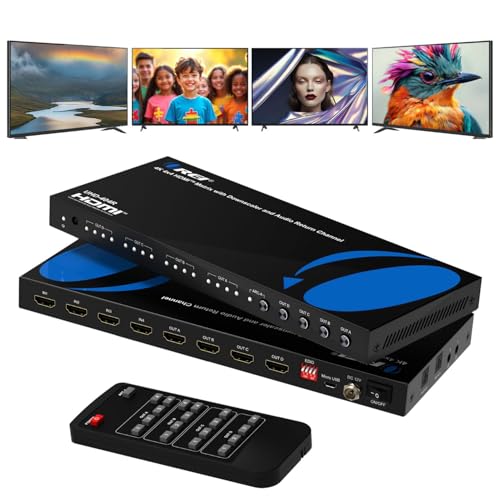
- 4K/60Hz with 18Gbps bandwidth
- Four inputs and four independently routed outputs
- Optical, 3.5mm, and ARC audio support
Best For: Multi-display home theaters with external audio
Best for Many Sources

- Six HDMI inputs and two independent outputs
- 4K/60Hz, HDR, Dolby Vision, and EDID
- Dual optical and 3.5mm audio outputs
Best For: Two-display theaters with numerous source devices
Best for Mixed-Resolution Displays
OREI 4x4 HDMI Matrix for 4K and 1080p

- Downscales 4K content to 1080p
- Four inputs and four outputs
- Supports HDR, HDCP 2.2, and 18Gbps
Best For: Theaters combining 4K and 1080p displays
Best for 8K Gaming

- 8K/60Hz and 4K/120Hz over 40Gbps
- VRR, HDR10, Dolby Vision, and HDCP 2.3
- RCA, optical, ARC, and EDID support
Best For: High-refresh PS5, Xbox, and 8K systems
Flexible 6-Source Hub

- Routes 6 sources to 2 displays
- 4K@60Hz with downscaling
- Optical and 3.5mm audio extraction
Best For: Multi-source home theaters with dual displays
Large-System Control Center
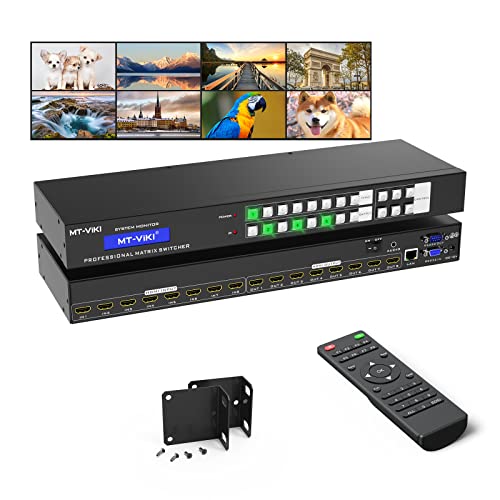
- Routes 8 sources to 8 displays
- Web, LAN, RS-232, app, and API control
- Custom EDID and rack-mount hardware
Best For: Large distributed AV installations
HDR Gaming Pick

- Connects 4 sources to 2 displays
- 4K@60Hz, HDR, and RGB 4:4:4
- Optical and dual 3.5mm audio outputs
Best For: Compact 4K HDR gaming and theater setups
Best for Custom Installations

- Routes four sources to four displays independently
- Supports 4K at 30Hz, 1080p, and 3D
- Web, LAN, RS-232, app, API, and rack-mount support
Best For: Complex multi-display home theater and commercial-style installations
Best for 4K60 and eARC Audio

- Supports 4K at 60Hz, HDR10, and HDCP 2.2
- Distributes eARC/ARC audio to up to four systems
- Includes optical, coaxial, and 3.5mm extraction
Best For: 4K gaming theaters and multi-room audio setups
Best Overall Flexibility – OREI 4×4 HDMI Matrix with ARC
For home theaters that need several sources and displays, this OREI is one of the more flexible HDMI matrix switches for home theaters. Its four inputs and four outputs support independent routing, while downscale-free operation, HDR, ARC, and audio extraction help it fit into a more advanced AV setup.
Best For: Home theater owners connecting up to four HDMI sources and four displays with external audio equipment.
Pros:
- Supports 4K at 60Hz with 18Gbps bandwidth, HDMI 2.0, and HDCP 2.2.
- Routes four sources independently to four displays.
- Includes optical and 3.5mm audio extraction plus ARC on Output A.
- Metal enclosure supports heat dissipation and the unit includes a remote.
Cons:
- Its 4K limit is 60Hz rather than HDMI 2.1 gaming rates.
- ARC audio extraction is specified for Output A.
The UHD-404R is a strong choice when routing flexibility and audio connectivity matter more than next-generation 8K or 4K/120Hz support. Its one-year warranty adds useful reassurance for a permanent installation.
Best for Many Sources – LUKFOCAB 6×2 HDMI Matrix
If your system has more source devices than displays, this LUKFOCAB provides six HDMI inputs and two outputs. Among HDMI matrix switches for home theaters, it is a practical fit for users who want to connect consoles, streaming devices, computers, and disc players without repeatedly swapping cables.
Best For: Home theaters with up to six source devices feeding two displays or projectors.
Pros:
- Six HDMI inputs can feed two displays with independent output selection.
- Supports 4K at 60Hz, 18Gbps, HDR, Dolby Vision, and EDID management.
- Provides two optical SPDIF and two 3.5mm audio outputs.
- Remote control operation and plug-and-play setup simplify switching.
Cons:
- Only two HDMI outputs are provided.
- The listed warranty is three months.
- Remote batteries are not included.
This model prioritizes input capacity and audio extraction rather than a large number of display outputs. It is especially useful when a two-screen theater setup has a crowded collection of HDMI sources.
Best for Mixed-Resolution Displays – OREI 4×4 HDMI Matrix for 4K and 1080p
This OREI 4×4 is a sensible option for home theaters combining newer 4K equipment with 1080p displays. Its downscale function can convert 4K content to 1080p, while four inputs and four outputs support identical or independent content across multiple screens.
Best For: Multi-screen systems using a mix of 4K and 1080p televisions, monitors, or projectors.
Pros:
- Downscales 4K content to 1080p for mixed-display compatibility.
- Connects up to four sources and distributes them to four displays.
- Supports 4K/60Hz, HDR, HDCP 2.2, and up to 18Gbps bandwidth.
- Handles up to 7.1-channel audio, including Dolby Digital and DTS-HD Master Audio.
Cons:
- It does not provide HDMI 2.1 features such as 4K at 120Hz.
- Audio extraction outputs are not highlighted in the supplied specifications.
The UHD-404 stands out when display compatibility is the main challenge. Its downscale capability can reduce conflicts between 4K sources and older 1080p screens, and the one-year warranty supports long-term use.
Best for 8K Gaming – FERRISA 8K 4×2 HDMI Matrix
For newer gaming and home theater gear, this FERRISA brings HDMI 2.1 performance to the category. It supports 8K at 60Hz and 4K at 120Hz, along with VRR, HDR10, Dolby Vision, ARC, and audio extraction, making it one of the more future-ready HDMI matrix switches for home theaters.
Best For: PS5, Xbox, and 8K-capable home theater setups using two displays.
Pros:
- Supports 8K/60Hz, 4K/120Hz, 40Gbps bandwidth, and VRR.
- Includes HDCP 2.3, HDR10, Dolby Vision, and CEC support.
- Offers RCA and optical audio extraction plus ARC and EDID management.
- One-button or remote switching and an integrated cooling system support convenient operation.
Cons:
- It has four inputs but only two outputs.
- The supplied details list television compatibility specifically rather than a broad device list.
- The product contains a button-cell battery that must be kept away from children.
This is the strongest match for high-refresh gaming and newer HDMI 2.1 equipment. Choose it over a 4K/60Hz matrix when 4K/120Hz, VRR, or 8K capability is a priority.
Flexible 6-Source Hub – 4K 6×2 HDMI Matrix
For home theaters with several source devices, this HDMI matrix switch for home theaters routes up to six HDMI inputs to two displays. It also adds useful optical and 3.5mm audio extraction, while supporting 4K at 60Hz and automatic 4K-to-1080p downscaling.
Best For: Home theater setups that need multiple sources, dual-display output, and flexible external audio connections.
Pros:
- Routes six HDMI sources to two displays or projectors.
- Supports 4K@60Hz, HDMI 2.0, HDCP 2.2, 3D, and 18Gbps transmission.
- Provides optical and 3.5mm audio extraction with support for LPCM, DTS 5.1, and Dolby formats.
- Can display 4K and 1080p outputs simultaneously, with automatic downscaling.
Cons:
- The remote requires AAA batteries, which are not included.
- Audio and video configuration may require adjusting the EDID settings for the connected equipment.
This is a strong all-around choice when your system combines several consoles, players, or streaming devices with two screens. Its metal housing and one-year warranty add practical durability, while the audio outputs make it easier to integrate an external sound system.
Large-System Control Center – MT-VIKI 8×8 HDMI Matrix
Designed for demanding installations, this HDMI matrix switch for home theaters independently routes eight HDMI sources to eight displays. Web, LAN, RS-232, app, API, IR, and front-panel controls make it suitable for large systems that may need integrated or remote management.
Best For: Large home theaters, conference spaces, and distributed AV systems requiring many independent outputs and advanced control options.
Pros:
- Routes any of eight inputs to any of eight outputs independently or simultaneously.
- Supports 4K@30Hz, 1080p, 3D, deep color, and simultaneous 4K and 1080p output.
- Offers Web GUI, LAN, RS-232, IR, Android app, API, and third-party control compatibility.
- Includes custom EDID writing, rack ears, and a two-year warranty.
Cons:
- Its 4K support is limited to 30Hz.
- 3.5mm audio extraction works only through OUT8 when the desired source is assigned to that output.
- Stable transmission is specified for up to 30 feet per input and output, using quality HDMI 1.4 cables.
This matrix is more installation-oriented than a typical living-room switcher. Choose it when independent routing and control integration matter more than 4K@60Hz performance, and plan the OUT8 audio-routing requirement before installation.
HDR Gaming Pick – ENBUER 4×2 HDMI Matrix
For smaller systems, this HDMI matrix switch for home theaters connects four HDMI sources to two displays while preserving support for 4K@60Hz, HDR, HDMI 2.0b, HDCP 2.2, and RGB 4:4:4. It also provides optical and 3.5mm audio outputs for a receiver, speakers, or headphones.
Best For: Compact home theaters and gaming setups with multiple 4K HDR sources and two displays.
Pros:
- Connects four 4K sources to two displays.
- Supports 4K@60Hz, 4K HDR, HDMI 2.0b, HDCP 2.2, 18.5Gbps, and RGB 4:4:4.
- Offers optical and 3.5mm audio extraction with LPCM, Dolby, and DTS 5.1 support.
- Includes EDID management for handling display compatibility.
Cons:
- EDID settings are configured for Output A and may require a restart after changes.
- It has fewer inputs and outputs than larger 6×2 or 8×8 matrix models.
This model fits a conventional two-screen entertainment setup particularly well. Its 4K HDR and 60Hz support make it appealing for console gaming, while the audio extraction options provide flexibility when the display or receiver does not handle the preferred audio connection.
Best for Custom Installations – MT-VIKI 4K 4×4 HDMI Matrix
For larger systems, this 4×4 model is one of the more flexible HDMI matrix switches for home theaters. It can route four HDMI sources to four displays independently or simultaneously, while offering web, LAN, RS-232, IR, app, API, and front-panel control.
Best For: Multi-display home theaters, conference rooms, churches, sports bars, and rack-mounted installations that need flexible routing.
Pros:
- Routes any of four sources to any of four displays independently or simultaneously.
- Supports up to 4K x 2K at 30Hz, 1080p, 3D, and deep color.
- Offers custom EDID writing and extensive control options, including web GUI, LAN, RS-232, app, and API control.
- Includes rack ears and fits a standard 1U 19-inch cabinet.
Cons:
- Audio extraction through the 3.5mm output is available only when the source is assigned to OUT4.
- Its 4K support is limited to 30Hz.
The MT-VIKI is best suited to a more complex, permanently installed system rather than a simple living-room switch. Its routing flexibility and integration options are strong, but buyers seeking 4K at 60Hz will need a different model.
Best Value 4×2 Setup – FERRISA 4×2 HDMI Matrix with Audio
This 4×2 unit is a practical choice among HDMI matrix switches for home theaters when you need to connect several sources to two displays. It also extracts audio through optical or 3.5mm outputs and includes IR remote control for convenient switching.
Best For: Home theaters with two TVs or projectors, multiple HDMI sources, and separate stereo or optical audio equipment.
Pros:
- Connects up to four HDMI sources to two HDMI displays.
- Provides optical and 3.5mm audio extraction, with audio from any HDMI input.
- Supports 4K, 1080p, 3D, deep color, LPCM, DTS 5.1, and Dolby Digital formats listed by the manufacturer.
- Includes IR remote control, front-button switching, EDID management, and signal equalization.
Cons:
- Both displays must use the same resolution at the same time.
- It does not support Dolby DD+, Dolby Vision, or the listed 7.1-channel formats.
- The package listing notes that an AAA battery is needed for the remote.
The FERRISA makes sense for a straightforward two-display setup where audio extraction matters. Its resolution-matching limitation is important, so confirm that both connected displays can operate at the same resolution before buying.
Best for 4K60 and eARC Audio – SUOFEIXIANG 4×2 HDMI Matrix
For newer systems, this SUOFEIXIANG model stands out among HDMI matrix switches for home theaters with 4K at 60Hz support and extensive audio options. It combines HDMI switching with eARC distribution, optical, coaxial, and 3.5mm extraction in a metal enclosure.
Best For: 4K home theaters, gaming setups, and multi-room audio systems using soundbars or AV receivers.
Pros:
- Supports 4K at 60Hz, HDR10, HDCP 2.2, 3D, and backward compatibility with 4K at 30Hz and 1080p.
- Provides eARC/ARC distribution to up to four soundbars or AV receivers.
- Offers optical, coaxial, and 3.5mm audio outputs plus HDMI support for Dolby TrueHD, DTS-HD, DTS, DSD, and Dolby Atmos.
- Uses adjustable EDID DIP switches, onboard buttons, and an IR remote for setup and switching.
Cons:
- Optical, coaxial, and 3.5mm outputs do not carry 7.1-channel surround content; HDMI eARC is required.
- The product description presents multiple operating functions, but its primary HDMI switching configuration is described as 4-in/1-out.
This is the strongest fit here for 4K60 gaming and advanced audio routing. Its eARC capabilities are particularly useful for multi-speaker systems, though buyers should verify the intended signal path and use HDMI eARC for higher-channel surround sound.
How We Picked the Best Hdmi Matrix Switches for Home Theaters
We focused on the features that matter most in real home theater installations: input and output count, supported resolution and refresh rate, HDR and HDCP compatibility, audio extraction, ARC or eARC-related functionality, EDID controls, remote management, and installation flexibility. The selection includes affordable 4K switches as well as higher-capacity and HDMI 2.1 models for more demanding setups.
Because product specifications and included accessories can vary by listing or revision, verify the current manufacturer details before buying. In particular, check whether the advertised audio format, refresh rate, downscaling, and control features apply to the exact model you are considering.
Quick Comparison
| Best For | Recommended Capability | What to Prioritize |
|---|---|---|
| Basic living-room system | 4K 4×2 | Simple switching, HDR, and reliable remote control |
| Multiple displays | 4×4 or 6×2 | Independent source-to-display routing and EDID settings |
| Large installation | 8×8 | High port count, custom EDID, and network or web control |
| Next-generation gaming | HDMI 2.1, 8K | Bandwidth, 4K at high refresh rates, VRR, and compatible cables |
| Separate sound system | Audio extraction | Optical, analog, ARC, or compatible surround formats |
Key Buying Factors for Hdmi Matrix Switches for Home Theaters
Inputs, Outputs, and Routing
A 4×2 switch accepts four sources and sends them to two displays, but confirm whether both outputs can show different sources simultaneously. A 4×4 or 8×8 model is better for multiple rooms, projectors, televisions, and receivers, though it requires more planning and cabling.
Resolution, Bandwidth, and HDR
For standard 4K systems, look for 4K at 60Hz, HDR, and HDCP 2.2 or later. HDMI 2.1 models are preferable for 8K, 4K at higher refresh rates, gaming features, and newer consoles. Every connected device—including cables and displays—must support the desired signal.
Audio and EDID Control
Audio extraction can send sound to an optical connection, analog output, AV receiver, or soundbar. Check supported formats rather than assuming that an extractor passes every Dolby or DTS signal. EDID controls help resolve blank screens, handshake failures, and mismatched audio by telling sources which display capabilities to use.
Downscaling and Control Options
Downscaling is useful when a 4K source must feed a 1080p display at the same time. IR remotes are convenient for everyday use, while web control and custom EDID profiles are more valuable in permanent or professionally managed installations.
Who Should Buy Which Hdmi Matrix Switches for Home Theaters?
Choose a compact 4×2 model if you have a few sources, one main television, and a projector or secondary display. It is usually the simplest and most economical arrangement. Move to a 6×2 switch when you need more source inputs without adding many displays.
A 4×4 unit suits households with several displays or zones that need flexible source routing. Select an 8×8 model for a whole-home or dedicated theater installation where centralized distribution, web management, and custom configuration justify the added cost.
Finally, choose an HDMI 2.1 or 8K model only when your sources and displays can use its extra bandwidth. If your priority is a soundbar or receiver connection, make audio extraction and format compatibility the deciding factors rather than resolution alone.