Choosing one of today’s large format 3D printers is no longer just about build size. Speed, chamber temperature, multicolor capability, and automation now matter just as much as raw volume.
This roundup focuses on machines that can handle ambitious prints with fewer compromises, whether you need production-ready parts, prototypes, cosplay props, or complex multi-material projects.
Best 10 Large Format 3d Printers Picks for 2026
Large-Format Speed Workhorse
Sovol SV08 MAX CoreXY 3D Printer
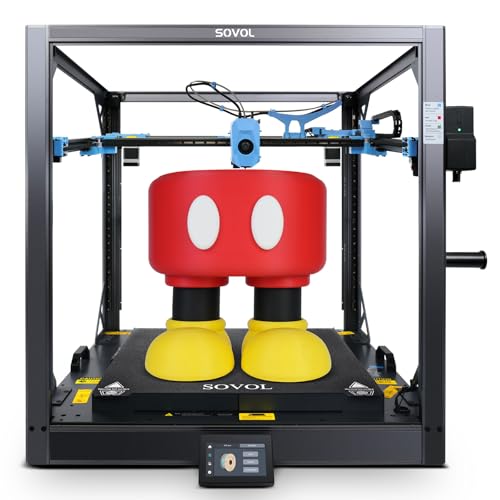
- 500 × 500 × 500 mm build volume
- Up to 700 mm/s printing speed
- Built-in camera and remote monitoring
Best For: Oversized prototypes and industrial parts
Fast Multi-Material Compact CoreXY

- 4-toolhead SnapSwap with 5-second changes
- Up to 5X less material waste
- 500 mm/s CoreXY with smart calibration
Best For: Multi-color and multi-material printing in a compact footprint
Enclosed Industrial Large-Format Pick

- 390 × 390 × 340 mm build volume
- 65°C active heated chamber
- Up to 800 mm/s with AI camera monitoring
Best For: Large engineering parts and high-temp materials
Quiet Multi-Color Large Build Choice

- 350 × 350 × 350 mm build volume
- CFS supports automatic multi-color switching
- 600 mm/s speed with AI monitoring
Best For: Quiet large prints with automatic color changes
Industrial Multi-Material Color System

- 4 toolheads and FlashSwap reduce purge waste
- 65°C heated chamber supports ABS, PC, and PA
- CoreXY motion reaches up to 600mm/s
Best For: Industrial teams needing fast multi-material printing with less waste
Extra-Large Print Farm Workhorse

- 400×400×400 mm build volume for oversized jobs
- CoreXY design reaches up to 700mm/s
- WLAN control helps manage multiple printers
Best For: Print farms and businesses needing large-volume, high-speed production
Compact Multi-Color Speed Printer

- Prints up to 4 colors with CoreXY speed
- 1-click auto leveling reduces setup hassle
- 300°C direct-drive extruder supports flexible use
Best For: Creators who want fast, easy multi-color printing in a compact size
Ultra-Large Industrial Pick
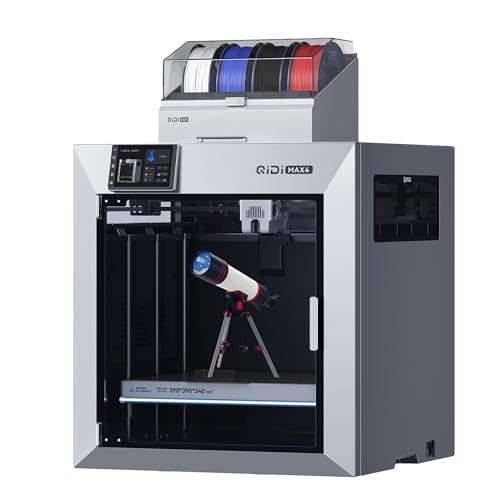
- 390×390×340mm build volume for oversized prints
- 65℃ heated chamber supports advanced materials
- AI camera and closed-loop motion improve control
Best For: Large prototypes, molds, and high-temperature functional parts
Compact Multicolor Starter

- Up to 16 colors with CFS expansion
- 95% pre-assembled for quick setup
- AI camera and smart leveling add convenience
Best For: Multicolor printing with fast setup and a compact footprint
Large-Format Flagship

- 350×350×350mm build volume for bigger jobs
- Up to 16 colors with all-new CFS
- 600mm/s speed plus dual AI cameras and 18 sensors
Best For: Large models, batch printing, and high-automation multicolor work
Large-Format Speed Workhorse – Sovol SV08 MAX CoreXY 3D Printer
If you want large format 3D printers that can handle oversized parts without dragging out print times, the Sovol SV08 Max is built for exactly that. Its 500 × 500 × 500 mm build volume, CoreXY motion system, and claimed 700 mm/s top speed make it a strong fit for users who need both scale and speed.
Best For: Makers and pros tackling full-scale prototypes, industrial parts, and oversized prints in one piece.
Pros:
- Massive 500 × 500 × 500 mm build area for big one-piece prints
- CoreXY design helps reduce vibration and improve high-speed precision
- Up to 700 mm/s printing with 40,000 mm/s² acceleration
- Built-in camera supports remote monitoring and timelapses
Cons:
- Heated chamber module is only an upgrade path and sold separately
- Optional nozzle sizes are sold separately
- Very large footprint may require significant workspace
For buyers focused on large format 3D printers, the SV08 Max stands out by pairing serious build volume with unusually fast motion. It is a practical choice when you need to make large prints in fewer pieces and want monitoring tools built in.
Fast Multi-Material Compact CoreXY – Snapmaker U1 3D Printer
The Snapmaker U1 is not a true large format 3D printer, but it is a strong pick if your buying decision is really about faster, cleaner multi-material output. Its four-toolhead SnapSwap system is designed to eliminate repeated purge cycles while keeping printing efficient and accurate.
Best For: Creators who want fast multi-color, multi-material printing with minimal waste in a compact format.
Pros:
- Four independent toolheads with 5-second tool changes
- Up to 5X less waste than traditional filament-swapping systems
- Supports multi-material combinations, including flexible and soluble support materials
- 500 mm/s CoreXY printing with smart calibration and remote control
Cons:
- 270 × 270 × 270 mm build volume is much smaller than true large-format machines
- Designed around multi-color efficiency rather than oversized prints
If your priority is production speed and material flexibility, the U1 is more about smart throughput than sheer size. It makes sense for detailed models, functional parts, and multi-color jobs where waste reduction matters.
Enclosed Industrial Large-Format Pick – QIDI Max4 3D Printer
For large format 3D printers aimed at industrial-style materials, the QIDI Max4 combines a 390 × 390 × 340 mm build area with an actively heated chamber. That makes it a compelling option if you need big parts, stable temperatures, and support for abrasive or high-temperature filaments.
Best For: Users printing large engineering parts, molds, and prototypes with demanding materials.
Pros:
- 390 × 390 × 340 mm build volume for large one-piece prints
- 65°C active heated chamber helps with high-temperature materials
- Up to 800 mm/s speed and 30,000 mm/s² acceleration
- AI camera can detect failures and pause the print automatically
Cons:
- Polar Cooler is not included and must be purchased separately
- 16-color printing requires the separate QIDI BOX accessory
- Focuses more on enclosed performance than open-access simplicity
The Max4 is a strong fit when material capability matters as much as build size. If you want a large machine for ABS-CF, PC, PPS-CF, or carbon-fiber nylon, this model is built with that workflow in mind.
Quiet Multi-Color Large Build Choice – Creality K2 Plus Combo 2026
If you want large format 3D printers with built-in multicolor capability, the Creality K2 Plus Combo combines a 350 × 350 × 350 mm build area with a CFS filament system. It is designed for users who want speed, automation, and color switching without sacrificing print size.
Best For: Makers and small teams that want large, quiet prints with automatic multi-color management.
Pros:
- 350 × 350 × 350 mm build volume for big models or multiple parts
- CFS system supports automatic filament switching and up to 16-color blending
- 600 mm/s print speed with 30,000 mm/s² acceleration
- Dual AI cameras and 18 sensors help monitor for failures
Cons:
- Filaments are not included in the combo
- Multi-color workflow depends on the included CFS unit
- Large-format size is useful, but not as expansive as the biggest machines here
The K2 Plus Combo is a practical choice if you want a roomy printer that also simplifies multi-color production. Its quiet operation and monitoring features make it appealing for home workshops and small professional setups.
Industrial Multi-Material Color System – FLASHFORGE Creator 5 Pro
If you want large format 3d printers built for advanced materials and efficient multi-color production, the FLASHFORGE Creator 5 Pro is aimed at serious workshop use. Its 4 independent toolheads and 7-second FlashSwap changer reduce purge waste, while the enclosed 65°C heated chamber helps with more demanding filaments.
Best For: Industrial users who want faster multi-material printing, lower waste, and better control over advanced filaments.
Pros:
- 4 independent toolheads with near-zero purge waste for cleaner multi-color work
- 65°C active heated chamber supports ABS, PC, and PA
- CoreXY motion, linear rails, and 1.5GT belts are built for up to 600mm/s printing
- HEPA 13 and activated carbon filtration helps manage fumes and particles
Cons:
- More focused on industrial multi-material printing than on simple entry-level use
- Enclosed, advanced-feature design may be more than casual hobbyists need
This is a strong fit if your priority is productivity with complex materials rather than just maximum build area. The Creator 5 Pro stands out for waste reduction, speed, and chamber control in a production-minded package.
Extra-Large Print Farm Workhorse – Creality Ender 5 Max
Among large format 3d printers, the Creality Ender 5 Max is designed around sheer capacity and throughput. Its 400×400×400 mm build volume is meant for oversized prototypes or batch jobs, while the CoreXY system and 700mm/s speed target fast production workflows.
Best For: Print farms, studios, and businesses that need a big build area and organized multi-printer control.
Pros:
- Extra-large 400×400×400 mm build volume for bigger models or multiple parts
- CoreXY system with up to 700mm/s printing for higher throughput
- 64-point auto leveling and auto Z-offset simplify setup
- WLAN multi-printer control and grouped management suit print-farm use
Cons:
- Its size and production focus make it less compact than smaller desktop printers
- Built for scaled output, so it may be more machine than a casual hobbyist needs
If your workflow is centered on bigger prints, batch production, or managing several machines at once, the Ender 5 Max makes a compelling case. It pairs a very large build volume with fast motion, automated leveling, and print-farm-friendly controls.
Compact Multi-Color Speed Printer – FLASHFORGE AD5X
The FLASHFORGE AD5X is not a true large format 3d printer, but it does offer fast, efficient output in a compact 220×220×220 mm build space. It combines 4-color printing, 1-click auto leveling, and a CoreXY frame that reaches up to 600mm/s, making it a practical choice for detailed everyday production.
Best For: Users who want fast multi-color printing and easy setup in a compact footprint.
Pros:
- Supports up to 4 colors simultaneously for more vivid prints
- 1-click auto leveling simplifies calibration
- CoreXY motion and 20,000mm/s² acceleration support up to 600mm/s printing
- 300°C direct-drive extruder and multiple nozzle sizes add flexibility
Cons:
- 220×220×220 mm build volume is compact compared with true large format printers
- Best suited to precision and speed rather than oversized models
The AD5X is a strong fit when you value speed, color, and convenience more than build size. It delivers a feature set that works well for rapid prototyping and batch printing in a smaller footprint.
Ultra-Large Industrial Pick – QIDI Max4 Combo 3D Printer
If you want a large format 3d printer built for oversized parts, the QIDI Max4 Combo stands out with its 390×390×340mm build volume and a heated chamber for demanding materials. It is aimed at users who need fewer splits, stronger first layers, and more control over big functional prints.
Best For: Makers and professionals printing large prototypes, molds, and high-temperature parts.
Pros:
- Very large 390×390×340mm build area for printing big parts in one piece.
- 65℃ active heated chamber plus high-flow hotend supports materials like ABS-CF, PC, and PPS-CF.
- Closed-loop motors, 30,000mm/s² acceleration, and a 2mm lead screw help support precise movement.
- Built-in AI camera can detect print failures and pause automatically.
Cons:
- Polar Cooler is not included and must be purchased separately.
- QIDI BOX is required for the advertised 16-color and multi-material expansion.
- Its advanced feature set may be more than casual users need.
Overall, this is a strong pick if build volume and material capability matter more than simplicity. It is especially appealing for large-format workflows where chamber heat, stability, and failure detection can save time and waste.
Compact Multicolor Starter – Creality K2 Combo
The Creality K2 Combo is a practical large format 3d printers option if you want multicolor printing in a more compact 260×260×260mm footprint. It focuses on quick setup, automatic leveling, and speed, making it easier to get from unboxing to finished prints without much fuss.
Best For: Users who want multicolor printing, fast setup, and a smaller build volume for everyday projects.
Pros:
- Supports up to 16 colors with CFS expansion.
- 95% pre-assembled for a plug-and-play start.
- Smart auto leveling targets only the relevant print area for faster setup.
- AI camera monitors for spaghetti failure and idle issues.
Cons:
- 260×260×260mm build volume is smaller than true large-format machines.
- K2 Combo includes only one CFS unit, so full 16-color use needs additional units.
- Best fit is convenience and multicolor work, not maximum print size.
In practice, this model is better viewed as an efficient multicolor printer than a giant production machine. It makes sense if you value speed, automation, and a straightforward out-of-box experience more than sheer build volume.
Large-Format Flagship – Creality K2 Plus Combo
The Creality K2 Plus Combo is the most spacious of these large format 3d printers, offering a 350×350×350mm build volume for bigger models or batch jobs. It pairs that size with 600mm/s printing, dual AI cameras, and a heated chamber, so it is aimed at users who want size and automation together.
Best For: Makers who want a large build area, multicolor capability, and strong automation for engineering-grade prints.
Pros:
- Large 350×350×350mm build volume handles big models and batch printing.
- Up to 16 colors with the all-new CFS system and RFID filament support.
- 600mm/s speed with 30,000mm/s² acceleration is fast for a large-format machine.
- Dual AI cameras, 18 sensors, and auto-adjusting Z-axis add useful automation.
Cons:
- Full 16-color printing requires four CFS units.
- The feature set is complex and likely overkill for basic hobby printing.
- High-end filament support depends on the 60°C chamber and 350°C nozzle setup.
This is the most capable all-around option here if you need a true large-format platform with serious speed and monitoring. It is a strong fit for ambitious users who want bigger prints without giving up automation or material flexibility.
How We Picked These Large Format 3d Printers
We prioritized build volume, print speed, chamber control, automation, and real-world usability. The best Large Format 3d Printers balance space with consistency, since a bigger build area is only useful if the printer can keep large parts stable from first layer to final layer.
We also favored models with features that reduce failed jobs and setup friction, such as auto leveling, enclosed or heated chambers, AI-assisted monitoring, and toolchanging or multicolor systems where relevant.
Quick Comparison: What Matters Most
Not every buyer needs the same kind of large-format machine. Some users want the biggest possible build area for single-material parts, while others want multicolor output, faster turnaround, or better performance with engineering filaments. Compare printers by the feature that will actually affect your workflow, not just the headline dimensions.
Key Buying Factors for Large Format 3d Printers
Build Volume Vs. Footprint
A larger build area can save you from splitting models, but it also means a bigger machine that needs more desk, floor, and maintenance space. Measure the printer footprint and your clearance for moving parts, filament paths, and enclosure access before buying.
Speed and Acceleration
Fast print speeds are appealing, but they are only meaningful if the printer can maintain quality on large travel moves and tall parts. For Large Format 3d Printers, motion system rigidity and calibration tools often matter more than the top advertised speed.
Chamber Temperature and Material Support
If you plan to print ABS, ASA, nylon, or other demanding materials, an enclosed or heated chamber can make a major difference. Open-frame machines are fine for PLA and PETG, but chamber control improves warp resistance on bigger parts.
Multicolor and Multi-Material Workflow
Toolchangers and filament systems expand what you can make, but they also add complexity. Choose multicolor only if you will use it often enough to justify extra setup, purge waste, and learning curve.
Automation and Ease of Use
Auto leveling, filament sensors, AI cameras, and preassembled frames are especially helpful on larger printers because long jobs magnify small mistakes. The less manual tuning you need, the more reliable your results will be over time.
Who Should Buy Which Large Format 3d Printers?
If you want the biggest practical build volume for functional parts and prototypes, look for a spacious enclosed model with strong thermal control. If your priority is speed and general-purpose printing, a rigid CoreXY design with good automation may be the better fit. If you create presentation models, props, or product mockups, multicolor systems are worth considering. For schools, studios, and small businesses, the best choice is usually the printer that combines manageable setup with the least downtime, not simply the largest bed.
In short, the right large format 3D printer depends on whether you value size, speed, materials, or multicolor flexibility most. Match the machine to your actual projects, and you will get far better results than choosing by volume alone.