A microphone isolation shield can reduce the room reflections your mic picks up, making vocals and spoken-word recordings easier to work with. The right choice depends on your microphone, mounting setup, and how much space you have.
These 10 options range from compact folding panels to larger, more enclosing designs. Use the buying guide below to narrow down which style fits your setup.
Best 10 Microphone Isolation Shields Picks for 2026
Lightweight Pick
ktondic PF8 Shield with Pop Filter

- 200 g portable design
- Dual-layer pop filter included
- Fits 40–60 mm microphones
Best For: Portable podcasting and streaming setups
Flexible Three-Panel Pick

- Adjustable three-panel design
- Tabletop or stand mounting
- 3/8-inch and 5/8-inch compatibility
Best For: Switching between desktop and stand-mounted recording
Configurable Coverage Pick

- Three- or five-panel setup
- Foldable top adds coverage
- Desktop or stand placement
Best For: Adjustable vocal and podcast recording setups
Wide Desktop Pick

- 23.2-inch-wide shield
- Desktop stand included
- 3/8-inch mount and 5/8-inch adapter
Best For: Desktop vocal and instrument recording
Stand-Included Pick

- Adjustable stand included
- Two thread adapters supplied
- Absorbent interior and steel frame
Best For: A shield-and-stand recording setup
Adjustable Five-Panel Pick
Moukey MPFBK5 Isolation Shield
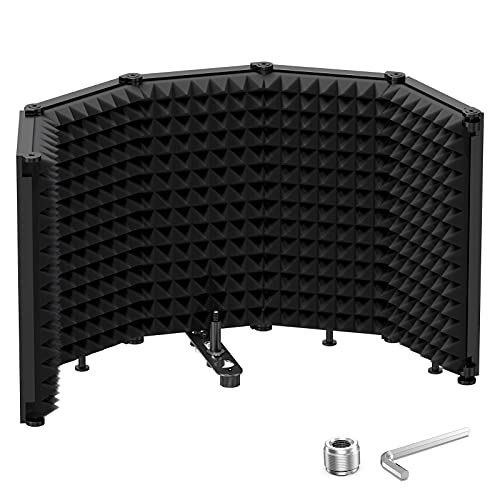
- Five adjustable folding panels
- Tabletop or stand placement
- Includes thread adapter nuts
Best For: Adjustable desk or stand recording
Compact Steel Pick

- Foldable, adjustable panels
- Tabletop or compatible-stand use
- Stand sold separately
Best For: Portable tabletop recording or an existing compatible stand
Best Foldable Booth
TroyStudio Portable Vocal Booth

- Foldable foam-lined enclosure
- 8 x 10 x 12-inch interior
- Tabletop or compatible stand use
Best For: Portable voice-over and podcast setups
Best Stand Bundle

- Adjustable tripod stand included
- Comes with a pop filter
- Foldable shield with metal back
Best For: Standing recording setups needing accessories
Best Adjustable Panels

- Angle-adjustable three-panel design
- Foldable top adds coverage
- Desktop or mic-stand placement
Best For: Flexible desk and stand recording setups
Lightweight Pick – ktondic PF8 Shield with Pop Filter
Among microphone isolation shields, the ktondic PF8 is a compact option for recording with a 40–60 mm microphone. Its acoustic foam helps absorb reflections, while the included dual-layer pop filter addresses sibilance and plosives.
Best For: Podcasters and streamers who want a portable shield and pop filter in one setup.
Pros:
- Weighs 200 g for easy transport.
- Includes a dual-layer pop filter.
- Can mount on desktop stands, boom arms, floor stands, or shock mounts.
Cons:
- Fits only microphones 40–60 mm in diameter.
- Microphone and holder are not included.
The PF8 makes sense if your microphone fits and portability matters more than a large reflection-filter setup. Check your mic diameter and mounting hardware before ordering.
Flexible Three-Panel Pick – Moukey Foldable Shield
The Moukey is one of the microphone isolation shields suited to both tabletop and stand-mounted recording. Its three folding panels let you adjust the curve around your microphone, and its foam-lined construction is designed to reduce reflected sound.
Best For: Home recordists who switch between desktop and microphone-stand setups.
Pros:
- Three panels fold for storage and angle adjustment.
- Works on a tabletop or mounted to a mic stand.
- Includes 3/8-inch and 5/8-inch mounting compatibility.
- Non-slip support points help it stay in place on a flat surface.
Cons:
- At 0.96 kg, it is less lightweight than compact wraparound shields.
- No pop filter is specified in the supplied package details.
Choose the Moukey if an adjustable three-panel shape and mounting options matter most. Its stated features target reflections and ambient interference, not complete room soundproofing.
Configurable Coverage Pick – XTUGA MIS02 Five-Panel Shield
The XTUGA MIS02 stands out among microphone isolation shields for its configurable enclosure: you can use a three- or five-panel arrangement, adjust the folding side panels, and add the foldable top for more coverage around the microphone.
Best For: Vocal or podcast recording setups that need adjustable side and top coverage.
Pros:
- Supports three-panel or five-panel configurations.
- Foldable top and side panels offer additional coverage options.
- Can be placed on a desktop or used with a microphone stand.
Cons:
- At 3.97 lb, it is relatively heavy for a portable shield.
- The supplied notes do not specify included stand hardware or thread sizes.
The MIS02 is a practical fit when you want to reshape the shield around your recording position. Its foam and panels can help manage sound reaching the microphone, but they should not be mistaken for room soundproofing.
Wide Desktop Pick – Aokeo AO-505 Shield
For shoppers comparing larger microphone isolation shields, the Aokeo AO-505 offers a 23.2-inch-wide foam-fronted design with a ventilated metal back. It includes a desktop stand and has room to accommodate recording vocals or instruments such as guitar and violin.
Best For: Desktop vocal and instrument recording where a wider shield is useful.
Pros:
- Wide 23.2 x 11-inch shield provides coverage for vocal or instrument recording.
- Desktop stand is included.
- Provides a 3/8-inch threaded mount and a 5/8-inch adapter.
- Metal alloy and sound-absorbing foam construction.
Cons:
- Its 23.2-inch width takes up more workspace than compact models.
- No pop filter is listed among the included parts.
The AO-505 is worth considering if you have desk space and want a broad reflection filter with a stand included. Confirm that its size fits your recording area before buying.
Stand-Included Pick – Aokeo AO-504 Isolation Shield
Among microphone isolation shields, the Aokeo AO-504 is a practical choice if you need a stand in the box. Its absorbent interior and vented metal back are designed to reduce reflections around the microphone, while the included adjustable stand offers flexible placement.
Best For: Recordists who want a shield and floor stand together.
Pros:
- Includes an adjustable stand and two metal thread adapters.
- Absorbent interior helps reduce reflected sound during recording.
- Steel construction offers a sturdy mounting setup.
Cons:
- Microphone is not included.
- The stand takes more room than a tabletop-only setup.
Choose this package when stand height and included mounting hardware matter more than keeping the setup compact.
Adjustable Five-Panel Pick – Moukey MPFBK5 Isolation Shield
The Moukey MPFBK5 stands out among microphone isolation shields for its five folding panels. You can adjust their arc around the microphone, then use the shield on a tabletop or mount it to a microphone stand.
Best For: Podcasters and vocalists who want adjustable coverage and flexible placement.
Pros:
- Five foldable panels allow angle adjustments and easier storage.
- High-density acoustic foam helps reduce sound reflections.
- Works on a tabletop or microphone stand; 3/8-to-5/8-inch adapter nuts are included.
- Non-slip support points help stabilize tabletop use.
Cons:
- Its five-panel layout needs tabletop space when unfolded.
- A microphone stand is not listed among the included items.
This is a versatile option if you expect to switch between desk recording and stand-mounted sessions.
Compact Steel Pick – Aokeo AO-403 Isolation Shield
If you want a foldable option among microphone isolation shields, the Aokeo AO-403 offers a steel panel with an absorbent interior. It measures 11.6 inches tall and 18.5 inches wide when fully extended, and it can sit on a tabletop or attach to a compatible stand.
Best For: Recordists who already have a compatible stand or prefer tabletop placement.
Pros:
- Folding panels allow angle adjustments and easier transport.
- Absorbent interior helps reduce sound reflections.
- Steel construction and screws provide a sturdy build.
Cons:
- No stand or microphone is included.
- Fit with non-Aokeo stands is not guaranteed.
Its portability is useful, but check your stand compatibility before choosing it for a mounted setup.
Best Foldable Booth – TroyStudio Portable Vocal Booth
Among microphone isolation shields, this TroyStudio model offers a foldable, foam-lined enclosure rather than a curved panel. Its 8 x 10 x 12-inch interior gives you room to position a microphone or small recorder for voice work.
Best For: Voice-over artists and podcasters who want an enclosed setup they can fold away between sessions.
Pros:
- Five panels of 2-inch dense acoustic foam cover the interior.
- Folds to 12 x 12 x 6 inches and weighs about 2 pounds.
- Works on a tabletop or with a compatible mic stand; openings accommodate cables and stands.
Cons:
- Stand mounting is limited to stands under 0.86 inches in diameter.
- Its enclosure takes up more desk space than a small shield panel.
Choose this if portability and coverage around the microphone matter more than a minimal desk footprint. Check the instructions before assembly, since the manufacturer cautions that incorrect setup can affect stability.
Best Stand Bundle – Aokeo Isolation Shield Kit
If you are comparing microphone isolation shields and need mounting accessories too, this Aokeo kit includes a foldable shield, adjustable tripod stand, pop filter, thread adapters, and a small storage tray. The shield pairs an absorbent interior with a vented metal back plate.
Best For: Recordists who want a standing shield setup with a pop filter included.
Pros:
- Includes a stand, pop filter, two thread adapters, and a storage tray.
- Stand and shield reach a stated height of 175 cm, with adjustable positioning.
- Steel construction and rear clips provide a defined mounting system.
Cons:
- Microphone is not included.
- The bundled stand adds equipment to store compared with a tabletop-only shield.
This is a practical choice when you need the shield and basic accessories in one package. Its pop filter addresses plosive sounds, while the shield is intended to help manage reflections around the microphone.
Best Adjustable Panels – XTUGA MIS01 Isolation Shield
The XTUGA MIS01 stands out among microphone isolation shields for its adjustable three-panel design and foldable top. You can change the panels’ angle to suit your recording position and use the shield on a flat surface or with a compatible mic stand.
Best For: Home recordists who want to adjust shield coverage for different desk or stand setups.
Pros:
- Three panels can be angled to change the shield’s shape.
- Foldable top adds coverage above the microphone area.
- Supports desktop placement or installation on a mic stand.
Cons:
- The supplied notes do not list a stand or microphone as included.
- At 2.77 pounds, it is heavier than the TroyStudio booth listed here.
This model makes sense if you prefer configurable panels over a fixed enclosure. Its foam and panel layout are designed to reduce nearby reflections, but they are not a substitute for treating a noisy room.
How We Picked These Microphone Isolation Shields
We prioritized a useful mix of compact three-panel shields, wider five-panel designs, desk-friendly options, and more enclosing vocal-booth styles. We also considered practical buying details: microphone fit, mounting hardware, portability, and whether accessories such as a pop filter or stand are included. Product descriptions alone cannot establish acoustic performance, so check current dimensions, package contents, and owner feedback before ordering.
Quick Comparison: Which Style Fits Your Setup?
- Three-panel folding shields: A compact choice for a crowded desk or a setup you frequently pack away.
- Five-panel folding shields: Offer a wider surface behind and beside the microphone, but need more room and a stable mount.
- Enclosing vocal-booth designs: Provide more coverage around the mic; check that there is enough space for your microphone and a comfortable speaking position.
- Shield-and-stand bundles: Convenient if you are starting from scratch, provided the included stand and hardware suit your mic.
Key Buying Factors for Microphone Isolation Shields
Coverage and Placement
A shield works mainly by absorbing some sound that would otherwise reflect back toward the microphone. Wider panels may help in a reflective room, but placement matters as much as size. Leave room to address the wall behind the performer, too; a shield around the mic cannot treat the entire room.
Microphone and Mount Compatibility
Confirm your mic’s diameter, mount type, and clearance before buying. A listing that specifies a 40–60 mm microphone fit may not accommodate a larger body. For threaded mounts, check whether the setup uses 3/8-inch or 5/8-inch hardware and whether an adapter is included. Larger microphones, including some Blue Yeti setups, may need extra space or a different mounting arrangement.
Stand Stability and Workspace
Foam-lined panels add weight and can shift a stand’s balance. Check the shield’s weight against your stand’s capacity and use a sturdy base, especially with a five-panel model. For desktop use, measure both the footprint and the space needed to unfold or reposition the panels.
Accessories and Realistic Expectations
A pop filter helps with plosive sounds; it does not replace acoustic treatment. Likewise, a reflection filter is not soundproofing: it will not reliably block traffic, neighbors, or computer fans. For the biggest improvement, combine sensible mic placement with a quieter recording space.
Who Should Buy Which Microphone Isolation Shields?
Choose a compact three-panel shield if portability and desk space are priorities. Consider a five-panel model if you have room for wider coverage and a stand that can support it. An enclosing design may suit a stationary vocal setup, while a bundle with a stand or pop filter can simplify a first purchase. If outside noise is your main problem, prioritize reducing that noise before spending more on a shield.