Traveling musicians need MIDI gear that packs small, connects reliably, and works without a complicated studio setup. The right interface can link keyboards, synths, controllers, tablets, and computers while keeping your mobile rig organized.
We selected 10 compact MIDI interfaces and related controllers for different travel needs, including direct USB connections, multi-port routing, MIDI splitting, and lightweight performance setups.
Best 10 Midi Interfaces for Traveling Musicians Picks for 2026
Rugged Recording Hub
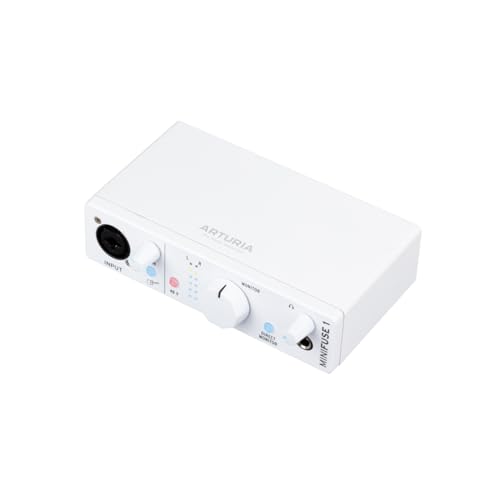
- 5-pin MIDI I/O plus USB audio recording
- Compact design with mic, instrument, and line connections
- Five-year warranty and included creative software
Best For: Traveling musicians needing MIDI and portable audio recording
Ultra-Light MIDI Cable

- Only 3.2 ounces with integrated cables
- USB bus-powered with no external supply
- Low-latency one-in/one-out MIDI connection
Best For: Simple single-device MIDI setups on the road
Flexible MIDI Router

- Standalone USB host bridges USB and 5-pin MIDI gear
- Routing, filtering, mapping, and splitting with presets
- Works across major desktop and mobile operating systems
Best For: Hybrid rigs with multiple USB and DIN MIDI devices
Portable Performance Controller

- 37 mini keys and 16 pads with polyphonic aftertouch
- Scale, Chord, arpeggiator, and DAW control features
- Includes music software, sounds, and Melodics lessons
Best For: Traveling producers who need keys, pads, and performance control
Best All-Around Routing

- 3-in/3-out MIDI with flexible routing, filtering, and merging
- USB-C plug-and-play support across major operating systems
- Compact, low-latency design for varied mobile rigs
Best For: Traveling musicians needing advanced MIDI routing
Best Simple Cable Interface

- One MIDI input and output with up to 16 channels
- Plug-and-play connection for Windows, macOS, and iPad
- LEDs make power and signal activity easy to monitor
Best For: Simple keyboard-to-computer travel setups
Best MIDI Splitter

- Routes one MIDI input to five standard MIDI outputs
- Compact housing suits travel rigs and pedalboards
- USB-C 5V power with optocouplers to help prevent ground loops
Best For: Distributing one MIDI source across multiple devices
Studio-to-Stage Hub
ESI M4U eX 8-Port MIDI Interface

- Eight adaptable MIDI ports with LED configuration feedback
- Built-in USB 3.0 hub with three connectors
- Standalone routing and merging without a computer
Best For: Traveling musicians with multiple MIDI and USB devices
Compact MIDI Splitter
MIDI Thru-6 USB MIDI Interface
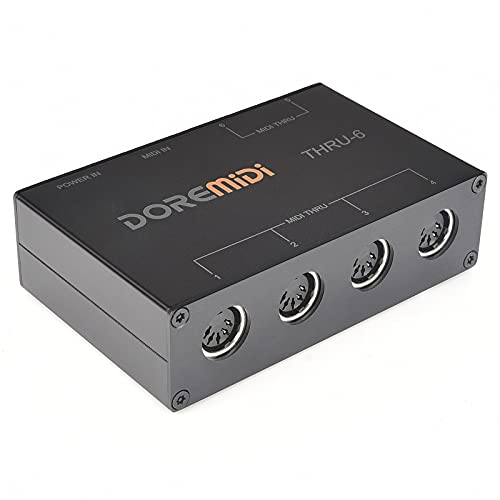
- Splits one MIDI input across six outputs
- Supports standard 16-channel MIDI messages
- Compact, USB-powered design
Best For: Travel rigs connecting one controller to several MIDI devices
Pocket Routing Cable
CME C2MIDI Pro USB-C MIDI Cable

- USB-C interface and computer-free MIDI cable modes
- Routing, filtering, and mapping via UxMIDI Tools
- 89 g design compatible with major operating systems
Best For: Travelers needing a lightweight USB-C MIDI connection
Rugged Recording Hub – Arturia MiniFuse 1
For traveling musicians who need more than basic MIDI connectivity, the Arturia MiniFuse 1 combines 5-pin MIDI input and output with a compact USB audio interface. Its microphone, instrument, and line connections make it practical for recording vocals, guitar, synths, and other sources while away from a studio.
Best For: Musicians who want MIDI connections plus portable audio recording and monitoring.
Pros:
- Includes 5-pin MIDI input and output for synths, controllers, and drum machines.
- Compact 14.4-ounce design with USB connectivity and plug-and-play workflow.
- Offers microphone, instrument, and line inputs, balanced outputs, headphone control, and 48V phantom power.
- Backed by a five-year warranty and includes a substantial software bundle.
Cons:
- Its single-channel design may be limiting for larger recording setups.
- It is more involved than a dedicated MIDI cable if you only need simple MIDI transfers.
The MiniFuse 1 is a versatile choice when your travel rig needs both MIDI and high-quality audio capture. Choose it over a simpler interface when recording flexibility and long-term durability matter.
Ultra-Light MIDI Cable – Roland UM-ONE-MK2
The Roland UM-ONE-MK2 is a straightforward pick among MIDI interfaces for traveling musicians. Its integrated USB and MIDI cables avoid extra adapters, while USB bus power keeps the setup light and free from a separate power supply.
Best For: Travelers who need a simple, low-latency one-in/one-out MIDI connection.
Pros:
- Weighs just 3.2 ounces and has a compact, user-friendly design.
- Integrated USB and MIDI cables simplify packing and setup.
- USB bus-powered operation requires no external power supply.
- Works with Mac, Windows, and iPad setups using Apple’s Camera Connection Kit.
Cons:
- Provides only one MIDI input and one MIDI output.
- Does not provide audio inputs, outputs, or headphone monitoring.
For basic MIDI duties, the UM-ONE-MK2 is one of the easiest options to carry and deploy. Its limited I/O makes it best suited to a single keyboard, controller, or hardware instrument rather than a complex rig.
Flexible MIDI Router – CME H2MIDI Pro
The CME H2MIDI Pro is designed for traveling musicians who move between modern USB gear and traditional 5-pin MIDI hardware. It can operate as a standalone USB host without a computer, or connect to a computer and mobile device through USB-C for routing, filtering, mapping, and splitting.
Best For: Hybrid performers and producers managing multiple USB and DIN MIDI devices while traveling.
Pros:
- Connects class-compliant USB MIDI devices directly to 5-pin DIN MIDI hardware without a computer.
- USB hub support can expand the host side to up to eight USB MIDI device ports.
- Supports macOS, Windows, iOS, Android, Linux, and ChromeOS.
- Offers advanced routing features, four presets, and precise handling of complex MIDI messages.
Cons:
- Its advanced routing features may be unnecessary for basic one-device MIDI connections.
- USB host expansion requires a standard USB hub.
- It has a one-year manufacturer warranty.
At only 2.08 ounces, the H2MIDI Pro packs substantial routing capability into a travel-friendly format. It is a strong fit for compact hybrid rigs, especially when you need standalone operation and compatibility across several platforms.
Portable Performance Controller – Novation Launchkey Mini 37
The Novation Launchkey Mini 37 is a compact USB MIDI keyboard controller for traveling musicians who want hands-on keys, pads, and creative performance tools. Its 37 mini synth-action keys, 16 pads, arpeggiator, and Scale and Chord modes support composing and performing from a portable setup.
Best For: Mobile producers and performers who need a compact keyboard controller with expressive pad and DAW control.
Pros:
- Combines 37 mini keys with 16 pads featuring polyphonic aftertouch.
- Includes Scale Mode, Chord modes, an arpeggiator, and an OLED display.
- Offers integration with Ableton Live, Logic, Cubase, Reason, Reaper, FL Studio, and Ardour.
- Includes Ableton Live Lite, Cubase LE, sounds, and Melodics lessons.
Cons:
- At 2.1 pounds and over 21 inches wide, it is less compact than a small MIDI cable interface.
- It is a keyboard controller rather than an audio interface with recording inputs.
- Its listed platform support centers on Mac and Windows, so mobile users should verify their setup needs.
The Launchkey Mini 37 is a practical travel choice when playing and creating notes is more important than minimizing every inch of gear. Its expanded key and pad layout offers considerably more control than a basic MIDI interface, while remaining portable enough for mobile production.
Best All-Around Routing – CME U6MIDI Pro
For musicians comparing MIDI interfaces for traveling musicians, the CME U6MIDI Pro is a versatile choice when a compact setup needs more than a basic input and output. It offers plug-and-play USB-C connectivity plus standalone routing, filtering, merging, splitting, and thru functions.
Best For: Traveling musicians who need flexible MIDI routing for keyboards, synthesizers, drum machines, or digital pianos.
Pros:
- 3-in/3-out MIDI operation with router, filter, mapper, merge, split, and thru capabilities.
- Works with macOS, iOS, Windows, Android, Linux, and Chrome OS through one USB-C connection.
- Supports MIDI notes, controllers, clock, SysEx, MIDI timecode, and MPE with low latency and no jitter.
- Compact 3.49-ounce design with high-precision wired transmission.
Cons:
- Advanced routing configuration requires the UxMIDI Tools software.
- It is more functionality than a traveler may need for a simple one-keyboard setup.
The U6MIDI Pro stands out when portability and routing flexibility matter equally. Its broad device and operating-system compatibility makes it a strong hub for changing travel rigs.
Best Simple Cable Interface – LEKATO MIDI to USB-C Cable
The LEKATO MIDI cable is a straightforward option for MIDI interfaces for traveling musicians who want to connect one standard MIDI setup to a computer or iPad. Its 6.5-foot cable combines USB-C connectivity with one MIDI input, one MIDI output, and status LEDs.
Best For: Musicians who need a simple, portable connection between a keyboard, synthesizer, digital piano, or drum pad and a compatible computer or iPad.
Pros:
- Plug-and-play connection with Windows and macOS, plus stated compatibility with iPad.
- One MIDI input and one MIDI output support up to 16 channels.
- LED indicators show power and MIDI signal activity for easier troubleshooting.
- Soft copper cable and interference-resistant design support stable transmission.
Cons:
- Offers only one input and one output, limiting larger MIDI setups.
- Some older, vintage, or proprietary devices may require special settings or interfaces.
- Compatibility details are centered on Windows and macOS, so other systems should be checked carefully.
With its integrated cable and visible connection indicators, the LEKATO keeps a basic travel rig easy to pack and monitor. It is best suited to direct, one-device-to-computer connections rather than complex routing.
Best MIDI Splitter – CME MIDI Thru5 WC
CME MIDI Thru5 WC 1-in-5-out MIDI Thru | 5-pin DIN, High-speed, Optional Bluetooth
Check Price On AmazonFor traveling musicians who need to distribute one MIDI source to several devices, the CME MIDI Thru5 WC is a compact 1-in/5-out MIDI thru box. It uses standard 5-pin MIDI connections and USB-C power, making it practical for mobile studios, stages, and pedalboards.
Best For: Performers and producers who need to send one MIDI signal to up to five connected devices.
Pros:
- One MIDI input feeds five MIDI outputs for simple multi-device distribution.
- Compact, lightweight housing is designed for limited spaces, road use, and pedalboards.
- USB-C power works with a standard 5V USB source.
- Optocouplers help prevent ground loops, while low-latency transmission supports notes, controllers, clock, SysEx, timecode, and MPE.
Cons:
- The USB port supplies power only; it is not a USB MIDI interface.
- Its one-input/five-output layout does not provide MIDI merging or multiple inputs.
- Requires standard 5-pin MIDI cables and a separate USB power source.
The Thru5 WC is a focused distribution tool rather than a computer interface. Its rugged, compact format and USB-C power make it a useful addition when a travel rig needs reliable MIDI fan-out.
Studio-to-Stage Hub – ESI M4U eX 8-Port MIDI Interface
For traveling musicians who need extensive routing in a portable setup, the ESI M4U eX is a versatile choice among MIDI interfaces for traveling musicians. Its eight adaptable MIDI ports, USB 3.0 hub, and standalone operation make it suitable for both computer-based and hardware-focused rigs.
Best For: Musicians traveling with multiple MIDI instruments, controllers, and USB devices.
Pros:
- Eight configurable MIDI inputs or outputs with LED status indicators.
- Built-in USB 3.0 hub provides three additional USB connections.
- Standalone routing and merging support computer-free operation.
- Works with Windows and macOS without requiring driver installation for basic plug-and-play use.
Cons:
- Larger and heavier than a simple MIDI cable, weighing 454 g.
- Its extensive port count may be more than solo performers need.
The M4U eX is best when a travel rig needs centralized connectivity rather than minimal size. Its standalone features and integrated hub can reduce the number of separate boxes required onstage or in a mobile studio.
Compact MIDI Splitter – MIDI Thru-6 USB MIDI Interface
The MIDI Thru-6 is a practical option for traveling musicians who need to send one controller’s MIDI data to several devices. As MIDI interfaces for traveling musicians go, its compact 1-in/6-out design is focused on straightforward hardware distribution rather than computer-based MIDI control.
Best For: Performers connecting one MIDI source to up to six keyboards, synths, or other MIDI devices.
Pros:
- One MIDI input distributes messages to six MIDI outputs.
- Supports standard 16-channel MIDI communication.
- USB-powered and requires no batteries.
- Compact enclosure weighs approximately 0.31 kg.
Cons:
- Provides MIDI Thru distribution rather than multiple configurable inputs and outputs.
- Requires a 5V DC USB power supply.
This box makes sense for a hardware-heavy travel rig where reliable signal splitting is the main requirement. It is less suited to musicians seeking advanced routing, mapping, or broad computer-interface functionality.
Pocket Routing Cable – CME C2MIDI Pro USB-C MIDI Cable
The CME C2MIDI Pro is a highly portable pick for musicians who want a cable-sized solution. It stands out among MIDI interfaces for traveling musicians by combining USB-C computer connectivity with a standalone mode that links two MIDI devices without a computer.
Best For: Mobile performers and producers using USB-C computers, tablets, phones, or compact hardware rigs.
Pros:
- Works as both a USB-C MIDI interface and a standalone MIDI cable.
- Supports routing, filtering, and mapping through UxMIDI Tools.
- Compatible with macOS, Windows, iOS, Android, Linux, and Chrome OS.
- Lightweight 89 g design includes a retractable USB-C plug.
Cons:
- Uses USB-C, so devices with other USB connector types may need an adapter.
- Its single-cable format is less suitable for large multi-device MIDI systems.
For travelers prioritizing low weight and flexible connections, the C2MIDI Pro offers an unusually broad feature set in a compact format. Its standalone mode is particularly useful when leaving a laptop out of the setup.
How We Picked the Best Midi Interfaces for Traveling Musicians
We focused on portability, connection flexibility, compatibility, and practical setup requirements. A travel-friendly MIDI interface should be easy to pack, quick to configure, and dependable when used with common computers, tablets, keyboards, synthesizers, and controllers.
We also considered the difference between simple cable interfaces and full MIDI hubs. Some musicians only need one reliable connection between a keyboard and laptop, while others need multiple inputs, outputs, routing options, or standalone operation. The products in this roundup cover that range rather than treating every mobile rig the same.
Quick Comparison
- Best for a compact audio-and-MIDI setup: Arturia MiniFuse 1
- Best for straightforward computer connections: Roland UM-ONE-MK2
- Best for connecting USB MIDI devices without a computer: CME H2MIDI Pro
- Best for portable performance control: Novation Launchkey Mini 37 MK4
- Best for larger MIDI rigs: CME U6MIDI Pro or ESI M4U eX
- Best for splitting one MIDI signal: CME MIDI Thru5 WC or MIDI Thru 6 Box
- Best for a minimal USB-C cable setup: LEKATO MIDI Cable or CME C2MIDI Pro
Key Buying Factors for Midi Interfaces for Traveling Musicians
Portability and Power
Check the device’s size, cable storage, and power requirements before buying. Bus-powered interfaces are usually easiest for travel, but some advanced hubs or standalone devices may require an external power source. Confirm whether the required cable or adapter is included.
Connections and Port Count
Match the interface to your equipment. A single MIDI input and output may be enough for one keyboard, while a multi-port interface is better for several synthesizers, drum machines, or controllers. USB host support is especially useful when you want to connect USB MIDI gear directly to traditional DIN-MIDI equipment.
Compatibility and Latency
Look for class-compliant, plug-and-play operation when possible, particularly if you use multiple computers or mobile devices. Also verify USB-C, USB-A, iOS, macOS, Windows, or other compatibility details for your setup. Reliable timing and low latency matter most for live performance and hardware sequencing.
Routing and Standalone Features
Advanced routing, filtering, mapping, MIDI merging, and standalone operation can reduce the need for a laptop. These features are valuable on stage, but they may add configuration complexity. Choose them when you know your rig will benefit from deeper control.
Who Should Buy Which Midi Interfaces for Traveling Musicians?
Choose a compact MIDI cable if you need the lightest possible connection between one instrument and a computer. Pick a small interface with MIDI I/O when you want a sturdier hub or additional audio functionality. A USB host interface suits musicians combining modern USB controllers with older DIN-MIDI hardware.
For multi-instrument travel rigs, prioritize several independent ports, standalone routing, or MIDI-thru outputs. Keyboard performers who want an all-in-one mobile control surface may prefer a compact controller such as the Launchkey Mini. Before ordering, count every device in your signal chain and leave at least one spare connection for future expansion.