Choosing the right controller can make composing, beat-making, and tracking ideas feel faster and more natural. The best MIDI keyboards for music production balance playable keys, pads, knobs, DAW integration, and the size that fits your workflow.
In this roundup, we focused on practical features that matter in real sessions so you can find a keyboard that matches your space, software, and playing style without paying for extras you won’t use.
Best 10 Midi Keyboards for Music Production Picks for 2026
Portable Beat-Making Starter
Akai MPK Mini MK3 25-Key USB MIDI Keyboard Controller

- 25 velocity-sensitive mini keys
- 8 MPC-style pads and 8 knobs
- Built-in arpeggiator and NKS support
Best For: Beat makers and portable home studio setups
Simple DAW-Friendly Pick
Nektar SE61 USB MIDI Controller Keyboard

- 61-key USB MIDI controller
- Nektar DAW integration for popular DAWs
- Compatible with Mac, PC, and iOS
Best For: Beginners who want straightforward DAW integration
Hands-On Creative Workflow
Arturia MiniLab 3 Universal MIDI Controller

- 25 slim velocity-sensitive keys
- 8 RGB pads, 8 encoders, and 4 faders
- Built-in arpeggiator and mini display
Best For: Producers who want compact hands-on control
Full-Size Entry Controller
M-AUDIO Keystation 49 MK3 USB MIDI Controller

- 49 full-size velocity-sensitive keys
- Pitch/mod wheels plus transport controls
- Plug-and-play USB with included software
Best For: Players who want a fuller key range and simple setup
Portable Creative Controller
Novation Launchkey Mini 37 MK4

- 37 mini synth-action keys in a compact layout
- 16 FSR pads for drumming, clips, and sequencing
- Scale, Chord, and Arp tools for fast songwriting
Best For: Portable beatmaking and DAW-driven songwriting
Feature-Rich Studio Controller
Arturia KeyLab Essential mk3 49

- 49 keys for more comfortable composing and two-handed parts
- Custom DAW scripts for deeper workflow control
- Includes Analog Lab V, pianos, Loopcloud, and Melodics
Best For: Producers wanting a 49-key controller with bundled sounds
Hands-On Beat Production Controller

- 49 full-size velocity-sensitive keys
- 8 knobs, 9 faders, and dual banks of pads
- Smart Chord, Smart Scale, and auto-mapped DAW control
Best For: Hands-on beatmakers who want lots of physical control
Compact Hybrid Controller
Akai MPK Mini Plus 37-Key USB MIDI Keyboard Controller

- 37-key mini controller with 3 octaves
- CV/Gate and MIDI I/O for hardware control
- 64-step sequencer plus pads and knobs
Best For: Producers who want a compact controller that can also run hardware gear.
Ultra-Portable Starter Controller
M-AUDIO Keystation Mini 32 MK3 USB MIDI Controller

- 32 velocity-sensitive mini keys
- Plug-and-play USB with no external power
- Includes MPC Beats and Melodics lessons
Best For: Mobile producers and beginners who want a lightweight sketchpad.
Full-Size Production Workhorse
M-AUDIO Oxygen Pro 61 USB MIDI Keyboard Controller
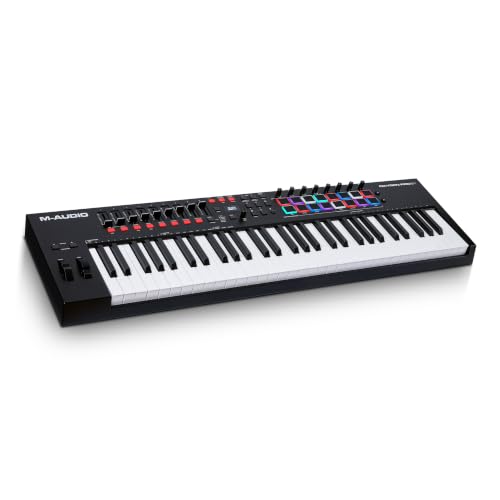
- 61 semi-weighted keys with aftertouch
- 16 pads, 9 faders, and 8 knobs
- NKS support plus auto-mapping and Smart modes
Best For: Producers who want a full-size, hands-on controller for composing and mixing.
Portable Beat-Making Starter – Akai MPK Mini MK3 25-Key USB MIDI Keyboard Controller
If you’re comparing midi keyboards for music production and want a compact controller with real beat-making tools, the Akai MPK Mini MK3 is built for quick sketching and hands-on control. Its 25 velocity-sensitive mini keys, 8 MPC-style pads, 8 assignable knobs, and built-in arpeggiator make it a practical fit for laptop-based production and drum programming.
Best For: Beat makers, home producers, and anyone who wants a portable all-in-one controller with pads and knobs.
Pros:
- 25 velocity-sensitive mini keys for compact, portable playing
- 8 backlit MPC-style pads with Note Repeat and Full Level for drums and samples
- 8 assignable knobs plus a 4-way thumbstick for pitch and modulation control
- Includes a music production starter software bundle and NKS support
Cons:
- Mini keys may not suit players who prefer a full-size keyboard feel
- Designed more as a compact controller than a large studio centerpiece
This is a strong pick if you want a small controller that covers melody, drums, and basic sound shaping without taking up much desk space. It stands out most for creators who value portability and immediate beat-making features over a larger keybed.
Simple DAW-Friendly Pick – Nektar SE61 USB MIDI Controller Keyboard
For midi keyboards for music production where software integration matters more than extra hardware controls, the Nektar SE61 keeps things straightforward. It offers the core expressive control you need to start making music with your computer, plus DAW integration for popular software and compatibility with MIDI music applications on Mac, PC, and iOS.
Best For: Beginners and budget-minded producers who want an uncomplicated keyboard with DAW integration.
Pros:
- Simple setup focused on music creation with your computer
- Nektar DAW integration for popular digital audio workstations
- Compatible with all MIDI music software applications
- Includes a Bigwig Studio 8-track DAW and sound content package
Cons:
- No detailed onboard controls like pads, knobs, or faders are listed
- Best suited to a streamlined workflow rather than deep hands-on control
The SE61 makes sense if you want a no-fuss keyboard that gets you playing and sequencing quickly. It is the most minimal option here, but that can be an advantage if your priority is easy integration and value.
Hands-On Creative Workflow – Arturia MiniLab 3 Universal MIDI Controller
If you want midi keyboards for music production that encourage an active, hands-on workflow, the Arturia MiniLab 3 is designed to keep you moving. It combines 25 slim velocity-sensitive keys with RGB pads, rotary encoders, sliders, a mini display, and capacitive pitch/mod sensors, so you can shape tracks without constantly reaching for the mouse.
Best For: Producers who want a compact controller with pads, faders, encoders, and modern workflow features.
Pros:
- 25 slim velocity-sensitive keys in a compact format
- 8 RGB backlit pads with two banks for drum triggering and clip work
- 8 rotary encoders plus 4 faders for hands-on control
- Built-in arpeggiator, mini display, and clickable browsing knob
Cons:
- Compact key size may not appeal to players wanting full-size keys
- Built for workflow control, so it is less minimal than a basic keyboard-only controller
The MiniLab 3 is a strong fit for producers who want more control surface than a plain keyboard without stepping up to a large controller. Its blend of pads, faders, and encoders makes it especially useful for building tracks in a fluid, controller-first setup.
Full-Size Entry Controller – M-AUDIO Keystation 49 MK3 USB MIDI Controller
Among midi keyboards for music production, the M-AUDIO Keystation 49 MK3 stands out if you prefer a more traditional playing feel. Its 49 full-size velocity-sensitive keys, pitch and modulation wheels, sustain pedal input, and simple plug-and-play USB connection make it a practical choice for writing parts, recording performances, and controlling software from a desk or studio setup.
Best For: Players who want 49 full-size keys and a straightforward controller for recording and composing.
Pros:
- 49 full-size velocity-sensitive keys for a natural feel
- Pitch/modulation wheels, volume fader, and transport controls
- Plug-and-play USB connection with no driver or power supply required
- Includes a software suite with DAW and instrument titles
Cons:
- Focused on keyboard control rather than pads or deep performance features
- Larger than compact mini-key controllers, so it takes more desk space
This is the most keyboard-forward option in the group, making it appealing if you value playability over extra pad-based features. It is a solid centerpiece for straightforward composing and recording, especially when you want a fuller key range.
Portable Creative Controller – Novation Launchkey Mini 37 MK4
If you want midi keyboards for music production that favor speed and hands-on songwriting, the Novation Launchkey Mini 37 MK4 is built around quick ideas and DAW control. Its 37 mini synth-action keys, 16 FSR pads, Scale and Chord modes, and arpeggiator make it easy to sketch beats, trigger clips, and build progressions without much setup.
Best For: Laptop producers, Ableton users, and beatmakers who want a compact controller with creative performance tools.
Pros:
- 37-key mini layout keeps the controller portable while still giving extra range over 25-key models.
- 16 responsive FSR pads support drumming, clip launching, step sequencing, chord triggers, and more.
- Scale Mode, Chord Mode, and arpeggiator help speed up writing and reduce wrong-note moments.
- Includes bundled software and lessons such as Ableton Live Lite, Cubase LE, and Melodics.
Cons:
- Mini keys may feel limiting for players who want a full-size piano-style feel.
- Compact size means fewer hands-on controls than larger controller keyboards.
This is a strong pick if you want a small controller that still feels focused on creative workflow. It stands out most when you value portability, clip launching, and fast idea generation over a larger keybed.
Feature-Rich Studio Controller – Arturia KeyLab Essential mk3 49
Among midi keyboards for music production, the Arturia KeyLab Essential mk3 is aimed at producers who want a bigger keybed and broad software integration. The 49-key design, custom DAW scripts, RGB pads, LCD screen, and included Analog Lab V library give it a practical mix of playability and control for composing, arranging, and beat-making.
Best For: Producers who want a 49-key controller with guided workflow tools and a large included sound library.
Pros:
- 49 keys offer more room for two-handed parts and general composing than mini controllers.
- Scale Mode, Chord Mode, and Arpeggiator support quicker writing and beat construction.
- Custom DAW integration covers major workflows including Ableton Live, Logic Pro X, and FL Studio.
- Includes Analog Lab V plus bonus pianos, Loopcloud, and Melodics for a strong starter software bundle.
Cons:
- Larger footprint is less travel-friendly than compact mini-key controllers.
- It may be more controller than some casual users need if they only want basic MIDI input.
Overall, this is a balanced choice for producers who want a more traditional playing range without losing modern creative tools. The included software and deeper DAW support make it especially useful as a centerpiece controller.
Hands-On Beat Production Controller – M-AUDIO Oxygen 49 MKV
If your priority is tactile control in midi keyboards for music production, the M-AUDIO Oxygen 49 MKV leans hard into hands-on beatmaking and mixing. It combines 49 full-size velocity-sensitive keys with drum pads, assignable knobs, faders, Smart Chord and Smart Scale modes, and auto-mapped DAW control for a workflow that feels ready for studio use.
Best For: Beatmakers and producers who want full-size keys plus lots of physical controls for instruments and DAW parameters.
Pros:
- 49 full-size piano-style keys provide a more natural playing feel than mini-key models.
- 8 assignable knobs and 9 assignable faders give plenty of hands-on control over synths, effects, and DAW settings.
- Two banks of 8 backlit pads with Note Repeat are useful for beat production, clip launching, and triggering sounds.
- Includes Smart Chord, Smart Scale, arpeggiator, and bundled software such as MPC Beats and Ableton Live Lite.
Cons:
- Larger control surface takes up more desk space than compact MIDI keyboards.
- Software and firmware setup requires following the included download process.
For producers who want a more complete control surface, the Oxygen 49 MKV offers a lot of value in one unit. It is especially appealing if you like to shape sounds, mix, and program beats without reaching for the mouse constantly.
Compact Hybrid Controller – Akai MPK Mini Plus 37-Key USB MIDI Keyboard Controller
If you want midi keyboards for music production that can bridge software and hardware, the Akai Professional MPK Mini Plus stands out with its 37-key layout, MPC-style pads, and CV/Gate plus MIDI I/O. It is built for beatmaking, melody writing, and hands-on control in a compact USB-powered format.
Best For: Producers who want a small controller that can also drive modular gear, sound modules, and standalone sessions.
Pros:
- 37 keys give you 3 full octaves for more comfortable melodic and harmonic playing.
- CV/Gate and MIDI I/O expand it beyond basic computer-only use.
- 8 RGB MPC pads, 8 assignable knobs, and DAW transport controls support hands-on production.
- Built-in 64-step sequencer lets you record and compose without a computer.
Cons:
- It is still a compact controller, so players who want a full-size keyboard may want more range.
- The workflow is geared toward production control rather than piano-style performance.
This is a strong pick if you want one controller that can handle DAW control, beat creation, and external synth connections in a portable setup.
Ultra-Portable Starter Controller – M-AUDIO Keystation Mini 32 MK3 USB MIDI Controller
For buyers comparing midi keyboards for music production on a budget or in a travel setup, the M-AUDIO Keystation Mini 32 MK3 keeps things simple. Its 32 velocity-sensitive mini keys, plug-and-play USB connection, and basic control features make it a practical entry point for writing parts on a laptop.
Best For: Mobile producers and beginners who want a lightweight, no-fuss keyboard for sketching ideas.
Pros:
- Very portable design with 32 velocity-sensitive mini keys.
- Plug-and-play USB connection requires no extra drivers or external power.
- Octave buttons, volume knob, and sustain button add useful basic control.
- Includes MPC Beats software and 60 interactive Melodics lessons.
Cons:
- Mini keys limit the feel and range compared with larger controllers.
- It is a stripped-down controller, so advanced hands-on control is limited.
This is a sensible choice if you need a compact MIDI keyboard that gets out of the way and lets you start producing quickly.
Full-Size Production Workhorse – M-AUDIO Oxygen Pro 61 USB MIDI Keyboard Controller
If you want midi keyboards for music production with more room to play and deeper control, the M-AUDIO Oxygen Pro 61 is the most complete option here. It combines 61 semi-weighted keys with aftertouch, 16 RGB pads, faders, knobs, DAW mapping, and Native Instruments NKS support for a full production-centered workflow.
Best For: Producers who want a full-size controller for playing, beatmaking, and mixing from one surface.
Pros:
- 61 semi-weighted keys with aftertouch and assignable zones feel suited to more expressive playing.
- 16 RGB pads plus 8 knobs and 9 faders give you extensive hands-on control.
- NKS integration and auto-mapping help streamline work with instruments and DAW parameters.
- Includes useful production tools like Smart Chord, Smart Scale, arpeggiator, and 5-pin MIDI out.
Cons:
- Its larger size makes it less portable than mini-key options.
- It may be more controller than casual users need if they only want basic note entry.
For producers who want a serious all-in-one controller, this model offers the most depth and the most playable keyboard in the group.
How We Picked the Best Midi Keyboards for Music Production
We looked for controllers that offer a strong mix of playability, software compatibility, hands-on controls, and value. Priority went to models that suit common production tasks such as entering melodies, programming drums, controlling plugins, and navigating a DAW quickly. We also considered portability, key count, and whether a board makes sense for beginners, traveling producers, or full-time studio users.
Quick Comparison
Compact 25- and 32-key models are best for mobile setups and beat programming, while 49- and 61-key controllers are better for two-handed playing and broader songwriting. If you want a simple desk-friendly option, smaller boards can be ideal. If you want a more complete performance and arrangement surface, larger controllers usually provide a better long-term fit for Midi Keyboards for Music Production.
Key Buying Factors for Midi Keyboards for Music Production
Key Count and Size
Choose the smallest layout that still matches how you work. Smaller keyboards save space and travel easily, but larger models reduce octave switching and are more comfortable for piano parts.
Key Action
Synth-action keys are common on compact controllers and are great for fast input. Semi-weighted options feel more substantial and can be better if you play keys regularly.
Controls and Workflow
Pads, knobs, faders, pitch and mod controls, and transport buttons can speed up production significantly. If you rely on beat-making or plugin tweaking, these extras matter more than raw key count.
DAW Integration and Software Bundle
Native DAW mappings and included software can shorten setup time and help you get productive sooner, especially if you are building a home studio from scratch.
Who Should Buy Which Midi Keyboards for Music Production?
If you need maximum portability, choose a compact mini controller. If you want an all-around starter board for songwriting and beat production, a 49-key model is often the sweet spot. If you play keyboard parts more seriously or want fewer octave shifts, a 61-key controller is worth the extra desk space. For producers who want a balanced, performance-friendly surface, the best choice is usually the one that matches your workflow more than the one with the most features.