A patch bay for guitar pedals can make a crowded board easier to connect, troubleshoot, and expand. The right model keeps input and output jacks accessible while reducing cable clutter and unnecessary wear on your pedalboard.
This roundup covers compact pedalboard junction boxes, programmable loop solutions, and studio-style balanced patch bays so you can match the design to your rig, available space, and routing needs.
Best 10 Patch Bay for Guitar Pedals Picks for 2026
Compact Routing Hub

- Four passive TRS stereo channels
- Mono and stereo compatibility
- True bypass, plug-and-play design
Best For: Compact pedalboard signal organization
Connected Pedalboard Control

- Four 1/4-inch mono TRS thru connections
- USB and dual MIDI thru ports
- AC IEC thru connection included
Best For: Expanded pedalboard connectivity
Simple Cable Management
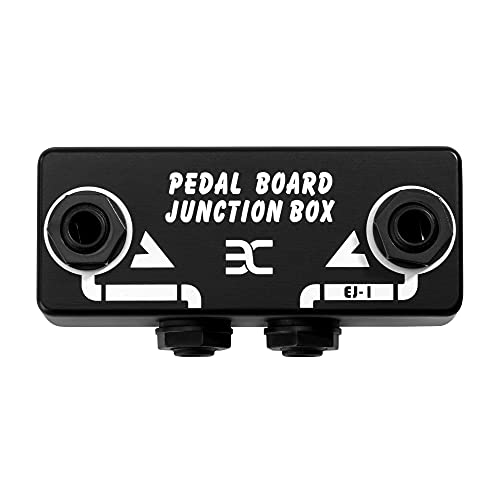
- Centralizes instrument and amp connections
- Passive and power-free operation
- Supports vertical or horizontal cable entry
Best For: Basic pedalboard input/output access
Programmable Loop Switching

- Four relay-based true-bypass loops
- Switchable input buffer
- Tuner, mute, and amp switching functions
Best For: Controlled multi-pedal performance rigs
Compact Cab-Sim Hub

- Cab simulator and DI pedalboard patchbay
- Compact 6.89-inch-long enclosure
- 2-year warranty included
Best For: Pedalboards needing cab-simulator and DI functionality
Balanced Routing Workhorse
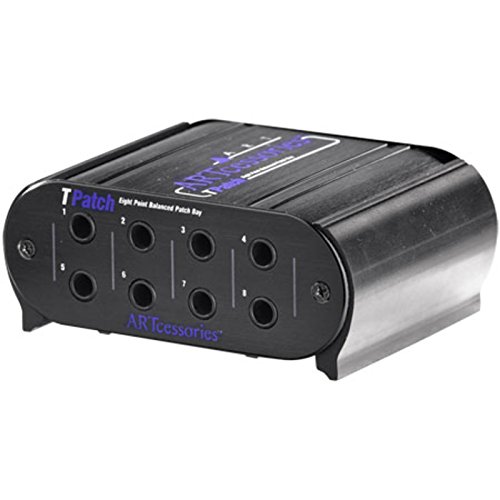
- Eight balanced signal points
- Four linked input/output pairs
- Switchable half-normal and normal modes
Best For: Studios and complex balanced pedal signal chains
TRS/XLR Connectivity Choice

- TRS and XLR pedalboard connectivity
- Supports DC, AC, and IEC connectors
- Mounting hardware included
Best For: Pedalboards requiring varied audio and power connections
Studio Rack Organizer

- 48-point fully shielded design
- 19-inch rack-mountable format
- Helps reduce cable clutter and connector wear
Best For: Rack-based studios, live sound, and installed audio
Flexible Routing Hub
Behringer ULTRAPATCH PRO PX3000

- 48-point balanced patch bay
- Selectable routing modes for flexible wiring
- Supports TRS, TS, XLR, and MIDI connectivity
Best For: Configurable studio racks and changing signal-flow setups
Balanced Switching Workhorse

- 48-point fully balanced 1/4-inch design
- Normal, Half-normal, and Thru modes
- Compact 1U rack-mountable construction
Best For: 1/4-inch studio racks needing convenient front-panel routing
Compact Routing Hub – SONICAKE Junction Box
If you need a compact patch bay for guitar pedals, the SONICAKE Junction Box provides four passive channels with TRS stereo connectivity. It helps organize pedalboard wiring, support mono or stereo setups, and reduce cable clutter without requiring a power supply.
Best For: Guitarists and bassists who want a compact, plug-and-play signal hub for pedalboard organization and flexible mono or stereo routing.
Pros:
- Four passive channels with TRS stereo connections
- Supports both mono and stereo configurations
- True bypass helps preserve the instrument signal
- Compact design saves pedalboard space and needs no power supply
Cons:
- Passive design does not provide programmable switching
- Limited to four channels
The SONICAKE is a straightforward choice when clean cable management and flexible connections matter more than advanced loop control. Its compact format and passive operation make it easy to add to an existing board.
Connected Pedalboard Control – ROCKBOARD Patch Bay
The ROCKBOARD by Warwick RBO B MOD 2 V2 is a versatile patch bay for guitar pedals designed to bring key connections together in one place. Along with four 1/4-inch mono TRS thru connections, it includes USB, MIDI, and AC IEC thru connections for a broader pedalboard setup.
Best For: Players building a connected pedalboard who need centralized audio, MIDI, USB, and power-related connections.
Pros:
- Includes four 1/4-inch mono TRS thru connections
- Adds USB and two MIDI thru connections
- Includes an AC IEC thru connection
- Centralizes effector setup and connections
Cons:
- More specialized than a basic passive junction box
- Audio connections are listed as mono TRS thru
With its mix of audio, MIDI, USB, and AC IEC connectivity, the ROCKBOARD suits more elaborate rigs. It is a practical choice for players who want one organized connection point rather than a simple audio-only patch bay.
Simple Cable Management – EX Pedalboard Junction Box
The EX Pedalboard Junction Box is a practical patch bay for guitar pedals when you want instrument input and amplifier output gathered in one location. Its passive, screw-in metal design helps simplify setup changes, protect pedal jacks from repeated plugging, and save space with vertical or horizontal connector placement.
Best For: Studio and stage pedalboards that need quick input/output access and cleaner cable routing without powered circuitry.
Pros:
- Aggregates guitar input and amplifier output in one place
- Passive operation requires no power supply
- Vertical or horizontal connector insertion supports space-saving layouts
- Metal, powder-coated construction with screw-in installation
Cons:
- Provides basic input/output aggregation rather than switching
- No channel count or stereo functionality is specified
The EX Junction Box focuses on the essentials: easier cable routing, faster board changes, and less wear from repeatedly using pedal input and output jacks. It is well suited to players who prefer a simple, passive installation.
Programmable Loop Switching – Hotone Patch Kommander
The Hotone Patch Kommander is a patch bay for guitar pedals with four independent relay-based true-bypass effects loops. Unlike a basic junction box, it adds programmable-style loop control features, a switchable input buffer, tuner output, mute function, and amp channel switching support.
Best For: Players who need four controlled effects loops plus buffering, tuning, muting, and amp channel switching in a compact unit.
Pros:
- Four independent relay-based true-bypass audio loops
- Switchable input buffer helps prevent high-frequency loss
- Includes mute/tuner function with independent tuner output
- Supports A/B amp channel switching
Cons:
- Requires a 9-volt DC power supply
- Heavier and more complex than a passive junction box
- Its four-loop design may be unnecessary for simple cable organization
The Patch Kommander is the strongest fit for a performance-oriented rig that needs active loop management rather than merely relocated input and output jacks. Its buffer and switching features add flexibility, while true-bypass loops preserve a direct signal path when engaged appropriately.
Compact Cab-Sim Hub – MOD 5 Pedalboard Patchbay
The RockBoard MOD 5 is a compact patch bay for guitar pedals designed around pedalboard connectivity, with a cab simulator DI format and a digital signal path. Its black enclosure measures 6.89 by 3.35 by 1.85 inches and weighs 1.3 pounds.
Best For: Guitarists who want a compact pedalboard patchbay with cab-simulator and DI functionality.
Pros:
- Combines a cab simulator and DI function in a pedalboard-oriented interface.
- Compact 6.89-inch-long enclosure helps conserve board space.
- Includes a 2-year warranty.
Cons:
- The supplied specifications list a micro USB connector but do not detail the full connection layout.
- Its 1.3-pound weight may be more than some minimal pedalboard setups require.
The MOD 5 stands out when your patch bay needs extend beyond simple routing. Consider it if the cab-simulator DI feature and compact footprint match your board setup.
Balanced Routing Workhorse – ART TPatch Eight-Point Bay
The ART Pro Audio TPatch is a practical patch bay for guitar pedals and broader studio routing, offering eight balanced direct-signal points through 1/4-inch TRS phone jacks. Its switchable half-normal and normal modes support flexible input/output configurations.
Best For: Home studios and pedal setups that need multiple balanced routing points and configurable connections.
Pros:
- Provides eight points of balanced direct signals.
- Offers four linked input/output pairs.
- Switches between half-normal and normal operation, including through-type connections.
- Uses a rugged extruded aluminum case.
Cons:
- Its eight-channel, rack-style routing approach may be more than a simple pedalboard needs.
- The supplied notes identify 1/4-inch TRS connectivity rather than dedicated pedalboard-specific connectors.
Choose the TPatch when routing flexibility and balanced connections matter more than a small pedalboard footprint. The configurable normalization modes make it particularly useful for more involved signal chains.
TRS/XLR Connectivity Choice – MOD 1 V2 Patchbay
The RockBoard MOD 1 V2 is a modern analog patch bay for guitar pedals that combines TRS and XLR connectivity with DC, AC, and IEC connector support. It measures 6.89 inches square by 1.85 inches high and includes mounting hardware for pedalboard installation.
Best For: Pedalboard users who need TRS and XLR connections in a compact, mountable interface.
Pros:
- Combines TRS and XLR connectivity in one pedalboard patchbay.
- Supports DC, AC, and IEC connector types.
- Includes mounting screws, counter nuts, and a TX wrench.
- Backed by a 2-year warranty.
Cons:
- The 6.89-by-6.89-inch footprint may require dedicated pedalboard space.
- The supplied specifications do not describe the exact routing or normalization options.
The MOD 1 V2 is a strong fit when your board requires varied connection types rather than a basic audio pass-through. Its included mounting hardware also makes installation planning simpler.
Studio Rack Organizer – Art Pro Audio P48
The Art Pro Audio P48 is a straightforward choice when you need a patch bay for guitar pedals and other studio gear. Its 48-point, fully shielded design mounts in a standard 19-inch rack and helps centralize connections while reducing cable clutter and connector wear.
Best For: Home or professional recording studios, live sound, PA, AV, and home-theater installations that need a rack-mounted cable-management solution.
Pros:
- 48-point balanced patch bay with XLR connectivity.
- Fully shielded construction helps organize connections.
- 19-inch rack installation suits studio and installed-audio setups.
- Helps reduce wear and tear on equipment connectors.
Cons:
- Its XLR connector format may be less convenient for pedalboard setups built around 1/4-inch plugs.
- The notes do not specify selectable normalled or half-normalled modes.
The P48 is best viewed as a simple, rack-oriented connection hub rather than a highly configurable patching system. Check your pedal and rack cabling before choosing it, especially if your setup primarily uses 1/4-inch connections.
Flexible Routing Hub – Behringer ULTRAPATCH PRO PX3000
Behringer ULTRAPATCH PRO PX3000 Multi-Functional 48-Point 3-Mode Balanced Patchbay
Check Price On AmazonThe Behringer ULTRAPATCH PRO PX3000 is a versatile patch bay for guitar pedals, mixers, and other audio equipment when flexible signal routing matters. Its 48 points and selectable operating modes let you adapt channel behavior to different studio wiring requirements.
Best For: Studios and audio setups that need configurable normalled, half-normalled, parallel, or open routing in a rugged rack-style patch bay.
Pros:
- Provides 48 patch points for centralizing audio connections.
- Offers selectable Parallel, Half-normalled, Normalled, and Open modes.
- Supports TRS, TS, XLR, and MIDI connectivity according to the supplied specifications.
- Rugged construction and high-quality jack connectors are designed for long-term use.
Cons:
- The supplied notes list a 3-mode product description while also identifying four selectable functions, so buyers should verify the exact front-panel configuration.
- Its broad routing feature set may be more than needed for a simple pedal connection setup.
The PX3000 stands out when you want a patch bay that can change with your signal-flow needs. Its configurable modes make it a strong fit for evolving studio racks, provided your equipment uses compatible patch connections.
Balanced Switching Workhorse – Samson S-Patch Plus
The Samson S-Patch Plus is a practical patch bay for guitar pedals and studio equipment, combining 48 front connections with 48 rear connections in a fully balanced 1/4-inch design. Front-panel switches make it easier to change routing without reaching behind your rack.
Best For: Studios and equipment racks that use 1/4-inch balanced connections and need convenient Normal, Half-normal, or Thru operation.
Pros:
- Fully balanced 48-point patch bay with 1/4-inch phone connections front and rear.
- Front-panel switches select Normal, Half-normal, or Thru operation.
- 19-inch, 1U rack-mountable construction saves rack space.
- Centralizes connections for cleaner, faster workflow.
Cons:
- The supplied specifications identify it primarily with 1/4-inch TRS connections, so confirm compatibility with unbalanced pedal wiring.
- It is designed for indoor use in the product details, despite a separate note mentioning indoor and outdoor use.
The S-Patch Plus is a strong all-around option when your system is built around 1/4-inch connections and you want hands-on routing control. Its front-mounted switches and compact 1U format are especially useful in a busy rack.
How We Picked the Best Patch Bay for Guitar Pedals
We evaluated these options by looking at connection flexibility, pedalboard compatibility, jack accessibility, enclosure design, signal-routing options, and ease of installation. We also considered whether each unit is best suited to a compact live board, a complex effects rig, or a studio rack.
Passive junction boxes are useful when you mainly want convenient front- or side-mounted connections. Patch bays with switching or multiple routing modes are better for players who need more control over effects loops and signal paths. Balanced rack units can be valuable in recording setups, but they may offer more capacity than a typical pedalboard requires.
Quick Comparison
| Type | Best For | What to Look For |
|---|---|---|
| Compact junction box | Small and medium pedalboards | Channel count, TRS compatibility, mounting options |
| Pedalboard patchbay | Clean stage connections | Board fit, jack placement, cable access |
| Loop switcher | Complex effects routing | Programmability, loop count, control layout |
| Rackmount patch bay | Studios and larger rigs | Balanced connections, routing modes, rack space |
Key Buying Factors for a Patch Bay for Guitar Pedals
Connection Type and Channel Count
Start by counting the connections you actually need. A four-channel unit may be enough for a basic board, while larger rigs may benefit from eight or more points. Check whether the jacks use 1/4-inch TS, TRS, or balanced connections, and make sure they match your cables and equipment.
Pedalboard Fit and Mounting
Measure the available width, depth, and clearance beneath or beside your board. Some pedalboard patch bays are designed for specific mounting systems, while standalone boxes may require adhesive, brackets, or a separate mounting plate. Leave enough room to insert plugs without sharply bending cables.
Passive Routing Versus Switching
A passive patch bay generally provides straightforward signal connections without changing the signal path. This keeps operation simple. A programmable loop switcher adds routing control and can reduce tap dancing, but it also requires more setup and may need power or MIDI integration.
Balanced or Unbalanced Operation
Most guitar pedal chains use unbalanced connections, while studio interfaces and rack equipment often use balanced lines. Do not assume that a balanced patch bay will improve a conventional pedal chain; choose it when your connected equipment supports the format and the extra routing capacity is useful.
Who Should Buy Which Patch Bay for Guitar Pedals?
- Choose a compact junction box if you want cleaner input and output access on a small or medium pedalboard.
- Choose a dedicated pedalboard patchbay if you regularly connect and disconnect your board at rehearsals, gigs, or studio sessions.
- Choose a programmable loop switcher if you use several effects loops and want preset-based control over your signal chain.
- Choose an eight-point or larger rack patch bay if you need to organize multiple pieces of studio equipment in one accessible location.
- Choose a 48-point balanced model for a permanent studio installation with extensive routing requirements rather than a simple pedalboard connection.
Before buying, map your signal chain, label each connection, and confirm the unit’s wiring scheme. A little planning helps prevent incompatible cables, unused channels, and a patch bay that takes up more space than it saves.