Choosing the right RAID enclosure can make a big difference in how well your data is protected, organized, and recovered after a drive issue.
Below, we focus on the best RAID enclosures for data security in 2026, with options that balance redundancy, capacity, speed, and ease of use.
Best 10 Raid Enclosures for Data Security Picks for 2026
Compact Mirror-Backup Pick
TERRAMASTER D2-320 USB RAID Enclosure

- RAID 1 mirror backup with automatic recovery
- Up to 10Gbps via USB 3.2 Gen 2
- Tool-free 2-bay design for HDDs and SSDs
Best For: small-scale backup with mirrored protection
High-Redundancy 4-Bay Choice

- RAID 1, 5, 10, JBOD, and more
- Up to 104TB across four SATA drives
- 20Gbps USB 3.2 Gen 2x2 on USB4
Best For: buyers who want flexible RAID and high capacity
Flexible Backup Workhorse
MAIWO 4 Bay HDD RAID Enclosure

- Multiple modes including RAID 5, 1/10, and Clone
- Up to 96TB with four 24TB drives
- Two fans help keep drives cool
Best For: backup-focused users needing flexible RAID modes
Security-Focused 5-Bay Option
ORICO RAID 5 Bay HDD Enclosure

- Eight RAID modes including RAID 5 and 10
- Locking design plus 80mm cooling fan
- Up to 110TB with five SATA drives
Best For: larger local backups with strong redundancy options
Portable Dual-Bay RAID SSD Enclosure

- Supports RAID 1, RAID 0, JBOD, and Clone mode.
- Tool-free design simplifies SSD installation and swaps.
- Auxiliary USB-C input helps with high-capacity dual-drive use.
Best For: Portable NVMe users who want redundancy and offline cloning.
High-Capacity 5-Bay RAID DAS

- Supports RAID 1, 3, 5, 10, JBOD, Large, PM, and Clone.
- Holds up to five SATA HDDs or SSDs for 160TB total.
- Smart cooling and LEDs help with stable operation and monitoring.
Best For: Backup-heavy users who want flexible RAID modes and large storage.
Enterprise 5-Bay RAID Storage
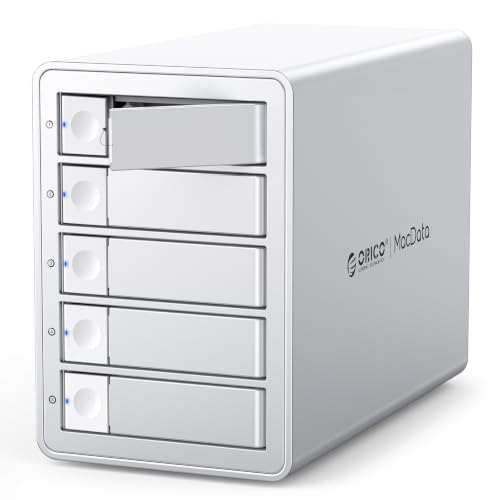
- Includes RAID 1, RAID 5, RAID 10, JBOD, and Normal modes.
- Supports up to five SATA drives and 130TB total capacity.
- Built-in fan and hot-swap support suit long-running workloads.
Best For: Enterprise and creator workflows that need capacity and redundancy.
Compact 4-Bay RAID Storage
CENMATE 4-Bay Aluminum DAS Enclosure

- 8 RAID modes including RAID 0/1/5/10 and clone
- Aluminum chassis with built-in fan for cooling
- Supports 2.5" and 3.5" SATA drives up to 80TB
Best For: People who want a smaller multi-mode RAID DAS for desktop backups
High-Capacity 5-Bay RAID
ORICO 5-Bay Hardware RAID Enclosure

- Hardware RAID with RAID, JBOD, Clone, and Clear modes
- Built-in 150W power supply for stable 5-drive use
- Supports up to 110TB with aluminum cooling design
Best For: Users needing a powerful desktop RAID DAS for backups and media
USB-C Flexible RAID
Yottamaster 5-Bay USB-C RAID Enclosure

- RAID 0/1/3/5/10 plus JBOD and clone modes
- USB-C connection with up to 5Gbps transfer speed
- Aluminum build with automatic 80mm cooling fan
Best For: Creators and backup users who want USB-C RAID flexibility
Compact Mirror-Backup Pick – TERRAMASTER D2-320 USB RAID Enclosure
If you want raid enclosures for data security in a compact 2-bay format, the TERRAMASTER D2-320 focuses on simple hardware RAID with mirrored protection. It supports RAID 0, RAID 1, JBOD, and Single mode, and its RAID 1 setup is designed to automatically recover data after a drive replacement. With USB 3.2 Gen 2 connectivity and support for both HDDs and SSDs, it suits users who want a straightforward local backup device.
Best For: Users who want a small RAID enclosure with mirror-based protection for everyday backup.
Pros:
- Supports RAID 1 for mirrored backup and automatic recovery after drive replacement.
- USB 3.2 Gen 2 connection offers up to 10Gbps transfer speed.
- Works with 2.5-inch and 3.5-inch SATA HDDs, plus 2.5-inch SATA SSDs.
- Tool-free tray design and push-lock mechanism simplify drive installation.
Cons:
- Only two drive bays, so expansion is limited.
- No advanced RAID levels beyond RAID 0, 1, JBOD, and Single.
- As a DAS, it is not a NAS for network sharing.
For a simple, security-minded desktop storage setup, this enclosure keeps the focus on mirrored redundancy rather than complexity. It is a practical choice if your priority is protecting a smaller set of important files.
High-Redundancy 4-Bay Choice – ORICO 4 Bay RAID Enclosure
Among raid enclosures for data security, this ORICO 4-bay model stands out for offering a wide range of redundancy options, including RAID 1, RAID 5, and RAID 10. It uses USB 3.2 Gen 2×2 for up to 20Gbps bandwidth on compatible USB4 connections, and the enclosure is built around a JMS591 chip for improved SATA 3.0 performance. If you need a stronger balance of capacity and protection, this is the most flexible option in the group.
Best For: Users who want multiple RAID protection levels in a high-capacity 4-bay enclosure.
Pros:
- Supports RAID 0, 1, 5, 10, JBOD, and Normal modes.
- Up to 104TB capacity with support for 26TB drives.
- USB 3.2 Gen 2×2 interface can reach 20Gbps on USB4.
- Built-in fan, aluminum alloy body, and hot-swapping help with sustained use.
Cons:
- RAID mode changes erase drive contents, so setup needs planning.
- Full 20Gbps speed depends on USB4; Thunderbolt is limited here.
- More advanced than a basic mirror-only enclosure, so it may be overkill for simple backups.
This enclosure is a strong fit when data protection and scalability both matter. Its broader RAID support makes it better suited to users who may want to tune redundancy, performance, or both.
Flexible Backup Workhorse – MAIWO 4 Bay HDD RAID Enclosure
If your priority is practical raid enclosures for data security with plenty of mode options, the MAIWO 4-bay enclosure is built around flexibility. It supports Normal, RAID 0, RAID 3, RAID 5, RAID 1/10, Clone, and Large (JBOD), giving you multiple ways to balance redundancy and storage use. With up to 96TB capacity and two cooling fans, it is aimed at users who want dependable local storage for backups and larger libraries.
Best For: Users who want a versatile 4-bay enclosure for backup, mirroring, or mixed storage needs.
Pros:
- Offers a wide range of RAID modes, including RAID 5, RAID 1/10, and Clone.
- Supports up to 96TB total capacity with four 24TB drives.
- Includes two cooling fans for better drive temperature control.
- USB A-C and C-C cables are included for easier connection options.
Cons:
- USB 3.1 speeds top out at 5Gbps, which is slower than newer high-speed enclosures.
- Focuses on 3.5-inch SATA drives, so it is less versatile for mixed drive types.
- RAID changes can require careful setup to avoid data loss.
This is a balanced choice if you need more RAID flexibility than a simple two-bay unit. It favors dependable storage organization and redundancy over raw transfer speed.
Security-Focused 5-Bay Option – ORICO RAID 5 Bay HDD Enclosure
For shoppers comparing raid enclosures for data security, this ORICO 5-bay enclosure adds extra protection options and more usable capacity than smaller models. It supports RAID 0, 1, 3, 5, 10, JBOD, Clone, and Clear modes, including dual data backup workflows. The enclosure also pairs its locking mechanism with a silent cooling fan, making it a solid fit for users who want local storage that stays organized and protected.
Best For: Users who want a 5-bay enclosure with multiple backup-oriented RAID modes.
Pros:
- Supports eight modes, including RAID 5, RAID 10, JBOD, and Clone.
- Up to 110TB capacity with support for 22TB drives.
- Independent safety locking mechanism helps prevent accidental drive removal.
- 80mm cooling fan and vented aluminum case support stable long-term use.
Cons:
- USB 3.0 speeds are limited to 5Gbps.
- Mode switching can erase drives, so backups are necessary before changes.
- Best suited to 3.5-inch SATA disks rather than mixed storage types.
This enclosure is a strong pick when you want more bays and more redundancy choices without moving to a network storage system. It is especially appealing for users who value lockable, organized, high-capacity local backups.
Portable Dual-Bay RAID SSD Enclosure – 20Gbps NVMe Clone Dock
If you’re comparing raid enclosures for data security, this dual-bay NVMe enclosure stands out because it combines RAID 1 redundancy with offline cloning in a compact, tool-free design. It’s built for M.2 2280 PCIe NVMe SSDs and supports RAID 0, RAID 1, JBOD, and Clone mode, so you can prioritize either speed, backup protection, or simple duplication.
Best For: Users who want a portable dual-SSD enclosure for RAID 1 backups and fast offline cloning.
Pros:
- RAID 1 mode automatically mirrors data to help protect important files.
- Tool-free cover makes SSD swaps and clone workflows quicker.
- 20Gbps transfer support is useful for large backups and data-heavy tasks.
- Auxiliary USB-C input helps stabilize demanding dual-drive setups.
Cons:
- Only works with M.2 2280 NVMe SSDs, not SATA drives.
- Dual-drive RAID features may be more than casual users need.
Overall, this is a practical pick if your priority is redundancy and quick drive duplication in a small metal enclosure. The mix of RAID 1, clone mode, and high-speed USB connectivity makes it a flexible tool for secure SSD-based storage.
High-Capacity 5-Bay RAID DAS – 8-Mode SATA Backup Enclosure
For buyers focused on raid enclosures for data security, this 5-bay UGREEN DAS gives you a broad set of modes, including RAID 1, RAID 3, RAID 5, and RAID 10 for protection against drive failure. It supports 2.5-inch and 3.5-inch SATA HDDs or SSDs, making it a strong way to reuse existing drives in a larger external storage setup.
Best For: Users who need a high-capacity multi-drive enclosure with flexible RAID protection options.
Pros:
- Offers 8 storage modes, including RAID 1/3/5/10, Large, PM, JBOD, and Clone.
- Five-bay design supports up to 160TB total capacity.
- Smart cooling with automatic fan control helps keep drives running steadily.
- Clear LED indicators make drive status and RAID issues easier to monitor.
Cons:
- Changing RAID modes requires reformatting, so backups are essential.
- 5Gbps USB-C is slower than higher-end 20Gbps enclosures.
- It works as external DAS storage, not as a NAS pool expansion.
This enclosure makes sense if your main goal is dependable multi-drive storage with real redundancy options and room to grow. The combination of strong capacity, multiple RAID levels, and clear status feedback is especially useful for backup-focused setups.
Enterprise 5-Bay RAID Storage – 20Gbps SATA RAID Hub
If you need raid enclosures for data security at a larger scale, this ORICO 5-bay unit is built around RAID 1, RAID 5, and RAID 10 support, plus a 20Gbps USB 3.2 Gen 2×2 interface for faster transfers. It’s designed for 2.5-inch and 3.5-inch SATA drives and is aimed at users who want high-capacity external storage with redundancy options and strong cooling.
Best For: Enterprise IT, creators, and technical users needing a high-capacity RAID enclosure with broad compatibility.
Pros:
- Six RAID modes, including RAID 1, RAID 5, RAID 10, JBOD, and Normal.
- Up to 130TB capacity supports large storage libraries and project archives.
- 20Gbps USB 3.2 Gen 2×2 connectivity is suited to faster data movement.
- Built-in fan, aluminum alloy body, and hot-swap support help with long-term use.
Cons:
- RAID changes erase drives, so setup needs careful planning and backups.
- Thunderbolt connections won’t reach full 20Gbps performance.
- Designed for SATA drives only, not NVMe SSDs.
Overall, this is the most enterprise-leaning option in the group, with a strong mix of capacity, RAID flexibility, and cooling. It’s a sensible choice when protection, scale, and compatibility matter more than simplicity.
Compact 4-Bay RAID Storage – CENMATE 4-Bay Aluminum DAS Enclosure
If you are comparing raid enclosures for data security and want a compact desktop DAS, this CENMATE 4-bay unit is built around hardware RAID, cooling, and broad drive support. It works with 2.5″ and 3.5″ SATA HDDs/SSDs, offers 8 RAID modes, and includes USB A/C 3.0 plus eSATA for flexible setup options.
Best For: Users who want a smaller 4-bay RAID enclosure with multiple mode options for personal or office backups.
Pros:
- Supports RAID 0/1/3/5/10, CLONE, LARGE, and NORMAL modes.
- Aluminum-alloy body and 2-inch fan help with heat management.
- Works with 2.5″/3.5″ SATA HDDs and SSDs, up to 80TB total capacity.
- Includes USB A/C 3.0 and eSATA cables for wider connection choices.
Cons:
- Switching RAID modes requires going back to NORMAL first and can cause data loss.
- Fan noise is listed around 40-50 decibels.
- Mac OS does not support RAID software here.
This is a practical pick if you want a straightforward RAID DAS with broad compatibility and built-in cooling, but it is best suited to users who are comfortable managing RAID changes carefully.
High-Capacity 5-Bay RAID – ORICO 5-Bay Hardware RAID Enclosure
For raid enclosures for data security that also need serious capacity, this ORICO 5-bay model is built for hardware RAID flexibility and stable multi-drive operation. It supports RAID 0, 1, 3, 5, 10, JBOD, Clone, and Clear modes, plus a built-in 150W power supply and aluminum cooling design for heavier workloads.
Best For: Large backup jobs, media libraries, and workstations that need a high-capacity 5-bay RAID DAS.
Pros:
- Hardware RAID controller with multiple modes, including RAID, JBOD, Clone, and Clear.
- Built-in 150W power supply helps keep five drives powered stably.
- Supports both 2.5″ and 3.5″ SATA HDDs and SSDs up to 110TB total.
- Aluminum alloy shell, 80mm fan, and airflow vents are designed for cooling.
Cons:
- Uses a USB 3.0 Type-A connection, which may be less flexible than USB-C setups.
- Single-drive capacity is listed at up to 22TB, so planning matters.
- Its larger 5-bay design is better for desktops than portable use.
This enclosure is aimed at users who want a desktop RAID station with strong redundancy options, stable power, and room to scale. It makes the most sense when data volume and drive management are top priorities.
USB-C Flexible RAID – Yottamaster 5-Bay USB-C RAID Enclosure
If you want raid enclosures for data security with a more modern USB-C connection, this Yottamaster 5-bay enclosure is built for flexible RAID setup and practical desktop storage. It supports RAID 0/1/3/5/10, JBOD, and CLONE, works with 2.5″ and 3.5″ SATA HDDs/SSDs, and is designed for quiet cooling with an automatic 80mm fan.
Best For: Video workflows, large backups, and users who prefer USB-C connectivity with hardware RAID options.
Pros:
- Supports RAID 0/1/3/5/10, JBOD, and CLONE modes.
- USB 3.1 Type-C interface offers up to 5Gbps transfer speed.
- Aluminum shell and 80mm temperature-controlled fan help with cooling.
- Supports up to 110TB total capacity across five bays.
Cons:
- Total drive power draw should not exceed 78W.
- New drives may need formatting and partitioning before recognition.
- It is a desktop DAS, not a NAS.
This is a strong middle-ground choice for users who want flexible RAID modes, solid capacity, and USB-C convenience. It is especially appealing if you want a quiet, removable-tray enclosure for frequent drive access.
How We Picked the Best Raid Enclosures for Data Security
We prioritized enclosures that support practical RAID modes, stable cooling, modern USB or USB-C connectivity, and enough drive capacity for backup-focused workflows. For Raid Enclosures for Data Security, we also looked at how well each design supports redundancy, monitoring, and simpler rebuilds after a disk failure.
Quick Comparison
In general, 2-bay models suit simple mirrored backups, 4-bay options offer a better balance of capacity and resilience, and 5-bay enclosures are best for users who want more storage flexibility or larger protected arrays. SSD-focused models are a good fit when speed matters more than raw capacity.
Key Buying Factors for Raid Enclosures for Data Security
RAID Level Support
RAID 1 is the easiest choice for redundancy, while RAID 5 and similar modes provide better usable capacity with fault tolerance. RAID 0 increases speed but does not protect data, so it is usually not the right choice for security-first buyers.
Drive Compatibility and Capacity
Check whether the enclosure supports 2.5-inch, 3.5-inch, SATA SSDs, or NVMe drives, and confirm the maximum supported capacity. If you expect to expand later, choose a model with headroom beyond your current storage needs.
Cooling and Reliability
For multi-drive arrays, thermal management matters. A fan, aluminum chassis, and sensible drive spacing can help reduce heat, which supports long-term reliability and steadier performance.
Connection Speed and Host Support
USB 3.2 Gen 2, USB-C, and higher-bandwidth interfaces are useful for large backups and faster restores. Make sure your computer or NAS-like setup can actually take advantage of the enclosure’s top transfer rate.
Who Should Buy Which Raid Enclosures for Data Security?
Buy a 2-bay enclosure if you want a simple mirrored backup for a laptop or desktop. Choose a 4-bay model if you need a stronger mix of protection, capacity, and value for a home office or creative workflow. Pick a 5-bay enclosure if you manage large archives, multiple backups, or shared storage where uptime and expansion matter.
If your priority is data protection first and speed second, focus on RAID 1 or RAID 5 support, solid cooling, and straightforward management. If speed is the top goal, consider an SSD-oriented enclosure—but only if it still supports the redundancy mode you need.