The right stage monitors help performers hear vocals, instruments, and backing tracks clearly without overpowering the room. This roundup compares 10 powered and passive options for rehearsals, live shows, churches, DJs, and small venues.
Use the buying guide below to narrow your choices by speaker size, amplification, portability, feedback control, and system compatibility.
Best 10 Stage Monitors Picks for 2026
Best Value Powered Stage Monitor

- 250-watt powered 12-inch monitor
- Adjustable feedback filter and limiter
- Multiple wired input and output options
Best For: Small live setups needing powered monitoring
Best Pair of Passive Stage Monitors
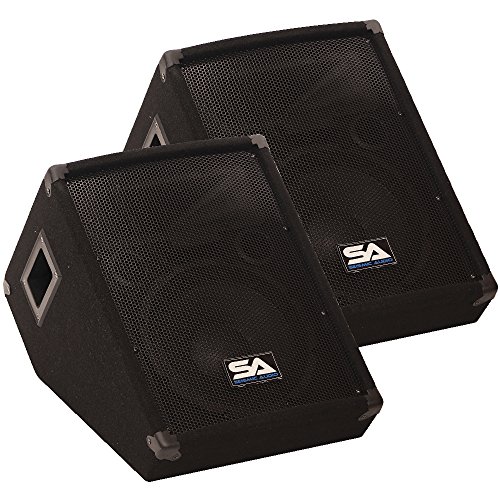
- Pair of 10-inch wedge monitors
- 150 watts RMS per speaker
- Titanium compression horn driver
Best For: Bands and venues needing two floor monitors
Best High-Power Feedback-Control Monitor

- 300-watt two-way powered design
- 12-inch woofer with compression driver
- Feedback filter, limiter, and sound processor
Best For: Live use requiring extra output and control
Best Bluetooth Stage Monitor

- 350-watt powered 10-inch speaker
- Built-in two-channel mixer
- Bluetooth streaming and TWS linking
Best For: Mobile performers and events needing flexible connectivity
High-Sensitivity Classic

- 12-inch woofer with 1-inch compression driver
- 300W program / 600W peak handling
- Built-in pole socket and 97dB sensitivity
Best For: Passive stage-monitoring rigs needing high output
Compact All-in-One

- Powered 10-inch two-way stage monitor
- 300W amplifier with three-band EQ
- XLR, 1/4-inch, and 1/8-inch inputs
Best For: Small venues and simple powered monitoring setups
Powerful Coaxial Active

- 800W Class D active monitor
- 10-inch woofer with 1-inch tweeter
- Combo input, link output, and FOH/Monitor switch
Best For: High-output live, DJ, and sound-engineering setups
Compact Live-Sound Monitor

- 10-inch woofer with 1-inch compression tweeter
- 150W RMS/300W peak at 8 ohms
- Parallel 1/4-inch jacks for daisy chaining
Best For: Compact bar, church, and small live-sound setups
High-Output Stage Wedge
Rockville RSM15P 15-inch Monitor

- 15-inch woofer and 1.75-inch titanium driver
- 1,400W peak power handling
- 70-by-50-degree horn coverage
Best For: High-volume DJ, PA, and touring applications
Matched Monitor Pair

- Two 12-inch passive wedge monitors
- 1,000W peak per cabinet
- Speakon and 1/4-inch input/thru connectors
Best For: Bands, worship spaces, DJs, and two-monitor stage setups
Best Value Powered Stage Monitor – Behringer EUROLIVE F1220D
The Behringer EUROLIVE F1220D is a practical powered option for stage monitors when you want a compact, self-contained setup. Its 12-inch woofer, 250-watt output, Class-D amplifier, adjustable feedback filter, and integrated limiter provide useful control for live performances and music playback.
Best For: Performers and small live setups needing a powered 12-inch monitor with feedback control.
Pros:
- 12-inch woofer with 250-watt maximum output
- Adjustable feedback filter and integrated limiter
- Class-D amplification keeps the cabinet relatively light at 23.6 pounds
- Supports XLR, 1/4-inch, RCA, and Speakon connectivity
Cons:
- Not waterproof or water resistant
- Designed for corded operation
The F1220D stands out as a straightforward, feature-focused monitor for users who value feedback management and flexible wired connections over wireless convenience.
Best Pair of Passive Stage Monitors – Seismic Audio SA-10MT
Seismic Audio - SA-10MT - Pair of 10" Floor / Stage Monitors Wedge Style with Titanium Horn
Check Price On AmazonThe Seismic Audio SA-10MT provides two wedge-style stage monitors for buyers building a stereo or multi-performer monitoring setup. Each 10-inch, two-way speaker is rated at 150 watts RMS and includes a titanium compression horn for projecting vocals and instruments across a live performance area.
Best For: Bands, venues, and event setups that need a pair of floor-mounted passive stage monitors.
Pros:
- Includes two 10-inch wedge-style monitors
- 150 watts RMS and 300 watts peak per speaker
- 40-ounce woofer magnet with a 2-inch voice coil
- Titanium compression horn driver for high-frequency output
Cons:
- Passive design requires suitable external amplification
- Heavier overall package at 44 pounds
- Not waterproof or water resistant
The SA-10MT is a sensible choice when quantity and floor coverage matter. Its included pair can simplify monitoring for multiple performers, but the passive format adds an amplifier requirement to the system.
Best High-Power Feedback-Control Monitor – Behringer EUROLIVE F1320D
The Behringer EUROLIVE F1320D is built for buyers who want extra output from powered stage monitors. This 300-watt, two-way design combines a 12-inch woofer with a 1-inch compression driver, an adjustable feedback filter, an integrated limiter, and a sound processor for live and playback applications.
Best For: Live performers and playback users who need a higher-powered powered monitor with built-in system protection.
Pros:
- 300-watt two-way powered monitor system
- 12-inch woofer and 1-inch compression driver
- Adjustable feedback filter, limiter, and integrated sound processor
- Built-in three-band EQ for tonal adjustment
Cons:
- Heavier than the F1220D at 33.1 pounds
- Not waterproof or water resistant
- Requires corded power
With its higher rated output and additional processing features, the F1320D is a strong fit for users who want more control and headroom from a single powered monitor.
Best Bluetooth Stage Monitor – Alto TX410
The Alto TX410 is a versatile powered speaker that works well as one of the more flexible stage monitors in this group. Its 10-inch woofer, 350-watt bi-amplified system, built-in two-channel mixer, Bluetooth streaming, and wedge-monitor configuration support performances, presentations, DJs, and mobile setups.
Best For: Mobile performers and event users who want powered monitoring with Bluetooth and mixer functionality.
Pros:
- 350-watt bi-amplified output with a 10-inch woofer
- Built-in two-channel mixer for microphone, line, and Bluetooth inputs
- Bluetooth streaming and True Wireless Stereo support
- Can be used as a wedge monitor or pole-mounted speaker
Cons:
- Not waterproof or water resistant
- Bluetooth operation depends on compatible devices and wireless range
- Specified for 100/120V power systems
The TX410 is the most connectivity-focused option here. It makes setup easier for mobile applications while retaining the physical flexibility of a speaker designed for both floor-monitor and pole-mounted use.
High-Sensitivity Classic – Yamaha BR12M
The Yamaha BR12M is a passive 12-inch option for stage monitors when you already have an amplifier or powered mixer. Its 300W program rating, 600W peak handling, 97dB sensitivity, and 90° x 40° horn support strong, focused coverage for live performances and sound reinforcement.
Best For: Performers and venues needing a high-output passive wedge with stand-mount flexibility.
Pros:
- 12-inch woofer and 1-inch titanium compression driver provide a broad two-way design.
- 300W program and 600W peak power handling suit demanding stage-monitoring setups.
- Built-in pole socket, steel handles, corner protectors, and protection circuitry improve versatility and durability.
Cons:
- Requires an external amplifier or powered mixer.
- Its 12-inch cabinet is less compact than the smaller active monitors in this roundup.
- Wired operation offers no wireless connectivity.
The BR12M is a practical choice when you want dependable passive stage monitors with high sensitivity and substantial power handling. Choose it if your rig already includes suitable amplification and you value a larger woofer and pole-mount option.
Compact All-in-One – Sound Town METIS-10MPW
The Sound Town METIS-10MPW is a powered 10-inch monitor for stage setups that need amplification built in. Its 300W amplifier, three-band EQ, and multiple input and output options make it a flexible choice for rehearsals, small venues, bars, churches, and live performances.
Best For: Small-venue performers and users who want compact stage monitors without a separate power amplifier.
Pros:
- Integrated 300W amplifier simplifies setup and reduces external equipment.
- Offers XLR input and link output plus 1/4-inch auxiliary and 1/8-inch MP3 inputs.
- Onboard bass, mid, and treble controls allow quick tonal adjustments.
- Recessed handle, metal grille, carpet covering, and reinforced corners support transport.
Cons:
- Its 10-inch woofer is smaller than the Yamaha BR12M’s 12-inch driver.
- Not water resistant.
- Specified 8-ohm impedance may require attention when integrating with other equipment.
The METIS-10MPW offers a useful balance of portability, connectivity, and straightforward control. It is especially convenient when you need an active wedge for modest stage volumes and want to connect several common audio sources directly.
Powerful Coaxial Active – Samson RSXM10A
The Samson RSXM10A is an active 10-inch coaxial monitor built for live performances, DJ booths, and sound engineering. With 800W of output, a Class D amplifier, an XLR/1/4-inch combo input, and an XLR link output, it suits users who want high powered stage monitors in a relatively compact format.
Best For: Live performers, DJs, and engineers seeking an active monitor with high output and flexible signal routing.
Pros:
- 800W output provides substantial headroom for stage-monitoring applications.
- Coaxial 10-inch woofer and 1-inch tweeter deliver a compact two-way design.
- XLR/1/4-inch combo input and XLR link output support flexible connections and daisy chaining.
- FOH/Monitor selector and 1 3/8-inch pole receptacle add setup flexibility.
Cons:
- At 30 pounds, it is heavier than some compact monitor options.
- Its listed 55Hz frequency response may not satisfy users seeking extended low-end coverage.
- Not waterproof and requires corded power.
The RSXM10A stands out for output and routing flexibility rather than minimum weight. Its coaxial layout, selector switch, and pole mount make it a versatile active wedge for performers and small production systems that need plenty of power.
Compact Live-Sound Monitor – Sound Town METIS-10M
The Sound Town METIS-10M is a compact passive option for stage monitors, using a 10-inch woofer and 1-inch compression tweeter in a floor-standing wedge design. Its 8-ohm, 150W RMS/300W peak handling suits smaller live-sound setups, while parallel 1/4-inch jacks simplify daisy chaining.
Best For: Bands, churches, bars, and portable live-sound setups that need a manageable passive floor monitor.
Pros:
- 10-inch woofer paired with a 1-inch compression tweeter.
- 150W RMS and 300W peak power handling at 8 ohms.
- Parallel 1/4-inch jacks support easy connections between monitors.
- Carpet finish, metal grille, reinforced corners, and a recessed side handle support portability.
Cons:
- Passive design requires an amplifier or powered mixer.
- Not waterproof for exposed outdoor use.
- Its 10-inch format may provide less low-end output than larger monitors.
The METIS-10M emphasizes straightforward connectivity and portability rather than maximum output. It is a practical fit when you want a compact wedge for vocals or general stage monitoring in a modest-sized system.
High-Output Stage Wedge – Rockville RSM15P 15-inch Monitor
The Rockville RSM15P is a large passive choice for stage monitors, combining a 15-inch woofer with a 1.75-inch titanium compression driver and up to 1,400 watts peak handling. Its angled wedge cabinet, broad horn coverage, and dual 1/4-inch and Speakon connections make it suited to demanding DJ, PA, and live-event systems.
Best For: DJs, touring performers, and event systems that prioritize high output and wide stage coverage.
Pros:
- 15-inch woofer and 1.75-inch titanium compression driver deliver substantial output.
- 1,400 watts peak power handling supports high-volume applications.
- 70-by-50-degree horn coverage helps distribute sound across the stage.
- Dual 1/4-inch and Speakon input/output connectors provide flexible system integration.
Cons:
- At 54.9 pounds, it is less convenient to transport than smaller monitors.
- Passive operation requires external amplification.
- It has no stated warranty and is not waterproof.
The RSM15P is built for output and physical durability, with an MDF cabinet, steel grille, carpet finish, and ergonomic handles. Choose it when your stage-monitoring system needs the scale of a 15-inch enclosure and portability is a secondary concern.
Matched Monitor Pair – Rockville RSM12P 2-Pack
The Rockville RSM12P two-pack provides a matched pair of 12-inch passive stage monitors for performers who need consistent coverage across a set. Each wedge combines a 12-inch woofer, 1-inch titanium compression horn, 8-ohm impedance, and 1,000-watt peak handling, with Speakon and 1/4-inch input and thru connections for flexible cabling.
Best For: Bands, houses of worship, DJs, and small event rigs needing two coordinated floor wedges.
Pros:
- Two matched 12-inch monitors are included for consistent stage coverage.
- Each cabinet handles up to 1,000 watts peak, with 250W RMS and 500W program ratings listed.
- Speakon and 1/4-inch input/thru connectors support daisy chaining.
- Wedge cabinets include steel grilles, recessed handles, rubber feet, and aviation-grade carpet.
Cons:
- Passive cabinets require a compatible amplifier or powered mixer.
- The two-speaker package is less suitable if only one monitor is needed.
- They are not waterproof for unprotected outdoor placement.
This package balances system consistency with practical stage flexibility. The 12-inch format offers more scale than a compact 10-inch wedge, while the included pair makes it easier to create separate vocal, instrument, or cue mixes across a performance area.
How We Picked These Stage Monitors
We selected these monitors to cover the most common live-sound needs, from compact 10-inch wedges and powered all-in-one designs to larger passive cabinets for higher output. The lineup includes powered models with built-in amplification, passive speakers that require an external amplifier, and pairs for performers who need more even coverage across a stage.
Our comparison focuses on practical specifications and setup considerations: woofer size, stated power handling, two-way design, compression drivers or horns, feedback-reduction features, portability, and value. Because published wattage can be measured differently between manufacturers, treat power ratings as a starting point rather than a direct apples-to-apples performance guarantee.
Quick Comparison
- Best for simple setups: Powered monitors such as the Behringer, Alto, Sound Town, and Samson models include amplification in the cabinet.
- Best for flexible systems: Passive Yamaha, Sound Town, and Rockville monitors work with a suitable external power amplifier.
- Best for compact stages: 10-inch wedges are easier to carry and typically provide focused near-field monitoring.
- Best for fuller low end: 12- and 15-inch models can move more air, which may help bass-heavy music but adds size and weight.
- Best for multiple performers: A pair can improve left-to-right coverage and give singers or musicians more consistent sound.
Key Buying Factors for Stage Monitors
Powered or Passive Design
Powered monitors are usually the easiest choice for quick setups because they only need signal and AC power. Passive models can be lighter and integrate well with an existing amplifier, mixer, or distributed sound system, but the amplifier must match the speaker’s impedance and power requirements.
Speaker Size and Coverage
A 10-inch monitor is often a practical balance for vocals, keyboards, acoustic instruments, and smaller stages. A 12-inch cabinet offers more low-frequency presence, while a 15-inch design may suit larger stages or performers who need stronger bass response. Larger does not automatically mean clearer, especially at close range.
Feedback Control and Connections
Look for feedback filters, practical input and output connections, and controls that match your mixer. Place wedges so their coverage pattern points toward the performer while the rear of the microphone is aimed toward the cabinet’s least sensitive area. Good placement is often as important as speaker power.
Portability and Durability
Check cabinet dimensions, weight, handles, grille protection, and wedge stability before buying. For frequent gigging, a slightly smaller monitor that is easy to carry may be more useful than a larger cabinet that rarely leaves the rehearsal space.
Who Should Buy Which Stage Monitors?
Choose a powered 10-inch monitor if you want a compact, straightforward solution for vocals, solo performance, DJ use, or small venues. Choose a powered 12-inch model when you need more headroom and low-end support without adding an external amplifier.
Choose passive monitors if you already own compatible amplification or want to build a centralized PA system. Choose a pair when several performers need dependable coverage or when one wedge leaves uneven sound across the stage. Before ordering, confirm amplifier compatibility, connector types, available AC power, and the return policy for bulky equipment.