The right encoder can turn a camera, switcher, or computer into a dependable live-streaming setup without adding unnecessary complexity. For home studios, the best choice balances video quality, connection options, streaming protocols, and ease of use.
This roundup covers compact HDMI models, professional SDI units, NDI-capable hardware, and all-in-one systems so you can match your encoder to your studio workflow, platform, and budget.
Best 10 Streaming Encoders for Home Studios Picks for 2026
Flexible Network Streaming

- 4K H.264/H.265 encoding
- Four simultaneous protocol outputs
- Custom text, logos, and video adjustments
Best For: Multi-platform home studios using HDMI sources
Broadcast-Ready Connectivity

- SDI input with loop-through
- Supports 1.5G to 12G SDI rates
- USB-C webcam output and Ethernet
Best For: SDI-equipped home studios and small broadcasts
All-in-One Live Production

- Built-in 4K encoder and switcher
- Four HDMI inputs with touchscreen control
- Horizontal, vertical, and ISO recording workflows
Best For: Multi-camera creators who want laptop-free production
Compact NDI Workflow

- NDI, SRT, RTMP(S), and RTSP support
- 4K HDMI passthrough and IP decoding
- PoE, USB-C power, and tripod mounting
Best For: Compact NDI, gaming, and network-video setups
Best Broadcast-Ready Pick
Blackmagic Streaming Encoder 4K
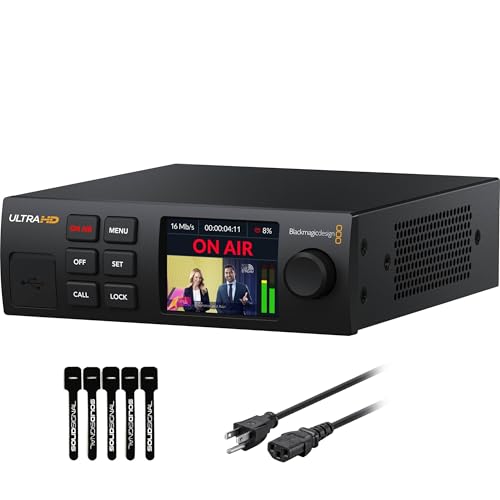
- 4K60 H.264/H.265 encoding via SRT or RTMP
- 12G-SDI with standards conversion and monitor outputs
- Ethernet-to-mobile auto-failover and webcam output
Best For: SDI-based studios and dependable 4K live production
Best HDMI Workflow Pick
Magewell Ultra Encode HDMI Plus

- 4K HDMI encoding with loop-through monitoring
- Streams to multiple destinations using modern protocols
- Simultaneous streaming and recording with 128GB storage
Best For: HDMI studios needing recording and IP workflow flexibility
Best Multi-Output Value

- One 4K30 or four simultaneous 1080p30 outputs
- H.264, H.265, and MJPEG encoding with HDMI loop-out
- OLED status display and broad streaming protocol support
Best For: Multi-output HDMI streaming on a practical studio budget
Best Professional SDI Pick

- 4K SDI encoding up to 4096×2160p30
- Multi-protocol, multi-destination streaming
- Simultaneous streaming and 128 GB recording
Best For: Professional SDI-based home studios
Best Dual-Channel Value

- HDMI 2.0 and 12G-SDI inputs
- Dual-channel streaming to two platforms
- Wi-Fi 6, PoE, and local TF/USB recording
Best For: Mixed HDMI/SDI studios and dual-platform broadcasts
Best HDMI/SDI All-in-One

- HDMI and SDI dual-input mixing
- Streaming to up to six destinations
- 4K encoding with local and network recording
Best For: Advanced multi-source home studio productions
Flexible Network Streaming – 4K HDMI Encoder
For home studios needing flexible streaming encoders, the URayCoder UHE265-1L-4K converts an HDMI source into network streams using H.264 or H.265. It supports 4K input and output at up to 30fps, plus multiple streaming protocols for distributing content to platforms such as YouTube, Facebook, Twitch, and Vimeo.
Best For: Home studios that need multi-platform streaming, customizable overlays, and broad protocol support from an HDMI source.
Pros:
- Supports 4K at up to 30fps and up to 120fps at 2K or lower resolutions.
- Can output up to four streams using different protocols simultaneously.
- Offers text, logo, timestamp, cropping, rotation, and mirroring options.
- Includes HDMI and line-in audio support plus lifetime warranty and technical support.
Cons:
- It is focused on HDMI-to-network encoding rather than built-in switching or recording.
- Its extensive protocol and customization options may require more setup than a simplified streaming device.
This is a strong choice when protocol flexibility and stream customization matter more than an all-in-one production interface. Its 4K support and simultaneous outputs make it particularly adaptable for a connected home-studio workflow.
Broadcast-Ready Connectivity – Blackmagic Web Presenter HD
Blackmagic Design Web Presenter HD Bundle with Power Cord and HDMI Cable with Ethernet, 3 Feet
Check Price On AmazonThe Blackmagic Design Web Presenter HD Bundle is a compact option among streaming encoders for home studios that already use SDI equipment. It provides SDI input and loop-through, monitor outputs, Ethernet connectivity, and a USB-C webcam output for compatible streaming setups.
Best For: Home studios and small broadcast setups built around SDI video gear that need monitoring and USB-C connectivity.
Pros:
- Includes an SDI video input and SDI loop output.
- Supports SDI rates from 1.5G through 12G.
- Provides SDI, HDMI, Ethernet, and USB-C connectivity.
- Bundle includes a power cord and 3-foot HDMI cable.
Cons:
- Its listed video input is SDI, so HDMI-only setups may need additional conversion.
- The supplied notes do not describe built-in multi-camera switching or recording.
This model makes the most sense for creators whose studio already relies on SDI connections. It prioritizes professional signal compatibility and monitoring rather than an all-in-one touchscreen production workflow.
All-in-One Live Production – YoloBox Ultra
The YoloLiv YoloBox Ultra combines a 4K encoder, switcher, recorder, and 8-inch touchscreen in one unit. For home studios seeking streaming encoders with hands-on production controls, it supports multiple HDMI sources, horizontal and vertical streaming, overlays, instant replay, and network bonding.
Best For: Creators, churches, educators, and small productions that want multi-camera switching and streaming without a laptop or separate capture software.
Pros:
- Combines encoding, switching, recording, and monitoring in one device.
- Accepts four HDMI sources plus USB-C and USB-A devices.
- Supports horizontal and vertical platform streaming, including RTMP destinations.
- Offers cellular bonding with up to five network connections and ISO recordings.
Cons:
- Cellular bonding involves additional charges.
- The device has a one-year manufacturer warranty rather than the lifetime coverage listed for some alternatives.
- Its larger feature set may be more than needed for a single-camera studio.
Choose the YoloBox Ultra when production flexibility is a priority. Its touchscreen workflow and source switching can reduce the amount of equipment needed, while ISO recording adds useful control for post-production.
Compact NDI Workflow – ZowieBox 4K Encoder
The ZowieBox is a compact choice among streaming encoders for home studios using HDMI, NDI, or network-based workflows. It can encode HDMI to NDI, RTMP(S), RTSP, or SRT, decode IP streams back to HDMI, and provide zero-lag HDMI passthrough for compatible gameplay and video setups.
Best For: Compact studios, gaming setups, and creators building NDI or SRT workflows around HDMI sources.
Pros:
- Supports NDI|HX3, NDI|HX2, NDI|HX, SRT, RTMP(S), and RTSP workflows.
- Provides 4K HDMI passthrough and supports up to 4K at 30fps decoding.
- Can be managed through a web interface on a computer, phone, or tablet.
- Supports USB-C power, PoE, DC output, and tripod mounting.
Cons:
- Encoder and decoder modes cannot operate simultaneously.
- Full NDI signals are not supported.
- USB capture-card functionality is not currently supported.
ZowieBox is best suited to users who value a small, adaptable bridge between HDMI and IP video. Its NDI and SRT support are useful for networked production, while the passthrough design keeps source monitoring practical.
Best Broadcast-Ready Pick – Blackmagic Streaming Encoder 4K
For home studios that need dependable, high-resolution streaming without a dedicated encoding computer, this Blackmagic unit is a powerful option among streaming encoders for home studios. It supports H.264 and H.265 encoding up to 2160p60, accepts 12G-SDI, and can stream through SRT or RTMP.
Best For: SDI-based home studios, live productions, and creators who need 4K60 streaming with backup connectivity.
Pros:
- Supports H.264 and H.265 streaming up to Ultra HD 2160p60.
- 12G-SDI input, loop output, and Teranex standards conversion support flexible video sources.
- Ethernet and USB-C smartphone tethering include automatic failover.
- Provides webcam outputs, closed-caption embedding, timecode, and REST API control.
Cons:
- Its SDI-focused design may be more than an HDMI-only home studio needs.
- Advanced broadcast features can add setup complexity for beginners.
This is the most production-oriented choice of the group. Choose it when SDI compatibility, 4K60 support, and connection redundancy matter more than a simple plug-and-stream setup.
Best HDMI Workflow Pick – Magewell Ultra Encode HDMI Plus
The Magewell Ultra Encode HDMI Plus is a versatile choice for HDMI-centered streaming encoders for home studios. It can encode up to 4096×2160p30, pass the signal through to a monitor or switcher, stream to multiple destinations, and record at the same time.
Best For: HDMI camera, gaming, and production setups that need recording, overlays, and flexible network delivery.
Pros:
- Supports 4K HDMI encoding up to 4096×2160p30 with loop-through monitoring.
- Streams using RTMP, RTMPS, SRT, NDI|HX, HLS, and TS over UDP/RTP.
- Can stream and record simultaneously to internal 128GB storage, USB, or network locations.
- Includes Gigabit Ethernet with PoE, Wi-Fi, and support for USB 4G/5G modems.
Cons:
- 4K encoding is limited to 30 frames per second.
- 4G/5G USB modems are supported but not included.
For an HDMI-first studio, this offers an unusually broad feature set in a compact enclosure. Its combination of multi-protocol streaming, local recording, overlays, and NDI|HX makes it a strong fit for hybrid live-and-record workflows.
Best Multi-Output Value – ORIVISION 4K HDMI Encoder
This ORIVISION encoder is a practical budget-oriented option among streaming encoders for home studios, especially when one HDMI source needs to feed several 1080p streams. It can also operate in a single 4K30 mode and supports common delivery protocols including RTMP, RTMPS, SRT, RTSP, and HTTP.
Best For: Home studios, online teaching, IPTV, and live events needing multiple simultaneous 1080p outputs.
Pros:
- Offers either one 4K30 stream or four simultaneous 1080p30 streams.
- Supports H.265, H.264, and MJPEG encoding with HDMI loop-out.
- OLED display shows the IP address, resolution, and encoding status.
- Includes image flipping, OSD overlays, audio-only encoding, and ONVIF compatibility.
Cons:
- 4K input requires selecting the 4K EDID option in the web interface.
- It has one HDMI input and does not offer the broader connectivity of the other models.
- The supplied details list both a three-year limited warranty and a one-year warranty, so coverage should be verified.
The defining advantage is output flexibility: use one 4K stream or distribute four 1080p feeds from the same source. It is worth considering when multi-channel delivery is more important than premium broadcast control or 4K60 capability.
Best Professional SDI Pick – Ultra Encode SDI Plus
For home studios built around SDI cameras or switchers, the Magewell Ultra Encode SDI Plus is a highly capable choice among streaming encoders for home studios. It supports 4K SDI input, multiple streaming protocols, local recording, and flexible network connectivity in a compact standalone design.
Best For: Home studios using professional SDI equipment, NDI|HX workflows, or multi-destination streaming.
Pros:
- Encodes SDI video up to 4096×2160p30 using H.264 or H.265.
- Supports RTMP, RTMPS, SRT, NDI|HX, HLS, and TS over UDP/RTP.
- Streams and records simultaneously to internal, USB, or network storage.
- Includes overlays, scaling, cropping, de-interlacing, PoE, and Wi-Fi.
Cons:
- Its SDI-only video input limits compatibility with HDMI-based cameras.
- Some home creators may not need its broadcast-oriented controls and protocols.
The Ultra Encode SDI Plus is a strong fit when reliability, SDI compatibility, and professional workflow flexibility matter more than a beginner-focused setup. Its 128 GB internal storage and broad protocol support also make it useful for recording and contribution work.
Best Dual-Channel Value – CNDLive C6 4K Encoder
The CNDLive C6 gives home creators a flexible option among streaming encoders for home studios, combining HDMI 2.0 and 12G-SDI inputs with Wi-Fi 6, PoE, and dual-channel encoding. It is designed for live streaming while also recording locally to TF card or USB storage.
Best For: Studios that need HDMI and SDI connectivity, dual-platform streaming, and convenient PoE networking.
Pros:
- Supports both 12G-SDI and HDMI 2.0 inputs.
- Can encode and stream to two platforms simultaneously.
- Includes NDI|HX3, SRT, RTMP, H.265, and H.264 support.
- Records while streaming to TF card or USB storage.
Cons:
- The supplied notes do not specify detailed overlay or video-processing features.
- At 3 pounds, it may be less compact than simpler single-input encoders.
With dual-channel operation and both major video-input formats, the C6 is a practical choice for a mixed-camera home studio. Wi-Fi 6 and PoE add installation flexibility, while local recording provides a useful backup during live broadcasts.
Best HDMI/SDI All-in-One – Ultra Encode AIO
The Magewell Ultra Encode AIO is a versatile option among streaming encoders for home studios that use more than one video source. It accepts HDMI and SDI, supports dual-input layouts, and can stream to up to six destinations while recording to local or network storage.
Best For: Advanced home studios needing HDMI/SDI flexibility, picture-in-picture production, and multiple streaming destinations.
Pros:
- Accepts HDMI up to 4096×2160p60 and SDI up to 4096×2160p30.
- Combines HDMI and SDI sources in picture-in-picture or side-by-side layouts.
- Streams to up to six destinations using protocols including RTMP, SRT, and NDI|HX2/HX3.
- Supports simultaneous recording, overlays, PoE, Wi-Fi, and API control.
Cons:
- Its rack-mountable form factor and 3.6-pound weight may be more equipment than small studios need.
- Advanced features can add setup complexity for first-time streamers.
The Ultra Encode AIO stands out for studios that want one encoder to handle HDMI, SDI, compositing, and distribution. It is especially compelling for multi-camera or branded productions where six-destination streaming and onboard processing can reduce reliance on additional hardware.
How We Picked the Best Streaming Encoders for Home Studios
We focused on standalone hardware that can accept common studio sources and send live video to platforms, local networks, or production systems. We compared input types, supported resolutions, encoding formats, streaming protocols, recording features, monitoring, networking, and setup flexibility.
Because home studios vary widely, the selection includes simple HDMI encoders alongside more advanced SDI, NDI, PoE, Wi-Fi, and dual-input models. Compatibility with RTMP, RTMPS, SRT, RTSP, HLS, and related workflows was also considered where listed.
Quick Comparison
| Best For | Look For |
|---|---|
| Simple single-camera streaming | HDMI input, RTMP or RTMPS, straightforward setup |
| 4K production | 4K input support, HEVC, sufficient network bandwidth |
| Networked studio workflows | NDI or NDI|HX, Ethernet, and PoE compatibility |
| Professional cameras | SDI input, SRT support, stable wired networking |
| Mobile or flexible setups | Wi-Fi, cellular connectivity, or an integrated touchscreen |
| Multi-source production | Dual inputs, loop-through, mixing, or multiple outputs |
Key Buying Factors for Streaming Encoders for Home Studios
Inputs and Pass-Through
Start with the output on your camera or switcher. HDMI is common for mirrorless cameras and consumer gear, while SDI is better suited to longer cable runs and professional cameras. HDMI loop-through is useful when you need to send the same source to a monitor or capture device.
Resolution, Codec, and Frame Rate
4K support can preserve detail and provide flexibility for downscaled streams, but it does not guarantee a 4K broadcast on every platform. H.264 offers broad compatibility; H.265 can reduce bitrate requirements but may have more limited playback or platform support. Check the exact frame rates and whether 4K applies to input, recording, streaming, or all three.
Protocols and Platform Support
RTMP and RTMPS are widely used for YouTube and similar services. SRT is valuable when you need resilient transmission over less predictable networks, while NDI is designed for IP-based production inside a local network. Confirm the encoder supports your destination and desired workflow before buying.
Network and Control Features
Wired Ethernet is generally the most dependable choice for a permanent studio. Wi-Fi adds flexibility but can introduce interference and congestion. Features such as PoE, remote web control, local recording, status displays, and mobile connectivity can simplify installation and troubleshooting.
Who Should Buy Which Streaming Encoders for Home Studios?
Choose a compact HDMI encoder if you mainly stream one camera or computer source and want the simplest setup. Choose an SDI model for professional cameras, longer cable runs, or a broadcast-oriented studio. Choose an NDI-capable encoder if your production relies on software mixers, network cameras, or other IP video devices.
Choose an all-in-one system when you want switching, monitoring, recording, or vertical and horizontal layouts in one device. For demanding multi-camera studios, prioritize dual inputs, loop-through, SRT, and robust Ethernet connectivity over the lowest purchase price.