When selecting studio monitors, your choice can greatly impact sound accuracy in your workspace. You’ll want to evaluate features like frequency response and connectivity options to find the right fit for your needs. In this guide, we’ll explore some of the best options available, each tailored to different preferences and setups. Let’s uncover which monitors stand out and why they might be the perfect addition to your audio journey.
IK Multimedia iLoud MTM MKII Compact Studio Monitor (Pair)

If you’re serious about achieving accurate sound in your music production, the IK Multimedia iLoud MTM MKII Compact Studio Monitor (Pair) is an excellent choice. With an ultra-flat frequency range of 36 Hz to 32 kHz, you’ll enjoy deep bass and crisp highs, perfect for critical listening and mixing. Its precise time alignment minimizes phase distortion, reducing ear fatigue. Plus, the ARC technology enhances room calibration, correcting acoustic inconsistencies for balanced audio. The X-MONITOR software lets you emulate various reference systems, ensuring your mixes translate well across setups. With 100W power and versatile mounting options, these monitors deliver a superior listening experience.
Best For: Music producers and audio engineers seeking accurate sound for critical listening and mixing.
Pros:
- Ultra-flat frequency range ensures precise audio reproduction for detailed work.
- ARC technology corrects room acoustics for balanced sound in various environments.
- X-MONITOR software allows for versatility in testing mixes across different systems.
Cons:
- Microphone for ARC technology sold separately, adding to the overall cost.
- Compact size may not fill larger rooms effectively without additional monitors.
- Limited bass extension compared to larger studio monitors, which might affect low-end critical mixing.
JBL 305P MkII Active Powered Studio Reference Monitors

The JBL 305P MkII Active Powered Studio Reference Monitors are an excellent choice for both budding producers and seasoned audio engineers seeking precise sound reproduction. With dual 41-watt Class-D amplifiers, a 5-inch woofer, and a 1-inch tweeter, you’ll enjoy deep bass and crisp highs. The patented Image Control Waveguide enhances imaging and offers a wide sweet spot, perfect for detailed mixing. Plus, the Boundary EQ and HF Trim allow for tailored adjustments based on your room’s acoustics. Weighing just 10.43 pounds, these monitors are durable and reliable, making them a top pick for any studio setup.
Best For: The JBL 305P MkII Active Powered Studio Reference Monitors are best for music producers, podcasters, and sound designers seeking accurate sound reproduction in their studio setup.
Pros:
- Excellent sound quality with deep bass and crisp highs due to the dual amplifiers and quality drivers.
- Customizable audio adjustments via Boundary EQ and HF Trim for optimal performance in various room acoustics.
- Durable and reliable construction, rigorously tested for extended performance.
Cons:
- Wired connectivity may limit placement options compared to wireless monitors.
- Not waterproof, requiring careful placement in potentially humid environments.
- Some users may find the 5-inch woofer size limits bass response in larger spaces.
Edifier MR3 Powered Studio Monitor Speakers (Black, Pair)

For those seeking an immersive audio experience, the Edifier MR3 Powered Studio Monitor Speakers stand out with their Hi-Res Audio Certification. Featuring a frequency response from 52Hz to 40kHz and 18W RMS output, these monitors deliver full-range sound with 3.5-inch mid-low drivers and a tweeter. You’ll appreciate the customizable sound modes—Music, Monitor, and Custom—tailoring your listening experience. With Bluetooth V5.4 and multiple connectivity options, including balanced TRS and AUX inputs, you can easily connect to various devices. The MDF cabinet minimizes distortion, making them perfect for audio production or daily listening. Enjoy the user-friendly control via the EDIFIER ConneX app!
Best For: Audio professionals, musicians, and enthusiasts looking for high-quality sound reproduction in a versatile studio monitor setup.
Pros:
- Hi-Res Audio Certification ensuring superior audio quality.
- Customizable sound modes for tailored listening experiences.
- Multiple connectivity options including Bluetooth, TRS, RCA, and AUX for versatile usage.
Cons:
- Limited bass response may not satisfy those seeking deep low-end sounds.
- MDF cabinet might not appeal to users preferring more premium materials.
- App control may require a learning curve for some users unfamiliar with EQ adjustments.
Ortizan C7 Dual-Mode Studio Monitors (Pair)

Designed with versatility in mind, the Ortizan C7 Dual-Mode Studio Monitors are perfect for content creators, gamers, and music enthusiasts seeking accurate sound reproduction. These active speakers feature Bluetooth 5.3 for seamless wireless connectivity and multiple input options—RCA, 3.5mm AUX, and 6.35mm TRS—allowing you to switch effortlessly between different devices. With a 24-bit DAC, you’ll enjoy minimal signal loss and clear audio fidelity. The 3.5-inch carbon fiber speaker and 0.75-inch silk dome tweeter deliver rich mids and smooth highs. Plus, the user-friendly front panel makes connecting your gear and monitoring through headphones a breeze.
Best For: Content creators, gamers, and music enthusiasts seeking accurate sound reproduction in a compact setup.
Pros:
- Versatile connectivity options with RCA, 3.5mm AUX, and 6.35mm TRS inputs for seamless switching between devices.
- High audio fidelity with a 24-bit DAC, ensuring minimal signal loss and clear sound quality.
- User-friendly design featuring a front panel with easy access to AUX inputs and headphone monitoring.
Cons:
- Limited bass response due to the 3.5-inch speaker size, which may not satisfy bass-heavy music genres.
- Active monitors may require a power source, limiting placement flexibility compared to passive speakers.
- Bluetooth connectivity might introduce slight latency, which could be an issue for real-time audio applications.
YAMAHA Hs5 Powered Studio Monitor, Pair

Yamaha HS5 Powered Studio Monitor, Pair stands out as an exceptional choice for musicians and producers seeking precise sound reproduction. With a 5-inch cone woofer and a 1-inch dome tweeter, it delivers a frequency response from 54 Hz to 30 kHz. The bi-amplified design, featuring 70 watts of power, guarantees accurate mixing without coloring your sound. Built from MDF and polypropylene, these monitors provide a flat response and high resolution. Plus, with a stellar 4.8 out of 5 stars from customer feedback, they’re highly rated for studio monitoring. Their versatile connectivity options make them compatible with various devices, enhancing your music production experience.
Best For: Musicians and producers seeking precise sound reproduction for accurate mixing and music production.
Pros:
- High-quality sound with a flat response for accurate monitoring.
- Compact design ideal for small studio spaces.
- Versatile connectivity options, including XLR and TRS inputs.
Cons:
- Limited low-frequency response compared to larger monitors.
- No built-in Bluetooth for wireless connectivity.
- May require a subwoofer for enhanced bass performance.
Edifier MR4 Powered Studio Monitor Speakers (Black, Pair)
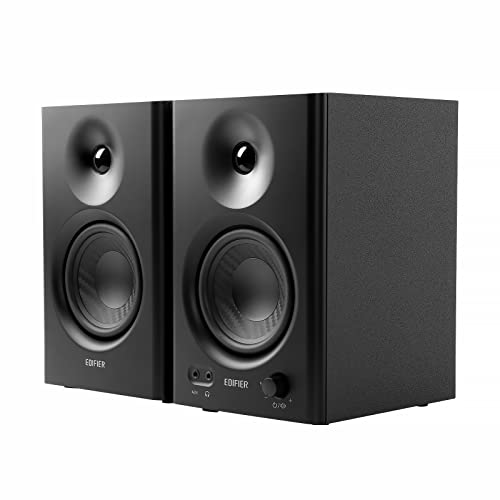
The Edifier MR4 Powered Studio Monitor Speakers are an excellent choice for anyone seeking studio-quality sound in a compact design. With a 4-inch composite woofer and a silk dome tweeter, you’ll enjoy clear and smooth audio across a frequency response of up to 20 kHz. Weighing 4500 grams, these monitors feature flexible connectivity options, including balanced TRS and RCA inputs, perfect for various devices. The user-friendly controls let you easily adjust high and low frequencies, while the dual mode design caters to both music production and relaxation. Backed by a 2-year warranty, these monitors are a reliable choice for any studio setup.
Best For: The Edifier MR4 Powered Studio Monitor Speakers are best for musicians, producers, and audio enthusiasts seeking high-quality sound in a compact and versatile studio monitor.
Pros:
- Excellent studio-quality sound with clear audio and a wide frequency response.
- Flexible connectivity options for various devices, including computers and mixers.
- User-friendly controls with separate knobs for high and low frequency adjustments.
Cons:
- The weight of 4500 grams may make them less portable.
- Limited maximum output power of 42 Watts may not be sufficient for larger spaces.
- Some users may prefer additional features or connectivity options not included.
Edifier MR5 2.0 Studio Monitor Bookshelf Speakers

If you’re seeking studio monitors that deliver precise sound reproduction, the Edifier MR5 2.0 Studio Monitor Bookshelf Speakers stand out with their impressive 3-way active crossover system. With a 5″ long-throw woofer, 3.75″ mid driver, and 1″ silk dome tweeter, you’ll experience a frequency response of 46Hz–40kHz, ensuring accurate audio. The Bluetooth 6.0 connectivity and versatile input options, including XLR and AUX, offer flexibility for your setup. Plus, the EDIFIER ConneX app allows for advanced room tuning. With 110W RMS power, these monitors fill mid-sized rooms effortlessly and provide a tailored listening experience you won’t want to miss.
Best For: Audiophiles and music producers seeking high-quality sound reproduction in studio environments.
Pros:
- High-Resolution Audio: Supports 24-bit/96kHz wired and wireless streaming for exceptional sound quality.
- Room Acoustic Tuning: Features adjustable knobs and an app for customizing sound based on room acoustics.
- Versatile Connectivity: Multiple input options including Bluetooth, XLR, TRS, and RCA for flexible setup.
Cons:
- Size: May be too large for very small spaces or casual listening environments.
- Price Point: Higher cost compared to standard speakers may not appeal to budget-conscious consumers.
- Rear Knob Placement: Physical knobs for frequency adjustments may be less convenient to access in certain setups.
PreSonus Eris E5 2-Way 5.25″ Near Field Studio Monitor

For those seeking precision in their audio production, the PreSonus Eris E5 2-Way 5.25″ Near Field Studio Monitor stands out with its impressive frequency response, reaching up to 22 kHz. Weighing just 10.2 pounds and measuring 7.7D x 7W x 10.2H inches, it’s perfect for any studio setup. The 5.25-inch woven composite woofer and 1-inch silk-dome tweeter deliver clear, balanced sound. With 80 watts of power, you’ll enjoy a maximum continuous SPL of 102 dB. Its acoustic tuning controls let you customize the sound for your environment, ensuring your mixes translate accurately across devices.
Best For: Audio professionals and enthusiasts seeking high-quality, accurate sound reproduction in a compact studio monitor.
Pros:
- Clear and balanced audio with a frequency response up to 22 kHz, ideal for mixing and mastering.
- Customizable sound tuning features allow for adjustments based on the acoustics of your mixing environment.
- Compact design makes it suitable for small studio spaces while still delivering powerful performance.
Cons:
- Limited low-end response compared to larger studio monitors, which may require a subwoofer for bass-heavy genres.
- Wired connectivity only, which may not suit those preferring wireless audio solutions.
- Weight may be a consideration for portability, as it is heavier than some small studio monitors.
KRK RP5G5 ROKIT 5 Generation Five 5″ Powered Studio Monitor Pair

Designed for both aspiring musicians and seasoned audio professionals, the KRK RP5G5 ROKIT 5 Generation Five studio monitors deliver impressive sound accuracy and clarity. With custom-designed Class D amplifiers and a 1” silk dome tweeter, you’ll experience enhanced high frequencies. The 5” woven Kevlar woofer ensures superior damping and modal control. Plus, the low diffraction baffle minimizes distortion for better stereo imaging. You’ll appreciate the three onboard DSP voicing modes and 25 room tuning EQ settings, allowing for precise acoustic adjustments. Compatible with various devices, these monitors come with a three-year warranty, making them a dependable choice for any studio setup.
Best For: The KRK RP5G5 ROKIT 5 Generation Five studio monitors are best for aspiring musicians and seasoned audio professionals seeking accurate sound reproduction for music production and mixing.
Pros:
- Impressive sound accuracy with custom-designed Class D amplifiers and a silk dome tweeter for enhanced high frequencies.
- Versatile connectivity options including XLR and 1/4” TRS combo inputs, making them compatible with various audio devices.
- User-friendly setup with 25 room tuning EQ combinations and a free app for precise acoustic adjustments.
Cons:
- Limited power output of 82 Watts may not be sufficient for larger studio spaces.
- Molded plastic enclosure might not appeal to users seeking a more premium aesthetic.
- Higher frequency response range might not be necessary for all users, potentially leading to a preference for different models.
PreSonus Eris 4.5BT Bluetooth Studio Monitors (Pair)

The PreSonus Eris 4.5BT Bluetooth Studio Monitors are an excellent choice for multimedia enthusiasts and budding audio professionals alike, thanks to their impressive 50W Class A/B power output and high-quality sound reproduction. With 4.5-inch woven-composite drivers, you’ll enjoy powerful bass and clear highs from the 1-inch silk-dome tweeters. Bluetooth 5.0 connectivity allows for high-quality wireless streaming, while versatile inputs cater to both professional and consumer devices. You can easily customize your listening experience with acoustic tuning controls. Plus, the built-in headphone amp and energy saver mode add convenience, making these monitors a fantastic addition to your audio setup.
Best For: Multimedia enthusiasts and budding audio professionals looking for high-quality sound and versatile connectivity options.
Pros:
- Clear, accurate, studio-quality sound with powerful bass and articulate highs.
- Bluetooth 5.0 for high-quality wireless audio streaming and versatile input options.
- Customizable acoustic tuning controls and built-in headphone amp for enhanced listening experiences.
Cons:
- Limited low-end response without a subwoofer for those seeking more bass.
- Size may be too compact for larger studio setups or those desiring larger speakers.
- Some users may prefer a more robust build quality for professional use.
Factors to Consider When Choosing Studio Monitors for Accurate Sound
When you’re choosing studio monitors for accurate sound, there are several key factors to keep in mind. You’ll want to take into account the frequency response range, power output, and any room calibration features. Additionally, connectivity options and build quality can greatly impact your overall listening experience.
Frequency Response Range
Choosing studio monitors with the right frequency response range is fundamental for achieving accurate sound reproduction. The frequency response, measured in Hertz (Hz), indicates the range of sounds your monitors can reproduce, covering everything from deep bass to high treble. Ideally, you want an ultra-flat frequency response, such as 36 Hz to 32 kHz, to guarantee all audio frequencies are faithfully represented without any coloration. A wider range enhances your listening experience, providing deeper bass and clearer highs, which is critical for detailed music production. Monitors that extend to at least 20 kHz capture the full spectrum of human hearing, essential for evaluating mixes accurately. This accuracy also helps minimize phase distortion and ear fatigue, allowing for longer, more enjoyable listening sessions.
Power Output and Amplification
Power output and amplification are vital factors in selecting studio monitors that deliver accurate sound. Look for monitors with power outputs ranging from 50 to over 100 watts per speaker, ensuring they can play loudly without distortion. The type of amplification matters too; Class D amplifiers are popular for their lightweight design and efficiency, while still providing ample power. Consider the size of the woofers and tweeters: larger woofers create deep bass, while smaller tweeters deliver crisp highs. It’s important to match the monitors’ power output to your room size, filling the space without overwhelming it. Finally, bi-amplification, where separate amplifiers drive the woofer and tweeter, can enhance clarity and minimize distortion across the frequency spectrum.
Room Calibration Features
Understanding your room’s acoustics is just as important as evaluating power output and amplification when selecting studio monitors. Room calibration features can correct acoustic inconsistencies by adjusting the monitor’s output based on your specific space. Advanced technologies like ARC (Advanced Room Correction) greatly enhance audio accuracy, tailoring sound reproduction to your environment. Some monitors even offer customizable settings through software, letting you emulate different monitoring setups and test mixes in various acoustic conditions. Proper room calibration reduces phase distortion and ear fatigue, providing a more enjoyable and precise listening experience during critical audio work. Enhanced calibration features guarantee balanced and accurate audio reproduction, making them essential for mixing, mastering, and detailed sound design tasks. Choose wisely for ideal results!
Connectivity Options Available
When selecting studio monitors, the variety of connectivity options can greatly impact your audio setup. Look for models with balanced XLR and 1/4-inch TRS inputs, as they minimize noise and interference, perfect for professional audio applications. Many monitors also include RCA and AUX inputs, offering versatility for connecting consumer electronics and mobile devices. If convenience is a priority, consider monitors with Bluetooth capabilities for easy wireless streaming from your smartphone or tablet. Integrated headphone outputs allow for private listening, ensuring you can monitor without disturbing others. Finally, some monitors enable simultaneous connections with multiple audio devices, which enhances flexibility for tasks like music production, gaming, or multimedia consumption. Choose wisely to fit your specific needs!
Design and Build Quality
The design and build quality of studio monitors are essential factors that directly influence sound accuracy. The enclosure material, like MDF, is critical for reducing resonance and distortion, enhancing overall sound quality. Pay attention to the baffle design; low diffraction designs minimize distortion and improve stereo imaging. To further enhance audio clarity, consider utilizing acoustic foam isolation pads, which help reduce resonance and optimize positioning. A well-constructed speaker cabinet should maintain volume without sacrificing sound integrity, so look for internal bracing that prevents unwanted vibrations. Finally, the physical dimensions and weight of the monitors affect stability and placement, which are significant for achieving accurate sound reproduction during your monitoring sessions.
Size and Positioning Flexibility
Choosing the right size and positioning for studio monitors can greatly enhance your sound experience. Larger monitors typically deliver deeper bass, while smaller ones fit better in compact spaces. Pay attention to positioning; place your monitors at ear level and angle them toward you to minimize phase issues and improve stereo imaging. Many models offer versatile mounting options, allowing you to position them on desks, shelves, or stands to suit your studio setup. Additionally, effective room calibration technology can adjust the monitor output based on their placement, correcting for any acoustic inconsistencies. Remember that monitor size and placement can affect frequency response, so be mindful of proximity to walls or corners to avoid muddy sound.
User-Friendly Controls and Apps
How can user-friendly controls and apps transform your studio monitor experience? When you have separate knobs for high and low frequency adjustments, you can easily contour the sound to fit your mixing environment. Dedicated apps for room compensation and EQ customization enhance your listening experience, catering to various settings. With front-panel headphone outputs and AUX inputs, you can connect devices and monitor privately without reconfiguring your setup. Acoustic tuning controls let you tailor the sound to your room’s acoustics, ensuring accurate audio reproduction. Plus, multi-point Bluetooth connectivity in some models allows you to switch seamlessly between multiple audio devices, boosting usability during your sessions. These features make your workflow smoother and more efficient.