Finding the right USB duplicator under $1,000 means balancing copy speed, target count, drive compatibility, and data-erasure features. The best choice depends on whether you need occasional duplication or repeatable batch production.
We compared 10 affordable duplicators and related drive-copying tools to help you identify the right fit for media distribution, IT deployment, backups, and secure drive sanitization.
Best 10 USB Duplicators Under 1000 Picks for 2026
Compact IT Toolkit

- 1-to-2 standalone copying and erasing
- Up to 1.5 GB/min with Copy & Compare
- LCD monitoring and sector-by-sector mode
Best For: Portable IT maintenance and small USB batches
Seven-Drive Workhorse

- Seven target ports for batch copying
- Up to 2 GB/min without a computer
- Supports synchronous and asynchronous modes
Best For: Routine multi-drive business duplication
High-Volume Flash Station
Vinpower 15-Target USB Duplicator

- 15 target slots for large batches
- Asynchronous copying with Smart and Raw modes
- Secure erase and optional multi-format support
Best For: High-volume flash-media duplication
Sanitization-Focused Batch Copier
Acumen Disc AD07-USB 1:7 Duplicator

- Seven-way copying at up to 35 MB/s
- Four erase modes including DoD three- and seven-pass
- Copy+Compare and standalone LCD operation
Best For: Batch duplication with configurable drive sanitization
Best Dual-Bay HDD Clone Dock

- Clones SATA drives offline
- Supports 2.5- and 3.5-inch HDDs/SSDs
- USB 3.0 and UASP connectivity
Best For: SATA drive cloning and desktop storage access
Best Standalone Multi-Target USB Duplicator
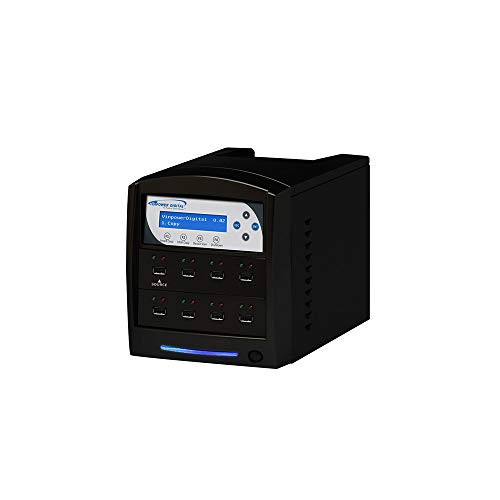
- Copies to seven USB targets
- Operates without a PC
- Includes secure erase and error prescan
Best For: Batch USB duplication in IT and office settings
Best Compact Computer-Connected USB Duplicator

- Duplicates up to 10 USB drives
- Copies from files, folders, images, or drives
- Includes Windows and Mac software
Best For: Flexible batch duplication at a connected workstation
Best Compact Choice
BestDuplicator UB300 1:2 USB Duplicator

- Duplicates one USB drive to two targets
- Quick Copy and bit-for-bit cloning modes
- Portable LCD operation with maintenance tools
Best For: Portable two-target USB duplication
Best High-Volume USB Pick
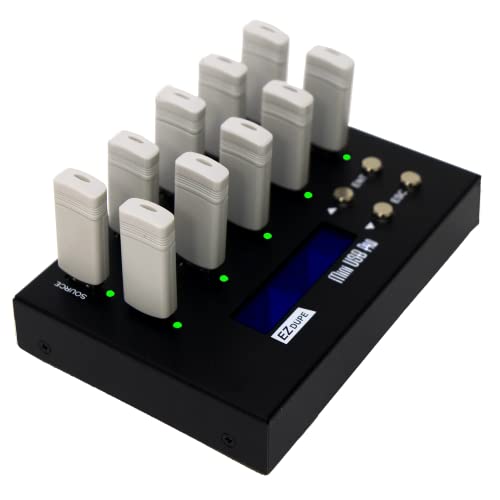
- Copies to up to nine USB devices simultaneously
- Supports USB 1.0, 2.0, and 3.0 media
- Includes copying and data-sanitizing modes
Best For: Batch USB duplication and distribution
Best Drive-Sanitizing Option
StarTech.com SU2DUPERA11 Drive Duplicator

- Clones and erases SATA and USB drives
- Four copy and five erase modes
- LCD controls with Copy & Compare verification
Best For: Mixed-interface cloning and drive sanitization
Compact IT Toolkit – StarTech 1:2 USB Duplicator
For technicians seeking usb duplicators under 1000, the StarTech USBDUP12 is a compact standalone option for making two USB copies or sanitizing drives without a computer. It supports system-and-file copying, sector-by-sector cloning, multiple erase modes, and copy verification.
Best For: IT technicians and small teams that need a portable 1-to-2 duplicator with erasing and verification tools.
Pros:
- Copies to two USB drives at up to 1.5 GB per minute.
- Supports file-based and sector-by-sector duplication across several formats.
- Includes quick erase, single-pass, and three-pass overwrite modes.
- LCD, activity indicators, error scanning, and Copy & Compare support monitoring.
Cons:
- Only provides two target USB ports.
- Asynchronous copying is limited to source content under 64 MB.
- Some external USB devices may need their own power source.
The StarTech stands out when portability, drive sanitation, and straightforward status monitoring matter more than high-volume duplication. Its two-target layout is best suited to smaller batches.
Seven-Drive Workhorse – Systor 1:7 USB Duplicator
The Systor SYS-USBD-7 is a practical choice among usb duplicators under 1000 when producing up to seven copies at once is the priority. It operates independently of a computer, supports synchronous and asynchronous modes, and copies at up to 2 GB per minute.
Best For: Businesses and workgroups that regularly duplicate several USB flash drives in a single batch.
Pros:
- Provides seven target ports for higher-volume duplication.
- Standalone design requires no computer or software.
- Supports USB 1.1, 2.0, and 3.0 flash drives.
- Copy speed remains consistent as the number of loaded drives increases, according to the supplied specifications.
Cons:
- At approximately 10 pounds, it is less portable than compact units.
- USB Type-C drives require an adapter.
- The supplied notes do not specify dedicated erase modes or verification features.
Choose the Systor when seven simultaneous targets provide more value than a small footprint. Its synchronous and asynchronous operation gives batch users useful workflow flexibility.
High-Volume Flash Station – Vinpower 15-Target USB Duplicator
For buyers comparing usb duplicators under 1000 for larger production runs, the Vinpower USBDBL provides 15 target slots and standalone operation. Its asynchronous duplication, Smart Copy, Raw Mode, and secure erase functions are designed for flexible flash-media workflows.
Best For: High-volume duplication projects that need independent copying and occasional secure drive erasure.
Pros:
- Offers 15 target slots for large duplication batches.
- Asynchronous duplication lets completed drives be replaced independently.
- Smart Copy handles accessible content while Raw Mode performs bit-by-bit duplication.
- Can support SD, microSD, CompactFlash, and other media with optional adapter modules.
Cons:
- Its approximately 11-pound chassis is intended more for a workstation than portability.
- Additional flash-media formats require separate adapter modules.
- The supplied notes do not state a transfer rate.
The Vinpower is the most capacity-focused option in this group. Its 15-target design and asynchronous workflow make it compelling for repeated, high-volume jobs, provided the larger footprint fits your workspace.
Sanitization-Focused Batch Copier – Acumen Disc AD07-USB 1:7 Duplicator
The Acumen Disc AD07-USB is a strong contender among usb duplicators under 1000 for users who want seven-way copying alongside multiple erase standards. This standalone Type-A unit supports up to 35 MB per second, real-time Copy+Compare, and both file-level and whole-media duplication.
Best For: IT and service workflows that require batch copying plus configurable USB sanitization.
Pros:
- Copies to up to seven drives at speeds of up to 35 MB per second.
- Offers quick, full, DoD three-pass, and DoD seven-pass erase modes.
- Supports synchronous and asynchronous copying, including bit-for-bit comparison.
- LCD menu and Copy+Compare help confirm successful duplication.
Cons:
- Supports standard USB Type-A media; Type-C drives need an adapter.
- Hardware-encrypted or protected USB drives are not supported.
- Adapters for Type-C drives are not included.
The AD07-USB is particularly appealing when data removal is as important as duplication. Its seven ports, verification tools, and graduated erase options provide a well-rounded batch workflow, with media restrictions worth checking before purchase.
Best Dual-Bay HDD Clone Dock – WAVLINK SATA Duplicator
If you need USB duplicators under 1000 for cloning or accessing SATA drives, the WAVLINK dual-bay dock is a practical option. It supports 2.5- and 3.5-inch SATA HDDs and SSDs, with offline source-to-target cloning and USB 3.0 connectivity.
Best For: Home users and technicians who need a two-drive SATA dock with offline cloning.
Pros:
- Supports 2.5- and 3.5-inch SATA HDDs and SSDs.
- Offline cloning works without a computer; the target drive must be at least as large as the source.
- USB 3.0, UASP, hot-swapping, and up to 16TB per bay are supported.
- Works with Windows, Mac OS X, and Linux/Unix without requiring dock drivers.
Cons:
- Offline cloning is not online cloning and requires a target drive with equal or greater capacity.
- Not compatible with M1- or M2-based Macs.
This dock is more specialized than a multi-target flash duplicator, but it is a strong fit for SATA drive maintenance, upgrades, and straightforward offline cloning.
Best Standalone Multi-Target USB Duplicator – Vinpower USBShark 7-Target
Vinpower Digital USBShark Standalone USB Flash Drive Duplicator - 7 Targets (High Speed)
Check Price On AmazonFor buyers comparing USB duplicators under 1000 for batch flash-drive work, the Vinpower USBShark provides standalone operation with seven target ports. It copies without a PC and supports USB 3.0, 2.0, and 1.0 devices.
Best For: Offices, IT teams, and production environments that need to duplicate multiple USB drives without a computer.
Pros:
- Duplicates to up to seven USB targets simultaneously.
- Standalone operation means no PC is required.
- Bit-by-bit duplication supports all data formats according to the supplied specifications.
- Includes smart copy, secure erase, and source-drive error prescan features.
Cons:
- At 10 pounds, it is less portable than compact computer-connected models.
- The supplied specifications do not include a warranty.
The USBShark is the most independent choice in this group, combining multiple targets with data-management features for repeatable USB media workflows.
Best Compact Computer-Connected USB Duplicator – DupliM Mini 1-to-10
If portability and flexible source options matter when shopping for USB duplicators under 1000, the DupliM Mini can duplicate up to 10 USB 3.0 or 2.0 drives at once. It connects to a Windows PC or Mac and uses the included DupliM software suite.
Best For: Small businesses, creators, and technicians who want multi-drive duplication with computer-based file and image sources.
Pros:
- Duplicates up to 10 USB flash drives simultaneously.
- Can copy from image files, flash drives, or selected files and folders.
- Supports Windows and Mac systems listed in the specifications.
- Includes the DupliM software suite, power adapter, and USB 3.0 cable.
Cons:
- Requires a connected computer for operation.
- Compatibility depends on the listed Windows or Mac operating-system requirements.
This is a flexible choice for users who prefer software-controlled duplication and multiple source types over a fully standalone duplicator.
Best Compact Choice – BestDuplicator UB300 1:2 USB Duplicator
If you need usb duplicators under 1000 for occasional deployment, backup, or classroom use, the BestDuplicator UB300 offers simple standalone 1-to-2 copying without a computer. It supports both quick file copying and whole-media, bit-for-bit cloning.
Best For: IT technicians, schools, small businesses, and field deployments that need a portable two-target USB duplicator.
Pros:
- Copies one USB drive to two targets simultaneously.
- Offers Quick Copy and Whole Media Copy modes.
- Includes erase, capacity-check, device-information, and speed-test tools.
- Compact LCD-controlled design works without Windows or Mac software.
Cons:
- Limited to two target drives per duplication cycle.
- Designed primarily for USB 1.1 and USB 2.0 media.
- Memory-card duplication requires a compatible USB card reader sold separately.
The UB300 is a practical, lightweight option when straightforward two-drive duplication matters more than high throughput or broad modern-interface support.
Best High-Volume USB Pick – EZ Dupe 1:9 MiniUSB Pro
Among usb duplicators under 1000, the EZ Dupe MiniUSB Pro stands out for producing up to nine USB copies at once. Its standalone design supports quick file duplication, sector-by-sector copying, and drive-erasing functions.
Best For: Software distribution, training programs, offices, and other workflows that need multiple USB copies per cycle.
Pros:
- Duplicates up to nine USB flash media devices simultaneously.
- Supports USB 1.0, 2.0, and 3.0 flash media and USB devices.
- Provides Quick Copy and Whole Media Copy modes.
- Can support external USB-powered hard drives up to 2TB when separately powered.
Cons:
- External hard drives require their own power source.
- Its compact chassis still requires space for up to ten connected devices.
- Copy speed is specified at approximately 2GB per minute.
Choose the MiniUSB Pro when output volume is the priority. Its nine-target capacity can reduce repetitive duplication cycles compared with smaller USB-only copiers.
Best Drive-Sanitizing Option – StarTech.com SU2DUPERA11 Drive Duplicator
For usb duplicators under 1000 that also need to handle storage-drive workflows, the StarTech.com SU2DUPERA11 combines standalone cloning with erasing for SATA HDDs, SSDs, and USB flash drives. Its LCD menu and tool-free design simplify drive-to-drive operations.
Best For: IT departments, repair benches, and organizations that need to clone or sanitize SATA and USB storage media.
Pros:
- Supports 2.5- and 3.5-inch SATA HDDs and SSDs plus USB flash drives.
- Offers four duplication modes, including sector-by-sector copying.
- Includes five erase modes, including secure, cryptographic, and three-pass overwrite options.
- Provides Copy & Compare verification and LCD status information.
Cons:
- Additional adapters are required for eSATA, mSATA, IDE, and M.2 SATA interfaces.
- It is a 1:1 duplicator, so it handles one target per cycle.
- Some supported drive connections require separately sold accessories.
The SU2DUPERA11 is the most versatile choice here for mixed USB and SATA work. Its broad erase controls make it especially useful where secure media reuse or disposal is part of the workflow.
How We Picked the Best USB Duplicators Under 1000
We focused on products that support practical USB duplication, cloning, copying, or erasing workflows without requiring enterprise-level spending. Our comparison considers the number of target ports, advertised transfer speed, standalone operation, USB and SATA compatibility, source-drive support, and ease of use.
We also included models with sanitization features because organizations often need to erase drives before reuse or disposal. Products vary considerably: some are dedicated flash-drive duplicators, while others are compact docks or computer-connected copiers better suited to occasional use.
Quick Comparison
| Best For | Look For | Why It Matters |
|---|---|---|
| Small batches | 1:1 or 1:2 duplication | Lower cost and simpler operation |
| Routine production | 1:7, 1:9, or 1:10 target capacity | Copies more drives per cycle |
| High-volume work | 1:15 target capacity | Reduces operator time for larger batches |
| Secure reuse | Built-in erase or sanitization modes | Helps prepare drives for reassignment |
| Mixed storage media | USB and SATA support | Handles flash drives, SSDs, and hard drives |
Key Buying Factors for USB Duplicators Under 1000
Target Count and Throughput
Target capacity is one of the biggest differences between these devices. A 1:2 unit can be suitable for occasional copying, while seven-, nine-, ten-, or fifteen-target systems make more sense for deployment teams, resellers, and content distributors. Advertised speeds are maximum figures; actual performance depends on the source, target drives, file size, and USB generation.
Standalone Operation
Standalone duplicators operate without a computer, which can simplify repeatable jobs and reduce software dependencies. Computer-connected models may offer more flexibility, but they can require compatible operating systems, drivers, or third-party utilities.
Drive and Interface Compatibility
Check whether the unit supports USB 2.0, USB 3.x, USB-C, SATA hard drives, or SATA SSDs. A USB-only duplicator is usually the most convenient for thumb drives, whereas a dock or hybrid copier is more useful when your workflow includes internal drives.
Erasing and Verification
If drives contain sensitive information, look for dedicated erase or sanitization modes and, where available, verification options. Copy verification can help catch failed or incomplete transfers before the duplicated media is distributed.
Who Should Buy Which USB Duplicators Under 1000?
Choose a compact 1:1 or 1:2 model for home users, small offices, and occasional boot-media or recovery-drive creation. Select a seven- to ten-target duplicator for schools, IT departments, installers, and businesses that regularly prepare multiple identical drives. A fifteen-target system is better suited to higher-volume production where minimizing operator time matters most.
For users who copy both USB media and SATA drives, a dual-purpose duplicator or docking station offers greater flexibility. If secure drive reuse is central to your workflow, prioritize a model with clearly specified erasure or sanitization functions rather than choosing solely by port count. Finally, confirm the supported drive capacities and connector types before purchasing, since a low-priced duplicator is only useful if it matches your source and target media.