The right video switcher can make a multi-camera production faster, cleaner, and easier to manage. Whether you stream from a studio, produce events, or create polished content at home, the best choice depends on your inputs, output resolution, audio workflow, and preferred level of control.
This roundup compares 10 video switchers spanning compact HDMI units, professional SDI/HDMI mixers, ISO recording systems, and models with integrated streaming or PTZ control features.
Best 10 Video Switchers Picks for 2026
Best Streamlined Pick

- Four HDMI inputs with multiview
- Built-in streaming and recording
- Transitions, keying, and audio mixing
Best For: Compact four-camera streams and presentations
Best Integrated Production Hub

- Six HDMI and USB video inputs
- Two studio-grade Neutrik combo inputs
- Scenes, overlays, streaming, and ISO recording
Best For: Integrated video and audio production
Best Flexible Streaming Workflow

- Four HDMI inputs and dual HDMI outputs
- Simultaneous streaming to three platforms
- Portrait mode, recording, overlays, and auto-switching
Best For: Feature-rich events and multistream productions
Best for HDMI-Rich Productions

- Eight HDMI inputs for larger setups
- Built-in multiview and AUX output
- 18-channel audio mixer with effects
Best For: HDMI-heavy events and broadcasts
Versatile Hybrid Production

- Four SDI, four HDMI, USB-C, and NDI HX source support
- Multiple control methods and advanced key effects
- Streams to up to three platforms simultaneously
Best For: Flexible multi-camera events and live productions
Compact 4K Control
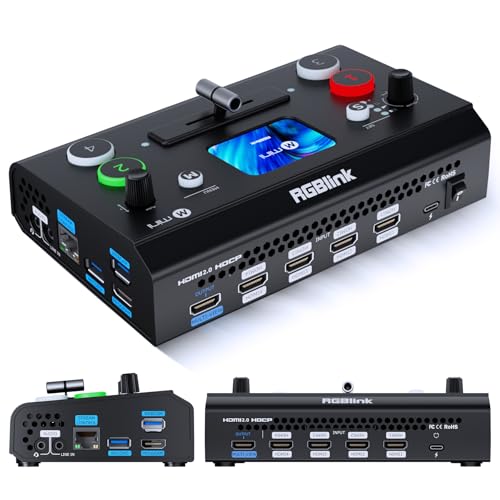
- Four HDMI inputs with dual 1080p outputs
- 2.1-inch touch screen and T-bar control
- UVC webcam mode and USB recording support
Best For: Entry-level HDMI streaming and multi-camera content
ISO Recording Powerhouse

- Four 4K HDMI and four SDI inputs
- Simultaneous ISO recording for all eight channels
- SRT, RTMP, NDI HX, XLR audio, and triple streaming
Best For: Professional events requiring isolated recordings
Professional 4K Control

- 4K60 input with 1080p60 output
- Four-camera PTZ control with presets
- Professional audio and multi-platform streaming
Best For: Churches, studios, and professional live productions
Advanced Streaming Hub

- Four 4K HDMI inputs with dual outputs
- PTZ, chroma-key, and touchscreen control
- Streams to four platforms and records to SSD
Best For: Multi-camera events, worship, education, and live streaming
Simple 2K Multicam Switching

- Four HDMI inputs with 2K support
- USB webcam output for streaming software
- Transitions, PIP layouts, and LAN control
Best For: Solo streamers and computer-based multi-camera broadcasts
Best Streamlined Pick – Blackmagic ATEM Mini Pro
The Blackmagic Design ATEM Mini Pro is one of the more approachable video switchers for multicamera streaming and presentations. It combines four HDMI inputs, built-in streaming, multiview monitoring, recording, transitions, keying, and audio mixing in a compact unit.
Best For: Education, business presentations, livestreamed esports, and small multicamera internet or broadcast productions.
Pros:
- Four HDMI camera inputs with a four-camera multiview.
- Built-in streaming, recording, and a six-input, two-channel audio mixer.
- Supports transitions, upstream and downstream keying, and USB-C webcam output.
Cons:
- Provides four HDMI inputs, fewer than the eight-input options in this roundup.
- Its listed audio connectivity is limited to embedded HDMI audio and two 3.5mm stereo inputs.
Choose this model if you want a compact workflow with the essential tools for four-camera live production without adding separate streaming and recording hardware.
Best Integrated Production Hub – RØDECaster Video
The RØDE RØDECaster Video is an integrated choice among video switchers, combining six video inputs with studio-oriented audio, scenes, media playback, graphics, and direct streaming. Its front-panel controls are designed to keep common production tasks accessible without relying entirely on a computer.
Best For: Creators and production teams that need video switching, professional microphone connections, custom scenes, overlays, and recording in one system.
Pros:
- Switches up to six sources, including four HDMI and two USB inputs.
- Includes two Neutrik combo inputs with Revolution Preamps for XLR microphones and instruments.
- Supports custom scenes, chroma keying, media playback, direct streaming, and ISO recording.
Cons:
- Its feature-rich design may be more than needed for simple camera switching.
- The supplied notes list a 1080p60 highlight but do not specify the supported resolutions for every input type.
This is a strong fit when audio quality and flexible scene-based production matter as much as switching, particularly for shows that mix cameras, USB sources, microphones, and graphic elements.
Best Flexible Streaming Workflow – Osee GoStream Deck
The Osee GoStream Deck is a versatile option for video switchers, with four HDMI inputs, dual HDMI outputs, USB-C connectivity, recording, playback, and direct streaming. Its hardware controls include PVW/PGM buses, a T-bar, macros, and support for landscape or portrait production.
Best For: Churches, conferences, podcasts, weddings, education, and live events that need multiple streaming destinations, graphics, and flexible formats.
Pros:
- Offers four HDMI inputs, two HDMI outputs, multiview, and USB-C input/output options.
- Can stream to three platforms simultaneously through Ethernet.
- Includes recording, media playback, audio effects, keying, graphics overlays, and auto-switching.
Cons:
- The supplied notes do not identify the maximum video resolution or frame rate.
- Its broad control set may require more setup than a basic switcher with fewer production features.
Consider the GoStream Deck if your productions benefit from portrait support, direct multistreaming, local recording, and hands-on switching controls rather than a minimal HDMI-only setup.
Best for HDMI-Rich Productions – Roland V-8HD
The Roland V-8HD is built for productions that need more HDMI connections and detailed live control. It handles up to eight HDMI sources and adds a built-in multiview monitor, AUX output, layered effects and keying, automated switching, still storage, and an 18-channel digital audio mixer.
Best For: Live events, presentations, and broadcasts using several HDMI cameras, computers, or other HDMI sources.
Pros:
- Eight HDMI inputs support larger all-HDMI production setups.
- Built-in preview monitor, AUX output, preset memories, macros, and sequencing support efficient operation.
- Provides five-layer effects and keying, still storage, and an 18-channel audio mixer.
Cons:
- It does not list built-in internet streaming in the supplied features.
- At 5.1 pounds, it is heavier than the compact ATEM Mini Pro and Osee GoStream Deck listed here.
The V-8HD is a practical choice when input capacity and routing flexibility take priority, especially for HDMI-heavy shows that can use a separate streaming or distribution path.
Versatile Hybrid Production – Osee GoStream Duet
Osee GoStream Duet Multiple Camera SDI and HDMI Live Stream Video Mixer Switcher
Check Price On AmazonFor creators and event teams comparing video switchers, the Osee GoStream Duet stands out for its broad source support. It accepts four SDI inputs, four HDMI inputs, USB-C, NDI HX sources, and SD/SSD playback, with landscape or portrait operation for inputs and outputs.
Best For: Multi-camera live streaming, events, and productions that need flexible SDI, HDMI, and network-source support.
Pros:
- Combines four SDI and four HDMI inputs with USB-C and NDI HX support.
- Offers multiple control options, including the built-in GUI, Mac/Windows software, and Bitfocus Companion.
- Includes keying, PIP, DSK, multisource layouts, and MIX, DIP, WIPE, and T-bar transitions.
- Can stream to up to three platforms simultaneously and connect with OBS or vMix.
Cons:
- Unlocking the included NDI HX license requires downloading the latest firmware.
- The extensive input and control options may require more setup than a basic HDMI switcher.
With its hybrid connectivity and flexible streaming workflow, the GoStream Duet is a strong choice when a compact switcher needs to handle both professional SDI sources and HDMI equipment.
Compact 4K Control – RGBlink Mini V3
The RGBlink Mini V3 is a compact option for shoppers comparing video switchers for multi-camera streaming. It provides four HDMI inputs, a 2.1-inch touch screen, professional T-bar control, dual 1080p HDMI outputs, and UVC webcam mode for computer-based streaming.
Best For: Entry-level creators and small productions using HDMI cameras with direct recording or webcam-style streaming.
Pros:
- Offers four HDMI inputs, dual HDMI outputs, and a built-in 2.1-inch touch screen.
- Supports UVC webcam mode for recognition on platforms such as YouTube and Facebook.
- Provides PIP layouts, chroma key overlays, and 15 transition effects.
- Can record to USB drives up to 2TB.
Cons:
- Recording and selected advanced functions require optional TAO Cloud activation.
- Stable UVC streaming with OBS on Mac or PC requires the included USB 3.0 cable.
- A 35W or higher USB-C power adapter is recommended.
The Mini V3 balances a small footprint with useful live-production controls. Its licensing model is worth considering, but it can be a practical HDMI-centered switcher for creators who want touch control and webcam connectivity.
ISO Recording Powerhouse – Osee GoStream Duet 8 ISO
For demanding productions, the Osee GoStream Duet 8 ISO is one of the more capable video switchers in this group. It combines four 4K HDMI inputs and four SDI inputs with simultaneous isolated recording, hardware streaming, SRT, NDI HX, and professional audio connections.
Best For: Corporate AV, education, conferences, and live events that need isolated camera recordings for post-production.
Pros:
- Mixes four 4K HDMI sources and four SDI sources without external converters.
- Records clean individual feeds from all eight input channels to external SSDs or SD cards.
- Supports triple streaming, SRT, custom RTMP, NDI HX, and dual USB outputs.
- Includes two balanced XLR inputs and two 3.5mm audio jacks.
Cons:
- Video output is specified as 1080p despite supporting 4K HDMI inputs.
- Its broader professional feature set may be more than simple streaming setups require.
The GoStream Duet 8 ISO is especially compelling when post-production flexibility matters. Its eight-channel ISO recording and extensive connectivity make it well suited to productions where recovering or re-editing individual camera feeds is important.
Professional 4K Control – FoMaKo KC602
The FoMaKo KC602 is a professional option among video switchers for multi-camera live production. It accepts four 4K HDMI inputs, provides 1080p60 output, and combines PTZ control, streaming, recording, and extensive audio mixing in one console.
Best For: Churches, studios, event producers, and broadcasters needing PTZ control, professional audio, and flexible streaming options.
Pros:
- Accepts 4K 60fps HDMI input and supports 4K loop-through.
- Controls up to four PTZ cameras with nine recallable presets.
- Supports RTMP/RTMPS, UVC streaming, and 1080p60 USB recording.
- Offers XLR/TRS audio, 48V phantom power, 5-band EQ, and independent monitoring.
Cons:
- Its broad audio and production feature set may be more than a basic streamer needs.
- Program output is limited to 1080p60 despite 4K input support.
Choose the KC602 when you want a hands-on production workflow with a built-in display, T-bar, PTZ presets, and serious audio controls. It is particularly well suited to repeatable, multi-camera productions rather than simple webcam switching.
Advanced Streaming Hub – RGBlink Mini-pro V3
The RGBlink Mini-pro V3 is a capable choice among video switchers for creators who need four 4K HDMI inputs, PTZ control, multiview outputs, and direct streaming. Its touchscreen and joystick provide access to layer, chroma-key, aspect-ratio, and camera controls.
Best For: Worship services, conferences, education, weddings, gamers, and multi-platform live streams.
Pros:
- Provides four 4K HDMI inputs and dual HDMI outputs for monitoring and multiview.
- Streams to up to four platforms through RTMP(S) over Ethernet.
- Supports PTZ control using VISCA, with recallable presets.
- Can record to an external SSD up to 2TB and supports USB 3.0 output.
Cons:
- A 35W or higher USB-C power adapter is recommended for stable operation.
- Firmware should be updated before use, adding an initial setup step.
- Camera compatibility and Mac/PC streaming setup require attention to the manual and included cable.
The Mini-pro V3 balances advanced production tools with a compact control surface. It is a strong fit for users who want direct streaming and recording without giving up PTZ, chroma-key, or multiview functionality.
Simple 2K Multicam Switching – RGBlink Mini
The RGBlink Mini is a straightforward option among video switchers for four-camera 2K productions. It connects to a computer over USB 3.0 as a webcam, while built-in transitions, picture-in-picture layouts, and remote LAN control support solo streaming workflows.
Best For: Solo streamers and creators using OBS, vMix, or social platforms with multiple HDMI cameras.
Pros:
- Accepts four HDMI inputs with 2K input and output support.
- USB 3.0 output is recognized as a webcam by streaming computers.
- Includes 14 transition effects and nine picture-in-picture layouts.
- Supports audio embedding, de-embedding, and remote LAN control.
Cons:
- It does not provide onboard recording; the notes recommend Mini-Pro or higher models for that feature.
- It lacks the 4K input capability and advanced PTZ-focused controls of the Mini-pro V3.
The RGBlink Mini makes sense when ease of computer-based streaming matters more than standalone recording or 4K production. Its webcam-style USB connection and built-in layouts can simplify a compact multi-camera setup.
How We Picked These Video Switchers
We focused on the features that most affect real-world production: input type and count, supported resolution and frame rates, switching workflow, preview and program monitoring, streaming and recording options, audio connectivity, portability, and expansion potential. The list includes compact HDMI switchers for creators and presenters as well as larger systems suited to studios, events, houses of worship, and multi-camera productions.
Specifications such as 4K input support do not always mean that every output, recording, or streaming path is 4K. Before buying, confirm the exact signal limits for each connection and workflow you plan to use.
Quick Comparison
| Best For | What to Look For |
|---|---|
| Home streaming and creators | Simple HDMI inputs, USB webcam output, built-in streaming, and compact controls |
| Live events and presentations | Fast source switching, multiview monitoring, reliable outputs, and flexible transitions |
| Studio and broadcast-style work | SDI connectivity, genlock or professional signal support, multiple outputs, and robust audio control |
| Post-production flexibility | ISO recording, separate camera files, and sufficient storage or external recording options |
| PTZ and remote production | Camera control, network features, presets, and a clear preview/program interface |
Key Buying Factors for Video Switchers
Inputs and Signal Compatibility
Count the cameras, computers, and playback devices you use today, then leave room for at least one additional source. HDMI is common and convenient, while SDI is better suited to longer cable runs and professional installations. Check connector types, HDCP behavior, supported frame rates, and whether mixed resolutions are handled automatically.
Resolution, Frame Rate, and Outputs
Choose a switcher that matches your cameras and display equipment. Some models accept 4K signals but switch or stream at 1080p. Also verify the number and type of outputs: HDMI, USB, SDI, network streaming, and dedicated multiview may serve different purposes.
Switching and Monitoring Controls
Physical buttons can be faster during live work, while touchscreens and software control add flexibility. A multiview display helps you monitor all sources, preview the next shot, check audio levels, and confirm the program feed before switching.
Audio and Recording Workflow
If your production includes microphones, music, or remote guests, review the audio inputs, mixing tools, delay controls, and embedded-audio behavior. ISO recording is valuable when you need to edit individual camera feeds later, but it usually increases storage requirements and workflow complexity.
Who Should Buy Which Video Switchers?
Choose a compact HDMI model if you are a solo streamer, educator, presenter, or small-content team that wants quick setup and minimal cabling. A switcher with integrated USB output or streaming tools is especially useful when your computer needs to see the production as a webcam source.
Choose a larger HDMI mixer when you run several cameras, need more hands-on control, or produce events where dependable preview, transitions, and multiple outputs matter. For installed systems, longer cable runs, or professional cameras, an SDI-capable model is usually the more practical investment.
Pick an ISO-capable switcher if editing flexibility is more important than the simplest live workflow. If you use PTZ cameras, prioritize models with camera-control support and presets. Finally, match the switcher to your operator: more features are helpful only when the interface remains comfortable to use under live-production pressure.