Choosing the right wireless video system for a multi-camera production means balancing range, latency, resolution, receiver capacity, and connection type. The best option depends on whether you need a compact HDMI kit for simple monitoring or a more robust HDMI/SDI workflow for professional crews.
We’ve gathered 10 wireless video transmitters covering 1080p and 4K workflows, single- and multi-receiver configurations, and use cases ranging from live events to film sets. Use the guide below to narrow down the features that matter most before you buy.
Best 10 Video Transmitters for Multi Camera Setups Picks for 2026
Best Professional Interface Flexibility

- 4K30 HDMI transmission with HD HDMI/SDI support
- SDI output supports 23.98, 29.97, and 59.94 fps
- Up to four app monitors plus receiver-based monitoring
Best For: Production teams needing SDI and HDMI flexibility
Best Plug-and-Play Multi-Screen Value
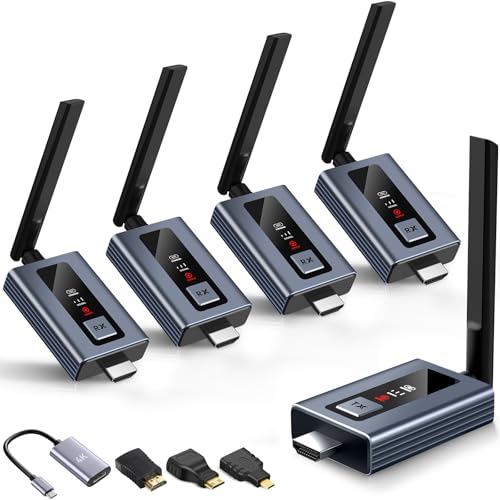
- Supports up to six simultaneous displays
- Plug-and-play setup with LED status information
- 4K input with 1080p60 output
Best For: Simple multi-screen HDMI monitoring and presentations
Best Long-Range Production Monitoring

- Up to 1,300 feet line of sight with 60ms latency
- Supports up to four receivers and app monitoring
- Includes HDMI loopout and UVC live streaming
Best For: Large film sets and live production teams
Best Budget Multi-Display Expansion

- Includes four receivers and supports up to six
- 4K input with 1080p output and 60Hz support
- Mirrors to iOS and Android devices through the app
Best For: Small HDMI-based setups needing many mirrored displays
Versatile 4K Monitoring

- 4K HDMI and 1080p SDI support
- Up to five connected monitoring devices
- 350 m claimed range with low latency
Best For: Mixed HDMI/SDI productions needing multi-device monitoring
All-in-One Crew Monitoring
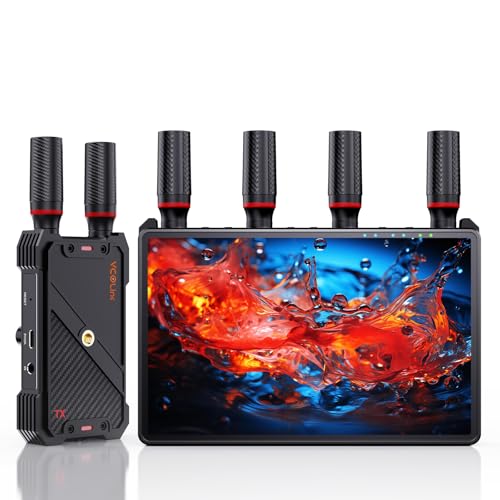
- Built-in 7-inch receiver monitor
- Supports up to five receivers
- HDMI loop out and flexible power options
Best For: HDMI crews needing portable built-in monitoring
Long-Range 4K Production

- 4K60 HDMI and 1080p SDI support
- Up to 2.5 km claimed transmission range
- Four wireless plus one wired connection
Best For: Long-distance film sets needing 4K and SDI flexibility
Best Multi-Camera 4K Hub
WL096 PRO Wireless HDMI System

- 4K30 transmission with approximately 0.1-second latency
- One transmitter supports up to five receivers
- UVC output enables direct computer streaming
Best For: Multi-camera monitoring and 4K live-streaming workflows
Best Long-Range 1080p Option

- 1080p60 transmission with approximately 0.05-second delay
- Up to 1300 feet in an unobstructed open field
- Supports up to five receivers and multiple displays
Best For: 1080p monitoring across rooms, venues, or presentation spaces
Best Professional 4K60 System
Hollyland Pyro Ultra 1TX & 2RX

- 4K60 HDMI plus professional SDI connectivity
- Broadcast Mode supports up to 20 receivers
- Focus Mode delivers approximately 20–45 ms latency
Best For: Film production, focus pulling, and professional multi-display monitoring
Best Professional Interface Flexibility – Hollyland Mars 4K
For video transmitters for multi camera setups that need both broadcast-friendly SDI and HDMI connectivity, the Hollyland Mars 4K is a versatile option. It supports up to 4K30 over HDMI, HD formats over HDMI or SDI, and professional decimal-point SDI frame rates including 23.98, 29.97, and 59.94 fps.
Best For: Film sets, production teams, and operators who need SDI/HDMI compatibility plus flexible monitoring.
Pros:
- Supports up to 3840×2160 at 24/25/30 fps through HDMI.
- Offers SDI and HDMI input/output for broader equipment compatibility.
- Supports up to four app monitoring devices without the receiver, with additional monitor options when receivers are added.
- Provides a stated 450-foot line-of-sight range and 66ms latency in ideal conditions.
Cons:
- The stated range and latency depend on interference-free, line-of-sight conditions.
- QC/PD charging is not supported through USB-C.
- Its 4K transmission is limited to 30 fps.
The Mars 4K stands out when your multi-camera workflow includes professional SDI equipment, multiple viewing points, or mixed HDMI and SDI sources. It is a stronger production-focused choice than a basic wireless HDMI extender.
Best Plug-and-Play Multi-Screen Value – Wireless HDMI 4-Receiver Kit
This wireless HDMI kit is aimed at straightforward multi-display distribution rather than advanced broadcast production. Among video transmitters for multi camera setups, it is most useful when a camera or other HDMI source needs to feed several screens with minimal setup and no app, Bluetooth, or Wi-Fi configuration.
Best For: Presentations, classrooms, venues, and simple camera monitoring across several 1080p displays.
Pros:
- Supports up to six screens when additional receivers are added.
- Uses a plug-and-play design with a stated five-second connection process.
- Supports 4K input and 1080p at 60Hz output.
- Includes USB-C, mini-HDMI, and micro-HDMI connection adapters for broader source compatibility.
Cons:
- Output is limited to 1080p, even with a 4K input.
- The stated 165-foot range can be affected by solid walls and other obstacles.
- An antenna must be installed for the system to operate properly.
This kit makes sense for buyers prioritizing simple installation and multiple displays over 4K output or production-grade connections. Its HDMI-focused design is better suited to general-purpose distribution than complex SDI camera networks.
Best Long-Range Production Monitoring – Hollyland Pyro H
The Hollyland Pyro H is a strong candidate for video transmitters for multi camera setups where crew members need to monitor a feed from a substantial distance. It combines 4K30 transmission, dual-band operation, smart channel scanning, and support for up to four receivers.
Best For: Film production, live streaming, ENG/EFP work, and larger sets requiring distributed monitoring.
Pros:
- Offers a stated 1,300-foot line-of-sight range with 60ms latency.
- Supports up to four receivers for broader crew monitoring.
- Smart Channel Scan selects an optimal frequency across 2.4GHz and 5GHz bands.
- HDMI loopout and UVC support enable local monitoring and plug-and-play computer streaming.
Cons:
- It uses HDMI connectivity rather than the SDI interfaces found on some professional systems.
- 4K transmission is limited to 24/25/30 fps.
- Performance claims are based on stated line-of-sight operating conditions.
For demanding shoots, the Pyro H offers the most expansive monitoring reach in this group and is designed around collaboration. Its receiver scalability and UVC streaming make it especially practical when the same camera feed must serve both on-set viewers and an online production workflow.
Best Budget Multi-Display Expansion – WELUSOPU Wireless HDMI Kit
The WELUSOPU wireless HDMI kit focuses on sending one HDMI source to several displays without complicated configuration. For video transmitters for multi camera setups, it can work well for basic HDMI camera monitoring, especially when extra receivers and mobile-device viewing are more important than 4K output.
Best For: Home studios, classrooms, conference rooms, and small productions needing several mirrored HDMI displays.
Pros:
- Includes four receivers and supports up to six receivers simultaneously.
- Uses 2.4GHz and 5GHz dual-band transmission with automatic frequency hopping.
- Supports 4K input and 1080p output with 60Hz support.
- Can mirror content to up to six iOS or Android devices through its app.
Cons:
- It outputs 1080p rather than 4K.
- The stated range is up to 165 feet in open spaces and may be reduced by obstacles.
- Mobile devices support mirroring only and cannot provide reverse control.
This is a practical choice when the goal is broad, mirrored viewing at a relatively simple setup level. Buyers needing SDI, higher-resolution output, or more production-specific control should consider a dedicated professional video transmission system instead.
Versatile 4K Monitoring – CineView Master 4K Lite
For creators comparing video transmitters for multi camera setups, the Accsoon CineView Master 4K Lite combines HDMI and SDI support with multi-device monitoring. It handles HDMI formats up to 4K at 60 fps, while SDI and HDMI also support 1080p, making it suitable for varied camera and production workflows.
Best For: Film, event, wedding, sports, and live-streaming crews needing 4K HDMI transmission and several wireless monitoring points.
Pros:
- Supports HDMI transmission up to 3840×2160 at 60 fps.
- Offers 1080p support through 3G SDI and HDMI.
- Connects with up to five devices: four wireless and one wired.
- Provides claimed range of at least 350 m and low latency of under 35 ms at 1080p60.
Cons:
- The stated range depends on unobstructed, interference-free conditions.
- USB-C output is intended for supported mobile devices, not computers using UVC.
- Some cables, including the proprietary USB-C-to-Lightning cable, are sold separately.
The 4K Lite is a flexible option when a production needs mixed HDMI/SDI compatibility, app-based monitoring, and camera-control support for selected Sony and Canon models. Verify device compatibility and cable requirements before buying.
All-in-One Crew Monitoring – 7-Inch Wireless HDMI Kit
This wireless HDMI system is a practical choice among video transmitters for multi camera setups when on-set viewing is a priority. Its receiver includes a built-in 7-inch monitor, while HDMI output, loop out, and support for up to five receivers make it useful for shared production monitoring.
Best For: Film crews, studios, and live-event teams that want built-in display monitoring without carrying a separate screen for every receiver.
Pros:
- Includes a built-in 7-inch HD receiver monitor.
- Supports 1080p at 60 Hz with a claimed range up to 1,312 ft in line-of-sight conditions.
- Allows one transmitter to broadcast to up to five receivers.
- Offers HDMI loop out, headphone monitoring, IR remote control, and flexible power options.
Cons:
- It is an HD system rather than a 4K transmission solution.
- External HDMI cables are not included.
- Smartphone or tablet use requires a Type-C-to-HDMI cable.
The integrated monitor is the standout feature, reducing the need for additional viewing hardware on location. It is best suited to HDMI-based workflows where 1080p is sufficient and portable crew monitoring matters more than SDI or 4K support.
Long-Range 4K Production – CineView Master 4K
For larger productions evaluating video transmitters for multi camera setups, the Accsoon CineView Master 4K offers 4K60 HDMI transmission, 1080p HDMI/SDI support, and a claimed range of up to 2.5 km. Its multi-stream design supports several wireless viewers plus one wired connection.
Best For: Film sets and production teams that need long-range transmission, 4K monitoring, and simultaneous wireless and wired viewing.
Pros:
- Transmits up to 4K60 through HDMI and 1080p through HDMI or SDI.
- Claims up to 2.5 km of range with latency under 25 ms at 1080p and under 35 ms at 4K.
- Supports four wireless connections and one wired connection.
- Uses 2.4 GHz, 5 GHz, and 6 GHz frequencies and includes an aluminum-alloy housing.
Cons:
- The maximum range is a manufacturer claim and will vary with conditions and obstructions.
- The system is more specialized than a basic HDMI-only wireless link.
- Monitoring-device compatibility should be checked before purchase.
The CineView Master 4K is the strongest fit here for demanding long-distance workflows. Its 4K60 capability, SDI support, and five-device distribution give larger crews more flexibility, provided the production can take advantage of those inputs and viewing options.
Best Multi-Camera 4K Hub – WL096 PRO Wireless HDMI System
If you need video transmitters for multi camera setups, the Vrriis WL096 PRO stands out for its 4K30 transmission, adjustable 5 GHz channels, and support for one transmitter with up to five receivers. Its UVC output also makes it practical for computer-based live streaming and monitoring.
Best For: Multi-camera monitoring, live streaming, and productions that need 4K video with flexible battery or USB-C power.
Pros:
- Supports 4K30 video with approximately 0.1-second latency.
- One transmitter can send to up to five receivers.
- UVC output supports streaming through OBS without a separate capture card.
- LCD screens show connection, signal, channel, and resolution information.
Cons:
- Approximately 0.1-second latency is not ideal for highly responsive applications.
- UVC output is limited to up to 1080p60.
- Batteries are not included.
The WL096 PRO is a flexible choice when a crew needs to distribute one camera feed across several viewing points while retaining local loop-out monitoring. Its 20-channel adjustment and multiple power options add useful setup flexibility, though demanding real-time operators should account for its stated latency.
Best Long-Range 1080p Option – WL082 Wireless HDMI System
For video transmitters for multi camera setups where Full HD is sufficient, the Vrriis WL082 combines a claimed 1300-foot open-field range with loop-out monitoring and support for up to five receivers. Its low stated delay also suits sports, presentations, and other real-time viewing needs.
Best For: 1080p multi-screen monitoring, remote TV or projector feeds, and setups that need IR source control.
Pros:
- Supports up to 1080p60 with approximately 0.05-second latency.
- Claims up to 1300 feet of transmission in an unobstructed open field.
- Transmitter loop-out and receiver dual HDMI outputs support multiple displays.
- Can work with up to five receivers and includes IR remote extension support.
Cons:
- Walls, metal, brick, and glass can significantly reduce coverage.
- Transmission distance decreases as more receivers are added.
- Batteries are not included.
The WL082 is a sensible value-oriented pick for teams that do not need 4K but want straightforward 1080p distribution and convenient display expansion. The loop-out and IR features are particularly useful when the source needs to remain locally monitored or controlled from another room.
Best Professional 4K60 System – Hollyland Pyro Ultra 1TX & 2RX
For demanding video transmitters for multi camera setups, the Hollyland Pyro Ultra offers professional connectivity, including 4K60 HDMI, SDI, low-latency Focus Mode, and distribution to multiple receivers. It is built for film production, live streaming, and larger wireless monitoring workflows.
Best For: Film crews, focus-pulling teams, broadcast-style monitoring, and productions requiring HDMI, SDI, UVC, and RTMP options.
Pros:
- Supports 4K60 video over HDMI and includes HDMI and SDI inputs and outputs.
- Broadcast Mode can distribute video to up to 20 receivers with a stated line-of-sight range of 4,900 feet.
- Focus Mode provides approximately 20–45 ms latency depending on resolution and frame rate.
- Built-in UVC and RTMP support enables direct capture and streaming workflows.
Cons:
- RTMP streaming is limited to up to 1080p60.
- The listed unit weighs 7.35 pounds, making it less portable than compact kits.
- Its professional feature set may be more than basic monitoring setups require.
The Pyro Ultra is the strongest fit for professional crews that need high-resolution monitoring, fast focus-pulling response, and broad workflow compatibility. Its HDMI/SDI support and multi-receiver Broadcast Mode make it especially capable for larger sets, while automatic frequency hopping helps manage crowded wireless environments.
How We Picked the Best Video Transmitters for Multi Camera Setups
We compared these systems by examining their supported video inputs and outputs, maximum stated resolution and frame rates, transmission range, latency, receiver capacity, and workflow features. HDMI-only kits can be practical for cameras, monitors, and televisions, while HDMI/SDI models generally offer greater flexibility for professional cameras and production infrastructure.
Advertised wireless range varies with walls, interference, antenna placement, and local spectrum conditions. Treat maximum-distance figures as best-case estimates and prioritize stable performance, dependable power options, and the connections your cameras already use.
Quick Comparison
| Feature | What to look for | Best suited to |
|---|---|---|
| Resolution | 1080p for monitoring; 4K for detailed previews and modern production | Events, studios, film sets, and content creation |
| Inputs and outputs | HDMI for common cameras; SDI for longer cable runs and pro equipment | Consumer, hybrid, and professional workflows |
| Receiver count | One receiver for a single monitor; multiple receivers for distributed viewing | Directors, clients, operators, and venue displays |
| Latency | Lower latency for live operation, camera control, and performance work | Live production and focus monitoring |
| Range | Choose based on the actual venue, obstructions, and interference | Small rooms through large event spaces |
Key Buying Factors for Video Transmitters for Multi-Camera Setups
Camera Compatibility
Check whether each camera provides HDMI, SDI, or both, and confirm the transmitter supports the exact signal format. Frame-rate compatibility is particularly important with 23.98, 29.97, and 59.94 fps workflows. Also verify whether the system passes embedded audio and whether a camera’s output must be set to a clean feed.
Resolution, Latency, and Stability
4K support is useful for high-detail monitoring, but it may reduce range, receiver capacity, or frame-rate flexibility. For live shooting, latency can matter more than peak resolution. Dual-band operation, channel selection, and a clear line of sight can improve reliability in crowded wireless environments.
Multi-Receiver Design
If several people need to view the same camera, select a system designed for multiple receivers rather than relying on splitters or improvised adapters. Confirm the maximum number of receivers, whether they can work simultaneously, and whether each receiver offers loop-out or other display connections.
Power and Physical Setup
Consider battery plates, USB-C or DC power, mounting points, antenna design, and transmitter size. A lightweight unit is preferable on a gimbal or compact camera, while studio installations may benefit from stronger connectors and continuous power options.
Who Should Buy Which Video Transmitters for Multi Camera Setups?
Choose an HDMI 1080p kit for basic camera-to-monitor links, classrooms, presentations, and home or small-venue viewing where affordability and simple setup matter most.
Choose a multi-receiver system when directors, clients, operators, or multiple displays need the same feed at once. Confirm its real-world range and receiver limit before planning the production.
Choose an HDMI/SDI 4K system for film sets, broadcast-style crews, and cameras that require professional connectivity or higher-resolution monitoring. These systems are usually the better long-term choice for mixed-camera environments.
Choose a long-range, low-latency model for outdoor events, stages, sports, and moving-camera work, but test the complete setup at the venue. No advertised wireless distance can guarantee performance through concrete, metal, crowded RF conditions, or multiple walls.