The best voice recorders make it easier to capture lectures, interviews, meetings, calls, and personal notes without relying on a phone. This roundup compares 10 options spanning simple playback models, high-capacity devices, and newer AI-powered recorders.
Use the guide below to match recording quality, storage, battery life, transcription features, and portability to the way you plan to work.
Best 10 Voice Recorders Picks for 2026
Best All-Around Recorder
EVISTR L357 64GB Voice Recorder

- 1536kbps PCM stereo recording with adjustable gain
- 64GB storage and up to 32 hours of recording
- Voice activation, scheduled recording, and playback tools
Best For: Students and professionals wanting a traditional, high-capacity recorder
Best AI Workflow
Comu Action Pro AI Voice Recorder

- Transcribes and summarizes recordings in 113 languages
- Generates emails, slides, reminders, and action items
- Six-microphone system with up to 70 hours of recording
Best For: Professionals converting meetings and calls into organized follow-up
Best High-Capacity Budget Pick
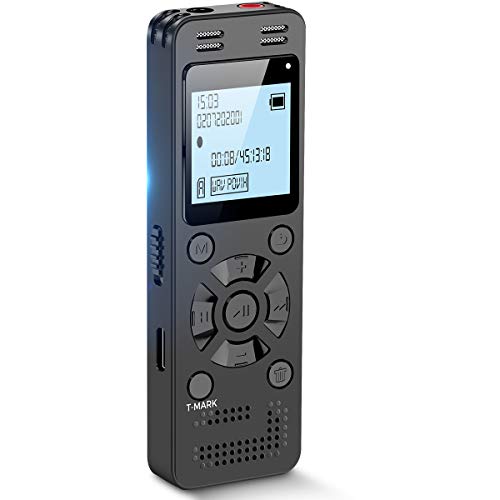
- 128GB capacity for up to 9,296 hours of storage
- 1536Kbps PCM recording with multiple MP3 settings
- Voice activation, password protection, and folder organization
Best For: Users needing extensive standalone recording storage
Best Premium AI Recorder
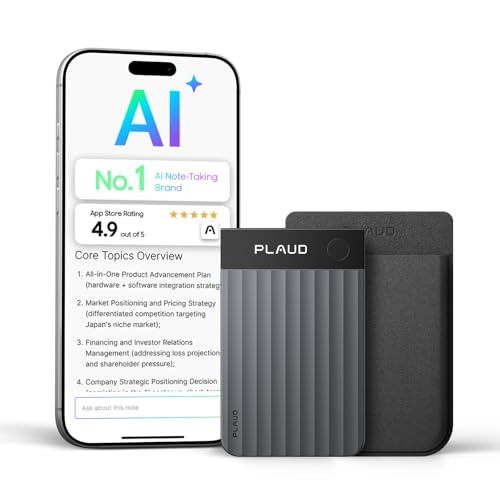
- AI transcription, summaries, Q&A, and email drafting
- Directional audio with call and meeting recording modes
- Slim design, 64GB storage, and up to 50 hours in Endurance Mode
Best For: Professionals managing sensitive meetings and calls with AI tools
Simple Lecture Recorder
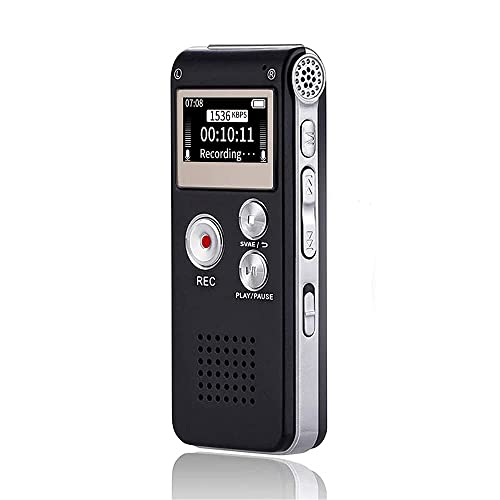
- One-button recording and easy playback
- Noise reduction with voice activation
- USB storage and MP3 player functions
Best For: Students and casual everyday recording
AI Note-Taking Recorder
EVISTR 128GB Transcribing Voice Recorder

- Transcribes in 113 languages with AI summaries
- 128GB storage and up to 33 hours recording
- OTG transfer, privacy lock, and voice activation
Best For: Students and professionals processing recordings into notes
Long-Run Storage Recorder
Elasound 9800-Hour Voice Recorder

- Up to 9800 hours of audio storage
- Up to 100 hours of continuous recording
- AI triple noise reduction and USB-C accessories
Best For: Frequent recorders needing maximum storage and endurance
Best High-Capacity Pick
Tonfarb 136GB Digital Voice Recorder

- 136GB total storage with included TF card
- Up to 68 hours of continuous recording
- PCM audio, noise reduction, and voice activation
Best For: Extended lectures, meetings, interviews, and field recording
Best Built-In Playback Pick
Holyask 160GB Digital Voice Recorder

- 160GB total storage included
- Up to 56 hours of battery life
- Built-in speaker and WAV recording
Best For: Meetings, lectures, interviews, and quick playback on the go
Best All-Around Recorder – EVISTR L357 64GB Voice Recorder
For shoppers comparing voice recorders for lectures, meetings, interviews, and everyday notes, the EVISTR L357 combines high-quality PCM recording with straightforward physical controls. Its large storage capacity, voice activation, and playback tools make it a practical option for users who want a traditional standalone recorder.
Best For: Students, teachers, writers, and professionals who need a portable recorder with extensive storage and easy file transfer.
Pros:
- Records in WAV or MP3, with up to 1536kbps stereo sound and adjustable recording gain.
- 64GB storage can hold up to 4,660 hours at 32Kbps, while the battery supports up to 32 hours of recording.
- Voice activation, scheduled recording, A-B repeat, variable-speed playback, and Type-C computer transfer add flexibility.
Cons:
- Its feature-rich menu may take some time to learn.
- It does not provide AI transcription or summaries.
The EVISTR L357 is a strong fit when dependable standalone recording matters more than cloud-based features. The two-button recording workflow, metal build, and broad playback controls keep it useful for routine recording tasks.
Best AI Workflow – Comu Action Pro AI Voice Recorder
The Comu Action Pro takes voice recorders beyond basic audio capture by pairing a six-microphone setup with transcription, summaries, and AI-generated work documents. It is designed for people who want recordings to become searchable notes, action items, emails, and presentation drafts.
Best For: Professionals and teams who record meetings, interviews, phone calls, and voice notes and want AI-assisted follow-up.
Pros:
- Creates transcriptions and structured summaries in 113 languages through the Comu app and website.
- AI can turn conversations into slides, emails, reminders, to-do lists, and action items.
- Four omnidirectional microphones, a directional microphone, and bone-conduction microphone support varied recording situations.
- Offers up to 70 hours of recording on one charge, plus Bluetooth, Wi-Fi, and MagSafe compatibility.
Cons:
- Its AI features depend on the Comu app and website rather than working as a simple standalone recorder.
- There is no headphone jack for direct wired listening.
The Action Pro is a specialized choice for productivity-focused recording. Its magnetic iPhone-friendly design and long battery life suit mobile workflows, while its AI tools can reduce the manual effort involved in turning conversations into usable documents.
Best High-Capacity Budget Pick – EVIDA 128GB Voice Recorder
Among voice recorders built for extended storage, the EVIDA recorder stands out with 128GB of capacity and a simple standalone design. It supports high-quality PCM recording, voice activation, password protection, and file transfer to a computer.
Best For: Students, teachers, seniors, business users, and writers who need substantial storage for lectures, meetings, speeches, or interviews.
Pros:
- 128GB storage holds up to 9,296 hours of recordings, depending on recording settings.
- Supports MP3 at 128Kbps or 192Kbps and WAV at 1536Kbps.
- Voice activation, four-folder file organization, password protection, bookmarks, and A-B repeat improve usability.
- Can also function as a USB flash drive and MP3 player.
Cons:
- The listed battery life is up to 54 hours, so it may need charging during especially long recording schedules.
- It lacks a headphone jack for direct private playback.
- The supplied specifications identify WAV as the listed format, while the product notes also describe MP3 recording options.
The EVIDA is a practical choice for buyers prioritizing storage and basic recording controls over smart transcription. Its password protection and organized folders are useful when keeping many recordings accessible on the device.
Best Premium AI Recorder – Plaud Note Pro
The Plaud Note Pro is one of the more advanced voice recorders for meetings and calls, combining directional audio, AI transcription, interactive recording analysis, and a slim card-sized design. It also lets users add typed notes, images, and marked moments for richer context.
Best For: Business, legal, medical, and other professional users who need secure, organized meeting and call records with AI-assisted analysis.
Pros:
- AI can transcribe, summarize, answer questions about recordings, draft emails, and suggest next steps.
- Automatically switches between call and meeting modes while directional audio and spatial awareness help reduce noise.
- Four MEMS microphones and a VPU microphone support speech capture up to 16.4 feet in Enhance Mode.
- Includes a 64GB recorder, magnetic accessories, a starter transcription plan, cross-device apps, and security certifications.
Cons:
- Enhance Mode provides up to 30 hours of recording, while the longer 50-hour figure applies to Endurance Mode.
- The included Starter Plan provides 300 transcription minutes per month; additional plans may be needed for heavier use.
- It has no headphone jack for wired listening.
The Plaud Note Pro is best suited to buyers who want a polished AI note-taking system rather than a basic recorder. Its privacy controls, team options, and multimodal notes make it particularly compelling for structured professional workflows.
Simple Lecture Recorder – Compact 16GB Voice Recorder
This compact 16GB option is a straightforward choice among voice recorders for lectures, meetings, interviews, and everyday notes. One-button recording, playback, voice activation, and built-in noise reduction keep the basic workflow simple.
Best For: Students and casual users who want an easy-to-operate recorder with playback and USB file transfer.
Pros:
- Simple REC, STOP, and PLAY controls with A-B repeat for reviewing important sections.
- Noise-reduction technology and a sensitive built-in microphone help capture clearer speech.
- Voice activation can reduce silent stretches and conserve recording time.
- Functions as an MP3 player and removable USB storage device.
Cons:
- Its 16GB capacity is much smaller than the storage offered by the other options here.
- Continuous recording is listed at more than 30 hours, with about 7 hours of playback.
- The built-in microphone operates in mono.
This is a practical pick when uncomplicated controls matter more than advanced transcription features or maximum storage. Its small, 35-gram design also makes it convenient to carry between classes or meetings.
AI Note-Taking Recorder – EVISTR 128GB Transcribing Voice Recorder
For shoppers seeking voice recorders that help organize spoken content, the EVISTR L359 combines 128GB storage with app-based AI transcription and summaries. It records in up to 3072Kbps HD audio and supports a wired OTG workflow for transferring files to a phone.
Best For: Students and professionals who want recordings plus multilingual transcription, summaries, speaker identification, and AI-assisted review.
Pros:
- AI DVR Link supports transcription in 113 languages, smart summaries, mind maps, speaker identification, and Ask AI insights.
- 128GB capacity can store up to 9,216 hours at 32kbps.
- Noise reduction and voice-activated recording help focus on speech and skip extended silence.
- One-touch recording, password encryption, a HOLD switch, and included OTG accessories add convenience.
Cons:
- AI features require use of the AI DVR Link app and a compatible phone workflow.
- Its listed continuous recording time is up to 33 hours, so frequent charging may be needed for extended projects.
- The wired OTG setup may be less convenient than a wireless transfer option for some users.
The L359 stands out when recording is only the first step and you also want help turning audio into organized notes. Its privacy lock and wired transfer design make it particularly suited to handling work or study recordings.
Long-Run Storage Recorder – Elasound 9800-Hour Voice Recorder
The Elasound is one of the most storage-focused voice recorders in this group, pairing a 128GB TF card with a claimed capacity of up to 9,800 hours at 32kbps. It also offers AI-assisted triple noise reduction, voice activation, USB-C transfer, and up to 100 hours of continuous recording.
Best For: Professionals, journalists, and frequent recorders who need extensive storage and long battery life for lectures, meetings, or interviews.
Pros:
- Large storage capacity is rated for up to 9,800 hours of audio at 32kbps.
- AI DSP 4.0 and triple intelligent noise reduction are designed to improve vocal clarity.
- Up to 100 hours of continuous recording and headphone playback support longer sessions.
- Includes voice activation, USB-C transfer, a clip-on microphone, headphones, and OTG adapters.
Cons:
- The stated storage figures vary between the listing’s 128GB TF card claim and 136GB product details.
- The large capacity is specified at 32kbps, so higher-quality recording may use space more quickly.
- Its listed dimensions and 0.17 kg weight suggest a less pocket-minimal design than the smallest recorder here.
This model is compelling for users who prioritize endurance and archival capacity over a highly compact form. The included accessories and USB-C connectivity also make it adaptable for transferring recordings to computers or mobile devices.
Best High-Capacity Pick – Tonfarb 136GB Digital Voice Recorder
For shoppers comparing voice recorders for lectures, interviews, and meetings, the Tonfarb A20 combines high storage capacity with long battery life. Its noise-reduction microphones, 1536 kbps PCM recording, voice activation, and one-touch recording make it a versatile option for capturing spoken audio.
Best For: Students, journalists, and anyone needing extended recording time with simple controls.
Pros:
- Includes 8GB built-in storage and a 128GB TF card for up to 136GB total storage.
- Records for up to 68 hours on one charge with its 1100mAh rechargeable battery.
- Offers PCM HD recording, automatic noise reduction, voice activation, and one-click recording.
- Provides A-B repeat, password protection, an LCD screen, and USB-C file transfer.
Cons:
- The supplied storage figures vary by recording format and quality.
- Its feature set may be more than needed for basic occasional recording.
Choose this model when storage and endurance are priorities. Its compact metal design and straightforward recording switch are especially useful for back-to-back sessions, while the playback and security features add flexibility for reviewing important audio.
Best Simple Budget Option – HoTiyan 8GB Digital Voice Recorder
Among compact voice recorders, this HoTiyan model focuses on simple operation and useful playback tools. Its three-button controls, voice-activated recording, stereo microphone, and included USB cable make it suitable for everyday lectures, meetings, interviews, and personal notes.
Best For: Students and casual users who want an affordable recorder with playback and study-focused functions.
Pros:
- Uses a higher-sensitivity microphone, noise reduction, and a recording chip for high-definition stereo recording.
- Voice activation can stop recording during quieter periods to help conserve storage.
- Supports MP3 and WAV files, with stated recording capacity up to 560 hours at 32 kbps.
- Includes A-B repeat, variable playback speed, password protection, timestamps, and MP3 playback.
Cons:
- Its 8GB storage is substantially lower than the capacity of the other listed models.
- The battery supports up to 20 hours of continuous recording, less than some alternatives.
- Uses a Micro USB connection rather than USB-C.
This is a practical choice for straightforward recording and review rather than maximum storage or endurance. The adjustable playback features are particularly useful for revisiting lecture material, language practice, or key meeting points.
Best Built-In Playback Pick – Holyask 160GB Digital Voice Recorder
This Holyask recorder is one of the most spacious voice recorders in the group, pairing 32GB of internal storage with an included 128GB memory card. It records in WAV format, has a large LCD screen and built-in speaker, and is designed for convenient use in meetings, lectures, interviews, and on-the-go note taking.
Best For: Professionals, students, and journalists who want abundant storage and immediate speaker playback.
Pros:
- Provides 160GB total storage without requiring a separate memory-card purchase.
- Offers up to 56 hours of battery life for extended recording sessions.
- Includes a 1.5-inch LCD screen, built-in speaker, headphone jack, and USB transfer.
- Supports voice activation, A/B repeat, and password protection.
Cons:
- The listed audio format is WAV, which may use more storage than compressed formats.
- The supplied notes do not specify a recording bitrate or detailed noise-reduction feature.
The Holyask stands out when storage, clear WAV capture, and convenient playback matter most. Its built-in speaker lets you review recordings without immediately reaching for headphones, while the password feature adds a layer of privacy for stored files.
How We Picked These Voice Recorders
We selected models that cover the most common recording needs, from straightforward lecture and interview capture to AI transcription and meeting summaries. We looked at advertised storage capacity, voice activation, playback controls, battery claims, microphone and noise-reduction features, charging method, portability, and whether the recorder supports transcription or summarization.
Capacity and runtime figures are manufacturer or seller claims, so actual results can vary with recording quality, file format, microphone use, playback, and standby time. AI features may also require a companion app, account, subscription, or internet connection.
Quick Comparison
| Best For | Look For | Products In This Roundup |
|---|---|---|
| Simple recording and playback | Physical controls, built-in speaker, USB charging | EVISTR, Tonfarb, 8GB, and 160GB models |
| Lectures and meetings | Voice activation, noise reduction, generous storage | EVIDA, Elasound, and 16GB models |
| AI notes and transcription | Automatic transcription, summaries, app support | Comu Action Pro, Plaud Note Pro, and EVISTR AI |
| Long-term storage | Large claimed capacity and organized file management | 128GB, 132G, 136GB, and 160GB models |
Key Buying Factors for Voice Recorders
Recording Quality and Microphones
For lectures and one-person dictation, a standard built-in microphone may be sufficient. Interviews, group meetings, and recordings made farther from the speaker benefit from multiple microphones, directional pickup, or noise-reduction processing. Check whether the device records in a common format such as WAV or MP3 and whether it offers adjustable quality settings.
Storage and File Management
More storage is useful when you record frequently or want to keep files on the device, but advertised hour counts depend heavily on recording quality. A recorder with simple folder controls, playback, file deletion, and easy computer transfer can be more practical than one with maximum capacity but awkward file management.
Battery Life and Charging
Compare continuous recording runtime rather than standby claims when possible. USB-rechargeable models are convenient, while long-runtime devices are better for conferences, travel, and multi-day use. If recording important events, consider how quickly the unit charges and whether it can operate while connected to power.
AI Transcription and Privacy
AI models can convert recordings into text, summaries, or organized notes, saving time after meetings and interviews. Before buying, confirm supported languages, app compatibility, subscription requirements, processing limits, and where audio or transcripts are stored. Do not record people without following applicable consent and privacy laws.
Size, Controls, and Playback
A compact recorder is easier to carry, but larger models may provide better buttons, displays, speakers, and battery capacity. Playback is valuable for reviewing notes without transferring files, especially if the device includes headphone support, speed controls, or bookmarking.
Who Should Buy Which Voice Recorders?
- Students: Choose a voice-activated model with clear microphones, playback, and enough storage for a full term of lectures.
- Professionals: Prioritize reliable battery life, easy file transfer, noise reduction, and a compact design for meetings and interviews.
- Researchers and journalists: Look for strong microphone performance, lossless or high-quality recording options, physical controls, and dependable storage.
- Meeting-heavy users: An AI recorder can be worthwhile if its transcription and summary workflow fits your apps and budget.
- Occasional users: A basic 8GB or 16GB recorder with USB charging may offer better value than paying for unused AI features or extreme capacity.