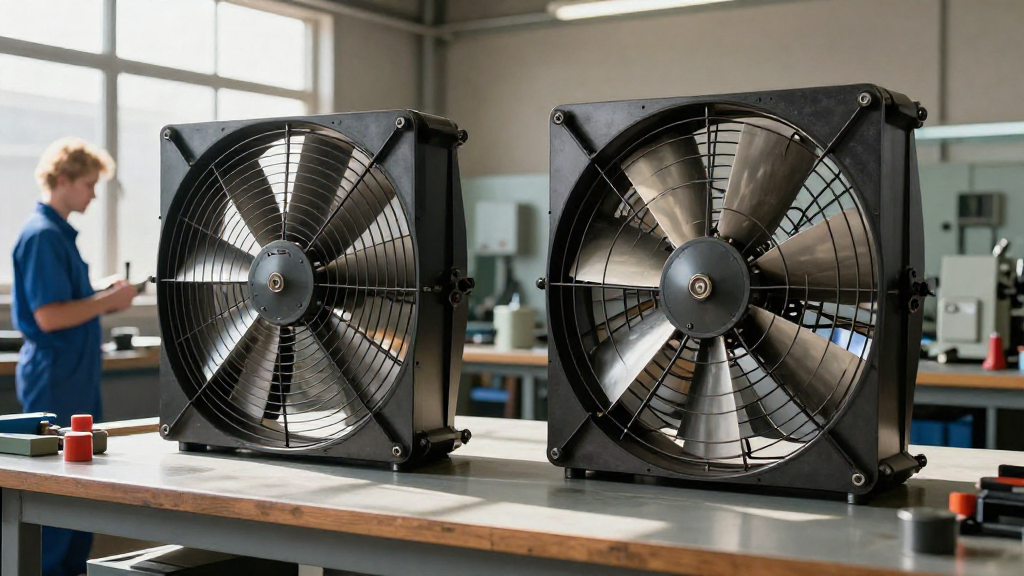
When it comes to choosing the right type of fan for your ventilation needs, understanding the difference between axial and centrifugal fans is crucial.
What Are Axial Fans?
Axial fans are designed to move air along the axis of the fan.
These fans work by drawing air into the blades and pushing it out in a straight line.
Some of the key characteristics of axial fans include:
- Compact Design: Axial fans are typically smaller and lighter than centrifugal fans.
- High Flow Rates: They are effective in moving large volumes of air quickly.
- Less Pressure: Axial fans generally operate at lower pressures.
Where Are Axial Fans Commonly Used?
Axial fans are commonly found in applications that require high airflow at low resistance. Here are some typical use cases:
- Cooling Systems: Used in computer cases and electronics.
- Exhaust Systems: Ideal for commercial kitchens and indoor air quality applications.
- HVAC Systems: Often used in air handling units for general ventilation.
What Are Centrifugal Fans?
Centrifugal fans, on the other hand, operate on a different principle.
They draw air in at a right angle and then accelerate it outwards using centrifugal force, which means the air is moved to the exhaust in a radial direction.
Key characteristics of centrifugal fans include:
- Higher Pressure: Capable of generating higher static pressures compared to axial fans.
- Robust Design: Generally more durable for industrial applications.
- Versatile Applications: Can be used in various configurations (e.g., forward-curved, backward-curved, and radial).
Where Are Centrifugal Fans Commonly Used?
Centrifugal fans are suitable for applications that require moving air against higher resistance. Common uses include:
- Industrial Ventilation: Suitable for applications like dust collection and fume extraction.
- Air Conditioning: Used in HVAC systems that require high-pressure airflow.
- Material Handling: Often utilized in conveying systems in manufacturing plants.
What Is the Key Difference Between Axial and Centrifugal Fans?
The main question many people have is, “What is the primary difference between axial and centrifugal fans?”
The fundamental differences can be summarized as follows:
-
Airflow Direction:
– Axial fans move air parallel to the fan shaft.
– Centrifugal fans move air perpendicular to the fan shaft. -
Pressure Output:
– Axial fans offer lower pressure output, making them ideal for applications with minimal resistance.
– Centrifugal fans provide higher pressure output, which is essential for overcoming more significant airflow obstacles. -
Efficiency:
– In environments with low resistance, axial fans are more energy-efficient.
– In settings where air needs to be moved against pressure, centrifugal fans can maintain efficiency despite the resistance. -
Size and Footprint:
– Axial fans often have a smaller footprint, making them more suitable for compact spaces.
– Centrifugal fans are larger and require more design consideration due to their robust construction.
Which One Should You Choose: Axial or Centrifugal?
Choosing between axial and centrifugal fans depends on several factors related to your specific needs.
Here’s a handy checklist to help you decide:
Use Cases for Axial Fans:
- High airflow applications with minimal resistance.
- Spaces where noise levels need to be kept low.
- Installations with a requirement for compact design.
Use Cases for Centrifugal Fans:
- Situations requiring high static pressure against significant ductwork or filters.
- Systems where versatility in airflow and direction is necessary.
- Environments involving heavy-duty applications like industrial ventilation or HVAC.
What Are the Maintenance Considerations?
Maintaining both types of fans is important for operational efficiency.
However, the maintenance requirements may differ:
- Axial Fans:
- Regularly check for dust and debris buildup on the blades.
- Ensure bearings are lubricated to reduce wear and tear.
-
Monitor and tighten all electrical connections periodically.
-
Centrifugal Fans:
- Inspect belts and pulleys (if applicable) for wear.
- Keep the motor clean to prevent overheating.
- Regularly check for vibrations, which may indicate misalignment.
Conclusion: Understanding the Differences is Key
In conclusion, knowing the difference between axial and centrifugal fans is essential for making informed decisions in selecting the right type of fan for your needs.
Both kinds of fans have their unique advantages, suitable applications, and maintenance requirements.
Whether you need high airflow with low resistance or high-pressure airflow against obstacles, understanding these differences will guide you to the right choice.
When making your selection, always consider the specific needs of your application, including airflow direction, pressure requirements, and space limitations.
With the right fan, you can ensure a more efficient and effective ventilation system, enhancing overall performance and energy savings.
Always remember, selecting the right fan is not just a matter of preference; it ultimately impacts the efficiency and effectiveness of your ventilation solutions.