The best compact subwoofers add convincing low-end impact without overwhelming a living room, office, or vehicle cabin. This lineup covers powered models from 8 to 10 inches, including home theater, desktop, and hideaway designs.
Use the buying guide below to compare cabinet size, amplifier output, connectivity, placement flexibility, and bass performance before choosing the right fit for your system.
Best 10 Compact Subwoofers Picks for 2026
Deep-Bass Compact Pick

- 10-inch front-firing woofer
- 300W peak amplifier
- RCA/LFE inputs and phase control
Best For: Compact home theater and music systems needing strong bass
Smallest Footprint Pick

- Compact sealed 8-inch design
- 300W peak power
- High-pass filter and phase switch
Best For: Desks, apartments, and tight listening spaces
Budget Home Audio Pick
- 10-inch Dynamic Balance woofer
- Up to 100W of power
- Line- and speaker-level inputs
Best For: Affordable bass upgrades in small-to-mid-size rooms
Maximum Output Pick

- 12-inch high-excursion woofer
- 400W maximum output
- 29Hz low-frequency response
Best For: Larger rooms and home entertainment systems prioritizing impact
Best Compact Home Subwoofer

- 6-inch driver in a compact enclosure
- 210-watt powered output
- RCA and 3.5mm inputs
Best For: Small home theater, desktop, and stereo setups
Best Compact Surround Subwoofer

- 8-inch spun-copper woofer
- Down-firing driver
- 150 watts of peak power
Best For: Wired surround-sound and home theater systems
Best Compact Car Subwoofer

- 10-inch powered design
- 300 watts of maximum output
- Under-seat mounting with remote control
Best For: Vehicle audio systems needing strong bass in limited space
Best Value for Home Theater

- 8-inch woofer with Advanced YST II
- 100W dynamic power rating
- Twisted flare port for tight bass
Best For: Simple home theater and music bass enhancement
Best for Desktop Studios

- 30 Hz low-frequency extension
- Bluetooth 5.0 and flexible wired inputs
- Adjustable crossover and room-tuning controls
Best For: Compact studio monitors and desktop audio
Best Slim Design
- Slim 6.69-inch-wide cabinet
- 70W RMS with 35 Hz bass response
- Adjustable filter and phase selector
Best For: Space-conscious home audio and bookshelf speakers
Deep-Bass Compact Pick – Klipsch R-100SW
The Klipsch R-100SW is a practical choice when you want the impact of a 10-inch driver without moving into an especially large subwoofer. Its front-firing woofer, 300-watt peak amplifier, and RCA/LFE connectivity make it a flexible option for compact home theater or music setups.
Best For: Small-to-mid-size rooms that need deeper bass for movies, TV, music, or gaming.
Pros:
- 10-inch spun-copper IMG woofer produces bass down to 32Hz.
- 300 watts of peak amplifier power provides strong output.
- Includes low-pass crossover, phase control, and auto power-on.
- RCA and LFE inputs support broad receiver compatibility.
Cons:
- Its 26-pound cabinet is larger and heavier than ultra-compact models.
- Wired RCA connectivity may not suit users seeking wireless placement.
With useful integration controls and a 10-inch driver, the R-100SW balances room-filling bass with manageable dimensions. It is a strong all-around pick when compact subwoofers need to deliver more than subtle low-end support.
Smallest Footprint Pick – Kanto SUB8VMB
Kanto SUB8VMB Sealed Powered Subwoofer | 300W Peak Power | 8" Woofer | Matte Black
Check Price On AmazonThe Kanto SUB8VMB is designed for listeners who have very little room to spare. Its sealed cabinet measures roughly 11 inches in each direction, making it especially suitable for desks, apartments, and other spaces where traditional compact subwoofers may still feel too large.
Best For: Desks, small apartments, gaming setups, and compact music or home theater systems.
Pros:
- Compact 11-by-11-by-11.9-inch footprint fits tight spaces.
- Sealed enclosure is designed for quick, accurate bass response.
- 300 watts of peak power from an 8-inch woofer.
- Adjustable high-pass filter and phase switch aid system integration.
Cons:
- The 8-inch driver may provide less large-room impact than larger models.
- It uses wired RCA connectivity rather than wireless audio.
The SUB8VMB prioritizes space efficiency and controlled response over maximum output. Its sealed design and integration controls make it a sensible choice when compact subwoofers must fit neatly into a smaller listening environment.
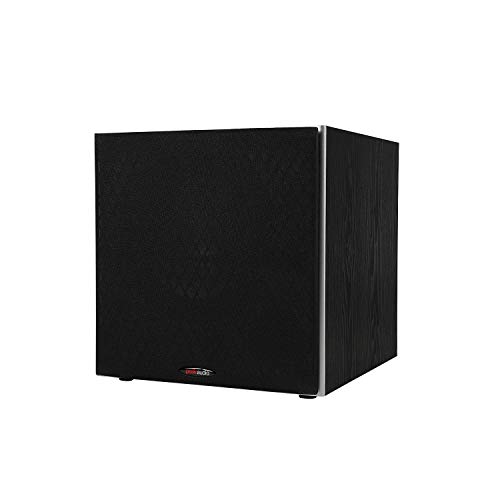
Budget Home Audio Pick – Polk Audio PSW10
The Polk Audio PSW10 adds extra low-end presence with a straightforward powered design and a 10-inch woofer. Its compact cabinet, speaker-level outputs, and adjustable crossover make it an accessible option for upgrading a small-to-mid-size home theater or stereo system.
Best For: Budget-conscious home audio users who want extra bass in a small-to-mid-size room.
Pros:
- 10-inch Dynamic Balance woofer delivers added bass and punch.
- Built-in 50-watt RMS amplifier provides up to 100 watts of power.
- Variable 80-160Hz crossover supports flexible blending with speakers.
- Offers both line-level and speaker-level connection options.
Cons:
- Its 17-inch depth is not as space-saving as the smallest compact subwoofers.
- Maximum output is lower than the higher-powered models in this roundup.
The PSW10 is a practical, easy-to-integrate choice for adding bass without overcomplicating a system. It suits buyers who value broad connection options and a 10-inch driver more than the smallest possible cabinet.
Maximum Output Pick – Klipsch R-120SW
The Klipsch R-120SW is the largest and most powerful option here, pairing a 12-inch high-excursion woofer with 400 watts of peak power. Although it is less compact than the other choices, it can be worth considering when a room has space for a larger cabinet and movie soundtracks need substantial low-frequency impact.
Best For: Home entertainment systems and larger listening spaces where maximum bass impact matters more than a small footprint.
Pros:
- 12-inch high-excursion woofer supports powerful low-frequency output.
- 400 watts of maximum acoustic output and 200 watts of amplifier power.
- Frequency response reaches down to 29Hz.
- Rear-firing bass-reflex port supports high-output performance.
Cons:
- Its 19.2-inch depth makes it the least compact model in this group.
- At 31 pounds, it is heavier to position than the smaller alternatives.
- Connectivity is wired through RCA.
The R-120SW is best viewed as a high-output alternative rather than a genuinely tiny subwoofer. Choose it when room space is available and powerful cinema-style bass is the priority.
Best Compact Home Subwoofer – Audioengine S6 Mini
The Audioengine S6 is one of the more space-conscious compact subwoofers for a home theater, desktop, or stereo setup. Its 6-inch driver and 210-watt output are designed to add deeper bass without requiring a large enclosure.
Best For: Small living areas, desktop audio, gaming, and home theater systems that need wired RCA or 3.5mm connectivity.
Pros:
- Compact 9.92-by-8.74-by-9.96-inch footprint
- 210-watt powered output with a front-firing design
- Includes RCA and 3.5mm audio cables
- Backed by a three-year warranty
Cons:
- Uses wired connectivity rather than wireless communication
- Its 6-inch driver may offer less impact than larger subwoofers
The S6 is a practical pick when size and setup flexibility matter. It is especially suited to listeners who want a compact wired subwoofer with a straightforward home-audio connection.
Best Compact Surround Subwoofer – Klipsch Reference R-8SW
Klipsch Reference R-8SW Surround Subwoofer, 150 Watts Peak Power (Brushed Black Vinyl, 8-Inch)
Check Price On AmazonThe Klipsch Reference R-8SW is a compact subwoofer for shoppers who want fuller bass in a surround-sound or home theater system. Its 8-inch spun-copper woofer, down-firing driver, and all-digital amplifier are built around a space-conscious floor-standing design.
Best For: Home theater, television, and music systems using an RCA or LFE connection.
Pros:
- 8-inch spun-copper woofer
- Down-firing driver for immersive bass
- Compact design with 150 watts of peak power
- Remote control included
Cons:
- Its 15.75-by-11.75-by-13.25-inch dimensions are larger than ultra-compact models
- Limited to wired RCA connectivity
- Includes a one-year warranty
The R-8SW makes sense for buyers who can accommodate a slightly larger cabinet in exchange for an 8-inch driver. It is a focused choice for adding bass to a wired surround or home theater setup.
Best Compact Car Subwoofer – KICKER Hideaway HS10
The KICKER Hideaway HS10 is a compact powered subwoofer designed for under-seat vehicle installation. Its 10-inch driver, aluminum frame, remote bass control, and high- and low-level inputs make it a flexible option for adding low-frequency impact to factory or aftermarket car audio.
Best For: Vehicle owners who need a powerful under-seat subwoofer with adjustable bass and broad head-unit compatibility.
Pros:
- 10-inch powered subwoofer with 300 watts of maximum output
- Under-seat mounting design
- High- and low-level inputs support factory or aftermarket head units
- Adjustable crossover, bass boost, phase switch, and automatic turn-on options
Cons:
- Designed for vehicle audio rather than home theater use
- Requires wired installation and power connections
- Backed by a one-year manufacturer warranty
The HS10 is the strongest fit here for car-audio buyers who want substantial bass without installing a separate enclosure. Its included remote and adjustment controls also make it easier to tailor bass while driving.
Best Value for Home Theater – Yamaha NS-SW050BL
The Yamaha NS-SW050BL is a straightforward choice among compact subwoofers for adding fuller bass to a home theater or music setup. Its 8-inch woofer, 100-watt dynamic power rating, and front twisted flare port are designed to deliver clear, tight low frequencies without taking over the room.
Best For: Home theater and music listeners who want a compact, wired powered subwoofer with simple operation.
Pros:
- 8-inch cone woofer with Yamaha Advanced YST II technology
- Twisted flare port is designed to contribute to clear, tight bass
- 100 watts of dynamic power and a compact floor-standing design
- Includes a subwoofer cable and a two-year manufacturer warranty
Cons:
- Wired connectivity only, despite the listing’s broader connectivity details
- Plastic enclosure may feel less substantial than an MDF cabinet
- Does not offer the tuning controls listed on some competing models
The NS-SW050BL keeps things uncomplicated: connect it to a compatible system, place it on the floor, and use the powered 8-inch driver to reinforce the low end. It is a sensible pick when dependable home audio performance matters more than extensive adjustment options.
Best for Desktop Studios – PreSonus Eris Sub 8BT
The PreSonus Eris Sub 8BT stands out among compact subwoofers for desktop studio work, multimedia, and hi-fi listening. It combines an 8-inch front-firing driver with Bluetooth 5.0, flexible wired inputs, crossover controls, and a response that reaches down to 30 Hz.
Best For: Music production, compact studio monitors, multimedia setups, and listeners who want Bluetooth plus detailed subwoofer adjustment.
Pros:
- 8-inch woven-composite woofer designed for tight, accurate bass
- Bluetooth 5.0 plus balanced TRS, RCA, and front-panel aux connections
- Highpass and lowpass filters help integrate the subwoofer with main monitors
- Room-tuning controls and a front headphone output add desktop flexibility
Cons:
- More controls and connections may be unnecessary for a basic home theater system
- Bluetooth range is listed at 10 meters, so placement still matters
- Its studio-focused features may require more setup than a plug-and-play home model
The Eris Sub 8BT is the most adjustment-friendly option in this group. Its crossover and tuning controls make it easier to blend with compact monitors, while Bluetooth and the headphone output suit a desktop listening or production environment.
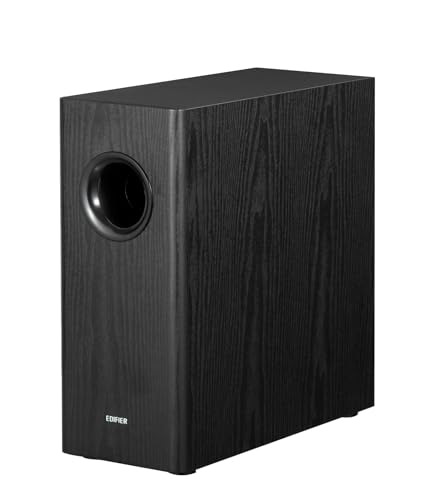
Best Slim Design – Edifier T5s Powered Subwoofer
The Edifier T5s is one of the more space-conscious compact subwoofers, pairing an 8-inch long-throw woofer with 70 watts RMS in a slim cabinet. Its front-firing driver, right-firing port, adjustable low-pass filter, and phase selector make it practical for home audio and compatible bookshelf-speaker systems.
Best For: Home audio users who need a slim powered subwoofer with adjustable integration and RCA connectivity.
Pros:
- Slim 6.69-inch-wide cabinet helps conserve floor or desk space
- 8-inch woofer and 70W RMS Class-D amplification deliver bass down to 35 Hz
- Low-pass filter and 0°/180° phase selector support system matching
- Auto-standby, included cables, and built-in amplification simplify setup
Cons:
- No wireless communication technology is included
- Its 35 Hz response does not extend as low as the PreSonus model’s listed 30 Hz
- Series connection without a sub output requires main speakers with LINE IN
The T5s is a practical fit where cabinet width matters. It offers useful crossover and phase controls, straightforward RCA connections, and enough output for many bookshelf-speaker or home-theater systems without requiring an external amplifier.
How We Picked the Best Compact Subwoofers
We selected these Compact Subwoofers based on a balance of low-frequency performance, cabinet size, amplifier power, connection options, brand reputation, and intended use. The list includes sealed and ported designs, desktop-friendly models, home theater options, and a hideaway subwoofer for installations where space is extremely limited.
Because specifications are not directly comparable across every manufacturer, peak and RMS wattage should be treated as useful context rather than a complete measure of performance. Crossover controls, phase adjustment, enclosure design, and system compatibility can have just as much effect on the final result.
Quick Comparison
| Best For | Recommended Type | What to Prioritize |
|---|---|---|
| Small living rooms | 8- or 10-inch powered subwoofer | Adjustable crossover and phase |
| Home theater | Ported 10-inch model | Deep extension and output |
| Desktop speakers | Compact 8-inch subwoofer | Low-noise operation and easy integration |
| Vehicles or hidden installations | Powered hideaway subwoofer | Enclosure depth and wiring options |
| Music-focused listening | Sealed or controlled ported design | Accurate, tunable bass response |
Key Buying Factors for Compact Subwoofers
Size and Placement
Measure the available space before buying, including clearance around the rear panel and ventilation areas. A smaller enclosure is easier to position, but larger 10-inch models generally have more headroom for movies and larger rooms. Corner placement can increase perceived bass, while placement near a wall may produce a fuller response.
Power and Bass Extension
Look beyond the wattage number. A subwoofer with a suitable amplifier, rigid cabinet, and well-matched driver can sound stronger than a higher-rated model with poor integration. Check the claimed frequency range, but remember that real-room performance depends on placement, room size, and listening volume.
Connections and Controls
Confirm that the subwoofer works with your receiver, powered speakers, sound system, or vehicle. Line-level inputs are common for home audio, while speaker-level compatibility can help with systems that lack a dedicated subwoofer output. Adjustable crossover and phase controls make it easier to blend bass with the main speakers.
Sealed Versus Ported Designs
Sealed cabinets often favor a tighter, more controlled presentation and can be easier to place. Ported models typically deliver greater output and deeper perceived bass from a similarly sized driver, making them attractive for action movies and electronic music.
Who Should Buy Which Compact Subwoofers?
Choose a compact 8-inch model for a bedroom, office, apartment, or desktop setup where moderate output and easy placement matter most. Step up to a 10-inch subwoofer for a small or medium living room, especially if you want stronger movie effects or listen at higher volumes.
Desktop listeners should focus on straightforward connections, compact dimensions, and a clean crossover rather than maximum power. Home theater buyers should prioritize deep extension, output headroom, and phase adjustment. If the subwoofer must fit beneath a seat or inside a vehicle, a powered hideaway design is the most practical choice.
Finally, match the subwoofer to the rest of your system and room. The best choice is not necessarily the most powerful model; it is the one that fits your space, connects easily, and adds bass without sounding boomy or disconnected.