Long HDMI runs can introduce signal drops, limited resolution, and difficult remote-control setups. The best 4K HDMI extenders use Cat5e, Cat6, or Cat7 cabling to carry video farther while adding useful features such as IR control, loop outputs, HDR support, and power over cable.
This roundup compares 10 options for different installation needs, including 4K at 30Hz or 60Hz, point-to-point connections, multi-display distribution, and professional control systems.
Best 10 4K Hdmi Extenders Picks for 2026
Best Long-Range Pick

- 4K@60Hz transmission up to 400 feet
- HDR, Dolby Vision, and 18Gbps support
- Two-way IR, RS-232, loop-out, and PoC
Best For: Large-room and commercial AV installations
Best Value Setup
PWAY 230-Foot 4K HDMI Extender

- 4K@30Hz up to 130 feet
- 1080P reach up to 230 feet
- IR, loop-out, mirror/extended modes, and PoC
Best For: Straightforward home and meeting-room installations
Best Compact 4K60 Pick

- 4K@60Hz 4:4:4 up to 165 feet
- 18Gbps, HDR, and HDCP 2.2 support
- Loop-out, EDID management, and one-way IR
Best For: Fixed home theater and commercial AV runs
Best Mixed-Display Option
J-Tech Digital 230-Foot 4K Extender

- 4K@60Hz 4:4:4 up to 230 feet
- Downscales to 1080P for remote displays
- Loop-out, bi-directional IR, HDR, and PoC
Best For: Systems combining 4K and 1080P displays
Best for 4K Home Theater Runs

- 4K@30Hz up to 131 feet
- HDMI loop out and EDID copy
- IR pass-through with one-way PoC
Best For: Home theaters, CCTV, and meeting spaces needing 4K@30Hz
Best for 4K@60Hz

- 4K@60Hz up to 230 feet
- 18Gbps, HDR10+, and HDCP 2.2
- PoC simplifies receiver power
Best For: High-refresh home theater, gaming, and professional AV
Best for Multi-Display Flexibility

- 4K@30Hz up to 131 feet
- Loop out supports local viewing and cascading
- IR, EDID copy, PoC, and 7.1-channel audio
Best For: Multi-display AV installations and presentation spaces
Best Long-Run Single-Link Pick
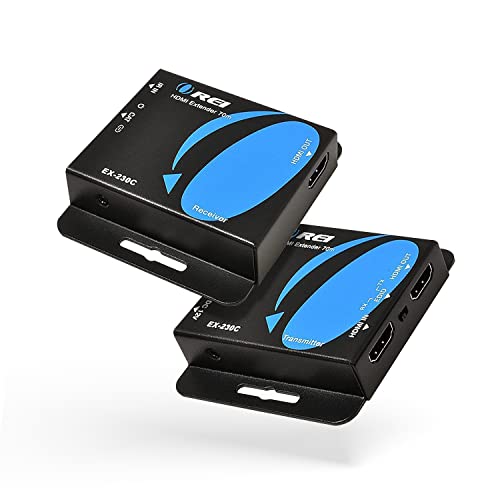
- 4K@30Hz to 130 feet
- 1080p@60Hz to 230 feet
- PoC, loop-out, IR, and EDID
Best For: One remote HDMI display over Cat6/7
Best Dual-Display Splitter

- Sends one source to two displays
- 4K@30Hz up to 165 feet
- Local loop-out and PoC receivers
Best For: Two-display meeting rooms and home media setups
Best Multi-Display Setup
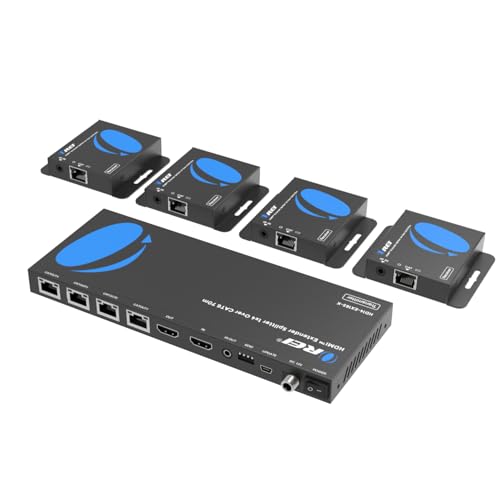
- Distributes one source to four displays
- 4K@30Hz up to 165 feet
- Four PoC receivers with IR passback
Best For: Four-screen commercial and presentation installations
Best Long-Range Pick – 400-Foot 4K HDBaseT Extender
For installations that need maximum reach, this OREI model is one of the more capable 4k hdmi extenders. It sends 4K video up to 400 feet over a direct Cat5e/6/7 cable and adds HDR, advanced audio support, local loop-out, and control features.
Best For: Large homes, conference rooms, commercial displays, and AV racks where long-distance 4K transmission is the priority.
Pros:
- Extends 4K@60Hz video up to 400 feet with HDBaseT technology and zero-latency transmission.
- Supports HDR, HDR10+, Dolby Vision, 18Gbps bandwidth, HDCP 2.2, and 7.1-channel audio formats.
- Includes HDMI loop-out, two-way IR, RS-232, CEC, and PoC with one power adapter.
Cons:
- Only the matching transmitter and receiver pair is supported; it is not interchangeable with other OREI or third-party HDBaseT units.
- Requires a suitable direct Ethernet-cable connection and careful installation for its full range.
This is the strongest choice here for distance and feature depth, especially when you need reliable 4K60 performance and flexible device control. Its proprietary pairing requirement is the main setup limitation.
Best Value Setup – PWAY 230-Foot 4K HDMI Extender
This PWAY extender offers a practical way to run HDMI over a single Cat6 cable. Among 4k hdmi extenders, it stands out for combining 4K@30Hz support, IR control, local loop-out, and power over cable in a relatively straightforward installation.
Best For: Home theaters, meeting rooms, live-streaming setups, and dual-screen installations that need moderate distance and simple wiring.
Pros:
- Supports 4K@30Hz up to 130 feet and 1080P up to 230 feet over Cat6.
- Provides mirror and extended display modes for flexible dual-screen use.
- Includes IR control, HDMI loop-out, and PoC, so only one power adapter is required.
Cons:
- 4K transmission is limited to 30Hz rather than 60Hz.
- The listed maximum distance depends on resolution: 130 feet at 4K and 230 feet at 1080P.
Choose this model when ease of installation and useful everyday features matter more than 4K60 playback. It is a sensible mid-range option, but users with high-frame-rate 4K sources should consider a 60Hz model instead.
Best Compact 4K60 Pick – OREI 165-Foot HDMI Balun
The OREI UHD-EX165H-K is a focused option for extending uncompressed 4K video over a direct Cat6 or Cat7 cable. It is a good fit among 4k hdmi extenders when you want 4K@60Hz, HDR, local monitoring, and straightforward one-way remote control.
Best For: Home theaters, gaming rooms, digital signage, CCTV setups, and conference rooms with runs up to 165 feet.
Pros:
- Transmits 4K@60Hz 4:4:4 video up to 165 feet over one Cat6/7 cable.
- Supports 18Gbps bandwidth, HDR, HDCP 2.2, and up to 12-bit color.
- Includes HDMI loop-out, EDID management, one-way IR, and broad audio-format support.
Cons:
- IR control is one-way rather than bi-directional.
- Requires a direct Cat6 or Cat7 connection and is not compatible with network switches or routers.
This model balances high-quality 4K60 performance with a moderate reach and useful installation features. It is especially appealing for fixed AV runs, provided your wiring plan does not rely on network hardware.
Best Mixed-Display Option – J-Tech Digital 230-Foot 4K Extender
J-Tech Digital’s JTECH-EX230V2 is designed for setups that combine different display capabilities. It carries 4K@60Hz 4:4:4 over Cat5e/6, supports HDR, and can downscale the remote output to 1080P, making it a flexible choice among 4k hdmi extenders.
Best For: Installations using a 4K local display alongside a remote 1080P screen, such as home theaters, classrooms, or conference rooms.
Pros:
- Extends 4K@60Hz 4:4:4 video up to 230 feet over one Cat5e/6 cable.
- Supports 4K-to-1080P downscaling for mixed-resolution displays.
- Offers local HDMI loop-out, bi-directional IR, HDR support, and PoC with one power adapter.
Cons:
- The downscaling function requires a 4K display connected to the transmitter’s local HDMI output.
- Its listed 230-foot range depends on suitable Cat5e/6 cabling and installation conditions.
This is the most adaptable pick for mixed-display systems, particularly when the local screen is 4K but the remote display is limited to 1080P. Its downscaling requirement should be planned before installation.
Best for 4K Home Theater Runs – Reliable 4K@30Hz Extension
For buyers comparing 4k hdmi extenders, the OREI EX-170C is a practical choice when you need to send uncompressed video and audio over a direct CAT5e, CAT6, or CAT7 connection. It supports 4K at 30Hz, includes HDMI loop out and EDID copy, and uses one-way PoC so only the transmitter needs a power adapter.
Best For: Home theaters, conference rooms, classrooms, digital signage, and 4K CCTV setups that do not require 4K at 60Hz or HDMI ARC.
Pros:
- Extends 4K@30Hz up to 131 feet and 1080p up to 230 feet.
- HDMI loop out supports local display monitoring.
- One-way IR pass-through and PoC simplify remote control and installation.
- EDID copy helps optimize source-and-display compatibility.
Cons:
- Does not support 4K@60Hz or HDMI ARC.
- Requires a direct CAT5e/CAT6/CAT7 connection rather than a network switch or router.
The EX-170C is a solid fit when dependable 4K@30Hz transmission and installation flexibility matter more than higher refresh rates. Its loop-out and IR features add useful control for multi-display and remote-source setups.
Best for 4K@60Hz – Long-Range HDR Extension
Among 4k hdmi extenders, the OREI HD-EX196E-K stands out for buyers who want 4K at 60Hz over a long Cat6, Cat6A, or Cat7 run. Its HDMI 2.0a and HDCP 2.2 support, 18Gbps bandwidth, HDR formats, and PoC make it suited to demanding home and professional AV installations.
Best For: Home theaters, gaming and media setups, conferences, monitoring systems, and digital signage requiring 4K@60Hz and HDR support.
Pros:
- Extends HDMI signals up to 230 feet over a single compatible cable.
- Supports 4K@60Hz YUV 4:4:4, 18Gbps bandwidth, HDR10+, and Dolby Digital.
- PoC powers the receiver from the transmitter for a cleaner installation.
- Rugged metal housing helps protect components and dissipate heat.
Cons:
- Requires Cat6, Cat6A, or Cat7 cabling for the stated long-distance performance.
- The supplied information does not list HDMI loop out or EDID management.
This is the strongest option in the group for high-refresh 4K content. It is especially compelling when 4K@60Hz, HDR, and full-color video are more important than local loop-out functionality.
Best for Multi-Display Flexibility – 4K@30Hz with Loop Out
For 4k hdmi extenders that balance distance and installation features, the OREI EX-165C+ provides 4K@30Hz transmission over a direct CAT6 connection. It adds HDMI loop out, EDID copy, one-way IR, and PoC, making it useful for setups where a local display and a remote screen need to show the same source.
Best For: Home theaters, conference rooms, classrooms, digital signage, and multi-display installations using 4K@30Hz.
Pros:
- Supports 4K@30Hz up to 131 feet and 1080p up to 230 feet.
- HDMI loop out enables local monitoring and supports cascading to another extender.
- Includes one-way IR pass-through, EDID copy, and PoC.
- Supports up to 7.1-channel HD audio, including Dolby TrueHD and DTS-HD.
Cons:
- Does not support 4K@60Hz.
- Requires a direct CAT5e/CAT6 cable connection and should not be used through network switches or routers.
The EX-165C+ is a well-rounded choice when loop-out and cascading support are priorities. Its 4K capability is limited to 30Hz, but the added audio, IR, EDID, and local-display features make it versatile for structured AV installations.
Best Long-Run Single-Link Pick – 230ft 4K HDMI Extender
For straightforward, point-to-point 4k hdmi extenders, the OREI EX-230C sends video over Cat6/7 cable while keeping setup simple. It supports 4K at 30Hz to 130 feet and 1080p at 60Hz up to 230 feet, with loop-out, IR control, EDID management, and power over cable.
Best For: Home offices, media rooms, classrooms, and installations that need one distant HDMI display.
Pros:
- Supports 4K@30Hz up to 130 feet and Full HD up to 230 feet.
- PoC requires only one power adapter for the transmitter and receiver.
- Includes HDMI loop-out, one-way IR, and local or remote EDID selection.
- Supports multichannel formats including PCM 7.1, Dolby TrueHD, and DTS-HD.
Cons:
- 4K transmission is limited to 30Hz.
- Uses HDCP 1.4 rather than a newer HDCP standard.
- Shielded Cat6/7 cable is recommended for best signal quality.
This is a practical choice when distance and uncomplicated installation matter more than high-refresh 4K. Its loop-out and EDID controls add flexibility for mixed home or business setups.
Best Dual-Display Splitter – 1×2 4K HDMI Over Ethernet
This OREI model is one of the more flexible 4k hdmi extenders for sending a single source to two remote displays. It carries 4K at 30Hz up to 165 feet over Cat6/7, offers a local HDMI output, and powers the receivers through the cable.
Best For: Meeting rooms, conference spaces, bars, and home setups that need two displays from one HDMI source.
Pros:
- Distributes one HDMI source to two displays simultaneously.
- Supports 4K@30Hz up to 165 feet and 1080p@60Hz up to 230 feet.
- Two-port Cat6 output and an additional HDMI loop-out support local viewing.
- Includes IR control, EDID management, and PoC-powered receivers.
Cons:
- 4K output is limited to 30Hz.
- Requires separate Cat6/7 runs to the two receiver locations.
- Shielded Cat6 is recommended for reliable signal quality.
Choose this version when two screens are part of the plan. The local loop-out, remote IR, and receiver PoC reduce extra hardware, while the 1080p distance rating suits longer cable runs.
Best Multi-Display Setup – 1×4 4K HDMI Extender
For installations requiring several screens, this OREI 1×4 unit distributes one HDMI source to four remote displays over Cat6/6a/7 cable. It supports 4K at 30Hz up to 165 feet, includes a local HDMI output, and uses one power adapter through PoC.
Best For: Digital signage, exhibitions, video conferences, meeting rooms, and bars with four displays.
Pros:
- Feeds one HDMI source to four displays simultaneously.
- Supports 4K@30Hz up to 165 feet over compatible Ethernet cable.
- Includes four receivers, IR passback, and a local HDMI loop-out.
- PoC lets the system operate with one power adapter.
Cons:
- 4K transmission is limited to 30Hz.
- Each remote display needs its own Cat6/6a/7 cable run.
- The supplied notes identify 1080p@60Hz as the highest resolution in the stated application description.
This is the strongest fit of the three for a larger synchronized display installation. It adds the receiver count needed for four screens while retaining IR control and local monitoring, though cable planning is essential.
How We Picked the Best 4K Hdmi Extenders
We evaluated these 4K Hdmi Extenders by comparing their supported resolution, refresh rate, transmission distance, cable compatibility, and installation features. We also considered practical extras such as IR pass-through, HDMI loop out, EDID management, HDR support, HDCP compatibility, and PoC, which can reduce the number of power adapters required.
Distance claims depend on cable quality, connector condition, interference, and the source and display devices. For dependable installations, use properly terminated, solid-core network cable and confirm that the extender’s distance rating matches your required resolution.
Quick Comparison
| Use case | Features to prioritize | Best fit |
|---|---|---|
| Long-distance 4K video | HDBaseT, 4K at 60Hz, HDR, reliable cable ratings | Professional home theaters and commercial AV |
| Standard 4K distribution | 4K at 30Hz, PoC, IR, and loop out | Streaming, signage, and general installations |
| Multiple displays | 1×2 or 1×4 distribution, EDID, loop out | Classrooms, offices, and entertainment systems |
| Remote source control | Bi-directional or one-way IR support | Equipment racks and concealed source devices |
Key Buying Factors for 4K Hdmi Extenders
Resolution and Refresh Rate
Look beyond the word “4K.” Models rated for 4K at 30Hz are suitable for movies, signage, and many streaming devices, but 4K at 60Hz is preferable for gaming, desktop use, and smoother motion. Check whether the extender downscales 4K to 1080p when needed.
Transmission Distance and Cabling
Choose an extender with more range than your measured cable path. Cat6 or Cat6a is generally the safer choice for longer or higher-bandwidth runs, while Cat5e can work within the manufacturer’s stated limits. Avoid routing network cable directly alongside high-voltage wiring.
Control and Installation Features
IR pass-through lets you control a remote source from the display location. HDMI loop out is useful for adding a local monitor, while EDID management helps the source and display negotiate compatible settings. PoC can simplify installation by allowing one unit to power the other, but verify the included power arrangement.
HDR, HDCP, and Audio Compatibility
Confirm support for the HDR format used by your source and display, along with the required HDCP version. If your setup includes an AV receiver, soundbar, or game console, check the product specifications for compatible audio formats and bandwidth.
Who Should Buy Which 4K Hdmi Extenders?
Choose a 4K at 60Hz model for gaming, modern media players, computer workstations, or any setup where smooth 4K motion matters. Choose a 4K at 30Hz model when cost, simple distribution, and long cable runs are more important than high-refresh desktop or gaming performance.
Choose an HDBaseT model for demanding residential or commercial installations that need extended range and stronger control integration. Choose a loop-out model if you want to keep a local display connected while sending the same source to a distant screen.
Choose a 1×2 or 1×4 extender splitter when one HDMI source must feed multiple displays. Before buying, map the complete signal path, identify the highest required resolution and refresh rate, and confirm that every connected display can negotiate a compatible format.