The best audio mixers under $500 can give you hands-on control over microphones, instruments, playback, and effects without the cost or complexity of a large-format console.
This roundup includes compact analog mixers, USB-equipped boards, Bluetooth-enabled models, and gaming-focused options so you can match features to your setup and budget.
Best 10 Audio Mixers Under 500 Picks for 2026
Best All-Around Choice

- 10 inputs with USB connectivity
- SPX effects, EQ, filters, and compressors
- Rugged metal chassis
Best For: Home studios and small live setups
Best Feature-Packed Value

- Eight channels with 48V phantom power
- Bluetooth and USB/MP3 playback
- Ultra-thin design with LED display
Best For: Karaoke, events, and casual live performances
Best Compact Analog Mixer

- Six-input analog design
- D-PRE preamps with EQ and filters
- Rugged two-pound chassis
Best For: Small recording, lecture, and performance setups
Best for Bluetooth and DSP Effects

- Bluetooth and USB playback/recording
- 16 DSP effects with three-band EQ
- Four XLR inputs with 48V phantom power
Best For: Karaoke, streaming, and small live gigs
Compact Analog Pick

- Five-channel compact mixer with low-noise performance
- Phantom power and two-band EQ for basic studio use
- RCA and 1/4-inch connections for playback and recording
Best For: Home recording and simple live sound setups
Streaming Control Pick

- XLR input with built-in 48V phantom power
- Individual faders for mic, line, headphones, and output
- Sound effects, voice modes, mute controls, and RGB lighting
Best For: Gaming streams and live content creation with an XLR mic
Feature-Rich Budget Pick

- Five channels with three XLR inputs and 48V phantom power
- USB, Bluetooth, RCA, and 6.35mm connectivity
- Built-in headphone monitoring, EQ, echo, and delay effects
Best For: Small live sound, podcasting, streaming, and flexible playback
Best Compact Mixer
LZSIG 4-Channel Mini Audio Mixer
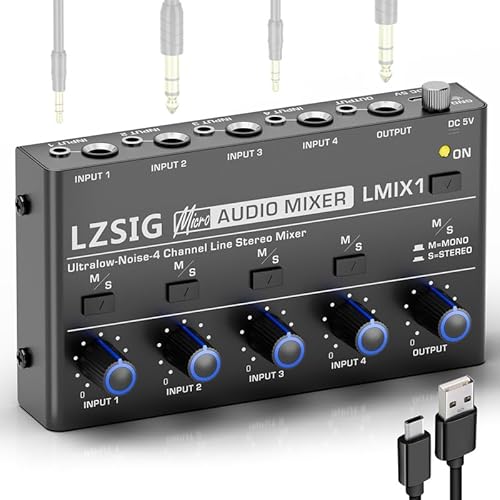
- Four inputs combine into stereo or mono output
- 3.5mm and 6.35mm connectivity
- Compact, low-noise design
Best For: Simple line-level source combining
Best for Larger Setups
8-Channel Professional Audio Mixer

- Eight inputs for microphones and other sources
- USB, Bluetooth, and flash-drive functions
- 3-band EQ, effects, and 48V phantom power
Best For: Live shows, streaming, and multi-input recording
Best for PC Recording

- Three XLR inputs plus 1/4-inch and RCA stereo inputs
- Built-in USB-B PC recording interface
- Bluetooth, USB playback, effects, and 48V phantom power
Best For: Home recording, podcasts, and live streaming
Best All-Around Choice – Yamaha MG10XU
For shoppers comparing audio mixers under 500, the Yamaha MG10XU is a versatile 10-input option with USB connectivity, onboard SPX digital effects, and practical channel controls for recording, live sound, and performances.
Best For: Home studios, small live setups, and users who want USB recording plus built-in effects.
Pros:
- 10 inputs provide useful capacity for microphones and instruments.
- USB connectivity and SPX digital effects support recording and flexible mixing.
- D-PRE preamps, three-band EQ, high-pass filters, and one-knob compressors offer hands-on control.
- Rugged, impact-resistant powder-coated metal chassis.
Cons:
- At 7.7 pounds, it is less portable than the smaller mixers here.
- Its 10-input layout may be more than a very simple setup requires.
The MG10XU stands out as a balanced choice when you need dependable construction, multiple inputs, and computer-friendly USB connectivity in one mixer.
Best Feature-Packed Value – FULUODE CT-80S
Among audio mixers under 500, the FULUODE CT-80S emphasizes convenience with eight channels, Bluetooth, USB/MP3 playback, reverb, and 48V phantom power for karaoke, events, and basic live sound.
Best For: Karaoke, family KTV, campus activities, conferences, and casual band performances.
Pros:
- Eight-channel design supports wired, wireless, and capacitive microphones or instruments.
- Built-in Bluetooth 5.0 and MP3/USB input add convenient playback options.
- 48V phantom power supports compatible condenser microphones.
- Ultra-thin 1.57-inch design and large LED display.
Cons:
- The supplied notes identify a 110-volt American plug, so compatibility should be checked for other regions.
- The 3.3 kg weight is relatively substantial for an ultra-thin mixer.
- The included warranty is listed as 365 days.
This is a practical choice for users who prioritize built-in playback and wireless features over a traditional studio-focused feature set.
Best Compact Analog Mixer – Yamaha MG06
For buyers seeking audio mixers under 500 without extra digital features, the Yamaha MG06 is a straightforward six-input analog mixer with D-PRE preamps, EQ, high-pass filters, and XLR outputs.
Best For: Small recording setups, lectures, performances, and users who prefer a simple analog workflow.
Pros:
- Compact six-input format is easy to place and operate.
- D-PRE preamps support natural-sounding bass and smooth highs.
- Three-band EQ and high-pass filters help shape and clean up audio.
- Rugged, impact-resistant powder-coated metal chassis.
Cons:
- No USB connectivity; the supplied notes specify analog operation.
- Six inputs provide less capacity than the MG10XU.
- It does not include the built-in digital effects listed on some competing models.
The MG06 is a focused, portable-feeling option for users who need reliable analog mixing rather than Bluetooth, USB, or onboard effects.
Best for Bluetooth and DSP Effects – 6-Channel Audio Mixer
This six-channel model is a flexible pick among audio mixers under 500, combining Bluetooth streaming, USB playback and recording support, 48V phantom power, three-band EQ, and 16 DSP effects.
Best For: Karaoke, streaming, small live gigs, and users who want wireless playback with built-in effects.
Pros:
- Four XLR inputs support microphones and instruments, with 48V phantom power on those channels.
- Bluetooth and USB functions support wireless streaming, playback, and recording.
- Three-band EQ and 16 DSP effects provide sound-shaping flexibility.
- Separate controls include channel, master output, and effect adjustment faders.
Cons:
- The manufacturer-listed warranty is 90 days from purchase.
- At 2.3 kg, it is less lightweight than the Yamaha MG06.
- The supplied notes describe a traditional analog product, so setup and operation may require careful adjustment.
Choose this mixer when Bluetooth, USB media handling, phantom power, and a broad selection of built-in effects matter more than a minimal analog interface.
Compact Analog Pick – Mackie Mix5
For shoppers comparing audio mixers under 500, the Mackie Mix5 is a straightforward compact option for basic microphone, playback, and recording setups. It provides five channels, low-noise performance, phantom power, and dedicated stereo connections in a small, lightweight design.
Best For: Home recording, simple live sound, and users who want a compact mixer with essential analog controls.
Pros:
- Five-channel design with one mic/line input and two stereo 1/4-inch line inputs
- Phantom power supports studio condenser microphones
- Dedicated stereo RCA inputs and outputs for playback or recording
- Compact 1.4-pound enclosure with two-band EQ and main L/R outputs
Cons:
- Offers fewer channels and effects than the more feature-heavy alternatives in this roundup
- Connectivity is primarily analog rather than USB or Bluetooth-based
The Mix5 makes the most sense when dependable basic mixing matters more than built-in digital features. Its compact footprint and essential I/O suit small setups, while the limited channel count may be restrictive for larger productions.
Streaming Control Pick – FIFINE Ampligame SC3
Among audio mixers under 500, the FIFINE Ampligame SC3 focuses on streamers who want hands-on control over voice, game, music, and monitoring levels. Its XLR input, individual channel controls, mute and monitor buttons, sound effects, and RGB lighting are tailored to live content creation.
Best For: Gaming streams, podcasts, online chat, and creators using an XLR condenser microphone.
Pros:
- XLR microphone input with built-in 48V phantom power for compatible condenser microphones
- Independent controls for microphone, line input, headphones, and line output
- Front-facing mute and monitor buttons support convenient live operation
- Includes customizable sound-effect buttons, voice-changing modes, auto-tune changes, and RGB lighting
Cons:
- Not compatible with USB microphones
- XLR cable is not included
- Its two-input, two-output setup is aimed more at streaming than broad multi-channel mixing
The SC3 is a specialized streaming mixer rather than a traditional multi-channel console. It is a strong fit for creators who value quick controls and effects, provided they already use—or plan to use—a compatible XLR microphone.
Feature-Rich Budget Pick – BOMGE BM-05
The BOMGE BM-05 is a flexible choice for shoppers comparing audio mixers under 500, combining five-channel connectivity with USB, Bluetooth, RCA, and 6.35mm connections. It also adds headphone monitoring, 48V phantom power, two-band EQ, gain controls, and echo or delay effects for recording and live applications.
Best For: Small live setups, podcasting, streaming, music playback, and users who need several connection options.
Pros:
- Three XLR inputs with switchable 48V phantom power for condenser microphones
- USB-B recording interface, USB-A playback and recording, and Bluetooth music streaming
- Headphone monitoring plus two-band EQ, gain, echo, and delay controls
- Provides RCA and 6.35mm stereo inputs and outputs for active sound equipment
Cons:
- Bluetooth, USB, and four- or five-channel functions cannot be used simultaneously
- Bluetooth operating range is listed as 1.5 feet
- Output connections are intended for active speakers or active sound systems
The BM-05 offers the broadest feature set here for users who want digital playback and recording alongside traditional mixer connections. Its mode limitations and active-output requirement are important considerations when planning a more complex setup.
Best Compact Mixer – LZSIG 4-Channel Mini Audio Mixer
If you need audio mixers under 500 for simple source combining, the LZSIG Mini Audio Mixer offers four inputs and one stereo or mono output in a compact enclosure. It accepts both 3.5mm and 6.35mm connections, making it useful for routing instruments, computers, CD players, or gaming consoles.
Best For: Sub-mixing several line-level sources in a compact home, gaming, or instrument setup.
Pros:
- Combines up to four audio sources into one stereo or mono output.
- Supports both 3.5mm and 6.35mm TS/TRS cables without adapters.
- Uses low-noise components and includes mono/stereo switching.
Cons:
- The power adapter is sold separately.
- It is designed for line mixing rather than a full channel-strip console.
The LZSIG is a practical choice when size and straightforward routing matter more than extensive controls. Confirm your power-supply needs before ordering.
Best for Larger Setups – 8-Channel Professional Audio Mixer
Among audio mixers under 500, this 8-channel console stands out for users who need multiple microphone connections plus USB, Bluetooth, and recording options. Its channel controls, effects, headphone monitoring, and 48V phantom power support make it suited to live and recording-oriented setups.
Best For: Live shows, streaming, podcasting, small bands, karaoke, and multi-input recording setups.
Pros:
- Provides eight channels with XLR and unbalanced 1/4-inch input support.
- Includes USB playback and recording, Bluetooth streaming, and REC/TAPE connections.
- Offers 3-band EQ, gain, reverb, delay, headphone monitoring, and 48V phantom power.
Cons:
- The larger control set may be more than needed for basic two-source mixing.
- It uses corded power rather than a portable battery setup.
This mixer is the more flexible option for users building a small live, streaming, or studio system. Its eight-channel layout provides room for several microphones and additional playback sources.
Best for PC Recording – Aveek 5-Channel Audio Mixer
For audio mixers under 500 aimed at home recording and streaming, the Aveek 5-Channel Audio Mixer combines microphone, instrument, stereo, and RCA inputs with a built-in PC recording interface. It also adds USB playback and recording, Bluetooth streaming, headphone monitoring, and selectable 48V phantom power.
Best For: Podcasting, live streaming, PC recording, small performances, and meetings requiring multiple source types.
Pros:
- Includes three XLR inputs plus 1/4-inch and RCA stereo inputs.
- Supports plug-and-play PC recording through its USB-B connection.
- Adds USB drive playback/recording, Bluetooth, 2-band EQ, echo, delay, and headphone monitoring.
Cons:
- Bluetooth, USB, and 4/5-channel functions cannot be used simultaneously.
- Bluetooth operates within a stated 15-foot range.
- Outputs are intended for headphones or active speakers/power systems.
The Aveek offers a broad feature set for a compact recording and streaming station. Its input variety is useful, but users should plan around the stated limitations when combining USB, Bluetooth, and channel functions.
How We Picked the Best Audio Mixers Under 500
We focused on mixers that offer useful features for their price, including channel count, input flexibility, preamp and phantom-power support, built-in effects, USB connectivity, monitoring controls, and portability. The selection covers established options from Yamaha and Mackie alongside affordable boards designed for streaming, karaoke, DJ use, home recording, and small live performances.
Because specifications and included accessories can vary by listing, confirm the current input layout, USB functions, power requirements, and software compatibility before buying.
Quick Comparison
| Best For | What to Look For | Recommended Type |
|---|---|---|
| Home recording | Clean preamps, USB interface, phantom power | USB mixer with flexible channel inputs |
| Live sound | Enough inputs, dependable controls, effects | Traditional analog mixer with onboard DSP |
| Streaming and gaming | Easy monitoring, mute controls, computer connectivity | Compact USB or gaming mixer |
| DJ and karaoke use | Bluetooth, playback, echo or reverb | Feature-rich digital or analog board |
| Simple setups | Low noise, small footprint, straightforward routing | Mini mixer with essential inputs |
Key Buying Factors for Audio Mixers Under 500
Inputs and Channel Layout
Count the sources you need to connect at the same time, not just the advertised channel total. Check whether channels accept XLR microphones, 1/4-inch instruments, stereo line sources, or dedicated playback signals. Extra channels provide room for expansion.
USB Connectivity and Recording
A USB mixer can simplify recording and streaming by sending the mix directly to a computer. However, many budget models provide a stereo mix rather than multitrack recording. If separate track editing matters, verify the USB routing and driver support.
Phantom Power and Microphone Support
+48V phantom power is important for many condenser microphones. Look for channel-level gain control, clear signal indicators, and balanced outputs if you plan to run longer cables or connect professional speakers.
Effects, Bluetooth, and Monitoring
Reverb, echo, Bluetooth playback, and built-in DSP can be convenient for live vocals, karaoke, and content creation. Prioritize headphone volume, monitor outputs, mute controls, and low-noise operation if you will mix while recording or streaming.
Size, Build, and Power
Compact mixers save desk space and travel easily, while larger boards offer more accessible controls. Consider the enclosure, knob spacing, power adapter, output connectors, and whether the mixer is intended for fixed installation or frequent transport.
Who Should Buy Which Audio Mixers Under 500?
Choose a Yamaha MG10XU or similar full-featured analog mixer if you need dependable controls, multiple microphones, and onboard effects for rehearsals, small venues, or serious home setups.
Choose a compact Yamaha MG06 or Mackie Mix5 for a simple, reliable setup with a few microphones or line-level sources and no need for extensive digital features.
Choose a USB, Bluetooth, or DSP-equipped budget mixer if streaming, karaoke, DJ playback, or casual recording is your priority and you want more functions in one device.
Choose the FIFINE gaming mixer if your setup centers on PC gaming, voice chat, quick level changes, and convenient desktop controls.
Choose a mini low-noise mixer such as the LZSIG when you need basic signal combining in a very small footprint. For any model, match the connector types and output requirements to your microphone, speakers, headphones, and computer before purchasing.