Audio snakes simplify live sound by bundling multiple balanced microphone or line-level connections into one organized cable run. The right model can reduce setup time, keep channels easier to trace, and help prevent a crowded stage or mixing position.
These 10 picks cover common needs, from short four-channel breakout cables and compact circuit-board snakes to 25- and 50-foot options with eight, 12, or more channels. Use the guide below to match cable length, connector layout, channel count, and construction to your setup.
Best 10 Audio Snake Cables for Live Sound Picks for 2026
Best Long-Reach Pick
GEARit 8-Channel 30 ft XLR Snake

- 30-foot reach for stages and studios
- Eight balanced XLR channels
- Metal connectors with channel labels
Best For: Longer mixer-to-stage and monitor connections
Best Color-Coded Value
EBXYA 8-Channel 25 ft XLR Snake

- Eight balanced XLR channels
- Color-coded connectors for quick matching
- Shielded OFC cable with locking connectors
Best For: Organized live, studio, and karaoke setups
Best Stage-Box Flexibility
Speakers 8 Send/4 Return Snake

- Eight sends and four returns
- Low-profile stage box
- Marked connections for easier routing
Best For: Live setups needing multiple send and return paths
Best Compact Setup
Phenyx Pro 4-Channel 3 ft XLR Snake

- Compact 3-foot, four-channel design
- Double shielding for cleaner signal paths
- Color-coded and numbered channels
Best For: Short, organized mixer and microphone connections
Best for Everyday Use
Cable Matters 4-Channel 10-Foot XLR Snake

- Four male-to-female XLR channels
- Shielding helps minimize interference
- Color-coded for quick identification
Best For: Compact stage and studio signal runs
High-Channel Stage Pick
PRORECK 12-Channel 50-Foot XLR Snake

- Twelve XLR signal channels
- 50-foot stage-to-console reach
- Numbered connectors simplify routing
Best For: Larger live sound and recording systems
Compact 8-Channel Pick

- Eight XLR channels in a compact 10-foot length
- Shielding helps minimize EMI and RFI noise
- Color- and number-marked connectors speed setup
Best For: Compact stages, studios, and live sound rigs
Flexible Stage Routing

- 12 XLR channels with a 25-foot cable
- Circuit-board stage box supports solid connections
- Numbered connectors simplify stage routing
Best For: Medium-sized live sound and recording setups
Large-Format Road-Ready Pick
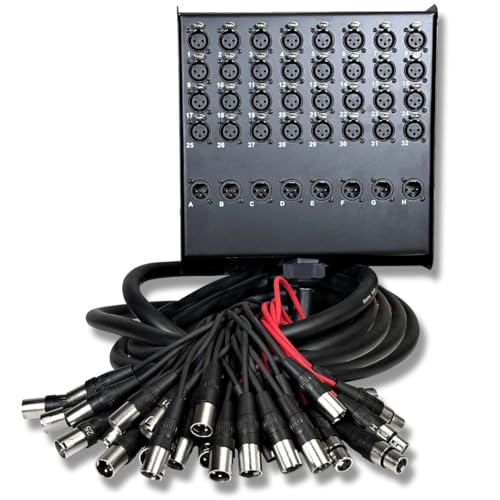
- 32 sends and eight returns for high channel capacity
- Heavy-duty steel stage box for road use
- Individually shielded pairs and labeled connections
Best For: Large live venues, studios, and touring setups
Best Long-Reach Pick – GEARit 8-Channel 30 ft XLR Snake
For buyers comparing audio snake cables for live sound, the GEARit 8-channel model offers a useful 30-foot reach for connecting mixers, stage monitors, speakers, or studio processing equipment. Its metal connectors and labeled channels are practical for organized setups.
Best For: Small venues, live stages, recording studios, and longer mixer-to-stage connections.
Pros:
- 30-foot length supports flexible stage and studio routing.
- Eight channels carry multiple balanced XLR signals in one cable.
- Metal locking connectors and clear channel labels aid secure, organized setup.
Cons:
- Its 8-channel, male-to-male configuration may not suit every connection path.
- The longer cable can be more than needed for compact setups.
The GEARit is a straightforward choice when reach, channel organization, and rugged connector hardware matter more than a compact footprint.
Best Color-Coded Value – EBXYA 8-Channel 25 ft XLR Snake
The EBXYA is a practical option for audio snake cables for live sound when quick channel identification and flexible routing are priorities. Its 25-foot male-to-female cable combines eight balanced channels with color-coded connectors.
Best For: Live sound, studio recording, karaoke setups, DJ equipment, and systems using standard 3-pin XLR connections.
Pros:
- Eight channels consolidate multiple XLR runs into one cable.
- Different connector colors make channel matching easier.
- OFC conductors and multilayer shielding are designed to resist interference.
- Self-locking metal connectors support stable connections.
Cons:
- At 25 feet, it offers less reach than a 30-foot option.
- The multicolor connector design may be less visually uniform on stage.
Choose the EBXYA when fast identification and a standard male-to-female connection are especially useful during setup and teardown.
Best Stage-Box Flexibility – Speakers 8 Send/4 Return Snake
For audio snake cables for live sound that need both sends and returns, this Speakers model provides an 8-send, 4-return layout in a 25-foot cable. Its low-profile box helps reduce stage footprint while clearly marked connections simplify routing.
Best For: Live stages, recording rooms, studios, and console setups requiring multiple send and return paths.
Pros:
- Provides eight send channels and four return channels.
- Low-profile stage box takes up less space.
- Clearly marked cable ends and box connections support easier identification.
- Designed for indoor and outdoor use in live, recording, and studio applications.
Cons:
- The specialized send/return configuration may be unnecessary for simpler systems.
- Its 25-foot length may not cover larger stages.
This is the most purpose-built option here for setups that need return lines as well as outgoing channels, especially where stage-box space is limited.
Best Compact Setup – Phenyx Pro 4-Channel 3 ft XLR Snake
The Phenyx Pro is a compact choice among audio snake cables for live sound, combining four short XLR channels into one 3-foot cable. Its color coding, number labels, shielding, and locking connectors suit close-range equipment connections.
Best For: Compact mixer, microphone, instrument, studio, and stage setups with equipment positioned nearby.
Pros:
- Four channels reduce cable clutter in short connection runs.
- Color coding and numbered labels make channels easy to identify.
- Double shielding is designed to reduce RFI and EMI noise.
- Male-to-female locking XLR connectors support broad professional-audio compatibility.
Cons:
- The 3-foot length is limiting for larger stages or spread-out gear.
- It provides four channels rather than the eight channels offered by several alternatives.
- Listed for indoor use.
The Phenyx Pro makes sense when short, tidy connections are the priority and four labeled channels are sufficient for the system.
Low-Profile Circuit Board Pick – PRORECK 8-Channel 50-Foot XLR Snake
For live sound setups needing multiple microphone or line connections, the PRORECK 8-channel snake provides 50 feet of reach and eight numbered XLR channels. Its low-profile design and circuit board construction make it a practical option for routing signals between a stage box and an analog or digital console.
Best For: Live performances, recording sessions, stage events, and studio projects requiring eight XLR channels.
Pros:
- Eight channels with numbered connectors for easier setup.
- 50-foot length supports stage-to-console routing.
- Circuit board is designed to help maintain solid connections and reduce external noise.
- Rugged cord material is suited to indoor and outdoor use.
Cons:
- Eight channels may be more than needed for smaller systems.
- The supplied configuration uses female connectors at the box and male connectors at the fantail.
This PRORECK is a strong choice when you want a long, clearly labeled audio snake cable for live sound without adding converters between the snake and your console.
Best for Everyday Use – Cable Matters 4-Channel 10-Foot XLR Snake
The Cable Matters 4-channel XLR snake is a compact option for audio snake cables for live sound, studio work, and shorter signal paths. Its 10-foot length, shielding, and color-coded channels are useful when quick identification and manageable cable runs matter more than extended stage reach.
Best For: Short stage, studio, live-performance, and recording connections requiring four XLR channels.
Pros:
- Four-channel male-to-female XLR configuration supports streamlined connectivity.
- 10-foot length suits compact setups.
- Shielding is designed to minimize interference and signal loss.
- Color-coded channels help speed up identification and reduce connection errors.
Cons:
- 10 feet may be limiting for larger stages or distant console positions.
- Four channels provide less expansion than 8- or 12-channel snakes.
Choose this Cable Matters model when you need a shorter, easy-to-identify snake for a mixer-based setup and do not require the reach or channel count of a larger stage snake.
High-Channel Stage Pick – PRORECK 12-Channel 50-Foot XLR Snake
For larger live sound systems, the PRORECK 12-channel snake combines 50 feet of cable with twelve individually numbered signal paths. The female stage-box connectors and male fantail connectors provide a defined routing setup for mixers, amplifiers, PA systems, and recording equipment.
Best For: Larger live, recording, stage, and studio systems that need twelve XLR channels over a 50-foot run.
Pros:
- Twelve channels provide capacity for larger microphone and equipment setups.
- 50-foot length supports stage-to-console connections.
- Numbered channels simplify identification at the box and fantail.
- Circuit board construction is designed to support solid connections and reduced external noise.
Cons:
- The higher channel count may be unnecessary for small rigs.
- The supplied configuration includes four XLR female connectors and twelve XLR male connectors, so connector planning is important.
This PRORECK model is the better fit when a compact four- or eight-channel snake would leave too little capacity. Its long run and 12-channel layout are aimed at more demanding audio signal-routing duties.
Compact 8-Channel Pick – 10ft Shielded XLR Snake
For smaller live sound systems, the PRORECK 10-foot snake provides eight XLR channels in a manageable cable run. Its shielded construction, copper conductors, and color- and number-marked connectors make it a practical choice when you want cleaner signal transmission and faster setup.
Best For: Compact stage, studio, and live applications requiring eight XLR channels over a short distance.
Pros:
- Eight channels transmit multiple audio signals simultaneously.
- Shielding helps reduce electromagnetic and radio-frequency interference.
- Numbered and color-marked connectors simplify identification and routing.
- Standard male-to-female XLR connectors offer broad compatibility.
Cons:
- The 10-foot length may be limiting for larger stages or distant stage boxes.
- It provides eight channels, fewer than the larger multi-channel snakes in this roundup.
This is a straightforward option for buyers who need audio snake cables for live sound without a long cable trunk or high channel count. Choose it for compact setups where quick identification and interference reduction matter most.
Flexible Stage Routing – 12-Channel Low-Profile Snake
The PRORECK 12-channel low-profile snake is designed for live sound and recording setups that need more inputs over a 25-foot run. Its circuit-board stage box, numbered connections, and direct XLR compatibility support organized routing without requiring converters.
Best For: Live sound engineers, recording studios, and stage systems needing 12 channels across a 25-foot cable.
Pros:
- Offers 12 channels through a 25-foot cable.
- Circuit-board construction is designed to support solid connections and reduce external noise.
- Numbered box and fantail connections make channels easier to identify.
- Can connect directly to analog or digital consoles without converters.
Cons:
- The configuration uses four XLR female connectors on the box and 12 XLR male fantail connectors, so connector layout should be checked before purchase.
- Its low-profile design is practical for routing but does not provide the heavier steel stage box specified for the Seismic Audio model.
Among these audio snake cables for live sound, this model balances channel count and reach for medium-sized setups. It is a sensible fit when 12 channels and direct console connectivity are more important than maximum expansion.
Large-Format Road-Ready Pick – 32×8 25ft XLR Snake
The Seismic Audio SACB-32x8x25 is built for demanding live sound, stage, and studio systems that need extensive channel capacity. It combines 32 sends, eight returns, a 25-foot trunk, individually shielded pairs, and a heavy-duty steel stage box for a more substantial professional setup.
Best For: Larger live venues, recording facilities, and road setups requiring 32 sends and eight returns.
Pros:
- Provides 32 XLR male sends and eight XLR female returns.
- Individually shielded pairs and 25-gauge heavy-duty conductors support clean signal transmission.
- Heavy-duty steel stage box is designed for road use.
- Numerically labeled stage box and color-coded, numbered fantail improve connection management.
Cons:
- At 15.5 pounds in the listed specifications, it is substantially heavier than a compact snake.
- The 32-channel configuration may be more cable capacity than smaller systems require.
- The 25-foot length may not suit setups needing a shorter or longer trunk.
This is the strongest choice here for high-channel-count audio snake cables for live sound. Its steel stage box, extensive sends and returns, and individually shielded pairs make it better suited to demanding installations and touring-style use than compact alternatives.
How We Picked These Audio Snake Cables for Live Sound
We focused on practical features that matter during rehearsals, performances, recording sessions, and stage installations: channel count, cable length, balanced XLR connectivity, connector identification, physical layout, and portability. The selection includes conventional male-to-female snakes as well as low-profile circuit-board designs, since each style suits a different workflow.
We also considered whether a cable is better suited to short equipment connections, general stage use, or longer runs between a stage box and mixer. A snake should make multiple connections easier to manage without introducing unnecessary bulk or confusion.
Quick Comparison
| Best For | Typical Choice | What to Prioritize |
|---|---|---|
| Small rigs and compact setups | 4-channel, 3- to 10-foot snake | Low bulk and easy storage |
| Typical bands and venues | 8-channel, 10- to 30-foot snake | Channel labeling, shielding, and flexible length |
| Larger stage inputs | 12-channel, 25- to 50-foot snake | Capacity, strain relief, and durable connectors |
| Permanent or low-profile installations | Circuit-board snake | Compact breakout design and secure placement |
Key Buying Factors for Audio Snake Cables for Live Sound
Channel Count
Choose enough channels for your current inputs, then leave room for expansion when practical. Four channels can suit a small recording or auxiliary setup, while eight channels work well for many compact live rigs. Twelve or more channels are useful for drum kits, larger bands, and stage-box applications.
Length and Routing
Measure the actual path from the stage or source equipment to the mixer, not just the straight-line distance. A little extra length helps with routing around stands and walkways, but excess cable can create tangles and signal-management problems.
Connector and Breakout Design
Most models use XLR male-to-female connections for balanced microphone or line-level signals. Standard bundled breakouts are flexible and familiar; low-profile circuit-board snakes can save space and keep connectors grouped in a compact housing.
Labels, Color Coding, and Build Quality
Numbered channels and color-marked connectors speed up setup and troubleshooting. Look for firmly attached connectors, adequate strain relief, shielding, and a cable jacket that can tolerate repeated coiling and transport. Balanced wiring helps reject interference, but good routing and sensible gain staging still matter.
Who Should Buy Which Audio Snake Cables for Live Sound?
Choose a short four-channel model for a small interface, compact mixer, keyboard rig, or recording setup where portability matters most. Choose an eight-channel snake for general-purpose rehearsals, small venues, and typical band configurations. Choose a 12-channel or larger model if you need several drum, vocal, instrument, or monitor connections and want capacity for future expansion.
Choose a low-profile circuit-board snake when connector density and a tidy footprint are priorities. For longer stage-to-mixer runs, select a 25- or 50-foot option after confirming that the route will not require excessive slack. Before buying, verify the connector gender, channel numbering, total length, and whether the snake is intended for microphone-level signals, line-level signals, or both.