Compact synthesizers make it easier to sketch melodies, build beats, and experiment with sound without committing to a full-size keyboard or desktop setup. The right choice depends on whether you prioritize keys, sequencing, sampling, portability, or immediate hands-on control.
We’ve compared 10 portable instruments and music-making tools, ranging from pocket synths and chord machines to sampler-workstations and MIDI controllers, so you can find a setup that matches your workflow.
Best 10 Compact Synthesizers Picks for 2026
Best Hybrid Experimenter
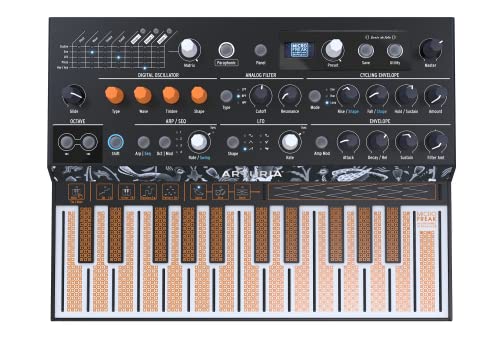
- Hybrid digital engines with a resonant analog filter
- 25-key touch keyboard with poly-aftertouch
- CV, MIDI, USB, modulation matrix, and sequencing
Best For: Advanced experimental sound design and modular integration
Best Pocket Polysynth

- Micro polysynth inspired by the SH-101
- Hands-on controls and onboard sequencing
- Designed for portable basses, leads, and wave manipulation
Best For: Portable sound creation for beginners and synth explorers
Best Portable FM Value
M-VAVE Wireless FM Synthesizer

- Six-operator FM engine with 32 algorithms
- 128 presets, six effects, arpeggiator, and sequencer
- Battery-powered with speaker and multiple MIDI options
Best For: Portable FM music-making and beginner-friendly experimentation
Best Sampling Workstation

- Built-in mic for portable sample capture
- Chopping, step sampling, resampling, and chromatic playback
- Granular controls, per-sample shaping, and onboard sequencing
Best For: Portable beatmaking and experimental sample-based sound design
Classic Pocket Pick

- Three-octave vintage-style sound
- Stylus control is beginner-friendly
- Pocket-sized and battery-powered
Best For: Beginners and retro-sound enthusiasts
Portable Rhythm Workhorse

- TR-808, TR-909, TR-606, and TB-303 sounds
- 16-step sequencing with advanced rhythm controls
- USB-C audio/MIDI and onboard effects
Best For: Portable beatmaking and acid-style performances
Standalone Sampling Hub

- Computer-free sampling and sequencing
- 16 pads, microphone, speaker, and rechargeable battery
- Chopping, resampling, and 60 effect types
Best For: Portable beatmaking and DAWless sampling
Ultra-Compact Sound Designer

- Compact 9.21 x 6.1 x 2.56-inch design
- Lightweight 0.65 kg alloy-steel body
- MIDI connectivity for compatible setups
Best For: Portable, space-conscious sound design
Chord-Driven Portable Synth

- Four-voice JUNO-60 synth engine
- 100 chord sets and 64 sequencer patterns
- USB-C audio and MIDI interface
Best For: Portable chord creation and electronic songwriting
Standalone Mini Keyboard

- Over 100 built-in drum and instrument sounds
- 25 velocity-sensitive keys and eight MPC pads
- Built-in speaker with battery or USB power
Best For: Mobile beat making and computer-free practice
Best Hybrid Experimenter – Arturia MicroFreak
The Arturia MicroFreak is one of the most versatile compact synthesizers for sound designers who want hybrid digital oscillators, an analog filter, and expressive control in a small footprint. Its 25-key touch keyboard, modulation matrix, sequencer, and CV connectivity make it particularly capable for hands-on experimentation.
Best For: Advanced users seeking experimental sounds, expressive sequencing, and integration with MIDI or modular gear.
Pros:
- Offers 17 oscillator modes spanning wavetable, physical modeling, vocoder, and other timbres.
- 25-key touch-plate keyboard supports individual pressure or poly-aftertouch sensing.
- Includes a 5×7 modulation matrix, arpeggiator, step sequencer, USB, MIDI, and CV connectivity.
Cons:
- The touch-plate keyboard may feel less familiar than a conventional keybed.
- Its advanced modulation and synthesis options may suit experienced users better than beginners.
Choose the MicroFreak if compact size matters but you do not want to sacrifice sound-design depth or hardware connectivity. It is a strong option for evolving patterns and unusual hybrid textures.
Best Pocket Polysynth – Roland AIRA Compact S-1
Roland AIRA Compact S-1 Tweak Synth | Ultra-Portable Micro Polysynth. Advanced Tools
Check Price On AmazonThe Roland AIRA Compact S-1 Tweak Synth is a practical pick among compact synthesizers for portable beat-making and melodic work. Inspired by the SH-101, it combines hands-on controls with wave manipulation, onboard sequencing, and performance-focused features in a small 1-pound design.
Best For: Beginners and experienced creators who want a compact, portable polysynth for basses, leads, and quick musical ideas.
Pros:
- Offers a micro polysynth workflow inspired by the Roland SH-101.
- Provides hands-on controls and an intuitive workflow for immediate experimentation.
- Includes onboard sequencing and wave-manipulation features for modern sound creation.
Cons:
- The supplied notes do not specify key count, battery operation, or detailed connectivity.
- Its compact format may provide less physical control space than a full-size synthesizer.
The S-1 makes sense when portability and an approachable workflow are more important than extensive technical specifications. It is designed to move quickly from classic-inspired sounds to more futuristic textures.
Best Portable FM Value – M-VAVE Wireless FM Synthesizer
The M-VAVE FM Synthesizer stands out among compact synthesizers for its battery-powered, all-in-one design. It combines a six-operator FM engine, 32 algorithms, 128 presets, built-in effects, a speaker, and a 16-step sequencer with a small set of silicone keys.
Best For: Beginners and mobile creators who want classic FM sounds, built-in playback features, and wireless or wired MIDI options.
Pros:
- Six operators and 32 algorithms support classic FM-style sound creation.
- Includes 128 presets, six effects, an arpeggiator, and a 16-step sequencer.
- Battery operation, built-in speaker, Bluetooth MIDI, USB MIDI, and 3.5mm MIDI input support portable use.
Cons:
- The compact silicone-key design may not provide the feel of a traditional keyboard.
- The supplied notes do not identify the battery runtime or display size.
This M-VAVE model is a compelling choice for casual composing, travel, and quick FM exploration without extra equipment. Its presets and standard piano layout also make it approachable for users new to FM synthesis.
Best Sampling Workstation – Roland AIRA Compact P-6
The Roland AIRA Compact P-6 is a strong alternative to traditional compact synthesizers for creators who prefer manipulating recorded sound. This pocket-size sampler includes a built-in microphone, onboard keyboard, chopping and resampling tools, granular parameters, and a sequencer for building custom sounds and loops.
Best For: Beatmakers and sound designers who want portable sample capture, chromatic playback, and detailed sample manipulation.
Pros:
- Built-in microphone enables quick sample capture without external equipment.
- Supports chopping, step sampling, resampling, chromatic playback, and polyphonic performance.
- Provides per-sample filters and envelopes plus extensive granular sound controls.
Cons:
- It is a sampler rather than a conventional oscillator-based synthesizer.
- Advanced editing and sound import/export require the P-6 Sample Tool software on macOS or Windows.
The P-6 is best suited to users who want to turn everyday sounds into playable instruments and loops. Its built-in mic and granular controls give it a distinct role in a compact setup.
Classic Pocket Pick – Stylophone Original
The Stylophone Original is one of the most approachable compact synthesizers for quick experimentation. Its stylus-controlled metal touch surface produces a distinctive vintage sound, while the pocket-sized, battery-powered design makes it easy to play away from a desk.
Best For: Beginners, nostalgic synth fans, and musicians wanting a highly portable sound source.
Pros:
- Iconic analog-style sound with three octaves and optional vibrato.
- Simple stylus-based control is easy for beginners to learn.
- Built-in speaker, headphone socket, and computer connectivity.
- Runs on three AA batteries and measures less than 12 cm wide.
Cons:
- Its compact control surface offers fewer production features than larger synthesizers.
- Requires three AA batteries for portable use.
The Stylophone prioritizes character and immediacy over deep sequencing or sound design. Choose it when a fun, retro instrument and truly pocketable format matter more than an extensive feature set.
Portable Rhythm Workhorse – Roland AIRA Compact T-8
The Roland AIRA Compact T-8 is a focused choice among compact synthesizers for building beats and bass lines on the go. It combines TR-808, TR-909, and TR-606 drum sounds with TB-303 bass, a 16-step sequencer, effects, and performance-oriented pattern controls.
Best For: Beatmakers, acid enthusiasts, and performers who want portable drum-and-bass production.
Pros:
- Authentic Roland-inspired drum and bass sounds through ACB technology.
- 64 user patterns with sequences of up to 32 steps each.
- Hands-on controls, probability, sub step, velocity, and live performance tools.
- USB-C audio/MIDI plus audio, MIDI, and sync connectivity.
Cons:
- Its specialized drum-machine and bass-synth design is less suited to broad melodic synthesis.
- At 1.3 pounds, it is portable but not as pocket-sized as simpler mini instruments.
The T-8 is a strong fit when sequencing and groove creation are the priority. Its dedicated workflow encourages fast jamming, while onboard effects and flexible pattern controls give performances more movement.
Standalone Sampling Hub – Akai MPC Sample
The Akai MPC Sample brings a full sampling and beatmaking workflow to the compact synthesizer and production-device category. It works without a computer, using 16 MPC pads, a color display, built-in microphone and speaker, rechargeable battery, microSD storage, and onboard effects for portable creation.
Best For: Beatmakers, finger drummers, DAWless producers, and creators who want portable sampling.
Pros:
- Standalone, battery-powered operation with built-in microphone and speaker.
- 16 responsive pads and a 2.4-inch color display support hands-on beatmaking.
- Includes sample chopping, timestretching, repitching, resampling, and more than 60 effect types.
- Offers USB-C audio/MIDI, line I/O, MIDI connectivity via adapter, and microSD storage.
Cons:
- The included MIDI adapter is not included.
- Its sampling-focused workflow may be more than needed for players seeking a simple keyboard synthesizer.
- Some features and storage depend on the device’s software and microSD-based workflow.
The MPC Sample is the most production-oriented option here, especially for turning recorded sounds into complete grooves. Its rechargeable, computer-free design suits mobile creators, while broad connectivity keeps it useful in a studio or live setup.
Ultra-Compact Sound Designer – PHARA-O MINI
The Behringer PHARA-O MINI is a straightforward option for musicians seeking compact synthesizers for portable sound design. Its small alloy-steel body measures 9.21 x 6.1 x 2.56 inches, while MIDI connectivity supports integration with compatible music setups.
Best For: Musicians who want a compact, lightweight synthesizer focused on portable sound-design setups.
Pros:
- Compact dimensions for space-conscious setups.
- Lightweight 0.65 kg construction.
- Alloy-steel body with a glossy black finish.
- MIDI connector for compatible gear.
Cons:
- Supplied notes provide limited information about onboard synthesis features.
- Its single MIDI connector may not suit users seeking extensive connectivity.
The PHARA-O MINI is best considered when size, weight, and basic MIDI integration matter more than a documented list of advanced controls or built-in features.
Chord-Driven Portable Synth – Roland J-6
The Roland AIRA Compact J-6 stands out among compact synthesizers for chord-focused songwriting and portable production. It combines a four-voice JUNO-60 synth engine with 100 chord sets, programmable sequencing, arpeggios, effects, and USB-C audio and MIDI.
Best For: Songwriters and electronic musicians who want portable chord creation, sequencing, and JUNO-60-inspired sounds.
Pros:
- Four-voice JUNO-60 synth engine using ACB technology.
- 100 chord sets and 64 user sequencer patterns with up to 64 steps.
- Nine arpeggio and phrase styles with 12 variations each.
- USB-C audio and MIDI plus audio, MIDI, and sync I/O.
Cons:
- The compact design may offer fewer hands-on controls than a larger synthesizer.
- Its feature set is especially centered on chords, phrases, and sequencing.
The J-6 is a strong fit for fast idea generation: its chord library and sequencer can help build progressions quickly, while filter, envelope, delay, and reverb controls support real-time shaping.
Standalone Mini Keyboard – MPK Mini Play MK3
The Akai Professional MPK Mini Play MK3 is a versatile choice among compact synthesizers and mini music controllers. It combines 25 velocity-sensitive keys, built-in sounds, a speaker, MPC pads, knobs, an arpeggiator, and USB MIDI in a portable package.
Best For: Beat makers, songwriters, and musicians who want built-in sounds and controller features without relying exclusively on a computer.
Pros:
- Over 100 internal drum and instrument sounds.
- 25-key dynamic keybed with eight velocity-sensitive backlit MPC pads.
- Built-in speaker, OLED display, arpeggiator, and note repeat.
- Battery or USB-powered operation with included software.
Cons:
- Batteries are not included.
- Its 25-key format is less suitable for players who need a full-size keyboard.
- USB connectivity is provided through a single USB port.
The MPK Mini Play MK3 balances standalone convenience with computer-based production. It is particularly practical for mobile beat making, with internal sounds and a speaker complemented by MPC Beats, AIR Music Tech instruments, Melodics lessons, and included Splice access.
How We Picked These Compact Synthesizers
We focused on instruments that are genuinely portable and useful for creating music away from a traditional studio. Our selection considers sound generation, sequencing and sampling features, controls, connectivity, battery operation, built-in speakers, learning curve, and the type of musician each device serves best.
The list includes several distinct categories rather than treating every small instrument as interchangeable. Some are standalone synthesizers, while others are samplers, beat machines, chord-focused songwriting tools, or MIDI controllers with onboard sounds. That distinction matters when choosing a compact setup.
Quick Comparison
| Best For | What to Prioritize |
|---|---|
| Portable sound design | Versatile synthesis, effects, and accessible controls |
| Beatmaking | Sequencing, drum sounds, pattern storage, and performance controls |
| Sampling | Sample recording, editing, triggering, and storage |
| Melodies and chords | Playable keys, chord functions, and reliable sequencing |
| Beginners and casual players | Simple controls, presets, speaker output, and low setup friction |
| Computer-based production | USB MIDI, software compatibility, and responsive controls |
Key Buying Factors for Compact Synthesizers
Sound Engine and Creative Range
Decide whether you want subtractive, FM, digital, or sample-based sound. A flexible engine offers more room to grow, while a focused instrument can be faster to learn and better suited to a specific style.
Controls and Playability
Small keyboards, touch strips, pads, step buttons, and knobs each support different workflows. Compact keys are useful for melodies and chords; pads suit drums and samples; sequencer buttons favor pattern-based composition. Check whether the controls feel practical rather than merely compact.
Standalone Use and Connectivity
Battery power and a built-in speaker are valuable for travel, practice, and quick ideas. For studio integration, look for USB MIDI, audio connectivity, sync options, and compatibility with your existing gear. Some devices produce sound independently, while controllers require a computer or another sound source.
Sequencing, Sampling, and Storage
If you build complete sketches on the device, examine pattern length, song mode, automation, sample memory, and project storage. A simple sequencer may be ideal for spontaneous ideas, but deeper arrangements benefit from more advanced pattern and sample management.
Who Should Buy Which Compact Synthesizers?
Choose a full-featured compact synthesizer if you want hands-on sound design and room to explore. A pocket synth or beginner-friendly instrument is better for quick practice, travel, and casual experimentation. Beat-focused buyers should consider a dedicated drum machine or sampler, while producers who work with recordings will get more value from a sample-oriented device.
Chord-based songwriting tools suit musicians who want fast harmonic ideas without extensive keyboard technique. A compact MIDI keyboard is the better fit if your main sounds come from a computer, tablet, or hardware module. Before buying, confirm the device’s power method, audio outputs, connectivity, and control layout; these practical details often determine whether an instrument becomes part of your everyday workflow.