The right DI box can turn an instrument’s unbalanced output into a clean, balanced signal that travels reliably to a mixer or stage box. It can also help solve hum, gain, and connection problems before they reach the PA.
We’ve compared 10 popular DI boxes for live sound, including passive, active, stereo, dual-channel, and budget-friendly models, so you can match the features to your instruments, routing needs, and stage setup.
Best 10 Di Boxes for Live Sound Picks for 2026
Reliable Passive Choice
Radial Pro DI Passive Direct Box

- Passive mono DI with custom transformer
- Rugged I-beam and stainless-steel construction
- Works with guitars, bass, keyboards, and drum machines
Best For: Mono live or studio instrument setups
Stereo Hum Control
Mackie MDB-2P Passive Stereo DI Box

- Dual 1/4-inch inputs for stereo sources
- Ground lift helps reduce loop buzz
- 15 dB pads handle hot signals
Best For: Stereo keyboards, DJ rigs, and playback systems
Flexible Active Performance
Samson MDA1 Mono Active Direct Box

- 48V phantom or 9V battery operation
- 0 dB/-15 dB attenuation and ground lift
- Impact-resistant metal housing
Best For: Guitar and bass setups needing active flexibility
Control-Rich Dual Passive
ART DualZDirect Dual Professional Direct Box

- Dual passive transformer channels
- 0, -20, and -40 dB attenuation
- Low-pass, phase-invert, and ground-lift controls
Best For: Two-channel setups needing extensive signal control
Piezo Pickup Specialist
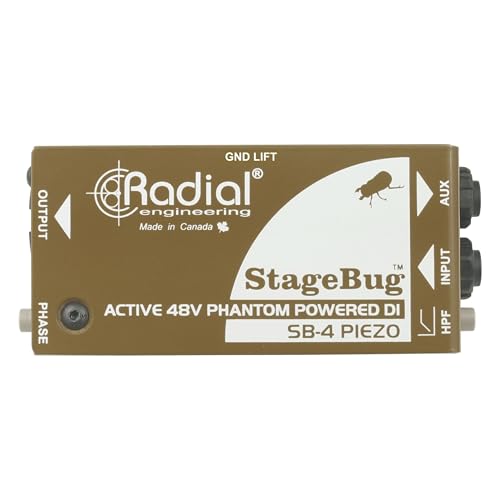
- Active one-channel DI for piezo pickups
- 1/4-inch auxiliary output
- High-pass filter and polarity switch
Best For: Piezo-equipped instruments and compact live rigs
Multi-Channel Workhorse

- Eight channels for larger setups
- Mains or phantom-powered operation
- XLR, TRS, and TS connectivity
Best For: Live events, studios, and multi-source rigs
Flexible Passive Option

- High-impedance 1/4-inch input and throughput
- Balanced floating XLR output
- Variable attenuation and ground controls
Best For: Individual instruments and straightforward passive stage routing
Compact Hum-Control DI

- 1/4-inch input with balanced and unbalanced XLR connectivity
- Ground lift and hum-cancellation support
- Compatible with instruments, keyboards, and consumer audio
Best For: Compact single-channel live and recording setups
Dual-Channel Stage DI
Pyle-Pro PDC22 Passive Direct Box
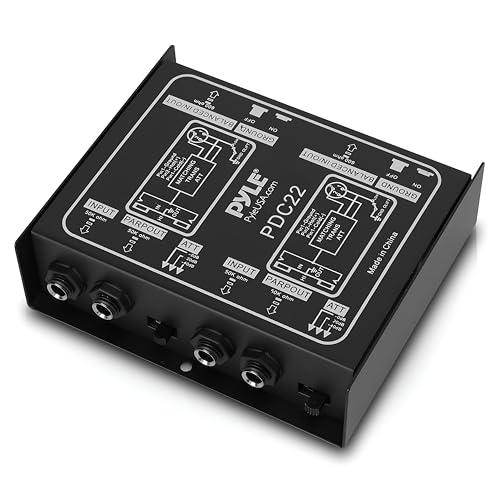
- Two channels for multiple instruments or sources
- All-steel chassis for durable live use
- Ground lift and hum cancellation for cleaner routing
Best For: Keyboard rigs and small setups needing two DI channels
Thru-Out Performance DI

- Thru output supports simultaneous amp and PA connections
- 50kΩ impedance matching with 1/4-inch and XLR connectivity
- Ground lift and isolation transformer help reduce noise
Best For: Performers needing amp monitoring plus a mixer feed
Reliable Passive Choice – Radial Pro DI Passive Direct Box
For musicians comparing di boxes for live sound, the Radial Pro DI is a straightforward passive mono option built for instruments such as acoustic guitars, basses, keyboards, and drum machines. Its transformer-based design and rugged construction suit demanding live or studio setups.
Best For: Players and engineers who need a durable passive DI for mono instruments and professional snake or console connections.
Pros:
- Passive mono operation requires no listed battery power.
- Custom transformer helps provide a wired XLR output.
- Rugged I-beam construction and stainless-steel enclosure support durability.
- Suitable for acoustic guitars, bass, keyboards, drum machines, and studio or live use.
Cons:
- Mono design is not intended for stereo keyboard or DJ applications.
- No attenuation, phase-invert, or ground-lift controls are listed.
The Radial Pro DI focuses on dependable passive signal conversion rather than extensive controls. It is a sensible fit when ruggedness and simple XLR connectivity matter most.
Stereo Hum Control – Mackie MDB-2P Passive Stereo DI Box
The Mackie MDB-2P is a practical choice among di boxes for live sound when a stereo source needs to reach a mixer cleanly. Dual 1/4-inch inputs, ground lift, and attenuation make it especially useful for keyboards, DJ controllers, and backing-track rigs.
Best For: Stereo keyboards, DJ rigs, and playback systems that need hum reduction and flexible handling of hot signals.
Pros:
- Dual 1/4-inch high-impedance inputs support stereo sources.
- Ground lift helps address ground-loop buzz.
- 15 dB pads help manage hot signals without distortion.
- Passive design requires no power and uses a roadworthy steel case.
Cons:
- The supplied notes specify a 15 dB pad rather than multiple attenuation levels.
- Its stereo-focused layout may be more than needed for a simple mono instrument.
With two channels and practical noise-control features, the MDB-2P is well suited to stereo sources that need reliable mixer connectivity without an external power supply.
Flexible Active Performance – Samson MDA1 Mono Active Direct Box
For di boxes for live sound that need active operation and flexible powering, the Samson MDA1 offers a compact mono solution. It combines a balanced XLR output with 1/4-inch input and thru connections, plus attenuation and ground-lift controls.
Best For: Guitar and bass players or live engineers who want active DI performance with phantom-power or battery options.
Pros:
- Can run from 48V phantom power or a 9V battery.
- Includes 0 dB/-15 dB attenuation switching.
- Ground lift helps address unwanted connection noise.
- All-metal, impact-resistant steel design supports stage use.
Cons:
- Mono operation is less suitable for stereo sources.
- Battery operation requires maintaining a 9V battery when phantom power is unavailable.
The MDA1 adds useful control and power flexibility without complicating the signal path. It is a strong option when a guitar or bass setup may encounter different power arrangements from venue to venue.
Control-Rich Dual Passive – ART DualZDirect Dual Professional Direct Box
The ART DualZDirect is a versatile dual-channel option for di boxes for live sound, combining passive transformer operation with several signal-management controls. It converts 50k-ohm inputs to 600-ohm balanced outputs without requiring a battery.
Best For: Engineers handling two channels or varied sources who want attenuation, filtering, phase, and ground-isolation controls.
Pros:
- Dual-channel design provides two balanced outputs.
- Fully passive operation requires no battery.
- Switchable 0, -20, and -40 dB input attenuation accommodates different signal levels.
- Includes low-pass filter, phase invert, and switchable ground lift.
Cons:
- Its tabletop format may be less convenient where a compact pedal-style unit is preferred.
- The supplied notes do not specify a battery or phantom-power option.
With unusually broad control over attenuation, filtering, phase, and isolation, the DualZDirect is a practical choice for more involved two-channel setups. Its passive design keeps operation simple while preserving useful routing flexibility.
Piezo Pickup Specialist – Radial StageBug SB-4
The Radial StageBug SB-4 is a focused choice among DI boxes for live sound when you need to connect a piezo-equipped instrument. This one-channel active direct box includes a high-pass filter, polarity switch, and auxiliary 1/4-inch output for flexible stage routing.
Best For: Musicians using piezo pickups who want a compact active DI with extra routing control.
Pros:
- Designed for piezo pickups.
- Includes a 1/4-inch auxiliary output.
- High-pass filter and polarity switch add practical signal-shaping options.
- Offers 1/4-inch and XLR connectivity.
Cons:
- Only provides one channel.
- Its feature set is specialized rather than suited to multi-channel setups.
The SB-4 makes the most sense when piezo compatibility is the priority. Its active design and additional controls give solo performers and small live rigs useful flexibility without requiring a larger DI system.
Multi-Channel Workhorse – Behringer DI800 V2
The Behringer DI800 V2 stands out among DI boxes for live sound when a larger setup needs multiple channels. It provides eight channels, XLR and 1/4-inch interfaces, and can operate from mains power or phantom power for flexible installation in live, studio, or event systems.
Best For: Live events, recording studios, and other setups that need eight channels of impedance and signal matching.
Pros:
- Provides eight direct-box channels.
- Supports optional mains or phantom-powered operation.
- Offers XLR, TRS, and TS connectivity.
- Servo-balanced operation is specified for ultra-flat frequency response.
Cons:
- Its five-pound weight and multi-channel format may be excessive for small gigs.
- Uses corded electric power when mains operation is selected.
Choose the DI800 V2 when channel count and system flexibility matter more than portability. Its eight-channel layout is particularly practical for venues, studios, and production environments handling several sources at once.
Flexible Passive Option – Livewire SPDI Passive DI
The Livewire SPDI is a practical passive option among DI boxes for live sound, combining a high-impedance 1/4-inch input and throughput with a balanced, floating low-impedance XLR output. Its attenuation pad and ground controls help it accommodate different input levels and connection conditions.
Best For: Players and live setups needing passive signal conversion with variable attenuation and ground-lift control.
Pros:
- Provides both 1/4-inch input and throughput.
- Balanced, floating XLR output ignores +48V phantom power.
- Variable attenuation supports a range of input levels.
- Lift and GND modes offer ground-connection control.
Cons:
- Passive design does not offer the active circuitry of an active DI.
- Its listed feature set does not include an auxiliary output or multiple channels.
The SPDI is well suited to straightforward stage signal routing where passive operation, input flexibility, and ground management are important. It is a sensible fit for individual instruments and uncomplicated live setups.
Compact Hum-Control DI – Pyle Premium Passive DI Unit
For musicians comparing DI boxes for live sound, the Pyle Premium Passive DI Unit is a compact option for connecting guitars, basses, keyboards, and other unbalanced sources to a mixer or PA. Its impedance transformer, input attenuator, and ground-lift functionality are aimed at cleaner signal routing and hum reduction.
Best For: Musicians and small live setups needing a straightforward passive DI for instruments, keyboards, or consumer audio sources.
Pros:
- Supports 1/4-inch connections and balanced or unbalanced XLR output.
- Ground-lift and hum-cancellation features help address buzz from unbalanced sources.
- Works with guitars, basses, keyboards, effects processors, and consumer stereo outputs.
- Compact 1.8 x 3.3 x 5-inch design weighs about 13.4 ounces.
Cons:
- It is a single-channel passive DI rather than a dual-channel unit.
- The supplied notes do not specify detailed output or frequency-response measurements.
This is a practical, flexible choice when you need basic impedance conversion and hum control without a larger multi-channel box. Its broad source compatibility makes it useful for both stage connections and simple recording setups.
Dual-Channel Stage DI – Pyle-Pro PDC22 Passive Direct Box
Among DI boxes for live sound, the Pyle-Pro PDC22 stands out for setups that need two channels in one enclosure. It is designed to route unbalanced instrument or line-level sources to a PA or recording mixer while providing ground-lift and hum-cancellation functions.
Best For: Performers, keyboard players, and small production rigs that need two passive DI channels in a steel chassis.
Pros:
- Two channels accommodate multiple instruments or stereo-style sources.
- Supports guitars, basses, keyboards, effects processors, submixers, and consumer audio devices.
- Ground-lift and hum-cancellation features help reduce buzz in live signal chains.
- All-steel chassis is built for extended use and weighs about 1.12 pounds.
Cons:
- The dual-channel chassis is larger and heavier than a compact single-channel DI.
- The supplied notes do not identify detailed transformer specifications or included accessories.
The PDC22 is a sensible value-oriented pick when channel count matters more than minimal size. Its rugged steel construction and broad source compatibility suit recurring live use, especially with keyboards or multiple instruments.
Thru-Out Performance DI – PRORECK DC21 Passive DI Box
For live performers comparing DI boxes for live sound, the PRORECK DC21 adds a thru output for simultaneous stage monitoring and mixer or PA connection. Its passive design combines impedance matching, signal conversion, ground isolation, and input attenuation in a compact unit.
Best For: Guitarists, bassists, keyboard players, and recording users who need an amp or stage-monitor feed alongside a balanced mixer output.
Pros:
- Thru output can feed a stage amplifier while the XLR path connects to a mixer or PA.
- 50kΩ impedance and transformer-based matching are designed to preserve instrument signal detail.
- Ground lift and isolation transformer help address hum, buzz, and ground-loop noise.
- Supports guitars, basses, keyboards, effects processors, submixers, and consumer stereo sources.
Cons:
- It is a single-channel passive DI, so larger multi-source setups may need additional units.
- The supplied notes do not provide detailed durability or long-term performance information.
The DC21 is particularly useful when a performer wants a direct PA feed without giving up the familiar amplifier or stage-monitor path. Its combination of thru routing and ground isolation makes it versatile for both shows and studio work.
How We Picked These Di Boxes for Live Sound
We focused on practical live-use features rather than cosmetic differences. The selection includes passive and active designs, single- and dual-channel models, stereo-capable options, and units with useful controls such as ground lifts, input attenuation, and multiple connection formats.
We also considered the needs of common users: guitarists and bassists, keyboard players, DJs, small venues, churches, rehearsal spaces, and mobile sound engineers. Build simplicity, signal compatibility, portability, and value all matter when a DI box has to work consistently during a performance.
Quick Comparison
| Best For | Recommended Type | Why It Matters |
|---|---|---|
| Passive guitar or bass pickups | Passive DI | Simple, reliable, and does not require batteries or phantom power |
| Active instruments and acoustic pickups | Active DI | Provides buffering and can better accommodate higher-impedance sources |
| Keyboards and stereo sources | Dual-channel or stereo DI | Preserves left/right routing without needing two separate boxes |
| Hum-prone venues | DI with ground lift | Helps interrupt unwanted ground-loop noise |
| Wide-ranging source levels | DI with attenuation pad | Reduces the chance of input overload |
Key Buying Factors for Di Boxes for Live Sound
Passive Versus Active Design
Passive DI boxes are usually the simplest choice for strong-output sources, passive basses, and general-purpose stage use. They do not need a battery or phantom power, making them dependable in a busy setup. Active DI boxes include powered circuitry and are often a better fit for piezo pickups, acoustic instruments, and sources that benefit from a high-impedance input.
Connections and Channel Count
Check whether you need a single mono channel, two independent channels, or stereo left/right operation. Most units accept a 1/4-inch instrument input and provide a balanced XLR output, but connector layouts vary. If you use keyboards, electronic drums, or other stereo equipment, a dual DI can reduce cable clutter and simplify routing.
Ground Lift, Pad, and Headroom
A ground-lift switch can be valuable when a PA, amplifier, or powered speaker introduces a low-frequency hum. An attenuation pad is useful when connecting high-output instruments or line-level equipment. Also look for adequate headroom and a clear signal path so loud transients do not distort the console input.
Durability and Stage Practicality
Metal housings, protected switches, sturdy jacks, and secure cable placement are worthwhile for equipment that will be stepped around, transported, and repeatedly connected. Compact dimensions help with pedalboards and small rigs, while rack-friendly multi-channel models may suit permanent installations.
Who Should Buy Which Di Boxes for Live Sound?
Choose a straightforward passive model if you want a dependable solution for guitar, bass, or general instrument-to-mixer connections. Select an active model for acoustic-electric instruments, piezo pickups, or setups where impedance matching is especially important. Keyboardists and performers with stereo sources should prioritize dual-channel designs. If your venue frequently suffers from buzz, choose a model with a ground lift and, ideally, an attenuation option for flexible gain management.
For occasional gigs, a compact budget DI may cover the basics. Frequent performers, touring musicians, and production teams should favor rugged construction and controls that solve real stage problems quickly. Before buying, confirm the source output, required channel count, power needs, and the XLR and 1/4-inch connections used by your mixer or stage box.