Choosing a DJ controller for four decks gives you more room to layer tracks, manage stems, and build complex transitions without constantly switching channels. The right model depends on whether you prioritize standalone operation, software integration, portability, or advanced performance controls.
Our selection covers professional four-channel systems, compact options with four-deck software support, and specialized controllers for stems, scratching, mobile performance, and live events.
Best 10 Dj Controller for Four Decks Picks for 2026
Club-Ready Choice

- Four-channel club-style layout
- Track Separation for live mashups
- Works with rekordbox and Serato
Best For: Open-format DJs and serious hobbyists
Standalone Powerhouse

- Laptop-free four-channel performance
- Onboard Stems and 10.1-inch touchscreen
- Wi-Fi streaming and flexible media inputs
Best For: Mobile DJs seeking an all-in-one system
Club-Style All-in-One

- Standalone four-deck USB playback
- 10.1-inch touchscreen with broad track view
- Full-size jog wheels and extensive FX
Best For: Club-style standalone performance
Motorized Performance Pick

- Seven-inch motorized high-torque platters
- Advanced Serato Stems and FX controls
- Adjustable faders and professional I/O
Best For: Tactile Serato performance and scratching
Best All-in-One Pick
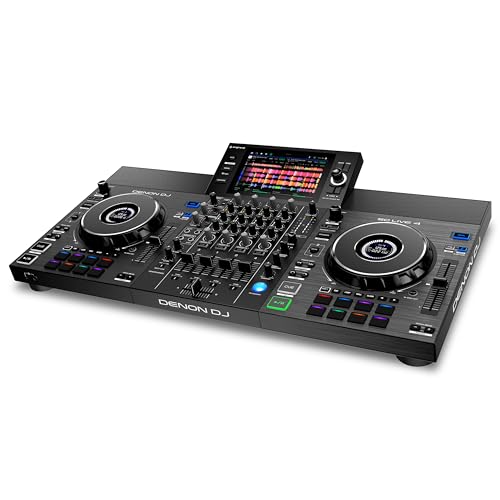
- Standalone four-channel control
- 7-inch touchscreen and built-in speakers
- Wi-Fi, Bluetooth, USB, and SD support
Best For: Mobile DJs and laptop-free performances
Best for Stems Performance
RANE FOUR Serato DJ Controller

- Dedicated Serato Stems controls
- 24 main FX and four channel FX
- Durable four-channel design with large jogs
Best For: Creative Serato performances and live remixing
Best Club-Style Learning Pick
AlphaTheta DDJ-GRV6 4-Channel Controller

- CDJ-3000 and DJM-A9-inspired layout
- Full-size jog wheels and eight pads
- Rekordbox and Serato DJ Pro support
Best For: Club-style practice and dual-software users
Versatile Event Controller

- Four-channel, four-deck Serato control
- 16 vocal effects and TR drum patterns
- Advanced routing for events and livestreams
Best For: DJs handling events, streaming, vocals, and production
Scratch-Focused Starter

- Two-deck battle-style layout
- Includes Serato DJ Lite
- Compact option for scratch beginners
Best For: Entry-level hip-hop, scratch, and open-format DJs
Performance Drum Controller

- Two channels with four-deck control
- Built-in TR drum kits and sequencer
- Balanced XLR and Booth outputs
Best For: Serato DJs combining four-deck mixing, scratching, and drum performance
Club-Ready Choice – Pioneer DJ DDJ-FLX10
The Pioneer DJ DDJ-FLX10 is a strong choice if you want a dj controller for four decks with a familiar club-style workflow. Its four-channel layout, Track Separation features, large jog wheels, and rekordbox/Serato DJ Pro support make it suited to detailed open-format mixing.
Best For: Serious hobbyists, mobile DJs, and performers who want a flexible laptop-based four-channel controller.
Pros:
- Track Separation enables live control of vocals, drums, and instruments.
- Four-channel layout and pro FX translate well to CDJ/DJM-style setups.
- Large jog displays show waveforms, artwork, and playing parts.
- Built-in DMX output supports lighting control.
Cons:
- At 14.8 pounds, it is less compact than a basic two-channel controller.
- Requires a computer and compatible rekordbox or Serato DJ Pro setup for operation.
The DDJ-FLX10 balances performance-focused controls with useful visual feedback and lighting integration. Choose it when software flexibility and a club-standard layout matter more than standalone operation.
Standalone Powerhouse – Denon DJ PRIME 4 G2
The Denon DJ PRIME 4 G2 is a dj controller for four decks designed for laptop-free performance. It combines onboard Stems Rendering, a large touchscreen, streaming over Wi-Fi, flexible media inputs, and professional outputs in a full-featured standalone system.
Best For: DJs who want four-deck performance, onboard processing, streaming access, and minimal dependence on a computer.
Pros:
- Standalone four-channel system with onboard Stems Rendering.
- 10.1-inch touchscreen supports browsing, waveforms, and Touch FX.
- Accepts USB drives, SD cards, an internal SATA drive, and Bluetooth audio.
- Includes balanced XLR outputs, microphone inputs, and an instrument input mode.
Cons:
- At 21.8 pounds, it is relatively heavy for mobile transport.
- Its 30-inch width requires substantial setup space.
The PRIME 4 G2 is the most self-contained option in this group. Its extensive connectivity and touchscreen workflow make it particularly practical for mobile entertainers and venues that need flexible media and output options.
Club-Style All-in-One – Pioneer DJ XDJ-AZ
The Pioneer DJ XDJ-AZ is a dj controller for four decks that combines standalone playback with a large touchscreen and club-oriented controls. It supports four-deck operation from USB, built-in Wi-Fi, SonicLink wireless technology, and a broad selection of Beat FX.
Best For: DJs who want standalone four-deck playback with a spacious, professional layout and detailed track browsing.
Pros:
- Controls four decks simultaneously from a USB device.
- 10.1-inch touchscreen can display up to 13 tracks at once.
- Includes built-in Wi-Fi, Bluetooth 5.3, and low-latency SonicLink support.
- Full-size jog wheels include adjustable Jog Feeling and extensive FX.
Cons:
- At 30 pounds, it is a substantial unit to transport.
- Its listed dimensions call for considerable table or booth space.
The XDJ-AZ is a strong fit for DJs who prioritize Pioneer’s club-style layout and standalone USB playback. Its touchscreen and jog-wheel controls favor hands-on performance, while wireless features add connectivity flexibility.
Motorized Performance Pick – RANE PERFORMER
The RANE PERFORMER is a dj controller for four decks built around hands-on performance. Its motorized aluminum platters, adjustable-tension faders, Stems controls, customizable FX, and Serato DJ Pro integration make it appealing to DJs who value tactile control.
Best For: Serato DJs, scratch-focused performers, and users who want motorized platters with extensive mixer and FX control.
Pros:
- Seven-inch motorized platters provide high-torque tactile control.
- Dedicated Stem modes include Stem-Split, Stem Level, and instant Acapella/Instrumental buttons.
- Adjustable-tension volume faders and MAG FOUR crossfader support precise mixing.
- Offers DVS capability, customizable FX, and a broad professional I/O suite.
Cons:
- At 28.2 pounds, it is not especially lightweight for transport.
- Its motorized platter design and extensive controls may be more than casual DJs need.
The RANE PERFORMER stands out for physical feedback and expressive control rather than standalone convenience. It is a compelling choice when platter feel, fader response, Serato features, and robust connections are top priorities.
Best All-in-One Pick – Denon DJ SC LIVE 4
The Denon DJ SC LIVE 4 is a flexible choice if you want a DJ controller for four decks without depending on a laptop. Its Engine DJ OS, 7-inch touchscreen, SD slot, two USB inputs, wireless streaming, and built-in speakers make it especially practical for mobile, streaming, and home setups.
Best For: Mobile DJs, streaming performers, and laptop-free four-deck setups.
Pros:
- Supports laptop-free performances through Engine DJ OS, SD storage, and two USB inputs.
- Offers four channels, built-in speakers, Wi-Fi streaming, Bluetooth audio input, and broad software compatibility.
- Provides extensive connections, including XLR and RCA main outputs, booth output, and two microphone inputs.
Cons:
- Its 13.6-pound, 28.3-inch-wide design may be less convenient for compact workspaces.
- Streaming features depend on supported services and an internet connection.
The SC LIVE 4 stands out for combining four-deck control with standalone operation and built-in audio. It is a strong fit when portability and flexible music access matter as much as traditional controller performance.
Best for Stems Performance – RANE FOUR Serato DJ Controller
The RANE FOUR is a performance-focused DJ controller for four decks, built around Serato Stems and a robust four-channel mixer. Dedicated stem controls, stem-level EQ, STEM-SPLIT, performance effects, and large jog wheels give hands-on performers detailed control over tracks and individual musical elements.
Best For: Serato DJs who want advanced stems manipulation, creative effects, and a durable club-style controller.
Pros:
- Includes dedicated controls for instrumental and acapella parts, STEM-SPLIT, and stem-level EQ.
- Offers 24 paddle-triggered main effects, four channel effects, and enhanced sampler routing.
- Features solid construction, a MAG FOUR crossfader, dual laptop connections, DVS support, and 8.5-inch jog wheels.
Cons:
- At 18.25 pounds and 30.8 inches wide, it is relatively large and heavy for transport.
- Its most specialized features center on Serato DJ Pro and Serato Stems.
The RANE FOUR is a compelling option for DJs who prioritize tactile stem control and performance effects over standalone operation. Its extensive mixer section and connectivity also make it suitable for more demanding live setups.
Best Club-Style Learning Pick – AlphaTheta DDJ-GRV6 4-Channel Controller
The AlphaTheta DDJ-GRV6 is a practical DJ controller for four decks if you want a club-inspired layout while keeping access to both rekordbox and Serato DJ Pro. Its full-size jog wheels, eight pads above each jog, and Groove Circuit support encourage hands-on live remixing and transferable performance habits.
Best For: DJs learning club-style workflows and performers who want rekordbox and Serato compatibility in one controller.
Pros:
- Uses a CDJ-3000 and DJM-A9-inspired layout designed to build familiar club-style muscle memory.
- Includes large jog wheels and eight pads above each jog for expressive control.
- Works with rekordbox and Serato DJ Pro, with Groove Circuit and Serato Stems FX features.
Cons:
- Its plastic construction may feel less substantial than heavier professional controllers.
- Unlike the Denon DJ option, the supplied notes describe computer and mobile-device compatibility rather than standalone operation.
The DDJ-GRV6 is a strong stepping-stone choice for DJs preparing for club equipment. Its dual-platform support and Groove Circuit tools add flexibility, while the familiar layout keeps the focus on practical performance skills.
Versatile Event Controller – Roland DJ-707M
The Roland DJ-707M is a strong choice if you need a dj controller for four decks that can also handle livestreaming, content creation, remixing, karaoke, and event production. Its four-channel, four-deck design is paired with extensive routing, vocal effects, professional outputs, and built-in Roland drum patterns.
Best For: DJs who need one controller for four-deck mixing, live events, streaming, vocals, and production-focused setups.
Pros:
- Supports four-channel, four-deck control with full Serato DJ Pro compatibility.
- Flexible input-to-output routing, separate output processing, anti-feedback, and scene presets suit event work.
- Includes 16 hardware vocal effects and a TR-style drum machine with 128 patterns.
- Offers multiple microphone and auxiliary connections for performers or guest musicians.
Cons:
- Its broad event, vocal, and production feature set may be more than a straightforward mixing setup requires.
- The supplied notes do not identify a color option.
The DJ-707M stands out when four-deck mixing is only part of the job. Choose it if routing flexibility, microphones, live sound control, and creative tools matter as much as traditional DJ performance.
Scratch-Focused Starter – Pioneer DJ DDJ-REV1
The Pioneer DJ DDJ-REV1 is not a dj controller for four decks; it is a compact, affordable two-deck controller designed for beginners focused on scratching, hip-hop, and open-format performance. Its battle-style layout and included Serato DJ Lite make it easy to start without a complex setup.
Best For: Beginners who prioritize scratch practice, battle-style controls, portability, and a lower-cost entry point.
Pros:
- Open, battle-style layout mirrors a traditional turntable and battle mixer setup.
- Tall pitch faders and accessible effect controls support scratch techniques.
- Tracking Scratch can trigger routines with a single motion to help new performers build confidence.
- Compact design and included Serato DJ Lite simplify getting started.
Cons:
- Controls only two decks, so it does not meet a four-deck requirement.
- Its single USB port and auxiliary connectivity offer a simpler setup than more feature-rich controllers.
The DDJ-REV1 is best viewed as an alternative for scratch-oriented beginners rather than a four-deck solution. Its main appeal is an approachable battle layout at a compact size and budget-friendly positioning.
Performance Drum Controller – Roland DJ-505
The Roland DJ-505 is a practical dj controller for four decks when you want two physical channels with Deck Select functionality for controlling up to four decks. It combines large low-latency platters, Serato performance pads, Roland TR drum sounds, sequencing, and professional audio outputs.
Best For: DJs who want four-deck Serato control with scratching, pad performance, built-in drum programming, and venue-ready connections.
Pros:
- Two-channel layout can control up to four decks simultaneously through Deck Select.
- Large, low-latency platters support scratching and precise performance control.
- Built-in TR-909, TR-808, TR-707, and TR-606 drum kits include real-time shaping and a 16-step sequencer.
- Balanced XLR, Booth, and separate headphone outputs support professional monitoring and PA connections.
Cons:
- The four-deck capability is accessed through two physical channels rather than four dedicated channel strips.
- Its model year is 2017, so buyers seeking newer hardware may prefer to compare current alternatives.
The DJ-505 is a compelling middle ground for DJs who want four-deck capability without giving up hands-on scratching and drum-machine performance. Its standalone mixer function and DVS upgrade readiness also leave room for more advanced setups.
How We Picked the Best Dj Controller for Four Decks
We focused on layout, software support, channel flexibility, performance controls, portability, and workflow. A strong four-deck controller should provide clear access to all four channels, responsive jog wheels or platters, dependable outputs, and controls that make layering practical rather than unnecessarily complicated.
We also considered whether each model requires a computer, supports standalone playback, offers stem separation or track separation, and suits different types of DJs. Because four-channel hardware varies widely in price and purpose, the list includes both feature-rich professional systems and more accessible choices for developing performers.
Quick Comparison
| Type | Best For | What to Consider |
|---|---|---|
| Standalone four-deck systems | Computer-free performance | Higher cost and larger footprint |
| USB DJ controllers | Software-based mixing | Require a compatible laptop and software |
| Stem-focused controllers | Live remixing and vocal or instrumental control | Features depend on software and track preparation |
| Compact controllers | Travel and smaller setups | Reduced mixer space or fewer dedicated controls |
Key Buying Factors for a Dj Controller for Four Decks
Channel Layout and Software Support
Confirm that the controller can address four virtual decks in your preferred software. Dedicated channel strips, deck selectors, and clearly labeled controls make four-deck mixing much easier than relying on layered menus. Check compatibility with rekordbox, Serato DJ, Engine DJ, or another platform before buying.
Standalone or Laptop-Based Operation
Standalone models are useful for mobile DJs, events, and setups where reliability and quick preparation matter. Laptop controllers typically offer deeper software integration and may provide better value, but they add a computer, cables, and software requirements to the setup.
Performance Features
Look for jog-wheel feel, pad modes, looping controls, beat effects, stem separation, track separation, and touchscreen access where relevant. Advanced tools are valuable only if they fit your mixing style and can be reached quickly during a performance.
Connectivity and Practical Setup
Review master and booth outputs, microphone inputs, USB connections, headphone monitoring, and the number of independent outputs available. DJs performing at venues should also check dimensions, weight, power requirements, and whether the controller integrates with existing mixers or sound systems.
Who Should Buy Which Dj Controller for Four Decks?
Choose a standalone four-deck system if you want a self-contained rig for parties, weddings, mobile work, or professional events. A laptop-based four-channel controller is generally the better choice for DJs who already use compatible software and want extensive library management and customization.
Stem-oriented models suit performers who actively remix vocals, drums, and instruments during a set. Scratch-focused controllers are better for turntablists who value platter response and battle-style layouts, while compact or entry-level options make sense for beginners, travelers, and DJs upgrading from a two-channel setup.
Before purchasing, prioritize the workflow you will actually use. Four channels provide creative headroom, but the best controller is the one whose layout, software, and connection options let you perform confidently without slowing down your mix.