Choosing among loop stations for beginners can be surprisingly difficult: some focus on simple one-button looping, while others add drum patterns, multiple tracks, and extensive storage.
This roundup compares 10 options across pedal and tabletop formats so you can find a looper that matches your instrument, practice habits, and performance goals.
Best 10 Loop Stations for Beginners Picks for 2026
Best Beginner Pedal

- Simple controls for recording and overdubbing
- 24-segment indicator shows loop status
- 12 minutes of stereo recording
Best For: First-time loopers using guitar, bass, or keyboard
Best Value Memory

- Nine loops and 40 minutes of total recording
- Built-in tuner and unlimited overdubs
- USB WAV import and export
Best For: Beginners needing extra loop storage and practice tools
Best Starter Bundle

- Includes adapter, instrument cable, patch cable, and picks
- Simple 24-segment loop indicator
- 12 minutes of stereo recording
Best For: New guitarists wanting a ready-to-use looping kit
Best With Drum Backing
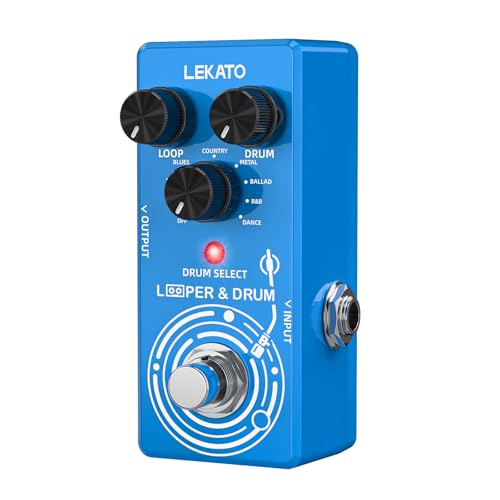
- Combines looping with eight drum grooves
- Unlimited overdubs and automatic saving
- Independent loop and drum volume controls
Best For: Solo practice, busking, and rhythm-supported performances
Premium Pedal Pick

- 13 hours of stereo recording and 99 phrase memories
- 57 rhythms with A/B variations and seven drum kits
- Multicolor LCD, USB, MIDI, and external control support
Best For: Beginners seeking a compact looper with room to expand
Most Practice-Friendly

- 160 minutes of stereo recording in 40 memory slots
- Built-in drums with quantization, tap tempo, and sync
- USB-C transfer and headphone output for quiet practice
Best For: Beginners focused on rhythm practice and home use
Tabletop Creative Choice

- Two simultaneous stereo phrase tracks
- Four input and four track effects
- 64 phrase memories across eight banks
Best For: Beginners wanting hands-on tabletop layering and effects
Best Beginner-Friendly Dual-Track Pick

- Two-track stereo looping with 13 hours of recording
- Onboard rhythm tracks for practice and performance
- Color LCD, USB, XLR, and 1/4-inch connectivity
Best For: Beginners wanting a capable pedal-style looper with room to grow
Best Tabletop Option for Vocalists

- Five stereo tracks for layered performances
- Two XLR mic inputs with phantom power
- Tabletop controls and onboard rhythm generator
Best For: Beginners building vocal or multi-layer tabletop performances
Best Feature-Rich Learning Platform

- 13 hours of stereo recording and 99 phrase memories
- 16 drum kits, 57 rhythms, and Loop FX
- 32-bit processing, USB, MIDI, and external-control support
Best For: Beginners who want advanced features to grow into
Best Beginner Pedal – BOSS RC-1 Loop Station
The BOSS RC-1 is a straightforward choice for beginners exploring loop stations for beginners. Its simple foot-controlled workflow supports recording, playback, overdubbing, undoing, and redoing, while the circular LED indicator makes the current mode easy to follow.
Best For: Guitar, bass, and keyboard players who want a dependable, easy-to-learn looper.
Pros:
- Simple recording, overdub, playback, undo, and redo controls
- 24-segment LED indicator shows the current looping mode
- 12 minutes of stereo recording and memory retention after power-off
- Includes a 9-volt battery and supports an optional PSA AC adaptor
Cons:
- AC adaptor is sold separately
- Battery life is approximately 4.5 hours
- Does not include a built-in drum machine
The RC-1 keeps the learning curve low and adds useful stereo connectivity, making it a strong foundation for practicing layered parts without unnecessary features.
Best Value Memory – LEKATO Looper Guitar Pedal
The LEKATO Looper is a practical option for beginners who want more storage than a basic pedal. It offers nine loop slots, up to 40 minutes of total recording time, unlimited overdubs, and one-button foot commands for core looping functions.
Best For: Beginners who want extended loop storage, a built-in tuner, and USB file transfers.
Pros:
- Nine loops with up to 40 minutes of total recording time
- Unlimited overdubbing with record, undo/redo, stop, and erase commands
- Built-in tuner supports continuous switching without interrupting the phrase
- USB import and export for WAV loop files
Cons:
- Requires electric power rather than a supplied battery
- Its several foot-command functions may take practice to learn
- Designed around mono 1/4-inch connections
With generous memory and a tuner in a compact enclosure, this LEKATO model gives developing players room to experiment while keeping playback volume control simple.
Best Starter Bundle – BOSS RC-1 Bundle
Boss RC-1 Loop Station | Bundle with Gearlux Power Supply, Instrument Cable, Patch Cable, and Picks
Check Price On AmazonThis BOSS RC-1 bundle suits shoppers seeking loop stations for beginners with essential accessories included. The pedal retains the RC-1’s simple operation, 12 minutes of stereo recording, and clear 24-segment loop indicator, while adding a power adapter, cables, and picks.
Best For: New guitarists who want a ready-to-use RC-1 setup with basic accessories.
Pros:
- Includes a power adapter, 10-foot instrument cable, patch cable, and picks
- Clear indicator for Rec, Overdub, and Play modes
- 12 minutes of stereo recording time
- Recorded phrases remain in memory after the pedal is turned off
Cons:
- Still provides the RC-1’s basic looping feature set rather than drums or advanced sequencing
- Bundle adds weight and bulk compared with the pedal alone
- Battery operation is not listed for this bundle configuration
The included accessories reduce the need for separate purchases, making this a convenient entry package for players building a first pedalboard around a familiar BOSS looper.
Best With Drum Backing – LEKATO 2-in-1 Looper Pedal
The LEKATO LP-02 combines a looper and drum machine for beginners who want rhythmic support while learning loop stations for beginners. It provides six minutes of recording, unlimited overdubs, automatic saving, and independent volume controls for the loop and backing track.
Best For: Solo players, buskers, and home practice sessions that benefit from built-in drum grooves.
Pros:
- Looper and drum machine can operate independently or together
- Eight drum grooves use samples from three acoustic drum kits
- Unlimited overdubs with auto-save and USB import/export
- Tap Tempo and automatic tempo matching for supported 4/4 phrases
Cons:
- Power adapter and cable are not included
- Six minutes of loop recording is less than some dedicated loopers
- Automatic tempo matching supports 4/4 phrases only
Its separate loop and drum volume controls make balancing easy, while buffer bypass helps preserve tone through longer cable runs or larger pedalboards.
Premium Pedal Pick – BOSS RC-5 Loop Station
For musicians comparing loop stations for beginners, the BOSS RC-5 offers a compact pedal format with an approachable display and plenty of room to grow. Its 13-hour stereo recording capacity, onboard phrase memories, built-in rhythms, and reverse function make it useful for practice, songwriting, and performance.
Best For: Beginners who want a pedalboard-friendly looper with professional audio quality and advanced expansion options.
Pros:
- 32-bit AD/DA conversion and 32-bit floating-point processing support high-quality audio.
- Stores up to 99 phrase memories and records up to 13 hours of stereo audio.
- Includes 57 rhythms with A/B variations and seven drum kits.
- Offers a multicolor LCD, USB, MIDI I/O, and external control support.
Cons:
- Optional PSA adapter is needed for extended sessions beyond battery operation.
- Advanced MIDI and external-control features may be more than a first-time looper user needs.
The RC-5 is a strong long-term choice if you want beginner-friendly core looping without quickly outgrowing the pedal. Its compact design and extensive connectivity also make it suitable for more complex setups later.
Most Practice-Friendly – FLAMMA FF03 Looper Pedal
The FLAMMA FF03 is a practical option for people exploring loop stations for beginners because it combines dual-foot control, looping, and a drum machine in one pedal. Tap tempo, count-in, quantization, and looper-drum sync help make practice more structured, while the headphone output supports quiet sessions.
Best For: Beginners who want guided rhythm practice, generous storage, and headphone monitoring in a single pedal.
Pros:
- Provides 160 minutes of stereo recording across 40 memory slots.
- Includes 11 drum styles, 11 patterns per style, and 11 metronome rhythms.
- Offers quantization, tap tempo, count-in, and looper-drum sync for steadier timing.
- USB-C file transfer and a headphone output support convenient practice and file management.
Cons:
- Its corded-electric design requires a power connection rather than battery operation.
- The feature-rich drum and looping controls may take time to learn.
With clear multicolor indicators and dedicated footswitches, the FF03 emphasizes hands-free operation and repeatable practice. It is especially appealing if built-in rhythms and silent monitoring matter as much as basic looping.
Tabletop Creative Choice – BOSS RC-202 Loop Station
The BOSS RC-202 takes a tabletop approach to loop stations for beginners, replacing a traditional pedal layout with fingertip controls for hands-on performance. Two simultaneous stereo phrase tracks, onboard effects, and phrase memories make it suited to layered arrangements and electronic-style experimentation.
Best For: Beginners who prefer tabletop control and want to explore layered loops with built-in effects.
Pros:
- Provides two simultaneous stereo phrase tracks with dedicated controls and status indicators.
- Includes four input effects and four track effects for DJ- and sampler-style processing.
- Stores 64 phrase memories across eight banks.
- Supports optional footswitches, an expression pedal, and MIDI connectivity.
Cons:
- The tabletop design is less pedalboard-friendly than a compact foot-operated looper.
- Optional external controls may be needed for more foot-based operation.
- Its 3.8-pound, larger format is less portable than a standard compact pedal.
The RC-202 is a good fit for users who want to see and manipulate multiple loop tracks directly while playing. Its effects and memory system offer substantial creative scope, though its tabletop format is best suited to stationary setups.
Best Beginner-Friendly Dual-Track Pick – BOSS RC-500
For beginners looking for loop stations for beginners, the BOSS RC-500 offers a practical balance of recording capacity, guided rhythm features, and hands-on control. Its two-track design, color LCD, and USB connectivity make it suitable for building layered performances while leaving room to grow.
Best For: Beginners who want stereo looping, onboard rhythms, and a clear display in a pedal-style unit.
Pros:
- Two-track looping with up to 13 hours of stereo recording time.
- Onboard rhythm tracks support practice and fuller performances.
- Color LCD, USB import/export, and XLR and 1/4-inch inputs add useful flexibility.
Cons:
- At 950 g, it is less lightweight than a very basic looper pedal.
- A separate BMIDI-5-35 adapter cable is available separately for expanded MIDI connectivity.
The RC-500 is a strong starting point for players who want straightforward pedal operation without giving up substantial recording time, rhythm support, or future expansion options.
Best Tabletop Option for Vocalists – BOSS RC-505 Mk2
The BOSS RC-505 Mk2 is a tabletop choice for beginners exploring loop stations for beginners through vocals, instruments, or hands-on performance. Five stereo tracks, two XLR microphone inputs with phantom power, and dedicated looping controls make it particularly suited to a seated or stage-based setup.
Best For: Beginners who prefer tabletop control and need multiple stereo tracks or microphone-friendly inputs.
Pros:
- Five stereo tracks provide more layering space than a basic single-track looper.
- Two XLR microphone inputs include phantom power.
- Two stereo line-input pairs and an onboard rhythm generator support varied setups.
Cons:
- Its tabletop format is less convenient for players seeking a compact floor pedal.
- The supplied dimensions and 2 kg weight indicate a substantially larger setup than a simple beginner pedal.
Choose the RC-505 Mk2 when physical tabletop controls and several simultaneous stereo tracks matter more than a minimal footprint. It is a more expansive platform for developing layered vocal or instrumental performances.
Best Feature-Rich Learning Platform – BOSS RC-500 Dual-Track
For beginners who want loop stations for beginners with advanced features to explore over time, this BOSS RC-500 combines dual-track looping with onboard rhythms, phrase memories, and Loop FX. Its multi-color display and USB file management also make it useful for organizing and refining loop ideas.
Best For: Beginners who want professional-grade audio processing, extensive rhythm choices, and deeper control options.
Pros:
- Offers 13 hours of stereo recording, 99 phrase memories, and USB WAV file management.
- Includes 16 drum kits, 57 preset rhythms with A/B variations, and Loop FX.
- Provides 32-bit AD/DA conversion, 32-bit floating-point processing, MIDI, and external-control support.
Cons:
- The number of editing, rhythm, memory, and control features may feel extensive for someone seeking a very simple first looper.
- The BMIDI-5-35 adapter cable is available separately for its mini-TRS MIDI connections.
This version is best for learners who expect their looping needs to grow. It offers a broad creative toolkit, although beginners wanting only basic record-and-playback operation may prefer a simpler control set.
How We Picked the Best Loop Stations for Beginners
We focused on features that matter most when learning to build loops: straightforward controls, dependable footswitches or hands-on interfaces, clear recording feedback, useful loop capacity, and practical connectivity. We also included a range of designs, from compact single-track pedals to advanced tabletop units, because “beginner” can mean either a first looper or an accessible way to start performing live.
Recording time, overdub support, rhythm functions, track arrangement, and power requirements were compared alongside ease of operation. More advanced models are included for beginners who want room to grow, but they may require more setup and practice.
Quick Comparison
| Best for | Look for | Suitable formats |
|---|---|---|
| Simple practice | One-track operation, visual timing display, easy undo | BOSS RC-1, comparable compact pedals |
| Guitarists on a budget | Built-in tuner, multiple memories, overdubbing | LEKATO and compact pedal options |
| Rhythm-based practice | Drum grooves, tap tempo, real-sample playback | LEKATO drum looper and FLAMMA FF03 |
| Song arrangement | Multiple tracks, longer recording time, phrase control | BOSS RC-5 and RC-500 |
| Live vocal or instrument looping | Hands-on controls, multiple inputs, tabletop workflow | BOSS RC-202 and RC-505 Mk2 |
Key Buying Factors for Loop Stations for Beginners
Controls and Learning Curve
A basic looper with record, play, stop, and overdub controls is usually the fastest way to learn timing. A visual loop indicator can help you see where a phrase begins and ends. Tabletop units offer more direct control, but their extra buttons and menus take longer to master.
Tracks, Overdubs, and Storage
Single-track loopers work well for chord practice and simple accompaniment. Choose a model with multiple tracks or phrase memories if you want to separate rhythm, harmony, and lead parts, save arrangements, or perform complete songs.
Drums and Timing Features
Built-in drum grooves make practice more engaging and can help establish tempo. Tap tempo is useful when you want to set a beat quickly, while quantization and rhythm synchronization can make layered parts easier to keep aligned.
Inputs, Outputs, and Power
Check whether the looper supports your instrument, microphone, stereo signal, or external effects. Guitar pedals commonly use standard pedal power, while tabletop models may need an adapter. Confirm input levels and output connections before buying.
Who Should Buy Which Loop Stations for Beginners?
Choose a compact single-track pedal if you want the simplest introduction, mainly practice guitar or bass, and value portability. Choose a drum-equipped pedal if you want built-in rhythm backing without adding a separate drum machine.
Choose a multi-track pedal if you are learning song structures or expect to perform with layered parts. Choose a tabletop looper if you sing, use several instruments, need hands-on phrase control, or plan to build detailed live arrangements.
For most first-time buyers, prioritize controls you can understand immediately over the highest recording capacity. A looper that is easy to operate will help you practice consistently, while expandable tracks and rhythm tools are worth paying for when your arrangements demand them.