The best portable DMX controllers make it easier to program, dim, and operate stage lights without committing to a large installation console. This roundup compares compact options ranging from simple 12-channel dimmers to wireless and MIDI-enabled controllers.
Whether you run a mobile DJ setup, small performance space, or moving-head rig, focus on channel capacity, control style, portability, and compatibility with your fixtures before buying.
Best 10 Portable Dmx Controllers Picks for 2026
Best Battery-Powered Pick

- Up to 72 hours of built-in battery operation
- Controls up to 12 fixtures across 192 channels
- MIDI, sound activation, tap sync, and 240 scenarios
Best For: Mobile DJs, bands, parties, and compact event lighting
Best Compact Chase Controller
Chauvet Obey 10 DMX Controller

- Controls up to eight intelligent lights
- Provides 96 DMX channels
- Six chase sets support up to 999 steps each
Best For: Small DJ, event, and stage lighting rigs
Best High-Capacity Pick
Rockville ROCKFORCE 384 DMX Controller

- Controls up to 24 fixtures across 384 channels
- Stores 240 scenes and six programmable chases
- Adds MIDI, music mode, LED display, and gooseneck lamp
Best For: DJs, clubs, and larger stage lighting systems
Best Simple Handheld Pick
ADJ SDC12 Basic DMX Controller

- 12 channel faders plus a master fader
- Supports optional 9V battery-powered handheld use
- Includes 3-pin and 5-pin DMX outputs
Best For: Basic dimming, demonstrations, and small lighting setups
Best Beginner Pick

- Controls 12 fixtures with up to 16 channels each
- Stores up to 240 scenes
- Beginner-friendly layout with voice control
Best For: DJs, small events, and first-time DMX users
Best Wireless Upgrade
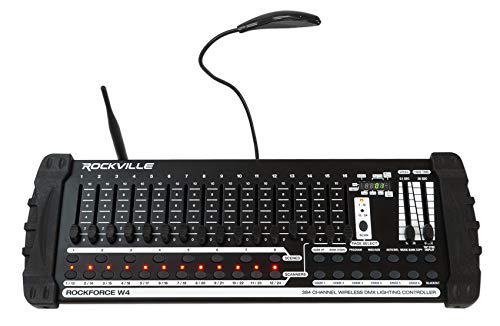
- 384 channels control up to 24 lights
- Built-in 2.4GHz wireless transmitter
- Adds MIDI, music-sync, and manual override
Best For: Mobile and professional lighting setups
Best Budget Scene Controller
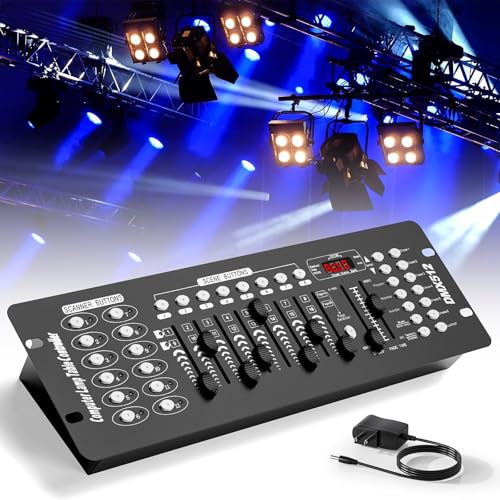
- Controls 12 devices across 192 channels
- Stores up to 240 scenes with six chases
- Eight sliders and three-pin equipment connectivity
Best For: Parties, seasonal displays, and small shows
App-Based Flexibility

- 256-channel tablet-based DMX control
- 15,000+ fixture library
- 50 presets and 21 automatic effects
Best For: Mobile lighting setups using tablets and varied DMX fixtures
Scene-Ready Control

- 192 channels for up to 12 fixtures
- Stores 240 programmable scenes
- Built-in microphone for sound activation
Best For: DJ and event setups needing physical faders and scene storage
Compact Manual Control

- Controls up to 12 DMX512 channels
- Compact aluminum design for travel
- Six faders plus a master control
Best For: Small stages and simple 12-channel lighting rigs
Best Battery-Powered Pick – Portable MIDI DMX Controller
This battery-powered option is one of the more flexible portable DMX controllers for mobile DJs, bands, parties, and small event setups. Its built-in battery can provide up to 72 hours of operation, while MIDI, tap sync, sound activation, and automatic modes support hands-off control.
Best For: Mobile lighting setups that need extended battery operation, MIDI control, and programmable scenes.
Pros:
- Built-in battery offers up to 72 hours of operation.
- 192 channels can control up to 12 fixtures with 16 channels each.
- Includes MIDI beat activation, microphone input, tap synchronization, and automatic operation.
- Stores 240 scenarios with six sets of chases.
Cons:
- Limited to 12 compatible smart lights.
- Uses 3-pin DMX connections, which may require adapters for other setups.
- Its 192-channel layout may be less suitable for larger lighting rigs.
Choose this model when battery runtime and automated performance features matter more than maximum fixture capacity. The aluminum housing and rack-mount form factor also suit recurring mobile use.
Best Compact Chase Controller – Chauvet Obey 10 DMX Controller
The CHAUVET DJ Obey 10 is a compact choice among portable DMX controllers for users who need straightforward control over several intelligent fixtures. It supports up to eight lights, with 96 DMX channels and programmable chase sequences for repeatable shows.
Best For: Compact DJ, event, and small-stage rigs using up to eight intelligent lights.
Pros:
- Controls up to eight intelligent lights with up to 12 channels each.
- Provides 96 DMX channels of control.
- Supports sequential linking of chases.
- Offers six chase sets with up to 999 steps each.
Cons:
- Supports fewer fixtures than higher-capacity 192- and 384-channel controllers.
- The supplied notes do not specify built-in battery operation.
- Its 22.2-inch width may be less convenient for very compact transport.
This controller makes sense for a smaller lighting system where chase programming is important. Its feature set is focused on intelligent lights rather than extensive fixture capacity or battery-powered operation.
Best High-Capacity Pick – Rockville ROCKFORCE 384 DMX Controller
The Rockville ROCKFORCE 384 is a strong option among portable DMX controllers when a setup needs more channels and fixture capacity. It controls up to 24 intelligent lights with 16 channels each and adds programmable scenes, MIDI operation, music mode, and practical features for dark venues.
Best For: DJs, clubs, and stage setups requiring control of many intelligent fixtures and multiple programmed looks.
Pros:
- 384 channels control up to 24 intelligent lights with 16 channels each.
- Stores 30 banks of eight scenes and six programmable chases.
- Includes MIDI control, a built-in microphone, and music-triggered modes.
- Metal housing, LED display, gooseneck lamp, power-failure memory, and reversible channels support practical operation.
Cons:
- At 5.3 pounds and over 20 inches long, it is less compact than basic controllers.
- Requires external power rather than offering built-in battery operation.
- The larger control capacity may be unnecessary for very small rigs.
For larger mobile or installed lighting systems, the ROCKFORCE 384 offers substantially more fixture and channel capacity than entry-level boards. Its 110–240V power supply and durable metal construction add flexibility for venue use.
Best Simple Handheld Pick – ADJ SDC12 Basic DMX Controller
ADJ Products SDC12, 12 Channel Basic DMX Controller, Easily Fade and Dim Multiple Lights
Check Price On AmazonThe ADJ SDC12 is a practical entry-level choice among portable DMX controllers for basic dimming and fading. Its 12 channel faders and master fader keep operation simple, while optional 9V battery power allows handheld use when a compact control surface is preferred.
Best For: Demonstrations, simple lighting systems, and users who want direct fader-based control.
Pros:
- Provides 12 channel faders plus one master fader.
- Lightweight 2-pound design supports travel and handheld operation.
- Can use 9V battery power for portable operation; battery is not included.
- Offers standard 3-pin and 5-pin DMX outputs and wall-mounting brackets.
Cons:
- Only 12 channels are available, limiting complex fixture control.
- Battery is not included.
- Its basic design does not provide the programmed scenes, chases, or MIDI features found on larger controllers.
This is a good fit when immediate manual control matters more than automation. Its compact construction and dual mounting options make it suitable for demonstrations, small systems, or occasional mobile use.
Best Beginner Pick – CO-Z 192 DMX Controller
If you need portable dmx controllers for small to midsize lighting setups, the CO-Z 192 DMX controller offers a straightforward manual layout. It supports up to 12 intelligent lights with up to 16 channels each, along with up to 240 scenes.
Best For: Beginners, DJs, weddings, church gatherings, and small event lighting setups.
Pros:
- Controls up to 192 channels, 12 fixtures, and 240 scenes.
- Dedicated controls make light selection, scenes, channels, and timing easy to access.
- Includes a three-pin cable for compatible fog machines and stage fixtures.
- Voice control supports convenient scene switching.
Cons:
- Corded operation limits placement flexibility.
- Its 192-channel capacity may be restrictive for larger professional rigs.
The CO-Z is a practical choice when simple controls and scene capacity matter more than advanced networking features. Its compact console format and beginner-friendly layout suit mobile entertainers and small venues.
Best Wireless Upgrade – Rockville ROCKFORCE W4
Among portable dmx controllers, the Rockville ROCKFORCE W4 stands out for wireless flexibility and a higher 384-channel capacity. Its built-in 2.4GHz transmitter, MIDI support, and rack-mountable design make it suited to more demanding mobile or professional setups.
Best For: Mobile entertainers and production users controlling multiple compatible fixtures without relying solely on wired connections.
Pros:
- Controls up to 24 intelligent lights with 16 channels each.
- Wireless transmission supports up to 7 groups and 25 receivers.
- Offers 30 banks, 6 chases, and up to 240 scenes.
- Includes MIDI, music-sync operation, manual override, and wired DMX in/out.
Cons:
- At 6.2 pounds, it is heavier than basic compact controllers.
- The broader feature set may be more than beginners need.
The ROCKFORCE W4 is the strongest option here for users who want wireless control and room to expand. Its sliders, rack-mountable construction, and multiple control modes provide useful flexibility for event production.
Best Budget Scene Controller – 192 DMX Stage Console
This 192-channel console is one of the more accessible portable dmx controllers for parties, holiday displays, and small stage shows. It provides controls for 12 devices, 240 scenes, programmable chases, and manual channel adjustment in a compact beginner-oriented design.
Best For: Small gatherings, parties, concerts, festivals, and seasonal lighting displays.
Pros:
- Supports 12 scanners with 16 channels each.
- Provides 23 banks of programmable scenes and 6 programmable chases.
- Includes eight sliders for manual channel control.
- Three-pin connectivity works with compatible stage equipment such as fog machines and moving heads.
Cons:
- It has fewer manual sliders than some larger controllers.
- The listed warranty and service terms should be verified before purchase, as the supplied notes mention different durations.
This controller makes sense for buyers who want core DMX programming features without stepping up to a larger professional console. Its scene and chase capacity is useful for repeatable small-show sequences.
App-Based Flexibility – ADJ MyDMX Go
For shoppers comparing portable dmx controllers, the ADJ MyDMX Go is a compact, app-based option for iPad or Android tablets. Its 256-channel capacity, wireless connectivity through Wi-Fi and USB, and broad fixture library make it practical for quickly building lighting displays without traditional programming.
Best For: Mobile lighting setups using tablets and a variety of DMX fixtures.
Pros:
- Controls up to 256 DMX channels through an iPad or Android app.
- Works with a library of more than 15,000 fixtures.
- Offers 50 user presets and 21 automatic effects without requiring programming.
- Compact, lightweight design includes O-Clamp brackets for truss mounting.
Cons:
- Requires a compatible tablet for app-based operation.
- Its compact interface relies on app control rather than physical faders.
The MyDMX Go is a strong fit when portability, fixture compatibility, and fast setup matter more than hands-on console controls. It also includes a two-year warranty.
Scene-Ready Control – 192 DMX Controller
Among portable dmx controllers, this 192-channel console offers a traditional layout with physical sliders, scene controls, and a built-in microphone. It can manage up to 12 fixtures with 16 channels each and store as many as 240 programmable scenes for repeatable shows.
Best For: DJs, bands, clubs, weddings, and churches that need physical controls and sound-activated operation.
Pros:
- Controls up to 12 fixtures with 16 channels per fixture.
- Stores up to 240 programmable scenes.
- Built-in microphone supports sound-activated lighting.
- Includes a DMX cable, power cord, manual, and two-year warranty.
Cons:
- At 18.9 inches long and 3.74 pounds, it is less compact than mini controllers.
- Its corded-electric design is less convenient for setups without nearby power.
This console is a practical middle ground for users who want organized physical controls, scene storage, and automatic music synchronization. Its standard three-pin XLR output supports a range of compatible lighting fixtures and effects equipment.
Compact Manual Control – MAD OWL 12-Channel DMX
If you need portable dmx controllers for a small lighting rig, the MAD OWL 12-channel controller keeps operation simple with six sub-control faders, a master fader, and a black-field function. Its lightweight aluminum body and standard three-pin XLR output suit travel and quick installations.
Best For: Small stages and DMX512 fixtures requiring no more than 12 channels.
Pros:
- Provides straightforward control over up to 12 DMX512 channels.
- Lightweight, compact design measures about 7.09 by 3.94 by 1.38 inches.
- Smooth push rods and simple controls support quick operation.
- Can work with a DMX-controllable dimming power supply for permanent installations.
Cons:
- Cannot be used with stage lighting equipment requiring more than 12 channels.
- Offers fewer controls than larger consoles designed for complex shows.
- Uses corded electric power.
The MAD OWL is best viewed as a focused, entry-level controller rather than a full-featured show console. Its small footprint makes it easy to transport, while the 12-channel limit keeps it suited to modest DMX lighting systems.
How We Picked These Portable Dmx Controllers
We selected these Portable Dmx Controllers to cover a range of real-world lighting needs, from basic manual dimming to programmable scenes, MIDI integration, wireless operation, and app-based control. We considered channel count, DMX512 support, physical size, portability, control layout, and suitability for common DJ and stage-lighting fixtures.
The selection includes compact 12-channel units for straightforward setups, 192-channel consoles for conventional fixtures, and 384-channel models for more complex rigs. Because feature lists and included accessories can vary, verify the current specifications, wireless requirements, and fixture compatibility before ordering.
Quick Comparison
| Controller Type | Best For | Main Advantage |
|---|---|---|
| 12-channel controller | Small stages and simple fixtures | Easy manual dimming and compact size |
| 192-channel console | Mobile DJs and basic programmed shows | More scene and fixture-control capacity |
| 384-channel controller | Larger lighting rigs | Additional room for multiple fixtures |
| Wireless DMX controller | Fast setup and cable reduction | Less physical cabling between controller and fixtures |
| App-based controller | Tablet or phone-centered workflows | Flexible visual programming and operation |
Key Buying Factors for Portable Dmx Controllers
Channel Capacity
Choose enough channels for every DMX parameter you need to control, not merely the number of fixtures. A basic dimmer may need only a few channels, while moving heads can use many channels for pan, tilt, color, gobos, focus, and effects. Leave some capacity for future expansion.
Programming and Operation
Physical faders and dedicated buttons are useful for fast live adjustments. Scene and chase programming is more valuable when you want repeatable shows. If you prefer a computer or tablet workflow, an app-based system may offer more visual control, but it can depend on compatible hardware and a reliable device.
Connectivity and Compatibility
Confirm that the controller uses the DMX512 connections and signal arrangement required by your fixtures. Wireless models can simplify setup, but transmitters, receivers, pairing, range, and interference should be checked carefully. MIDI support is helpful when lighting cues need to follow a keyboard, playback system, or other MIDI equipment.
Portability and Power
For mobile work, consider weight, enclosure durability, control layout, power requirements, and storage for cables. Battery-powered designs can be convenient in temporary locations, while compact mains-powered consoles may be better for permanent or semi-permanent installations.
Who Should Buy Which Portable Dmx Controllers?
Choose a 12-Channel Model If:
You operate a small venue, practice space, party rig, or simple wash-light setup and mainly need reliable manual dimming with minimal programming.
Choose a 192-Channel Controller If:
You are a mobile DJ or entertainer running conventional fixtures and want scene, chase, and fader control without the complexity of a full lighting desk.
Choose a 384-Channel or MIDI Model If:
You control several fixtures, use moving heads or fog equipment, or want greater room for expansion and synchronized operation with music hardware.
Choose Wireless or App-Based Control If:
You prioritize quick setup, reduced cable runs, or tablet-based programming. These options are especially practical when the controller needs to move around a venue, but they require closer attention to compatibility and wireless reliability.