The best portable radios for small spaces deliver dependable AM/FM reception without taking over a nightstand, kitchen counter, desk, or shelf. Compact designs, simple controls, and flexible power options make them useful for everyday listening and backup communication.
We compared 10 portable models across reception, power, tuning, sound, portability, and ease of use. The guide below helps you narrow the list based on room size, listening habits, and the features you actually need.
Best 10 Portable Radios for Small Spaces Picks for 2026
Best Pocket Pick
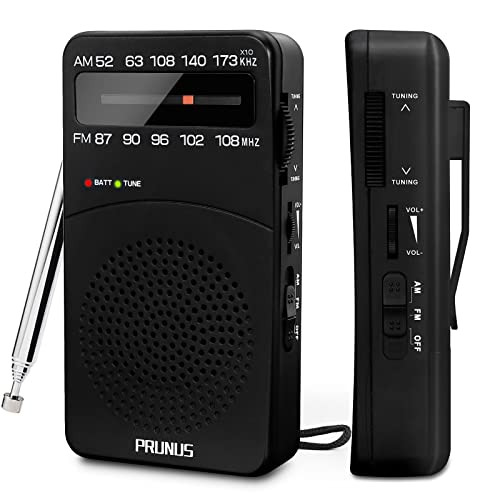
- Very compact 4.2-ounce design
- DSP-assisted AM/FM reception
- Clip, lanyard, and headphone jack
Best For: Pocket carry and small emergency kits
Best Shortwave Compact

- Compact 125-gram design
- AM/FM and shortwave reception
- Simple controls with headphone output
Best For: Shortwave listening in pockets or handbags
Best Home-Friendly Option

- Wall adapter and battery operation
- Large, easy-to-use analog dial
- Loud speaker and headphone jack
Best For: Kitchen, bedside, and emergency listening
Best Multi-Power Pick

- Solar, USB, rechargeable, and D-battery power
- AM/FM/shortwave reception
- Bluetooth, USB, and TF playback
Best For: Outages, camping, and flexible outdoor use
Reliable Plug-In Pick

- AC adapter or four AA batteries
- Large fluorescent tuning pointer
- Headphone jack for private listening
Best For: Bedside tables, kitchens, camping, and power-outage kits
Compact Reception Choice

- Rotatable 16.5-inch telescopic antenna
- Large tuning and volume controls
- Pocket-sized body with lanyard
Best For: Pocket carry, small desks, and emergency bags
Smallest Everyday Option
Panasonic RF-P50D Pocket Radio
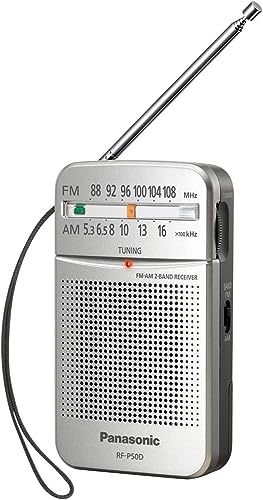
- Very compact, four-ounce design
- Tuning and battery-level indicators
- Side dial and headphone jack
Best For: Pocket carry, travel, and tightly limited spaces
Best with Extra Features

- Deck-of-cards footprint and 2.78-ounce weight
- Five station presets and LCD display
- Runs on two AAA batteries
Best For: Jogging, compact spaces, and emergency kits
Best Easy-Use Option
LEOTEC AM/FM Radio with AC Power
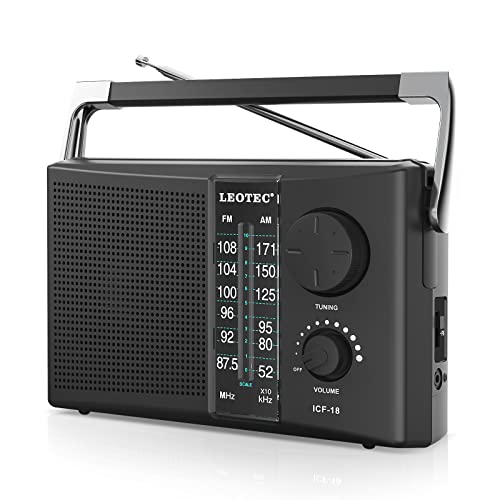
- AC cable or two D-battery operation
- Large tuning knob and clear analog dial
- Big speaker with earphone output
Best For: Home counters, kitchens, and senior-friendly listening
Best Full-Sound Choice

- AC plug or four-AA-battery flexibility
- Large speaker and easy-to-read controls
- Handle, telescopic antenna, and headphone output
Best For: Small rooms, kitchens, and portable outdoor listening
Best Pocket Pick – PRUNUS J-166 Mini AM/FM Radio
If you need portable radios for small spaces, the PRUNUS J-166 is an especially compact option for a nightstand, emergency kit, pocket, or desk. Its simple controls, battery indicator, and included clip and lanyard make it practical for everyday carry.
Best For: Pocket carry, emergency kits, walks, and listeners who prefer straightforward analog controls.
Pros:
- Compact 2.7-by-5-by-1.1-inch design weighing 4.2 ounces without batteries.
- AM/FM reception with a DSP chip and adjustable 16.5-inch antenna.
- Built-in speaker, 3.5mm headphone jack, tuning indicator, and battery indicator.
- Runs on two AA batteries and includes a back clip and lanyard.
Cons:
- Two AA batteries are required and are not included.
- It is not water resistant.
- Supports AM/FM rather than shortwave.
The J-166 prioritizes minimal footprint and uncomplicated operation. It is a strong fit when shelf, drawer, or bag space matters more than extra playback features.
Best Shortwave Compact – XHDATA D220 Pocket Radio
The XHDATA D220 is a practical choice for portable radios for small spaces when you want more than local AM/FM stations. Its compact body fits a pocket or handbag while adding shortwave reception and a simple three-control layout.
Best For: Small-space listeners who want AM, FM, and shortwave coverage in a lightweight battery radio.
Pros:
- Compact 2.8-by-1.1-by-4.9-inch body weighing 125 grams without batteries.
- Supports FM1, FM2, AM, and shortwave from 5.6 to 22.0 MHz.
- DSP chip is designed to improve reception.
- Includes a built-in speaker and 3.5mm headphone jack.
Cons:
- Two AA batteries are required and are not included.
- It has a non-digital display and manual controls.
- It is not water resistant.
Choose the D220 if shortwave access is valuable but your storage space is limited. Its feature set is broader than a basic AM/FM pocket radio without adding a bulky form factor.
Best Home-Friendly Option – DreamSky DS216 AM/FM Radio
The DreamSky DS216 suits portable radios for small spaces that may stay on a kitchen counter, bedside table, or shelf but still need outdoor flexibility. It combines an easy-to-read analog dial and loud speaker with both wall power and battery operation.
Best For: Home, kitchen, bedside, and emergency use where simple tuning and dual power options are priorities.
Pros:
- Can plug into the wall with the included adapter or run on four AA batteries.
- Large analog dial is designed for quick, straightforward tuning.
- AM/FM reception and a large speaker provide clear, loud sound.
- Includes a 3.5mm earphone jack for more private listening.
Cons:
- Its 8.2-inch length is less compact than the pocket radios in this roundup.
- Four AA batteries are required for portable use.
- It supports AM/FM only.
The DS216 is the better fit when “small space” means a compact room or countertop rather than a pocket. Its adapter support reduces battery dependence for regular indoor listening.
Best Multi-Power Pick – PRUNUS J-150 Solar Radio
The PRUNUS J-150 is a versatile choice among portable radios for small spaces when you also want music playback and backup power. Its compact handled design offers AM/FM/shortwave reception plus USB charging, solar charging, rechargeable power, and D-battery support.
Best For: Camping, outages, outdoor use, and listeners who want a radio that also works as a Bluetooth speaker.
Pros:
- Supports USB charging, a built-in 1200mAh rechargeable battery, solar charging, and two D batteries.
- Covers AM, FM, and shortwave with a 13.7-inch telescopic antenna and DSP chip.
- Bluetooth 5.0, USB drive, and TF card playback add music flexibility.
- Handle and 1.2-pound body make it practical to carry.
Cons:
- At 6.7 by 3.7 by 4.2 inches, it is bulkier than pocket-focused models.
- Two D batteries are required for that power option and are not included.
- It is not water resistant.
The J-150 takes more storage space but offers the broadest power and playback choices here. It is worth considering when emergency readiness and multiple audio sources matter more than the smallest possible footprint.
Reliable Plug-In Pick – Panasonic RF-2400D
Panasonic Portable AM/FM Radio, Battery Operated Analog Radio, AC Powered, Silver (RF-2400D)
Check Price On AmazonFor portable radios for small spaces, the Panasonic RF-2400D offers a straightforward design with flexible power options. Its compact handheld format, clear dial, and AC adapter make it practical for a bedside table, kitchen counter, camping kit, or emergency supply.
Best For: Small spaces where you want simple AM/FM operation with either wall power or four AA batteries.
Pros:
- Runs on four AA batteries or the included AC adapter.
- Large dial with a fluorescent pointer is easier to see in low light.
- Digital tuning with Auto Frequency Control supports smooth, stable tuning.
- 3.5mm headphone compatibility enables private listening.
Cons:
- It is larger than the pocket-sized radios in this roundup.
- It is not water resistant.
The RF-2400D is a practical choice when easy controls, readable tuning, and dependable power flexibility matter more than the smallest possible footprint.
Compact Reception Choice – Goodes AM/FM Portable Radio
The Goodes portable radio is a compact option for portable radios for small spaces, with a small body that fits easily in one hand or a pocket. Its long telescopic antenna, large controls, and battery operation suit everyday listening as well as emergency use.
Best For: Pocket, desk, or emergency-bag use when reception flexibility and easy-to-read controls are priorities.
Pros:
- DSP anti-jamming technology and a rotatable 16.5-inch telescopic antenna support reception.
- Large channel and volume controls are convenient for seniors and quick adjustments.
- Includes a speaker and 3.5mm headphone jack for shared or private listening.
- Compact design includes a lanyard for carrying or hanging from a bag.
Cons:
- Requires two AA batteries, which are not included.
- It is not water resistant.
With its small dimensions and carrying lanyard, the Goodes model is easy to place in tight spaces or take along, while the extended antenna adds useful reception flexibility.
Smallest Everyday Option – Panasonic RF-P50D Pocket Radio
When space is limited, the Panasonic RF-P50D is a particularly compact choice among portable radios for small spaces. It uses two AA batteries, has a side-mounted slide-rule dial, and includes indicators that help monitor tuning and battery status.
Best For: Pocket carry, bedside use, travel, and other situations where a very small AM/FM radio is useful.
Pros:
- Compact 2.75 x 4.62 x 1.16-inch design weighs about four ounces.
- LED tuning indicator shows when reception is strong, while a second indicator displays battery level.
- Side slide-rule dial supports quick one-finger tuning.
- Built-in headphone jack and hand strap add convenience for personal listening and carrying.
Cons:
- Two AA batteries are required and not included.
- The small speaker may be less suitable for filling a larger room.
- It is not water resistant.
The RF-P50D is the best fit when minimizing bulk is the main goal. Its tuning and battery indicators add practical usability without taking up much room.
Best with Extra Features – TOMASHI Compact AM/FM Radio
For anyone comparing portable radios for small spaces, the TOMASHI stands out for its deck-of-cards footprint and very light 2.78-ounce weight. It offers AM/FM tuning, five station presets, an LCD display, and battery operation for travel or backup use.
Best For: Jogging, bedside tables, emergency kits, and private listening on the go.
Pros:
- Compact 2.2 x 0.79 x 3.9-inch design weighs just 2.78 ounces.
- Uses two AAA batteries, which are easy to replace.
- Includes five preset buttons, a retractable antenna, speaker, and 3.5mm headphone jack.
- Supports AM and FM reception with an LCD display.
Cons:
- AAA batteries are not included.
- Not water resistant.
- Its small body may be less suitable when you want room-filling sound.
The TOMASHI is the easiest option to fit into a crowded drawer, small bag, or emergency pouch. Choose it when minimal size and low weight matter more than AC power or a larger speaker.
Best Easy-Use Option – LEOTEC AM/FM Radio with AC Power
The LEOTEC is a practical choice among portable radios for small spaces when simple controls and flexible power are priorities. Its large tuning knob, clear analog dial, external speaker, and included AC cable make it especially convenient for home use, while two D batteries provide portability.
Best For: Kitchens, home listening, older users, and anyone who prefers large, straightforward controls.
Pros:
- Can run from a 120V AC cable or two D batteries.
- Large tuning knob and easy-to-read dial simplify station selection.
- Retractable copper telescopic antenna is designed for stable AM/FM reception.
- Provides a big speaker and 3.5mm earphone jack.
Cons:
- Larger and heavier than pocket-style radios, at about 8 x 3 x 5 inches and 800 grams.
- D batteries are not included.
- Not water resistant.
Although it takes up more room than the TOMASHI, the LEOTEC remains manageable on a counter or shelf and adds the convenience of wall power. It is a strong fit when usability and louder home listening outweigh ultra-compact dimensions.
Best Full-Sound Choice – PRUNUS J03 AM/FM Radio
The PRUNUS J03 balances a relatively compact shape with a large speaker, making it appealing for portable radios for small spaces where clear room-filling audio is still important. It supports AC power or four AA batteries and includes a handle for moving it between rooms or taking it outdoors.
Best For: Kitchens, living rooms, outdoor trips, and listeners who want large controls and fuller speaker sound.
Pros:
- Works from an AC plug or four AA batteries.
- Large frequency scale and tuning knobs are easy to read and operate.
- DSP chip and 19.5-inch telescopic antenna support AM/FM reception.
- Large speaker delivers clear sound, with a 3.5mm headphone connection for quiet listening.
Cons:
- At about 8.2 x 5.2 x 2.4 inches and 20.8 ounces, it is not a pocket radio.
- AA batteries are not included.
- Not water resistant.
The J03 is a sensible middle ground for small rooms: it is portable, but its speaker takes up much of the enclosure for a fuller listening experience. Pick it over a pocket model when sound and easy controls are more important than the smallest possible footprint.
How We Picked the Best Portable Radios for Small Spaces
We focused on radios that are genuinely easy to place and carry, while still offering practical everyday performance. Key considerations included AM/FM support, tuning visibility, control simplicity, speaker output, portability, and whether each model can run from batteries, AC power, or both.
Additional features such as shortwave reception, Bluetooth, USB or TF-card playback, headphone connections, and large tuning knobs were treated as useful extras rather than requirements. A good small-space radio should be straightforward to operate and appropriately sized for its intended location.
Quick Comparison
| Best For | Features to Prioritize | Models to Consider |
|---|---|---|
| Bedroom or bedside use | Compact size, clear dial, headphone jack | Panasonic RF-2400D, TOMASHI, Panasonic pocket radio |
| Kitchen or living room | AC operation, strong speaker, large controls | DreamSky, PRUNUS J03, LEOTEC |
| Travel and emergency kits | Battery operation, light weight, reliable tuning | PRUNUS J-166, Goodes, XHDATA D220 |
| More listening options | Shortwave, Bluetooth, or file playback | XHDATA D220, PRUNUS J-150 |
Key Buying Factors for Portable Radios for Small Spaces
Size and Placement
Measure the intended surface before buying. A pocket-style radio works well on a crowded nightstand, while a slightly larger unit may provide better speaker volume and easier controls in a kitchen or living room.
Power Flexibility
Battery operation is valuable for portability and power outages. AC compatibility is more convenient for regular use and prevents frequent battery replacement. Models offering both options are usually the most versatile.
Tuning and Display Visibility
Analog dials are simple and often quick to adjust, but large markings and bright pointers make them easier to read. Digital tuning can improve station precision, especially when you regularly switch between stations.
Reception and Sound
Reception depends on location, antenna design, and local signal strength, so no radio guarantees perfect results everywhere. For spoken programs, prioritize clear vocal reproduction and a usable volume range over oversized bass.
Extra Listening Features
Shortwave can expand station choices, while Bluetooth, USB, or TF-card playback may let one compact device double as a basic speaker. Choose extras only if you expect to use them, since they can add controls and complexity.
Who Should Buy Which Portable Radios for Small Spaces?
Choose a pocket radio if portability and minimal counter space matter most. Select a larger AC-and-battery model for a kitchen, workshop, or household emergency kit where stronger speaker output and easier controls are useful. A Panasonic option is a sensible choice for buyers who prioritize familiar, straightforward operation. Pick a feature-rich PRUNUS or XHDATA model if you want more than basic AM/FM listening. For bedside use, look for the smallest radio with a readable dial and headphone support; for shared rooms, favor a larger speaker and flexible power supply.