Portable SDR radio receivers give you more than simple tuning: they add spectrum displays, wider mode support, and the flexibility to explore shortwave, airband, and ham signals with better control.
Whether you want a pocketable travel set, a touchscreen desktop-style receiver, or an RTL-SDR option for computer-based listening, this roundup highlights the best choices for 2026.
Best 10 Portable SDR Radio Receivers Picks for 2026
Compact SDR Starter Kit
RTL-SDR Blog V4 with Dipole Antenna Kit

- 500 kHz to 1.7 GHz receive range
- Includes portable dipole antenna kit
- RX only with TCXO and bias tee support
Best For: Beginners wanting a receive-only SDR bundle for VHF/UHF and satellite listening
Pocket Shortwave Receiver
ATS MINI V4 Metal Shell Pocket Radio

- AM/FM/LSB/USB support in a pocket design
- Built-in speaker and headphone amplifier
- Metal shell with 800mAh rechargeable battery
Best For: Portable listening on the go, including shortwave-style and everyday broadcast use
Wideband USB SDR Bundle
Nooelec NESDR SMArt v5 with Antennas
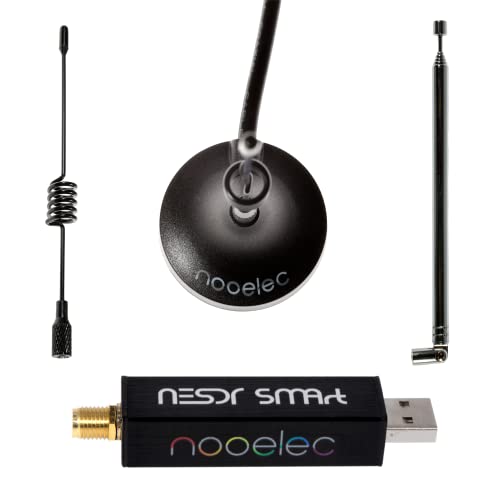
- 100 kHz to 1.75 GHz coverage
- Includes magnetic base and 3 antenna masts
- Works with Windows, Mac, Linux, and Android
Best For: Versatile receive-only SDR users who want a ready-to-go antenna bundle
All-Metal Handheld SDR Receiver
SDR-101 Aluminum Digital Demodulation Radio

- CW, AM, SSB, FM, and WFM modes
- All-aluminum compact handheld design
- 5000mAh battery with 4.3-inch IPS screen
Best For: Travel-friendly users who want a self-contained handheld receiver with multiple modes
Portable SDR Benchmark

- 100kHz to 1.75GHz coverage
- Works with computers and Android
- Improved sensitivity and tuning accuracy
Best For: Wideband SDR monitoring with a computer or mobile device
Portable Analog-Plus-SDR Radio
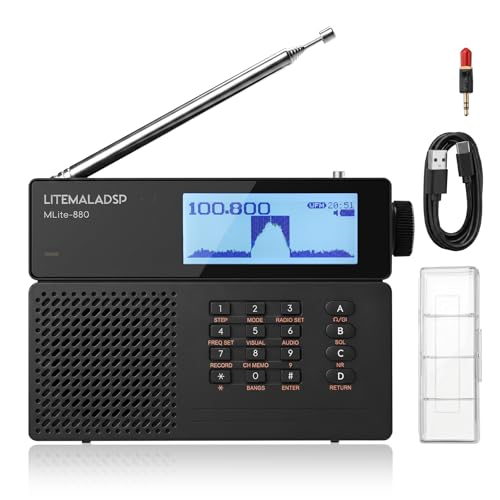
- 2.3-inch waterfall display
- SSB, AM, CW, and more modes
- 5000mAh rechargeable battery
Best For: Travel and field listening with hands-on tuning
Compact Travel Receiver

- Pocketable CNC aluminum design
- 2.4-inch touchscreen with RDS
- FM, MW, SW, and LW coverage
Best For: Casual travel listening with simple touchscreen controls
Portable Touchscreen SDR
Compact 100KHz-149MHz Receiver

- 4.3-inch touchscreen with waterfall display
- Covers 100KHz-149MHz in CW/AM/SSB/FM modes
- 5000mAh battery rated up to 12 hours
Best For: travelers and casual DX listeners who want a compact SDR with touchscreen control
IPS Display SDR
Bright 4.3-Inch Full-Band Receiver

- 4.3-inch IPS touchscreen with 800x480 resolution
- Supports FM/AM/LSB/USB/CW with 192kHz spectrum
- Built-in 3W speaker and 5000mAh battery
Best For: users who value a bright screen and built-in speaker in a portable SDR
All-Band Travel SDR
Keypad Tuning with Airband Support

- Covers FM, MW, LW, SW, and AIR bands
- Includes keypad entry, spectrum display, and encoders
- Bluetooth, microSD recording, and USB-C charging
Best For: airband and shortwave listeners who want direct keypad tuning and recording support
Compact SDR Starter Kit – RTL-SDR Blog V4 with Dipole Antenna Kit
If you want portable SDR radio receivers for a computer-based setup, this RTL-SDR Blog V4 bundle is a strong beginner-friendly option. It covers a wide tuning range, includes a dipole antenna kit, and adds hardware features like a TCXO, HF upconverter, and bias tee support for more flexible experimentation.
Best For: Beginners who want a compact receive-only SDR with an included antenna kit for terrestrial and satellite listening.
Pros:
- Tunes from 500 kHz to 1.7 GHz with up to 3.2 MHz instantaneous bandwidth.
- Includes a multipurpose dipole antenna kit for portable VHF/UHF use.
- Built-in HF upconverter, 1 PPM TCXO, SMA connector, and aluminum shielded case.
- Activatable bias tee and improved filtering add extra setup flexibility.
Cons:
- RX only, so it cannot transmit.
- Not suitable for HF reception, despite the built-in upconverter note.
- Requires a driver update and careful setup instructions.
This is a practical choice if you want an affordable portable SDR radio receiver package with useful hardware upgrades and an antenna included. It is especially appealing for listening to VHF/UHF signals and experimenting outdoors in temporary setups.
Pocket Shortwave Receiver – ATS MINI V4 Metal Shell Pocket Radio
This pocket-sized option stands out among portable SDR radio receivers if you want an all-in-one handheld radio rather than a computer dongle. The ATS MINI V4 uses an Si4732-based design with AM, FM, LSB, and USB support, plus a built-in speaker and headphone amplifier for easy everyday listening.
Best For: Listeners who want a rugged pocket radio for shortwave-style monitoring, travel, and casual outdoor use.
Pros:
- Supports AM, FM, LSB, and USB modes on an ESP32-S3 plus Si4732 platform.
- Built-in 1W cavity speaker and upgraded headphone amplifier.
- Metal shell, 1.9-inch HD screen, and rechargeable 800mAh battery.
- Hi-Z circuit, ESD-protected antenna input, and shielded tuner design.
Cons:
- Battery capacity is modest at 800mAh.
- Frequency details are limited in the supplied notes.
- Smaller pocket format may not suit users who want larger controls.
For buyers who value portability first, this is a rugged handheld receiver with useful band coverage and improved durability features. It fits well as a grab-and-go radio for hiking, camping, or casual listening at home.
Wideband USB SDR Bundle – Nooelec NESDR SMArt v5 with Antennas
Among portable SDR radio receivers that connect to a computer or phone, this Nooelec bundle is built for broad coverage and a complete starter setup. It supports a wide frequency range, comes with multiple antennas, and is designed for users who want to explore everything from broadcast listening to aviation, weather, and satellite signals.
Best For: Users who want a versatile wideband SDR bundle with antennas included and strong support for many signal types.
Pros:
- Covers 100 kHz to 1.75 GHz with up to 3.2 MHz instantaneous bandwidth.
- Improved performance over RTL-SDR v3, including better HF, VHF, and UHF SNR.
- Includes a magnetic antenna base, RG-58 feed cable, and three antenna masts.
- Compatible with Windows, Mac OS, Linux, and Android.
Cons:
- HF below 25 MHz requires direct sampling and a suitable antenna.
- For a more fulfilling HF experience, an upconverter is still recommended separately.
- USB dongle format still depends on an external device for operation.
This is a strong pick if you want a flexible SDR bundle that can handle many listening projects right out of the box. The included antennas and broad compatibility make it especially convenient for new users building a portable receive station.
All-Metal Handheld SDR Receiver – SDR-101 Aluminum Digital Demodulation Radio
If you want a truly portable SDR radio receiver in a self-contained handheld form, the SDR-101 focuses on digital demodulation and compact outdoor use. It supports CW, AM, SSB, FM, and WFM modes, and pairs that functionality with a high-brightness IPS screen and a large built-in battery.
Best For: Handheld listeners who want an all-in-one portable receiver for outdoor use and mode variety.
Pros:
- Supports CW, AM, SSB, FM, WFM, and FM broadcast stereo.
- All-aluminum alloy CNC shell for a rugged compact build.
- Large 5000mAh battery for portable operation.
- 4.3-inch 800×480 IPS LCD screen for easier viewing.
Cons:
- Supplied details list only one supported radio band.
- FM broadcast stereo requires headphones.
- It is a receiver-focused handheld, so it is not a general-purpose SDR dongle for computer scanning.
This model makes sense if you prefer a dedicated handheld receiver over a PC-based setup. Its metal housing, large display, and battery capacity make it a practical travel companion for casual monitoring anywhere.
Portable SDR Benchmark – Nooelec RTL-SDR v5
If you’re shopping for portable SDR radio receivers that can plug into a laptop, phone, or tablet, the Nooelec RTL-SDR v5 is a flexible low-cost option with very broad coverage. It supports reception from 100kHz to 1.75GHz, making it useful for everything from broadcast AM/FM and shortwave to air traffic, ADS-B, AIS, weather satellites, and more.
Best For: Listeners who want a compact USB SDR for wideband monitoring, experimentation, and travel-friendly use with a computer or mobile device.
Pros:
- Covers 100kHz to 1.75GHz with up to 3.2MHz instantaneous bandwidth.
- Works with Windows, Mac, Linux, and Android devices.
- Improved HF, VHF, and UHF performance over the earlier v3 model.
- Aluminum enclosure, SMA input, and 0.5PPM TCXO add stability.
Cons:
- HF reception below 25MHz requires a suitable antenna for direct sampling.
- For a stronger HF experience, the notes recommend an external upconverter.
- This version includes the receiver only, not an antenna set.
Overall, this is the most versatile pick if you want a compact SDR dongle that can cover a huge slice of the spectrum. It is best suited to users who already plan to pair it with antennas and software.
Portable Analog-Plus-SDR Radio – Raddy MLite-880
The Raddy MLite-880 is a practical choice among portable SDR radio receivers if you want an all-in-one handheld set for shortwave, aviation, and everyday listening. Its 2.3-inch waterfall display, SSB support, and DSP tools make it easier to find and clean up weak signals while staying fully portable.
Best For: Travelers, field listeners, and shortwave fans who want a rechargeable handheld radio with advanced tuning and signal tools.
Pros:
- Covers FM, MW, LW, SW, and air band from 118-136 MHz.
- Supports SSB, AM, CW, SAM, NFM, and WFM modes.
- Includes a 2.3-inch spectrum/waterfall display for signal hunting.
- 5000mAh rechargeable battery is designed for extended portable use.
Cons:
- Compact screen size may feel small compared with larger tabletop radios.
- Best suited to listening rather than computer-based SDR experimentation.
- Performance depends on using manual tuning and signal controls well.
This model stands out for combining classic handheld radio convenience with SDR-style visibility and mode support. It is a strong pick if you want a self-contained receiver you can carry without extra gear.
Compact Travel Receiver – TEF6686 V2.2 Shortwave Radio
For buyers comparing portable SDR radio receivers, the TEF6686 V2.2 is a compact travel-friendly set with a strong focus on everyday listening. Its TEF6686 chip, color touchscreen, RDS support, and small CNC aluminum body make it easy to carry while still covering FM, MW, SW, and LW bands.
Best For: Casual listeners who want a pocketable receiver with a color display, simple controls, and solid all-band coverage.
Pros:
- Compact 4.5 x 2.7 x 1.1 inch CNC aluminum body for travel use.
- 2.4-inch color touchscreen with RDS station and program info.
- Covers FM, MW, SW, and LW with customizable tuning steps.
- 1000mAh battery and Type-C charging keep it easy to recharge.
Cons:
- Battery life is listed at about 4-5 hours per charge.
- Not aimed at computer-connected SDR experimentation.
- Speaker power is modest at 2W, so it is best for personal listening.
This receiver is a good fit if portability and simple operation matter more than advanced software workflows. It offers enough band coverage and display features to make day-to-day listening straightforward.
Portable Touchscreen SDR – Compact 100KHz-149MHz Receiver
If you want a portable SDR radio receiver that keeps setup simple while still covering serious listening ranges, this model is built around a 4.3-inch touchscreen, 192kHz spectrum display, and 1Hz tuning steps. It supports CW, AM, SSB, WFM, and FM stereo, making it a flexible option for travel, casual monitoring, and ham-focused use.
Best For: listeners who want a compact touchscreen SDR with wide band coverage and long battery life for travel or outdoor use.
Pros:
- 100KHz-149MHz coverage with 1Hz step resolution.
- 4.3-inch touch display plus rotary encoder for control flexibility.
- 5000mAh battery is rated for up to 12 hours of use.
- Aluminum alloy CNC shell adds durability in a portable form factor.
Cons:
- Smaller 4-band support may be less expansive than some full-band competitors.
- Best suited to users comfortable with SDR-style controls and menus.
Overall, this receiver focuses on portable convenience without giving up the core SDR features most buyers want. If touchscreen control, preset storage, and a durable shell matter more than extra extras, it is a practical pick.
IPS Display SDR – Bright 4.3-Inch Full-Band Receiver
Among portable SDR radio receivers, this model stands out for pairing full-band coverage with a bright 4.3-inch IPS touchscreen and 800×480 resolution. It covers 100KHz to 149MHz, supports FM/AM/LSB/USB/CW, and adds a built-in 3W speaker for everyday listening without needing external audio gear.
Best For: buyers who want a bright, easy-to-read portable SDR with strong display quality and built-in speaker output.
Pros:
- 4.3-inch IPS touchscreen with 800×480 resolution.
- 192kHz spectrum display and 1Hz precision tuning.
- 5000mAh battery offers up to 12 hours of operation.
- Built-in 3W speaker plus headphone support for flexible listening.
Cons:
- Still relies on touchscreen and rotary controls rather than physical direct-entry keys.
- Compact size means it is more of a field receiver than a desktop-style unit.
This is a good all-around choice if screen visibility and audio convenience are high priorities. The aluminum alloy shell and preset storage help round out a portable package that feels ready for regular use.
All-Band Travel SDR – Keypad Tuning with Airband Support
If you want portable SDR radio receivers with more radio-service coverage, the MLite-880 is especially compelling because it adds FM, MW, LW, SW, and AIR band support along with AM, SAM, CW, USB, LSB, NFM, and WFM modes. Its 2.3-inch real-time spectrum display, tactile keypad, and mechanical encoders make it a strong fit for users who prefer direct control over touchscreen-heavy operation.
Best For: listeners who want an all-band portable SDR with airband support, keypad tuning, and recording features.
Pros:
- Wide coverage includes FM, MW, LW, SW, and AIR bands.
- Supports advanced features like NR, AGC, bandwidth control, RDS, and EQ.
- Built-in Bluetooth plus microSD recording and firmware update support.
- 5000mAh replaceable battery with USB-C charging for portable use.
Cons:
- 2.3-inch display is smaller than the 4.3-inch screen on some rivals.
- More feature-rich controls may take longer to learn than simpler receivers.
This receiver is aimed at users who want a more complete monitoring tool in a compact body. The combination of airband coverage, recording support, and tactile tuning makes it a practical upgrade for active listening.
How We Picked the Best Portable SDR Radio Receivers
We focused on reception range, supported modes, usability, portability, battery life, display quality, and overall value. For Portable SDR Radio Receivers, the best choice is not always the most advanced model; it is the one that matches how and where you plan to listen.
Quick Comparison
Computer-based RTL-SDR models are ideal if you want broad frequency coverage and maximum software flexibility. Standalone handheld radios are better if you want instant use, a built-in screen, and a simpler grab-and-go experience. Larger touchscreen sets usually offer the best balance of visibility and control for hobbyists who listen often.
Key Buying Factors for Portable SDR Radio Receivers
Frequency Coverage and Modes
Check the bands you care about most, especially FM, AM, shortwave, airband, SSB, CW, and ham-related reception. Not every receiver handles the same range or demodulation modes equally well.
Display and Interface
A waterfall display, spectrum view, or touchscreen can make weak-signal hunting much easier. If you travel often, physical controls may matter more than a large screen.
Power and Portability
Battery size, charging method, and overall weight matter if you plan to use the radio outdoors or on the move. Compact models are easier to carry, while larger units often provide better usability and audio.
Antenna and Input Quality
A good antenna connection is essential. Look for external antenna support, HF capability, and low-noise performance if you care about weak signals. For SDR dongles, software compatibility and stable driver support are just as important.
Audio, DSP, and Signal Stability
Noise reduction, stable frequency reference, and clean demodulation can make a big difference in real-world listening. These features help Portable SDR Radio Receivers perform better in crowded or noisy RF environments.
Who Should Buy Which Portable SDR Radio Receivers?
If you want the most flexible setup and already use a laptop or PC, an RTL-SDR model is the smartest value. If you want a self-contained radio for travel, choose a compact handheld with a battery and built-in speaker. If you want an easier full-featured listening experience at home or on the go, a touchscreen SDR receiver with waterfall display is usually the best middle ground.
In short, match the radio to your listening style, not just the spec sheet. The best Portable SDR Radio Receivers combine the bands you need, the controls you prefer, and the portability you will actually use.