SDR receivers can open up shortwave listening with sharper tuning, flexible filtering, and access to signals traditional radios may miss. The right model depends on how you plan to listen, what bands you want, and whether you prefer a simple portable radio or a PC-connected dongle.
Below, we focus on practical choices for different budgets and setups, with an eye toward reception quality, usability, and overall value in 2026.
Best 10 SDR Receivers for Shortwave Listening Picks for 2026
Compact HF-SDR Starter
RTL-SDR Blog V4 with Dipole Kit

- 1 PPM TCXO and shielded case
- Includes dipole antenna kit
- Not suitable for HF reception
Best For: Beginners wanting a polished SDR dongle for VHF/UHF and general experimentation
Portable Touchscreen Receiver
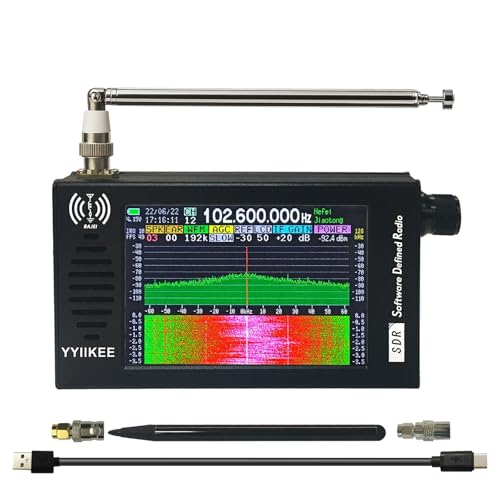
- 100 kHz to 149 MHz coverage
- 192 kHz spectrum and waterfall
- Touchscreen plus rotary encoder
Best For: Shortwave listeners who want a portable, self-contained receiver
Classic RTL SDR Bundle
RTL-SDR Blog V3 with Dipole Kit

- R860 tuner with 1 PPM TCXO
- Includes dipole antenna kit
- HF performance is reduced below 24 MHz
Best For: Beginners wanting a proven USB SDR for general receiving and light HF tinkering
Budget Touchscreen HF Radio

- 100 kHz to 149 MHz coverage
- 5000mAh battery with long runtime
- Touchscreen plus 99 presets
Best For: Travelers and casual listeners who want a compact rechargeable receiver
Portable USB SDR Dongle

- 1 PPM TCXO for stable tuning
- 500 kHz to 1.7 GHz coverage
- RX-only dongle with bias tee
Best For: Budget-minded listeners who want a compact SDR for shortwave and wideband receive-only use
Portable Touchscreen SDR Radio
ATS-25MAX Decoder II Shortwave Radio

- Covers FM, LW, MW, SW, and SSB
- Supports CW, RTTY, FT8, PSK, and more
- 2.4-inch touchscreen with 4000mAh battery
Best For: Listeners who want a portable, standalone shortwave radio with digital decoding and wireless features
Complete RTL-SDR Bundle
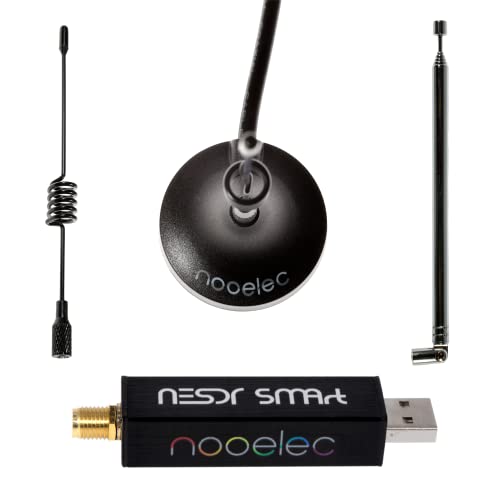
- 0.5 PPM TCXO for accurate tuning
- Includes antennas and feed cable
- 100 kHz to 1.75 GHz coverage
Best For: Shortwave hobbyists who want a bundled SDR with antennas and stronger HF performance
DX-Friendly Portable SDR
TEF6686 Full-Band DSP Shortwave Radio
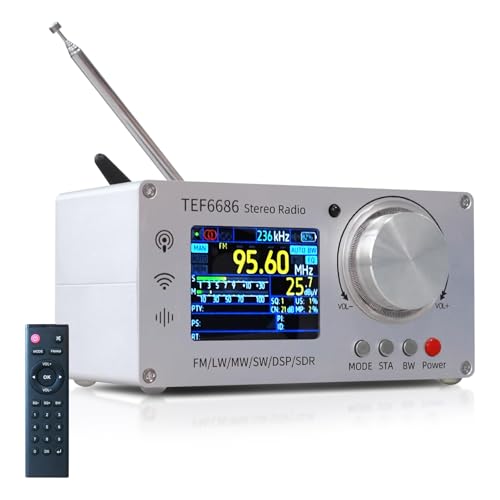
- Covers FM, LW, MW, and SW with DSP handling
- 4000mAh battery, USB-C charging, BNC antenna input
- TFT display plus remote control for easier operation
Best For: DXers and beginners who want a portable SDR-style radio
Aluminum SDR Receiver
SDR-101 Digital Demodulation Radio

- CW, AM, SSB, WFM, and FM demodulation
- All-aluminum CNC shell with 4.3-inch IPS display
- 5000mAh battery for portable listening
Best For: Listeners who want a compact SDR receiver with sideband support
USB SDR Dongle Pick
RTL SDR Receiver 100KHz to 1766MHz

- 100KHz to 1766MHz coverage with multiple demodulation modes
- 0.5 PPM TCXO for better tuning stability
- Direct sampling plus USB power for PC-based listening
Best For: PC-based listeners who want a wide-coverage software-defined radio receiver
Compact HF-SDR Starter – RTL-SDR Blog V4 with Dipole Kit
If you’re comparing SDR receivers for shortwave listening, this RTL-SDR Blog V4 is better viewed as a versatile entry-level SDR for VHF/UHF and experimentation, not a dedicated HF shortwave rig. It tunes from 500 kHz to 1.7 GHz, includes an HF upconverter, and adds a 1 PPM TCXO plus improved filtering and shielding, but the notes clearly state it is not suitable for HF reception.
Best For: Beginners who want a well-built SDR dongle for terrestrial and satellite monitoring, plus broader SDR learning.
Pros:
- R828D tuner with 1 PPM TCXO for improved frequency stability
- Built-in HF upconverter, bias tee, and aluminum shielded case
- Includes a multipurpose dipole antenna kit
- Tunes from 500 kHz to 1.7 GHz with up to 3.2 MHz bandwidth
Cons:
- Notes state it is not suitable for HF reception
- Requires a driver update and careful installation
- RX-only, so it cannot transmit
For buyers focused on shortwave listening, this is the least direct fit in the group; its strengths are the hardware upgrades and beginner-friendly package. It makes more sense if you also want a capable SDR for scanning VHF/UHF and learning the software side of radio.
Portable Touchscreen Receiver – 4.3" DSP Shortwave Set
Among SDR receivers for shortwave listening, this portable DSP unit is the most directly aligned with the job: it covers 100 kHz to 149 MHz and supports CW, AM, SSB, WFM, and FM stereo. The 4.3-inch touchscreen, rotary encoder, and 192 kHz spectrum/waterfall display make it a practical grab-and-go receiver for monitoring stations and fine-tuning signals.
Best For: Listeners who want an all-in-one handheld SDR-style receiver for shortwave, AM, SSB, and casual HF monitoring.
Pros:
- Wide 100 kHz to 149 MHz coverage for shortwave and beyond
- 192 kHz real-time spectrum and waterfall display
- 4.3-inch IPS touchscreen with rotary encoder control
- Aluminum alloy CNC case with rechargeable battery for portability
Cons:
- Coverage tops out at 149 MHz, so it is not a full-range SDR
- Uses a built-in retractable antenna, which may limit performance versus larger setups
- Not described with external antenna options in the supplied notes
If your priority is an easy portable receiver for shortwave listening, this model has the most consumer-friendly feature set here. The display and controls should appeal to users who want a self-contained radio rather than a computer-based SDR.
Classic RTL SDR Bundle – RTL-SDR Blog V3 with Dipole Kit
If you’re shopping SDR receivers for shortwave listening, this RTL-SDR Blog V3 is a capable budget dongle, but it is still a compromise choice for HF. It tunes from 500 kHz to 1.7 GHz and includes an HF bias tee plus direct-sampling support below 24 MHz, although the notes say HF performance is reduced and it is not suitable for HF reception overall.
Best For: Beginners who want a proven USB SDR for VHF/UHF experimentation and only occasional HF use.
Pros:
- R860 tuner with 1 PPM TCXO for stable tuning
- Includes an HF bias tee and multipurpose dipole antenna kit
- Tunes from 500 kHz to 1.7 GHz with up to 3.2 MHz bandwidth
- Aluminum shielded case with thermal pad for passive cooling
Cons:
- Notes state it is not suitable for HF reception
- HF below 24 MHz uses direct sampling with reduced performance
- Requires a computer or compatible device to use
This is a familiar, well-rounded RTL-SDR bundle, but shortwave buyers should treat it as a secondary option. Its real value is the included antenna kit, tuner stability, and broad receiving range for general SDR hobby use.
Budget Touchscreen HF Radio – Portable 4.3" DSP SDR
For buyers comparing SDR receivers for shortwave listening, this portable DSP radio is a straightforward handheld option with 100 kHz to 149 MHz coverage and support for CW, AM, SSB, WFM, and FM stereo. The 4.3-inch touchscreen, rotary encoder, 192 kHz spectrum display, and preset memory make it easy to use for everyday listening and quick station changes.
Best For: Travelers and casual listeners who want a compact, rechargeable shortwave-capable receiver.
Pros:
- Wide 100 kHz to 149 MHz tuning range
- 192 kHz spectrum display with 16-bit sampling
- Built-in 5000mAh battery with up to 12 hours of use
- Touchscreen controls plus rotary encoder and 99 channel presets
Cons:
- Frequency range ends at 149 MHz
- Supplied notes do not mention external antenna support
- Less specialized than a computer-based SDR setup
This model is appealing if you want a portable receiver that is simple to carry and quick to operate. It offers a useful mix of display, battery life, and mode support, though it is still more of a compact radio than a full-featured desktop SDR system.
Portable USB SDR Dongle – RTL-SDR Blog V3 Receiver
RTL-SDR Blog V3 R860 RTL2832U 1PPM TCXO SMA Software Defined Radio (Dongle Only) (Black)
Check Price On AmazonIf you want a flexible entry point into SDR receivers for shortwave listening, this RTL-SDR Blog V3 dongle is a compact computer-based option with a strong feature set for its class. It tunes from 500 kHz to 1.7 GHz, includes a 1 PPM TCXO for better frequency stability, and supports HF reception below 24 MHz in direct sampling mode, though with reduced performance.
Best For: Beginners and hobbyists who want an inexpensive RX-only SDR for experimenting with shortwave, HF, and wideband monitoring on a laptop, desktop, tablet, smartphone, or Raspberry Pi.
Pros:
- 1 PPM TCXO and improved component tolerances for stable tuning
- 500 kHz to 1.7 GHz coverage with up to 3.2 MHz instantaneous bandwidth
- Aluminum shielded case, SMA connector, and activatable bias tee
- Works with multiple device types and includes RX-only SDR functionality
Cons:
- HF reception below 24 MHz uses direct sampling with reduced performance
- Dongle only, so you must supply your own antenna and setup
- Designed for receive-only use, not transmission
For buyers comparing SDR receivers for shortwave listening, this model stands out for portability, stability, and broad coverage. It is a practical choice if you are comfortable using software and want a compact receiver that can handle both HF experiments and wider RF scanning.
Portable Touchscreen SDR Radio – ATS-25MAX Decoder II Shortwave Radio
The ATS-25MAX Decoder II is a self-contained option for SDR receivers for shortwave listening if you prefer an all-in-one portable radio instead of a computer dongle. It covers FM, LW, MW, SW, and SSB, adds DSP filtering, and supports digital decoding modes like CW, RTTY, FT8, PSK, DIGI, CWR, SYNC L, and SYNC U.
Best For: Travelers and casual shortwave listeners who want a portable touchscreen receiver with WiFi, Bluetooth, and built-in battery power.
Pros:
- Full-band coverage including FM, LW, MW, SW, and SSB
- Built-in decoding support for CW, RTTY, FT8, PSK, and more
- 2.4-inch color touchscreen with keypad frequency entry and spectrum display
- 4000mAh rechargeable battery for up to 8 hours of use
Cons:
- Less open-ended than a PC-based SDR dongle setup
- Battery life is useful but not all-day for heavy field use
- May be more feature-rich than needed for simple listening
This model makes sense if you want a portable radio that blends modern controls with shortwave capability. It is especially appealing when you value built-in decoding, wireless connectivity, and a simple standalone experience over software-heavy tinkering.
Complete RTL-SDR Bundle – Nooelec NESDR SMArt v5 Bundle
For buyers comparing SDR receivers for shortwave listening, the Nooelec NESDR SMArt v5 is a strong bundle because it combines the receiver with antennas and broad software compatibility. It covers 100 kHz to 1.75 GHz, uses a 0.5 PPM TCXO, and supports HF reception below 25 MHz through direct sampling with a suitable antenna.
Best For: Hobbyists who want a higher-end RTL-SDR bundle with included antennas and improved HF performance for shortwave use.
Pros:
- 0.5 PPM TCXO for improved tuning accuracy
- 100 kHz to 1.75 GHz range with up to 3.2 MHz bandwidth
- Includes a magnetic base antenna, feed cable, and three antenna masts
- Compatible with Windows, Mac OS, Linux, and Android
Cons:
- HF reception below 25 MHz requires direct sampling and a suitable antenna
- Upconverter is recommended for a more fulfilling HF experience
- More of a setup-oriented bundle than a simple plug-and-play radio
This bundle is a sensible upgrade if you want more than a basic dongle and need a package with antennas included. It offers a good mix of frequency coverage, accuracy, and support, making it a practical choice for shortwave listeners who expect to experiment and optimize their antenna setup.
DX-Friendly Portable SDR – TEF6686 Full-Band DSP Shortwave Radio
If you’re comparing SDR receivers for shortwave listening, this TEF6686-based portable is built for people who want broad band coverage, DSP filtering, and an easy-to-use display in one travel-friendly unit. It covers FM, LW, MW, and SW, and the notes emphasize strong sensitivity, good selectivity, and useful noise suppression for weak-signal listening.
Best For: DXers, ham radio users, and beginners who want a portable SDR-style radio with simple controls and room to experiment.
Pros:
- Supports AM/FM, LW, MW, and SW coverage with DSP-based signal handling.
- Useful for weak signals, adjacent-channel interference, and noisy environments.
- Includes a TFT display, automatic tuning, memory, and a dedicated remote control.
- Portable design with 4000mAh battery, USB-C charging, and BNC antenna input.
Cons:
- SW, MW, and LW reception requires AM mode and frequent tuning adjustments.
- Performance depends heavily on antenna choice and local interference.
- Beginners may face a learning curve on shortwave bands.
This model makes sense if you want a feature-rich portable radio for experimenting with bands and improving reception through better antenna setup. It offers strong flexibility for listeners who value practical controls and DSP-assisted reception over simplicity alone.
Aluminum SDR Receiver – SDR-101 Digital Demodulation Radio
For buyers focused on SDR receivers for shortwave listening, the SDR-101 is a compact digital demodulation receiver with CW, AM, SSB, WFM, and FM modes. Its notes point to a high-dynamic receiver design and a 4.3-inch IPS display, making it a practical pick if you want a small receiver you can use outdoors or at home.
Best For: Listeners who want a compact SDR receiver with sideband support and a rugged aluminum build.
Pros:
- SDR architecture with CW, AM, SSB, WFM, and FM demodulation.
- All-aluminum alloy CNC shell for a sturdy portable feel.
- 4.3-inch 800×480 high-brightness IPS LCD screen.
- 5000mAh battery for portable use.
Cons:
- Listed radio bands supported are only 1-band in the supplied details.
- FM stereo requires headphones.
- Shortwave-focused buyers should note the description is centered on demodulation modes rather than broad band convenience.
The SDR-101 is best viewed as a compact, mode-flexible receiver rather than a feature-heavy all-rounder. If your priority is digital demodulation, a durable metal shell, and a clear display in a small package, it fits that use case well.
USB SDR Dongle Pick – RTL SDR Receiver 100KHz to 1766MHz
If you want an entry point into SDR receivers for shortwave listening, this RTL-SDR dongle covers a very wide range and supports the common modes used for HF monitoring. The notes call out direct sampling for shortwave, a 0.5 PPM TCXO for stability, and compatibility with software and antennas that can help it perform well on HF, VHF, and UHF.
Best For: PC-based listeners who want an affordable software-defined radio receiver with wide frequency coverage.
Pros:
- Covers 100KHz to 1766MHz with support for FM, CW, DSB, LSB, USB, and NFM/WFM.
- 0.5 PPM TCXO helps reduce tuning drift and improve stability.
- Direct sampling support for shortwave/Q branch use.
- USB-powered and compatible with antennas such as long wire, random wire, or dipole.
Cons:
- Requires a computer and SDR software to operate.
- HF performance depends on using the right antenna and software setup.
- 8-bit ADC and dongle form factor are less convenient than a standalone radio.
This is the most software-dependent option in the group, but that also makes it highly flexible for experimentation. If you’re comfortable using a PC and external antennas, it offers a broad, practical path into SDR listening.
How We Picked the Best SDR Receivers for Shortwave Listening
For SDR Receivers for Shortwave Listening, the most important factors are usable HF coverage, stable tuning, sensitivity, and ease of setup. We also looked at whether a receiver works well as a stand-alone portable radio or as a computer-based SDR, since those two use cases suit very different buyers.
We favored models with strong frequency stability, useful antenna options, and features that help on weak signals, such as HF support, bias tee power, spectrum/waterfall displays, and digital demodulation tools. Portability, battery life, display quality, and overall value also mattered.
Quick Comparison
In general, dongle-style RTL-SDR units are best if you want flexibility, software control, and broad band coverage with a computer. Portable DSP radios are better if you want an all-in-one listening experience without relying on a laptop or desktop. If shortwave listening is your main goal, pay close attention to HF performance and antenna handling rather than only the widest advertised frequency range.
Key Buying Factors for SDR Receivers for Shortwave Listening
HF and Shortwave Coverage
Make sure the receiver covers the shortwave bands you actually want to hear. Some products advertise very wide ranges, but real-world performance on HF can vary with design, firmware, and antenna quality.
Antenna Input and Signal Handling
An SMA or BNC input is useful, but antenna compatibility matters more than connector type alone. A good external antenna, plus features like a bias tee when needed, can make a bigger difference than extra headline specs.
Display and Controls
Standalone radios with a waterfall and touchscreen are easier for casual listening, while SDR dongles rely on software but often give you more control over bandwidth, filtering, and decoding.
Portability and Power
If you listen outdoors or while traveling, battery capacity, charging through USB-C, speaker quality, and physical size become important. For desktop use, heat management and software support may matter more.
Who Should Buy Which SDR Receivers for Shortwave Listening?
Choose a portable SDR if you want a self-contained shortwave radio that is easy to use out of the box. Choose a PC-connected SDR dongle if you want deeper experimentation, better software tools, and a lower-cost entry point. If you are mainly chasing strong everyday shortwave reception, look first for stable HF performance and good antenna support; if you want a broader radio hobby tool, prioritize software compatibility and flexibility.
For most buyers, the best SDR Receivers for Shortwave Listening are the ones that match your listening style, antenna setup, and learning curve—not just the ones with the biggest frequency numbers.