Finding the right amplifier does not require a four-figure budget. The best power amplifiers under $200 can deliver clean stereo sound, useful connectivity, and enough output for home audio, desktop systems, subwoofers, and small venues.
This roundup compares 10 affordable models across compact Class D designs, Bluetooth amplifiers, rack-mount units, mono subwoofer amps, and flexible integrated power amps. Focus on speaker compatibility, real-world power, inputs, and the features your system actually needs.
Best 10 Power Amplifiers Under 200 Picks for 2026
Best Versatile Mini Amp

- Up to 300W per channel
- Bass and treble controls
- Compact RCA stereo design
Best For: Desktop audio and passive bookshelf speakers
Best Subwoofer-Focused Amp

- Switchable full-range and sub-bass modes
- Passive and active sub outputs
- Includes 36V 6A adapter
Best For: Compact home theater and subwoofer setups
Best Rack-Mount Pro Amp
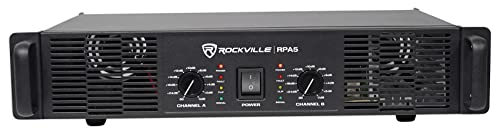
- 200W RMS per channel
- Stereo and bridged modes
- 2U rack-mount and pro inputs
Best For: DJ rigs and rack-based audio systems
Best Rack-Mount Value
Pyle PTA1000BT 2-Channel Amplifier

- Up to 2000W bridged output
- Bluetooth, USB, TRS, and XLR inputs
- Rack-mount design with cooling fan
Best For: PA and multi-speaker systems needing flexible connections
Best Compact Hi-Fi Pick
TOPPING Mini300 Stereo Power Amplifier

- 140W × 2 at 4 ohms
- Balanced TRS and RCA inputs
- Compact aluminum Class-D chassis
Best For: Desktop hi-fi and studio-monitoring setups
Best Bluetooth Flexibility
Fosi Audio BT20A Pro Amplifier
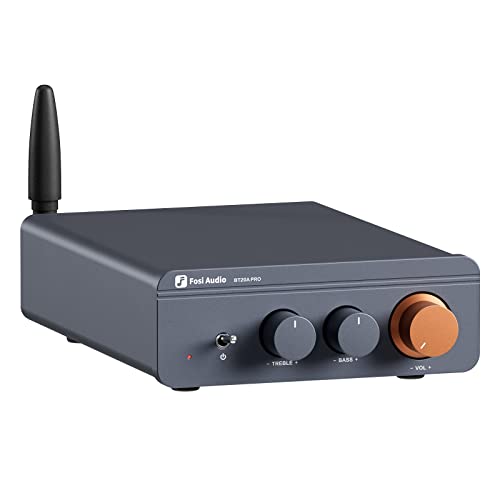
- Rated at 300W × 2
- Bluetooth 5.0 wireless playback
- Replaceable op-amps and tone controls
Best For: Compact passive-speaker systems with wireless audio
Best Budget Feature Set

- 200W peak, 100W RMS stereo output
- Bluetooth, FM, USB, SD, RCA, and mic inputs
- Remote control with adjustable EQ
Best For: Flexible home audio and karaoke setups
Best Compact Power

- Up to 600W two-channel output
- TPA3255 Class D design for passive speakers
- Adjustable pre-out and swappable op-amps
Best For: Compact desktop and home-theater stereo systems
Best Bridgeable Design
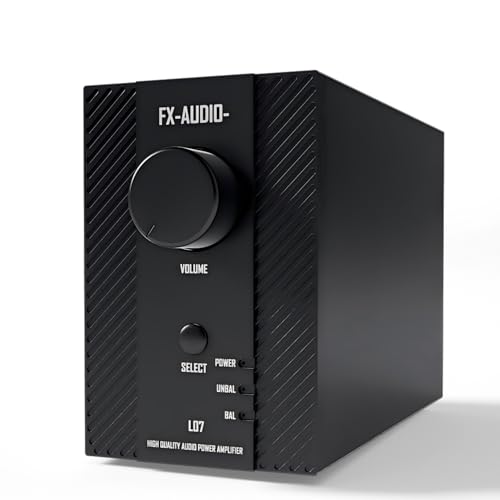
- 200W per channel in stereo mode
- 400W bridged output at 8 ohms
- Balanced XLR and RCA inputs
Best For: Passive-speaker systems needing flexible wired output
Best Versatile Mini Amp – Fosi Audio TB10D
The Fosi Audio TB10D is a flexible choice among power amplifiers under 200 for desktop audio, bookshelf speakers, and compact home setups. Its two-channel Class D design delivers up to 300 watts per channel, with bass and treble controls for simple sound adjustment.
Best For: Users who want a compact stereo amplifier with strong output, tone controls, and straightforward RCA connectivity.
Pros:
- Up to 300 watts per channel with compatible speakers
- Supports 2–8 ohm passive speakers and bass shakers
- Bass and treble knobs make sound tailoring easy
- Built-in protection circuits and a 24-month warranty
Cons:
- Provides RCA input rather than a broader selection of inputs
- Designed for passive speakers, so powered speakers are not the direct match
Choose the TB10D when you need substantial stereo power in a small enclosure and value basic hands-on controls over extra features.
Best Subwoofer-Focused Amp – AIYIMA A3001 Mono Amp
The AIYIMA A3001 stands out among power amplifiers under 200 for systems that need a dedicated mono amplifier with subwoofer flexibility. It offers switchable full-frequency and sub-bass modes, plus outputs for passive speakers, passive subwoofers, or active subwoofers.
Best For: Home theater and desktop users who want one compact amp that can switch between full-range mono and subwoofer duties.
Pros:
- Switchable full-frequency and subwoofer modes
- Built-in low-pass filter for subwoofer use
- Supports passive speaker, passive subwoofer, and active subwoofer connections
- Includes a 36V 6A power adapter
Cons:
- The advertised 300-watt figure is peak power with a different 48V 10A supply and 4-ohm speaker
- Mono operation may not suit users seeking conventional stereo amplification
The A3001 is a practical fit when bass management and connection flexibility matter more than a traditional two-channel layout. Be sure to evaluate its actual power with the included adapter.
Best Rack-Mount Pro Amp – Rockville RPA5
The Rockville RPA5 is a professional-style option among power amplifiers under 200, built for DJ rigs, installed systems, and rack-based audio. It provides 200 watts RMS per channel at 4 ohms, with stereo and bridged modes, a built-in crossover, and multiple pro-audio connections.
Best For: DJs, small venues, and users who need rack-mount construction, flexible inputs, and speaker-level output options.
Pros:
- 200W RMS per channel at 4 ohms or 400W RMS bridged at 8 ohms
- Stereo/mono switch and built-in crossover
- Combo XLR/1/4-inch and RCA inputs
- 2U rack-mountable design with cooling fans and protection circuitry
Cons:
- Its 2U rack format is less suitable for compact desktop systems
- Cooling fans may be less appropriate for quiet listening rooms
- Warranty coverage is one year
Pick the RPA5 when installation compatibility and pro-audio connectivity are priorities. Its rack-ready design makes it more specialized than the compact mini amplifiers in this roundup.
Best Dual-Mode Power Amp – AIYIMA A07 MAX
The AIYIMA A07 MAX is a strong contender among power amplifiers under 200 for listeners who want both stereo and bridged mono operation. It can deliver up to 300 watts per channel in stereo mode or up to 600 watts in mono mode, while its 3.5mm AUX output allows expansion to another unit.
Best For: Home audio and desktop users who want a compact amplifier that can grow into a higher-power dual-unit system.
Pros:
- Switchable 300W-per-channel stereo and 600W mono modes
- Compatible with 2–8 ohm speakers
- 3.5mm AUX output supports connection to another A07 MAX
- Includes a 36V 6A power adapter and upgraded ventilation
Cons:
- Does not include a phono input; a separate phono preamp is required
- Mono/stereo switching uses a bottom-mounted switch
- Maximum output depends on speaker impedance and power supply conditions
The A07 MAX is a good choice for flexible system building. Its dual-mode design supports everyday stereo listening now while leaving room for a more powerful bridged setup later.
Best Rack-Mount Value – Pyle PTA1000BT 2-Channel Amplifier
The Pyle PTA1000BT is a practical choice among power amplifiers under 200 for users who need rack-mount installation, flexible inputs, and high stated output. It can run in stereo at 1000 watts per channel or in bridged mode at up to 2000 watts, with support for 4- to 8-ohm speakers.
Best For: PA setups, multi-speaker systems, and buyers who want Bluetooth alongside professional-style connections.
Pros:
- Offers stereo and bridged operating modes for flexible system configurations.
- Includes Bluetooth, USB-A MP3 playback, TRS, XLR, Speakon, and binding-post connections.
- Rack-mountable metal-and-plastic chassis includes a cooling fan and front-panel level indicators.
Cons:
- Its 19-inch rack-mount form is less convenient for compact desktop use.
- The supplied specifications list a 220-volt voltage rating alongside a 120-volt minimum supply detail, so buyers should verify compatibility.
The PTA1000BT stands out for connectivity and installation flexibility rather than minimalist hi-fi design. Its bridge mode, cooling fan, and multiple outputs make it a useful option for larger or more feature-heavy audio systems.
Best Compact Hi-Fi Pick – TOPPING Mini300 Stereo Power Amplifier
The TOPPING Mini300 is a compact contender among power amplifiers under 200, combining a fully balanced Class-D design with up to 140 watts per channel at 4 ohms. Its small aluminum chassis suits desktop systems, while balanced TRS and unbalanced RCA inputs simplify connections to audio sources.
Best For: Desktop hi-fi listening, studio monitoring, and compact systems where low distortion and clean integration matter.
Pros:
- Provides up to 140W × 2 at 4 ohms with a stated ultra-low distortion figure at 8 ohms and 5 watts.
- Supports both balanced TRS and unbalanced RCA inputs without an adapter.
- Includes trigger-based automatic power synchronization and overheat and overcurrent protection.
Cons:
- Its maximum stated output is lower than the Pyle and Fosi options in this roundup.
- It is a freestanding mini amplifier, not a rack-mount unit.
- The amplifier requires a 12-volt DC supply.
The Mini300 is the most specification-focused and space-conscious option here. Choose it when a compact aluminum enclosure, balanced connectivity, and low stated distortion are more important than maximum system output.
Best Bluetooth Flexibility – Fosi Audio BT20A Pro Amplifier
The Fosi Audio BT20A Pro is a strong all-purpose option among power amplifiers under 200 for passive-speaker systems. Its TPA3255-based Class-D design is rated at 300 watts per channel, and Bluetooth 5.0 makes wireless playback straightforward for home or outdoor stereo use.
Best For: Passive-speaker owners who want a small wireless amplifier with adjustable bass and treble controls.
Pros:
- Delivers a stated 300 watts per channel and uses an efficient Class-D amplifier design.
- Bluetooth 5.0 includes memory pairing, while the volume control can remove the pairing connection.
- Replaceable op-amps and bass and treble controls allow sound customization.
Cons:
- The supplied notes do not list wired input types beyond its Bluetooth functionality.
- It is an integrated mini amplifier rather than a rack-mount power amplifier.
- Its actual speaker performance will depend on the connected speakers and system setup.
The BT20A Pro is appealing when wireless convenience and user-adjustable sound are priorities. It offers more tuning flexibility than a basic Bluetooth receiver, while its compact format keeps installation simple.
Best Budget Feature Set – Pyle PDA29BU.5
If you need one of the more versatile power amplifiers under 200, the Pyle PDA29BU.5 combines a 200-watt peak rating with Bluetooth, FM radio, USB, SD, RCA, AUX, and microphone inputs. Its compact design and included remote make it a practical choice for flexible home audio or karaoke setups.
Best For: Home audio, karaoke, and computer setups that need multiple input options.
Pros:
- Offers 200 watts of peak power and 100 watts RMS across two channels.
- Supports Bluetooth, FM radio, USB, SD card, RCA, AUX, and two microphone inputs.
- Includes bass, treble, microphone, and master-volume controls, plus a remote.
Cons:
- Its 200-watt figure is peak output; continuous output is listed as 100 watts.
- The feature-rich front panel may be more than needed for a simple stereo system.
The Pyle is a strong value when connectivity matters as much as amplification. Choose it over a minimalist amp if you want built-in playback, radio, microphone support, and convenient physical controls.
Best Compact Power – Fosi Audio V3
Among power amplifiers under 200, the Fosi Audio V3 stands out for pairing a compact chassis with a high-power Class D design. With the supplied 48V power supply, it is built for passive 2–8-ohm speakers and can suit desktop systems, bookshelf speakers, or home theaters.
Best For: Listeners who want a compact, high-output amplifier for passive speakers.
Pros:
- Delivers up to 600 watts across two channels according to the supplied product information.
- Uses a TPA3255 Class D chip and premium listed components for low-noise performance.
- Includes adjustable pre-out functionality and supports swappable compatible op-amps.
- Top-and-bottom vents and a full-body heatsink support heat dissipation.
Cons:
- It is a power amplifier for passive speakers rather than an all-in-one receiver.
- Op-amp swapping is an enthusiast feature that may not interest every buyer.
The V3 is a compelling pick when clean, compact power is the priority. Its minimalist format leaves out source features such as Bluetooth and radio, but its pre-out and upgradeable op-amp design add flexibility for a focused stereo system.
Best Bridgeable Design – FX-Audio L07
The FX-Audio L07 is a versatile option among power amplifiers under 200 for buyers who want strong stereo output with a bridge mode. It provides 200 watts per channel and can be switched to a 400-watt bridged configuration for compatible 8-ohm speaker setups.
Best For: Passive bookshelf, floor-standing, or home-theater speakers needing balanced inputs and bridgeable output.
Pros:
- Provides 200 watts per channel and a selectable 400-watt bridged mode at 8 ohms.
- Fully balanced architecture is designed for channel separation and clean audio.
- Accepts balanced XLR and single-ended RCA inputs from multiple source devices.
- Uses an MA5332MS chip and independent isolated dual power supply.
Cons:
- Bridged operation is specified for 8-ohm impedance, limiting compatibility with some speakers.
- It does not list built-in Bluetooth, radio, USB, or other source playback features.
The L07 makes the most sense when output flexibility and wired connectivity are more important than convenience features. Its bridge switch and XLR/RCA support give it a practical role in larger passive-speaker or multi-channel systems.
How We Picked the Best Power Amplifiers Under 200
We selected models that offer a practical balance of output, connectivity, size, and intended use at an accessible price. The list includes compact stereo amplifiers for passive speakers, dedicated mono options for subwoofers, rack-mount amplifiers for DJ or installation work, and Bluetooth-equipped units for convenient wireless playback.
We also considered amplifier topology, published impedance ratings, input and output options, controls, and whether each design suits a specific setup. Power claims can vary by impedance, distortion level, channel count, and test conditions, so wattage should be treated as one comparison point—not the sole measure of performance.
Quick Comparison
| Best For | What to Prioritize | Likely Best Fit |
|---|---|---|
| Compact home stereo | Clean Class D output and small footprint | Fosi Audio, AIYIMA, or TOPPING |
| Wireless listening | Bluetooth and convenient analog inputs | Fosi Audio BT20A Pro or Pyle Bluetooth models |
| Subwoofer duty | Mono output, bass control, and suitable impedance | AIYIMA TPA3255 Mono |
| DJ or rack installation | Rack mounting, balanced inputs, and durable connections | Rockville or Pyle rack amplifiers |
| Flexible passive-speaker system | Bridgeable operation and multiple input options | FX-Audio L07 or a Fosi Audio model |
Key Buying Factors for Power Amplifiers Under 200
Power, Impedance, and Speaker Matching
Check your speakers’ nominal impedance before buying. An amplifier’s output may be specified at 4 or 8 ohms, and the available wattage can change substantially between those loads. Avoid treating an advertised peak or bridged figure as continuous stereo power. Choose an amplifier that can drive your speakers comfortably without operating at its limit.
Inputs and Everyday Connectivity
Bluetooth is useful for phones and tablets, while RCA, AUX, XLR, TRS, USB, and optical connections serve different sources and installation needs. Confirm that the amplifier has the inputs you use now, not just features that sound impressive. A model with a subwoofer output, pre-out, or bridge mode may also be easier to expand later.
Form Factor and Cooling
Mini amplifiers fit desks, shelves, and small media cabinets, but they still need ventilation. Rack-mount models make more sense for DJ systems, equipment racks, and permanent installations. Fan noise, heat buildup, and access to the controls matter when the amplifier will run for long sessions.
Sound Quality and Controls
Look for low distortion, a sensible signal-to-noise specification, reliable volume controls, and protection against overheating or short circuits. Tone controls can be helpful in casual systems, while a simpler signal path may appeal to listeners using an external preamp or digital source.
Who Should Buy Which Power Amplifiers Under 200?
Choose a compact stereo Class D amplifier if you need affordable power for bookshelf, desktop, patio, or secondary-room speakers. A Bluetooth model is best for simple streaming with minimal equipment. If you are building a bass-focused system, select the mono subwoofer amplifier and verify its crossover and impedance compatibility.
For DJs, venues, and equipment racks, prioritize balanced inputs, rack hardware, bridge operation, and durable speaker connectors over the smallest size. Buyers assembling a more traditional hi-fi system should focus on clean stereo output, low noise, and the right analog inputs. Whichever model you choose, match its specifications to your speakers and source equipment before prioritizing maximum wattage.