The best soundproofing mats for home studios help control floor vibration, reduce reflected sound, and create a more manageable recording or practice space. The right choice depends on whether you need true sound isolation, acoustic absorption, or protection beneath drums, keyboards, speakers, and other equipment.
This roundup compares ten practical options, including mass-loaded vinyl barriers, interlocking felt mats, and acoustic foam panels. Use the guide below to match coverage, thickness, density, and installation requirements to your studio.
Best 10 Soundproofing Mats for Home Studios Picks for 2026
Heavy-Duty Barrier
Trademark 1 lb Mass Loaded Vinyl

- 100 sq. ft. of dense 1/8-inch MLV
- Stated 27 STC sound barrier rating
- Virgin, non-toxic, odorless material
Best For: Large studio sound-isolation projects
Flexible Floor Treatment

- 20 puzzle pieces cover up to 17 sq. ft.
- High-density felt cushions and absorbs sound
- Non-slip design protects hard floors
Best For: Instrument areas and impact-noise control
Echo Control Pick
Professional Wedge Acoustic Foam

- Two-inch wedge foam reduces reflected sound
- Four panels cover 4 sq. ft.
- Adhesive squares included; Class-A fire retardant rating
Best For: Targeted studio echo and reflection control
Solo-Install Barrier

- 8 sq. ft. flexible barrier sheet
- Stated STC rating of 28
- Cuttable, waterproof, and flame retardant
Best For: Smaller DIY isolation and vibration-control projects
Best for Wall Echo Control

- 12 panels cover 12 square feet
- Wedge foam helps reduce echo and reverb
- Lightweight, flexible mounting options
Best For: Wall and ceiling treatment in compact home studios
Best for Instrument Vibration Control
Aodyow Interlocking Floor Mats
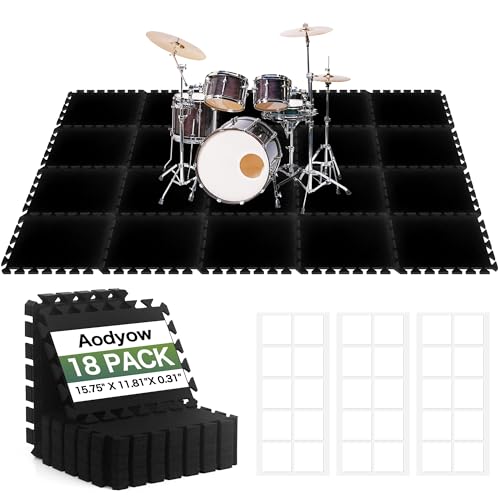
- 18 modular felt floor panels
- Helps damp impacts and instrument vibration
- Cuttable, removable, and stackable
Best For: Drum, piano, and equipment isolation on hard floors
Compact Echo Control
Focusound 1-Inch Acoustic Foam Panels

- 50 wedge panels target echo, reverb, and flutter echoes.
- Includes 300 pieces of double-sided adhesive.
- Suitable for studios, vocal booths, offices, and control rooms.
Best For: Wall-mounted spot treatment in compact recording spaces
Floor Vibration Control
TroyStudio Interlocking Felt Mats

- Dense felt absorbs sound and dampens instrument vibrations.
- Interlocking 11-by-11-inch tiles create a stable floor surface.
- Includes removable tape and can be cut for custom layouts.
Best For: Under-instrument and equipment floor treatment
Deep Pyramid Treatment
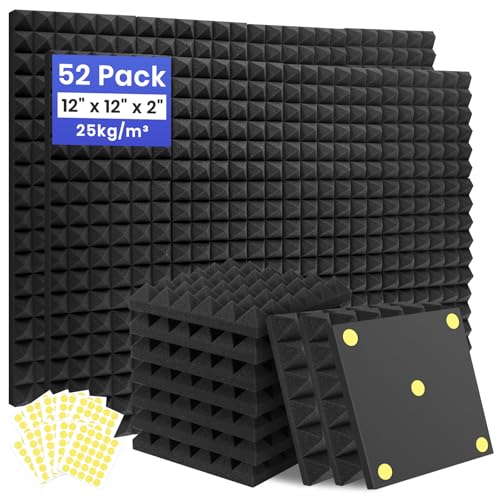
- 52 two-inch pyramid panels target noise, echo, and reverberation.
- Includes 300 adhesive dots for simple installation.
- Lightweight, cuttable, non-toxic, and flame-retardant.
Best For: Thicker wall treatment in recording and game rooms
Heavy-Duty Barrier – Trademark 1 lb Mass Loaded Vinyl
For home studios that need to limit sound transfer through walls, floors, or ceilings, this 1 lb mass loaded vinyl provides a dense, flexible sound barrier. The 1/8-inch material covers 100 square feet and is designed to add mass without taking up much space.
Best For: Large studio walls, ceilings, floors, apartments, and other projects requiring broad MLV coverage.
Pros:
- Provides a stated 27 STC rating and 1 pound-per-square-foot density.
- Covers 100 square feet in one roll.
- Made from virgin, non-toxic, odorless material.
- Includes installation instructions and works for walls, floors, and ceilings.
Cons:
- At 100 pounds, the roll may be difficult for one person to handle.
- It is a sound barrier rather than a decorative finished surface, so it typically needs to be concealed.
This is a practical choice when coverage and added mass matter more than portability. Its large format suits substantial construction projects, but plan the installation carefully because of the considerable weight.
Flexible Floor Treatment – Interlocking Felt Sound Mats
These interlocking felt mats offer a convenient way to address floor noise and vibration in a home studio. The 20-piece puzzle set covers up to 17 square feet, while the high-density felt cushions hard floors and helps reduce reverb and echo from foot traffic.
Best For: Drum areas, piano spaces, practice rooms, and studios needing portable floor cushioning and vibration dampening.
Pros:
- Interlocking design assembles and disassembles quickly.
- High-density felt provides cushioning and sound absorption.
- Non-slip construction helps protect hardwood floors from scratches and impacts.
- Additional sets can be combined for larger coverage.
Cons:
- The 20-piece set covers a maximum of about 17 square feet.
- Floor mats primarily address impact noise and room reflections, not broad wall-to-wall sound isolation.
Choose this set when you want an easy-to-reconfigure floor solution rather than a permanent construction material. It is especially useful beneath instruments or in activity areas where floor protection and reduced impact noise are priorities.
Echo Control Pick – Professional Wedge Acoustic Foam
For home studios focused on recording and monitoring clarity, these 2-inch wedge foam panels help absorb reflected sound, standing waves, and flutter echoes. Each four-pack covers 4 square feet, making it suited to targeted acoustic treatment rather than full-room isolation.
Best For: Vocal booths, recording studios, home theaters, and listening positions that need targeted wall or ceiling treatment.
Pros:
- Two-inch open-cell polyurethane foam is designed for sound absorption.
- Wedge profile helps address standing waves and flutter echoes.
- Adhesive squares are included, with other installation options available.
- Class-A fire retardant rating is stated according to ASTM E 84.
Cons:
- Each pack covers only 4 square feet.
- Foam treatment improves room acoustics but is not a mass-based sound-isolation barrier.
- Additional adhesive or mounting hardware may be needed for some installations.
This is a focused treatment option for improving the sound inside a room. Its small coverage area makes it best for strategic placement around microphones, monitors, or reflective surfaces, with multiple packs needed for broader treatment.
Solo-Install Barrier – TroyStudio 1.1 lb MLV
This TroyStudio mass loaded vinyl sheet is a compact option for home studios that need added mass and vibration control without handling a full-size roll. The 1-by-8-foot sheet weighs 9 pounds, has a stated STC rating of 28, and can be cut for walls, ceilings, doors, floors, and equipment-related applications.
Best For: Smaller studio projects, doors, vocal booths, HVAC areas, and DIY installations where manageable sheet size matters.
Pros:
- 1.1 pounds per square foot of density and a stated STC rating of 28.
- Flexible 1/8-inch material can be cut with a utility knife.
- Nonwoven backing supports even application of construction adhesive.
- Waterproof, flame retardant, and suitable for indoor or outdoor use.
Cons:
- One sheet covers only 8 square feet.
- Seams and joints require careful sealing with acoustic caulk or barrier tape.
- Adhesive, nails, screws, or sealing materials are not included.
Compared with a large MLV roll, this sheet is easier to handle and better suited to targeted upgrades. It can be a good fit for DIY studio work, provided you budget for proper fastening and airtight seam treatment.
Best for Wall Echo Control – JBER Acoustic Foam Panels
For home studios that need a lightweight wall treatment, these JBER wedge panels are a practical option among soundproofing mats for home studios. Their porous polyurethane construction is designed to absorb echoes and reverberation, helping recordings and playback sound clearer.
Best For: Home recording spaces, gaming rooms, bedrooms, offices, and home theaters where wall-mounted acoustic treatment is needed.
Pros:
- 12 one-foot square panels cover 12 square feet.
- 30kg/m³ polyurethane foam is designed to reduce echoes and reverberation.
- Wedge geometry and an NRC greater than 0.8 support sound absorption.
- Lightweight panels can be attached with glue, double-sided tape, or nails.
Cons:
- At 1 inch thick, these panels are intended primarily for acoustic treatment rather than complete room soundproofing.
- Adhesive and mounting hardware are not included with the non-adhesive model.
- The 12-square-foot coverage may require multiple packs for larger rooms.
This set makes sense when your main priority is controlling reflections on walls or ceilings without a complicated installation. Plan the layout carefully and use additional treatment if you need broader room coverage.
Best for Instrument Vibration Control – Aodyow Interlocking Floor Mats
These interlocking felt mats are a floor-focused choice among soundproofing mats for home studios. The dense, 0.3-inch panels help absorb impacts and vibrations from drums, pianos, pedals, and studio equipment while also creating a non-slip surface.
Best For: Drum kits, pianos, speakers, treadmills, home gyms, and studio setups placed on hardwood or other hard floors.
Pros:
- 18 panels provide a customizable interlocking floor surface.
- High-density 150kg/m³ felt is designed for sound absorption and vibration damping.
- Non-slip construction helps keep drum kits and pedals in place.
- Panels can be cut with a utility knife, stacked, and removed for storage.
Cons:
- At 0.3 inches thick, the mats may offer less cushioning than thicker floor systems.
- They are floor pads, so they do not address wall or ceiling reflections.
- Adhesive strips are supplied, but a permanent installation may require additional securing.
This set is particularly useful when foot impact and instrument vibration are the main concerns. Its modular design also makes it easier to create a dedicated area without permanently covering the entire floor.
Best for High-Density Wall Treatment – BXI Acoustic Panels
For creators seeking dense, tackable wall or ceiling treatment, the BXI panels are a strong contender among soundproofing mats for home studios. Their polyester-fiber construction is designed to absorb mid-to-high-frequency reflections, reducing echo and reverb in recording and listening spaces.
Best For: Home studios, vocal booths, podcast rooms, gaming rooms, offices, and home theaters requiring compact wall or ceiling panels.
Pros:
- High-density 200kg/m³ polyester fiber supports sound absorption.
- Six panels cover approximately 7.7 square feet and have a listed NRC of 0.95.
- Panels can be cut and mounted with construction adhesive or 3M VHB tape.
- Odorless, non-toxic, formaldehyde-free, and Class B1 flame-retardant construction.
Cons:
- The six-panel pack covers less area than some larger sets.
- Mounting adhesive or tape is sold separately.
- These 0.4-inch panels primarily treat reflections and are not a substitute for structural soundproofing.
Choose the BXI set when you value high density, a clean matte-black appearance, and flexible cutting for targeted treatment. Its limited coverage makes it best suited to first-reflection points or smaller recording areas.
Compact Echo Control – Focusound 1-Inch Acoustic Foam Panels
For shoppers comparing soundproofing mats for home studios, these 1-inch wedge foam panels are a lightweight option for treating wall reflections. The 50-pack is designed to reduce unwanted echoes, reverb, and flutter echoes in recording and office spaces.
Best For: Spot-treating walls in home offices, recording studios, vocal booths, and control rooms.
Pros:
- Triangular-groove surface helps absorb echoes, waves, and reverb.
- Includes 300 pieces of double-sided adhesive for installation.
- Fire-resistant, air-permeable, and made with non-toxic materials.
- Panels can recover their shape within 24 to 48 hours after treatment if needed.
Cons:
- At 1 inch thick, these panels are intended for spot treatment rather than substantial room isolation.
- Adhesive installation may require careful placement to protect walls.
This set makes sense when you want broad wall coverage and straightforward installation for echo control. It is better suited to improving room acoustics than blocking sound from entering or leaving the studio.
Floor Vibration Control – TroyStudio Interlocking Felt Mats
Among soundproofing mats for home studios, these interlocking felt tiles are designed for floor-based sound absorption and vibration dampening. Their dense polyester construction can help reduce reverb while adding a non-slip, protective layer beneath instruments and equipment.
Best For: Use beneath drums, pianos, speakers, treadmills, chairs, or other equipment on hardwood and studio floors.
Pros:
- High-density felt is rated with an NRC of 0.87 and an average absorption coefficient of 0.78.
- Interlocking edges create a flat, wrinkle-free surface.
- Thickened 0.4-inch construction provides vibration dampening, impact resistance, and floor protection.
- Includes removable double-sided tape and can be cut with a knife.
Cons:
- The 11-by-11-inch panels cover less area individually than larger floor mats.
- These are floor tiles, so they do not provide wall or ceiling acoustic treatment.
Choose this set when floor vibration and equipment placement are the main concerns. The interlocking design supports flexible layouts, while the cuttable felt lets you adapt coverage around instruments or furniture.
Deep Pyramid Treatment – Focusound 2-Inch Foam Panels
For home studios needing thicker wall treatment, this 52-pack of 2-inch pyramid foam panels offers a larger profile than standard 1-inch tiles. The 3D surface is designed to increase contact with sound waves and reduce noise, echo, and reverberation.
Best For: Recording studios, vocal rooms, control rooms, game rooms, bedrooms, and other spaces requiring wall-mounted acoustic treatment.
Pros:
- 2-inch pyramid design provides a substantial sound-absorbing surface for wall treatment.
- 52 panels offer broad coverage for studio or room applications.
- Includes 300 double-sided adhesive dots for tool-free installation.
- Lightweight, cuttable, non-toxic, odorless, and flame-retardant.
Cons:
- Vacuum-packed panels may need 24 to 48 hours to regain their full shape.
- Adhesive dots may not suit every wall surface or installation preference.
- These panels address acoustic reflections rather than fully isolating a room from outside noise.
This is the strongest wall-treatment choice of the three for shoppers who prefer thicker foam and a pronounced 3D profile. It is a practical fit for reducing reflections in a dedicated recording or gaming space, provided the panels are allowed to recover before installation.
How We Picked These Soundproofing Mats for Home Studios
We selected products across the main categories used in home-studio treatment: mass-loaded vinyl for adding sound-blocking mass, interlocking floor mats for reducing equipment vibration, and acoustic foam for controlling echo and reverberation. We also considered coverage, thickness, material density, pack size, installation flexibility, and suitability for common studio equipment.
Because “soundproofing” and “sound absorption” solve different problems, the list includes both isolation materials and room-treatment products. Foam panels can improve clarity inside a room, but they generally do not stop loud sound from passing through walls. Mass-loaded vinyl is more appropriate when the priority is transmission loss, while dense floor mats are useful beneath speakers, drum kits, stands, and other vibration-producing equipment.
Quick Comparison
| Material | Best use | Installation | Coverage priority |
|---|---|---|---|
| Mass-loaded vinyl | Wall, ceiling, or layered barrier construction | More involved; typically installed behind finishes | Large surfaces and sound isolation |
| Interlocking felt or rubber-style mats | Floor vibration and equipment protection | Fast, removable placement | Under gear or across practice areas |
| Acoustic foam | Echo and reverberation control | Adhesive or removable mounting | Reflection points and wall coverage |
Key Buying Factors for Soundproofing Mats for Home Studios
Sound Isolation Versus Sound Absorption
Choose mass-loaded vinyl or another dense barrier when you need to limit sound passing through a wall, door, ceiling, or partition. Choose foam or felt when you mainly need to reduce reflections within the room. Many studios benefit from combining both approaches rather than expecting one product to do everything.
Thickness, Density, and Coverage
Heavier barriers usually provide more useful isolation than lightweight materials, but they are harder to handle and may require secure support. For floor mats, prioritize enough thickness and density to separate equipment from the floor. Measure the treatment area before buying: small packs may work for a workstation, while drums or multiple monitors need broader coverage.
Placement and Installation
Floor mats should sit flat without sliding, curling, or interfering with stands and pedals. Foam panels work best at early-reflection points, including side walls and sometimes the ceiling. Mass-loaded vinyl is most effective when installed continuously with carefully treated seams; simply hanging a small piece on a wall may provide limited benefit.
Room Safety and Appearance
Check the manufacturer’s mounting guidance, fire-rating information, odor, and cleaning requirements. Avoid blocking vents, outlets, doors, or access to cables. In a rental, removable interlocking mats and temporary panel mounts may be more practical than permanent construction.
Who Should Buy Which Soundproofing Mats for Home Studios?
- For wall or ceiling isolation: Choose a mass-loaded vinyl product, especially when planning a layered wall, ceiling, or partition assembly.
- For drums, pedals, monitors, or stands: Choose thick interlocking floor mats to reduce vibration and protect the underlying floor.
- For vocals, podcasts, and music mixing: Choose acoustic foam to reduce flutter echo and harsh reflections, while keeping expectations realistic about outside noise.
- For a more complete studio setup: Combine a dense floor layer with strategically placed acoustic panels and, where construction allows, a properly installed barrier material.