If you edit 4K or 8K footage, your storage can make or break the workflow. The right enclosure keeps transfers fast, timelines responsive, and cache files moving without bottlenecks.
Below, we focus on ssd enclosures for video editing that prioritize sustained performance, thermal control, and modern connectivity for real editing use.
Best 10 SSD Enclosures for Video Editing Picks for 2026
Pro-Level 40Gbps Cooling Enclosure
ACASIS TBU405 Pro 40Gbps NVMe Enclosure

- 40Gbps USB4 / Thunderbolt-class performance
- Built-in fan helps reduce thermal throttling
- Supports 2280/2260/2242/2230 NVMe drives
Best For: Creators who need fast, portable storage with active cooling
Desktop-Class 80Gbps Speed
Satechi DotDisk 80Gbps NVMe Enclosure

- Up to 80Gbps USB4 V2 performance
- Active cooling for long transfers and backups
- Supports 2280 NVMe SSDs up to 8TB
Best For: Desktop editors planning for very large files and sustained speed
Magnetic Mobile Recording Enclosure
ACASIS EC1401 Magnetic 10Gbps NVMe Enclosure

- Supports 4K@60 ProRes recording on compatible iPhones
- Magnetic attachment for mobile workflows
- Built-in fan and aluminum body help with cooling
Best For: iPhone videographers and mobile editors recording ProRes to SSD
Editor’s Choice
OWC Express 1M2 40Gb/s Portable NVMe SSD

- Up to 3836MB/s real-world performance
- USB4, Thunderbolt, and USB-C compatibility
- Patented heat-dissipating portable design
Best For: Portable editors who need fast, reliable transfers
Multi-Drive Pick
ORICO 40Gbps All-Flash M.2 Dock

- USB 4.0 with up to 40Gbps bandwidth
- Supports four NVMe SSDs and up to 32TB total
- Built-in fan and vents for cooling
Best For: Large-capacity 4K/8K editing and fast imports
Performance Pick
MOKiN 80Gbps M.2 NVMe SSD Enclosure

- Up to 80Gbps with Thunderbolt 5
- LCD shows temperature and fan speed
- Active cooling for sustained transfers
Best For: Thunderbolt 5 users with heavy media workloads
Speed-first portable choice
UGREEN 40Gbps M.2 NVMe Enclosure
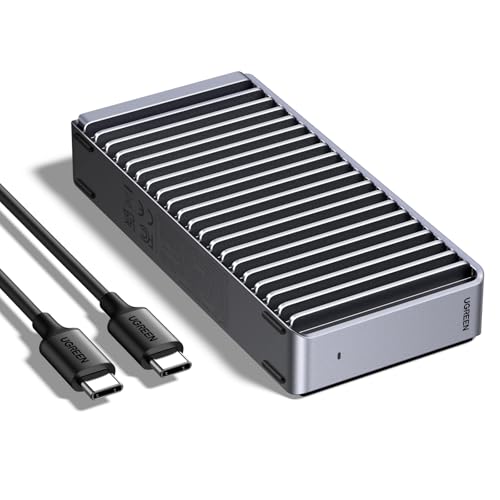
- Up to 3600MB/s with compatible Thunderbolt 4 gear
- Fanless aluminum cooling with double-sided fins
- Supports NVMe drives up to 8TB
Best For: Fast, compact storage for mobile video editing
Quiet pro workflow pick
ACASIS 40Gbps M.2 NVMe SSD Enclosure

- Fanless dual-fins cooling for silent use
- Up to 2700MB/s real-world performance
- Supports Thunderbolt 5/4/3, USB4, and up to 8TB
Best For: Quiet 4K editing and large-file backup workflows
Tool-free desktop-style pick
Yottamaster 40Gbps NVMe SSD Enclosure

- Tool-free installation with transparent cover
- ASM2464PD controller for stable 40Gbps transfers
- Supports NVMe drives up to 8TB
Best For: Quick-swap editing setups with steady high-speed transfers
Pro-Level 40Gbps Cooling Enclosure – ACASIS TBU405 Pro 40Gbps NVMe Enclosure
If you’re shopping for ssd enclosures for video editing, this ACASIS model is built for creators who move large files and want to avoid slowdowns. Its 40Gbps USB4/Thunderbolt-class design, built-in fan, and aluminum body are aimed at keeping a fast NVMe drive stable during heavy transfers and editing sessions.
Best For: Editors and power users who want a portable, high-speed enclosure with active cooling for sustained workloads.
Pros:
- 40Gbps USB4 enclosure with Intel JHL7440 chipset and Thunderbolt 4/3 compatibility
- Built-in cooling fan and heat-dissipation design to help prevent thermal throttling
- Supports M.2 NVMe sizes 2280/2260/2242/2230 for broad drive flexibility
- Tested speeds up to 2805/2734 MB/s with a Samsung 980 Pro on MacBook
Cons:
- Fan must be switched on manually
- SSD is not included
- Best performance depends on a compatible high-speed host and drive
For editing work that pushes storage hard, this enclosure stands out for its cooling-first approach and strong cross-platform support. It’s a practical pick when sustained speed matters more than just peak burst numbers.
Desktop-Class 80Gbps Speed – Satechi DotDisk 80Gbps NVMe Enclosure
Among ssd enclosures for video editing, the Satechi DotDisk is tuned for people handling large media libraries, 8K assets, and long transfer sessions. Its 80Gbps USB4 V2 rating, active cooling, and aluminum housing make it a strong fit for desktop-focused creative workflows.
Best For: Editors who want next-generation enclosure speed and a compact desk-first design.
Pros:
- Up to 80Gbps USB4 V2 performance for demanding large-file workflows
- Active thermal cooling helps maintain speed during extended transfers and backups
- Precision-milled aluminum housing supports durability and heat dissipation
- Supports 2280 NVMe SSDs up to 8TB and includes cable, screwdriver, screws, and thermal pad
Cons:
- SSD is not included
- Designed as a desk-first enclosure rather than a tiny pocket unit
- Real-world speed depends on the host device and SSD used
If your editing setup lives at a desk and you want headroom for bigger projects, this enclosure is the most future-facing option here. It’s especially appealing when sustained throughput and cooling are both priorities.
Tool-Free Creator Speed – SABRENT EC-U4TN USB4 NVMe Enclosure
If you want ssd enclosures for video editing that are fast without being fussy, this SABRENT model hits a useful balance. It supports USB4 and Thunderbolt 3/4 hosts, offers tool-free NVMe installation, and adds active cooling to help keep transfer speeds stable during large media moves.
Best For: Editors and mobile creators who want quick setup, wide compatibility, and strong portable performance.
Pros:
- Up to 3,900 MB/s over USB4 and 2,700 MB/s over Thunderbolt 3/4
- Tool-free installation for 2230/2242/2260/2280 PCIe NVMe drives
- Integrated active cooling fan helps maintain performance during long transfers
- Works with Thunderbolt 3, Thunderbolt 4, USB4, and USB-C on Windows and macOS
Cons:
- Does not support SATA M.2 SSDs
- SSD is not included
- Highest speeds depend on a compatible host and PCIe Gen4 x4 drive
This is a strong practical choice if you want editing-ready storage without extra setup hassle. The tool-free design and broad port support make it easy to move between laptops and desktops.
Magnetic Mobile Recording Enclosure – ACASIS EC1401 Magnetic 10Gbps NVMe Enclosure
For creators looking at ssd enclosures for video editing on the move, this ACASIS model is tailored to mobile capture and quick offload workflows. It combines a magnetic design, 10Gbps transfer support, a cooling fan, and a 4K@60 HDMI output aimed at iPhone ProRes recording and portable content creation.
Best For: iPhone creators, videographers, and short-form editors who need magnetic mounting and ProRes recording support.
Pros:
- Supports 4K@60 ProRes recording to SSD with compatible iPhone 15/16/17 Pro and Pro Max models
- Magnetic attachment helps secure the enclosure during mobile use
- Built-in silent fan plus aluminum alloy and thermal pad for improved heat dissipation
- 10Gbps transfer support for photos, videos, and files
Cons:
- Not aimed at the very highest desktop-class transfer speeds
- SSD is not included
- May need external power for larger drives over 1TB or multiple-device setups
This enclosure is less about peak desktop throughput and more about mobile video capture convenience. If your workflow centers on iPhone recording and travel-friendly editing, it offers a very specific and useful feature set.
Editor’s Choice – OWC Express 1M2 40Gb/s Portable NVMe SSD
If you need one of the fastest SSD enclosures for video editing, the OWC Express 1M2 is built for demanding transfer jobs and on-the-go use. It supports USB4, Thunderbolt, and USB-C systems, and its patented heat-dissipating design is meant to keep NVMe drives running cool during sustained work.
Best For: Editors who want a fast, bus-powered enclosure for portable 4K/5K workflows and reliable day-to-day transfers.
Pros:
- Up to 3836MB/s real-world performance for very fast media transfers
- Compatible with USB4, Thunderbolt, and USB-C computers and devices
- Patented heat-dissipating design helps maintain consistent speed
- Supports multiple NVMe M.2 sizes: 2280, 2242, and 2230
Cons:
- Single-drive enclosure, so it is not a multi-bay editing dock
- Best performance depends on a matching high-speed host connection
The OWC Express 1M2 is a strong fit when speed, portability, and thermal stability matter more than expansion features. For editors who move projects between systems, it offers a practical blend of performance and convenience.
Multi-Drive Pick – ORICO 40Gbps All-Flash M.2 Dock
The ORICO 40Gbps SSD enclosure is aimed at heavier media workflows, especially when video editing projects involve multiple drives and large transfers. Its USB 4.0 interface, all-solid-state design, and built-in cooling are meant to support sustained performance while keeping the unit compact and quiet.
Best For: Teams or creators who need high-capacity, multi-drive storage for 4K/8K video editing and fast project imports.
Pros:
- Supports up to 40Gbps bandwidth over USB 4.0
- Holds up to four NVMe SSDs for as much as 32TB total capacity
- Compact, shock-resistant design with no moving parts
- All-aluminum housing, fan, and vents help with thermal dissipation
Cons:
- SSDs are not included
- Single-drive speeds and real-world results depend on the connected system
- Fan noise is present, though noted to stay below 30dB
If you want an enclosure that is more like a compact storage cabinet than a simple adapter, this ORICO model stands out. It makes the most sense for editors handling large libraries, repeated imports, or shared workspace storage.
Performance Pick – MOKiN 80Gbps M.2 NVMe SSD Enclosure
For video editors looking at the cutting edge of SSD enclosures for video editing, the MOKiN 80Gbps model is built around high-bandwidth transfers and active thermal monitoring. It pairs a Thunderbolt 5 cable with an LCD display that shows temperature and fan status, which is useful when pushing large backups or intensive media jobs.
Best For: Editors with Thunderbolt 5 systems who want top-end transfer speed and visible thermal control.
Pros:
- Up to 80Gbps support with PCIe Gen5 SSDs on Thunderbolt 5
- LCD display shows temperature and fan speed in real time
- Active cooling fan helps prevent thermal throttling during long transfers
- Supports NVMe M.2 drives up to 8TB and multiple form factors
Cons:
- 80Gbps requires a Thunderbolt 5 port and cable
- Does not support SATA M.2 SSDs
- Actual speed varies by SSD and connected device
This enclosure makes the most sense for users who already have the host hardware to take advantage of its top speed. If you work with very large media files and want active status feedback, it is one of the more advanced options here.
Speed-first portable choice – UGREEN 40Gbps M.2 NVMe Enclosure
If you want one of the faster SSD enclosures for video editing, this UGREEN model is built around a 40Gbps USB4/Thunderbolt design and can reach up to 3600MB/s with the right Thunderbolt 4 cable and device. That makes it a strong fit for moving large footage libraries, proxies, and project files without waiting around.
Best For: Editors who need a compact, high-speed NVMe enclosure for fast transfers and portable workflows.
Pros:
- Up to 3600MB/s with Thunderbolt 4 gear for very fast file movement.
- Double-sided fin cooling is designed for quiet, fanless operation.
- Supports 2230/2242/2260/2280 NVMe drives and up to 8TB.
- Compact aluminum build is easy to carry for travel edits.
Cons:
- Does not support SATA NGFF or mSATA drives.
- Peak speed requires compatible Thunderbolt 4 cables and devices.
- Some thicker SSDs may need thinner thermal pads to fit properly.
Overall, this is a practical pick if your editing setup can take advantage of USB4 or Thunderbolt 4 speeds and you value silent cooling in a small enclosure.
Quiet pro workflow pick – ACASIS 40Gbps M.2 NVMe SSD Enclosure
For SSD enclosures for video editing, this ACASIS model stands out if you want strong transfer speed with a fanless design. It uses dual-sided aluminum fins for passive cooling and is rated for Thunderbolt 5/4/3 and USB4, with real-world speeds up to about 2700MB/s and tested results around 2805/2734MB/s on a Samsung 980 Pro.
Best For: Editors who want a quiet, portable enclosure for large-file transfers, 4K editing, and backups.
Pros:
- Fanless aluminum cooling keeps operation silent.
- Up to 2700MB/s real-world performance, with tested results above 2800MB/s in some setups.
- Works with Thunderbolt 5/4/3 and USB4 for broad high-speed compatibility.
- Supports up to 8TB NVMe SSDs and can be used as a bootable external drive.
Cons:
- Best speeds depend on the host device, cable, and SSD used.
- Not as fast on paper as some top-end 40Gbps enclosures under ideal conditions.
This is a solid choice if your priority is quiet, dependable performance rather than chasing the absolute highest benchmark number.
Tool-free desktop-style pick – Yottamaster 40Gbps NVMe SSD Enclosure
If you’re comparing SSD enclosures for video editing, the Yottamaster is aimed at users who want quick setup plus steady high-speed performance. It supports Thunderbolt 4 and USB4, uses the ASM2464PD controller, and is described as capable of sustained read/write speeds in the 2800 to 3200MB/s range under the right conditions.
Best For: Editors who want tool-free installation, visible status indicators, and reliable 40Gbps performance.
Pros:
- Tool-free installation makes SSD swaps fast and simple.
- ASM2464PD controller is built for stable transfers and protection features.
- Transparent design lets you see the LED and fan status easily.
- Supports 2230/2242/2260/2280 NVMe drives up to 8TB.
Cons:
- Actual speed depends on SSD, host system, and cable quality.
- Active cooling means it is not fanless.
For editors who want a straightforward enclosure that balances speed, convenience, and visibility, this Yottamaster model is an easy-to-use option.
How We Picked These SSD Enclosures for Video Editing
We prioritized enclosures built for sustained throughput, not just headline speeds. That means support for high-bandwidth interfaces like USB4 and 40Gbps/80Gbps connections, plus designs that help maintain performance under long transfers and heavy cache writes.
We also considered thermal design, tool-free access, SSD format compatibility, and whether the enclosure makes sense as a portable scratch disk or a semi-permanent editing drive.
Quick Comparison
For the fastest workflows, 80Gbps models are the most future-facing, while 40Gbps enclosures offer the best mix of speed and broad compatibility. 10Gbps options are still useful for lighter editing, proxy workflows, or field recording setups where simplicity matters more than peak bandwidth.
If you need the most reliable all-around option, look for a 40Gbps enclosure with strong cooling and USB4/Thunderbolt support. If you want portability and fewer setup hassles, magnetic or tool-free designs can be especially convenient on location.
Key Buying Factors for SSD Enclosures for Video Editing
Interface Speed
Your enclosure is only as fast as its connection. For modern editing, USB4 and 40Gbps are the sweet spot, while 80Gbps models can better support next-generation workflows and very fast NVMe drives.
Thermal Management
Video editing often means long sustained writes, which generate heat. Look for aluminum bodies, heatsinks, fins, or active cooling if you plan to move large camera originals, generate proxies, or work directly from the drive.
Drive Support
Make sure the enclosure supports the SSD type you already own, whether that is M.2 NVMe in a common 2280 size or a broader range of lengths. Some models are better suited to high-capacity drives and newer PCIe Gen5 SSDs.
Workflow Fit
Some SSD Enclosures for Video Editing are better as portable media drives, while others are designed for desktop-like dock use. If you constantly swap drives, tool-free access saves time. If you travel a lot, compact and durable builds are more practical.
Who Should Buy Which SSD Enclosures for Video Editing?
Choose 80Gbps models if you want maximum headroom for future hardware and the fastest possible transfers.
Choose 40Gbps USB4 enclosures if you want the best overall balance of price, speed, and compatibility for most editors.
Choose 10Gbps enclosures if you mainly need a simple portable drive for lighter projects, backups, or on-set media handling.
Choose cooled or finned designs if you expect long exports, heavy file transfers, or editing directly from the drive for extended sessions.