The right stage monitor helps every musician hear the details needed to stay in time, pitch, and control during a live set. This roundup covers conventional floor wedges and wireless in-ear systems for rehearsals, clubs, churches, and larger stages.
We compare practical differences such as power, speaker size, portability, connectivity, feedback control, and monitoring style so you can choose a setup that fits your band and venue.
Best 10 Stage Monitors for Bands Picks for 2026
Classic Passive Choice
Yamaha BR12M 12-inch Floor Monitor

- 12-inch woofer with titanium compression driver
- 300W program and 600W peak handling
- Pole socket, handles, and protection circuitry
Best For: Bands using an external amplifier for reliable passive stage monitoring
Compact Powered Flexibility
Alto TX408 8-inch Powered Monitor

- 350W bi-amplified powered speaker
- Two-channel mixer with Bluetooth input
- Wedge design, handles, and pole socket
Best For: Small gigs and rehearsals needing a portable all-in-one monitor
Wireless In-Ear System
Phenyx Pro PTM-33-4B Monitor System

- Four-channel UHF mono wireless monitoring
- Separate mixes for up to four performers
- Includes four receivers and in-ear earphones
Best For: Four-member bands seeking clutter-free wireless in-ear monitoring
High-Output Powered Wedge
Rockville RSM15A 15-inch Monitor

- 15-inch woofer with 350W RMS output
- Combo XLR/TRS input and three-band EQ
- Tilt-back design with feedback filter
Best For: Live bands needing a powerful active floor wedge with sound-shaping controls
Compact Powered Control

- 250-watt powered 12-inch monitor
- Adjustable feedback filter and limiter
- 23.6-pound cabinet with multiple inputs
Best For: Portable live band monitoring without a separate amplifier
High-Output Passive Wedge
Rockville RSM15P 15-inch Monitor

- 1400-watt peak passive monitor
- 15-inch woofer with titanium driver
- Rugged wedge cabinet and Speakon connections
Best For: High-output stages with an existing amplifier and PA system
Wireless Multi-Musician Monitoring
JM20505 2-Channel UHF In-Ear System

- Two channels with five bodypacks
- Over-300-foot stated reception range
- 80 preset UHF frequencies and dual antennas
Best For: Bands and ensembles needing wireless mono monitoring for multiple performers
High-Output Workhorse

- 300-watt active two-way monitor
- 12-inch woofer with 1-inch compression driver
- Built-in feedback filter and limiter
Best For: Live bands wanting a powerful corded floor monitor
Wireless IEM Flexibility
LEKATO MS-02 Wireless IEM System

- Under-4.5 ms mono latency
- Supports up to four receiver pairs
- Offers mono and stereo monitoring modes
Best For: Small and medium bands seeking cable-free in-ear monitoring
Rugged Stage Classic
Laney CXP-112 Active Stage Monitor
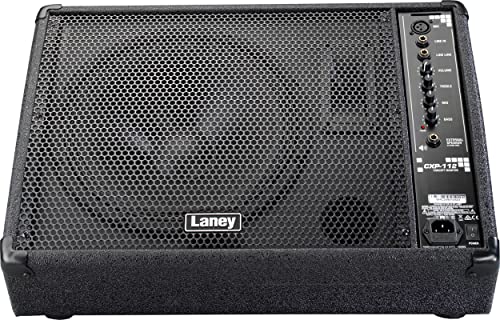
- 240-watt active monitor output
- 12-inch woofer plus horn
- Kick-proof steel grille and front port
Best For: Live performances needing a durable wired stage wedge
Classic Passive Choice – Yamaha BR12M 12-inch Floor Monitor
The Yamaha BR12M is a dependable passive option for bands seeking stage monitors for bands with punchy low end and clear high-frequency detail. Its 12-inch woofer, titanium compression driver, and 300-watt program handling suit live performance and sound-reinforcement setups, provided you already have a suitable amplifier.
Best For: Bands and venues needing a rugged passive wedge monitor for live performances, PA systems, or permanent sound-reinforcement installations.
Pros:
- 12-inch woofer and 1-inch titanium compression driver deliver balanced monitoring.
- 90° x 40° horn helps provide focused coverage.
- Built-in pole socket allows stand mounting as well as floor use.
- Steel handles, corner protectors, and protection circuitry support regular gigging.
Cons:
- Requires an external amplifier and speaker cables.
- Wired, mono operation offers no wireless or built-in mixing features.
- Its larger cabinet may be less convenient for especially compact stages.
The BR12M makes sense when you want a straightforward, high-sensitivity passive monitor that can integrate with an existing mixer-and-amplifier system. It is less suitable for buyers looking for an all-in-one powered speaker.
Compact Powered Flexibility – Alto TX408 8-inch Powered Monitor
The Alto TX408 is a compact powered speaker for bands that need stage monitors for bands without adding a separate amplifier. Its 350-watt bi-amplified design, built-in mixer, Bluetooth, and wedge-monitor configuration make it practical for small gigs, rehearsals, and other intimate performance spaces.
Best For: Small bands, DJs, presenters, and home-studio users who want a portable powered monitor with flexible wired and Bluetooth inputs.
Pros:
- 350 watts of bi-amplified Class-D power in a compact enclosure.
- Built-in two-channel mixer accepts microphone, line-level, and Bluetooth sources.
- Bluetooth and True Wireless Stereo support add convenient playback options.
- Integrated pole socket, handles, and metal grille make setup and transport easier.
Cons:
- Its 8-inch woofer may provide less low-end weight than larger monitors.
- Bluetooth is not a substitute for a dedicated wired monitor mix in every live setup.
- It is not water resistant.
The TX408 is a strong convenience-focused choice when portability and built-in connectivity matter more than maximum bass output. Its compact format is especially appealing for smaller stages and quick setups.
Wireless In-Ear System – Phenyx Pro PTM-33-4B Monitor System
The Phenyx Pro PTM-33-4B takes a different approach to stage monitors for bands by sending mono monitor mixes to four wireless in-ear receivers. Its integrated transmitter accepts four left/right input groups and loop outputs, letting a four-member band use separate mixes while reducing stage clutter and ambient sound.
Best For: Four-member bands, worship teams, stage musicians, and sound engineers who want wireless mono in-ear monitoring with individual mix flexibility.
Pros:
- Four independent wireless monitoring channels can support a four-member band.
- UHF transmission provides a stated 140-164-foot line-of-sight range.
- IR syncing simplifies linking receivers, while loop outputs support signal routing.
- Package includes four bodypacks, four in-ear earphones, antennas, and rackmount hardware.
Cons:
- Provides mono in-ear monitoring rather than stereo monitoring.
- Requires four auxiliary mixer outputs for its intended four-channel setup.
- Wireless range can be affected by thick walls, glass, and metal obstructions.
For performers who prefer personal wireless monitoring over wedge speakers, the PTM-33-4B offers a purpose-built four-channel solution. Confirm that your mixer has enough auxiliary outputs and that mono monitoring fits your needs before choosing it.
High-Output Powered Wedge – Rockville RSM15A 15-inch Monitor
The Rockville RSM15A is a large powered floor wedge for bands that need stage monitors for bands with substantial output and low-frequency presence. It combines a 15-inch woofer, 1.75-inch titanium driver, 350-watt RMS rating, and onboard sound-shaping controls in a tilt-back cabinet designed for live stages.
Best For: Bands, DJs, and live-event operators who need a high-output active floor monitor with direct mixer, microphone, or instrument connectivity.
Pros:
- 15-inch woofer and 1.75-inch titanium driver provide powerful, full-range monitoring.
- Combo XLR/TRS input supports mixers, microphones, and instruments.
- Three-band EQ and adjustable 300Hz-5kHz feedback filter enable sound shaping.
- Tilt-back wedge design, handles, and steel grille support stage use and transport.
Cons:
- At 61.2 pounds, it is considerably less portable than compact monitors.
- Its large cabinet may be excessive for small stages or low-volume setups.
- The supplied notes list no warranty.
The RSM15A is a practical choice when output, bass response, and built-in controls take priority over lightweight portability. Its active design avoids a separate amplifier, but plan for the cabinet’s substantial size and weight.
Compact Powered Control – Behringer EUROLIVE F1220D
For bands seeking practical stage monitors for bands, the Behringer EUROLIVE F1220D is a powered 12-inch monitor with built-in amplification, feedback filtering, and limiter protection. Its 250-watt output and relatively light 23.6-pound design suit performers who want a straightforward, portable floor-monitor setup.
Best For: Bands needing a compact powered monitor for live performances and music playback.
Pros:
- Built-in 250-watt Class-D amplification eliminates the need for a separate power amplifier.
- Adjustable feedback filter and integrated limiter help manage system control and speaker protection.
- 12-inch woofer, 3-inch tweeter, and wide frequency bandwidth support full-range monitoring.
- Offers XLR, 1/4-inch, RCA, and Speakon connectivity.
Cons:
- It is corded and not waterproof or water resistant.
- Its 8-ohm specification and mono output mode may not suit every system configuration.
The F1220D is a sensible all-in-one choice when portability and built-in control matter more than maximum output. The feedback filter and limiter are particularly useful features for live band setups.
High-Output Passive Wedge – Rockville RSM15P 15-inch Monitor
The Rockville RSM15P is a passive 15-inch floor monitor built for high-output stage use. For bands comparing stage monitors for bands, its 1400-watt peak rating, angled wedge cabinet, wide-dispersion horn, and professional speaker connections make it a strong option when an external amplifier is already part of the setup.
Best For: Touring bands, DJs, and PA systems that need a rugged passive floor monitor with substantial output.
Pros:
- 15-inch woofer and 1.75-inch titanium compression driver provide high-power two-way performance.
- Horn design offers 70-by-50-degree coverage for broad stage dispersion.
- Rugged MDF cabinet, steel grille, and carpet finish are suited to road use.
- Dual 1/4-inch and Speakon input/output connectors support amplifier and mixer integration.
Cons:
- As a passive speaker, it requires a separate amplifier.
- At 54.9 pounds, it is considerably heavier than compact powered monitors.
- The supplied details list no warranty.
The RSM15P prioritizes output, coverage, and physical durability. Choose it when your band already has suitable amplification and wants a larger wedge for demanding live stages.
Wireless Multi-Musician Monitoring – JM20505 2-Channel UHF In-Ear System
This JM20505 wireless in-ear monitor system offers two channels and five bodypacks, giving bands a way to provide personal monitoring without placing multiple floor speakers across the stage. Its UHF operation, 80 preset frequencies, dual antennas, and stated range of over 300 feet support flexible movement during performances.
Best For: Bands, churches, schools, and stage groups needing wireless in-ear monitoring for multiple musicians.
Pros:
- Includes two-channel transmission and five bodypack receivers.
- 80 preset frequencies and UHF coverage from 572 to 603.5 MHz support setup flexibility.
- Dual-antenna receiver and digital signal processing are designed to improve reception and reduce blind angles.
- Bodypacks include low-battery reminders, LCD indicators, and volume control.
Cons:
- The system uses mono sound rather than stereo monitoring.
- Bodypacks require two AA batteries and list an average battery life of eight hours.
- It is designed for devices with a 6.35 mm audio input, which may require adaptation for other outputs.
For groups that want individual monitoring and freedom to move, this system is more scalable than adding another floor wedge. Its five receivers are useful for shared band or ensemble setups, while the mono format keeps the system focused on practical live monitoring.
High-Output Workhorse – Behringer EUROLIVE F1320D
For bands comparing stage monitors for bands, the Behringer EUROLIVE F1320D is a practical powered floor-monitor option. Its 300-watt Class-D amplifier, 12-inch woofer, 1-inch compression driver, built-in limiter, and feedback filter are designed for live and playback applications.
Best For: Bands needing a powerful, corded floor monitor with feedback control for live performance or playback.
Pros:
- 300-watt, two-way active monitor design
- 12-inch woofer and 1-inch compression driver
- Integrated feedback filter, limiter, and sound processor
- Relatively light 33.1-pound Class-D design
Cons:
- Not water resistant
- Requires corded electric power
- Frequency response is listed as starting at 80 Hz
The F1320D is a strong choice when output and built-in system protection matter more than wireless convenience. Its floor-standing format and feedback controls make it well suited to conventional stage-monitor setups.
Wireless IEM Flexibility – LEKATO MS-02 Wireless IEM System
The LEKATO MS-02 takes a different approach to stage monitors for bands by sending monitor audio wirelessly to beltpack receivers and earbuds. It offers mono or stereo modes, under-4.5 ms mono latency, auto-pairing, and support for one transmitter with up to four receiver pairs.
Best For: Small or medium bands, singers, and rehearsals that need cable-free in-ear monitoring.
Pros:
- Under-4.5 ms mono transmission latency
- One transmitter can support up to four receiver pairs
- Offers mono and stereo modes with 24-bit/48 kHz audio
- Up to 6–8 hours of operation and a stated 100-foot open-area range
Cons:
- Earbuds are not included
- Wireless range depends on an open area
- Requires charging for transmitter and receiver operation
The MS-02 is a flexible alternative to floor wedges when performers prefer personal in-ear monitoring. Remember to budget for compatible earbuds, since they are required to complete the setup.
Rugged Stage Classic – Laney CXP-112 Active Stage Monitor
For bands shopping for stage monitors for bands, the Laney CXP-112 provides a straightforward active wedge-style solution. It combines a 240-watt output with a 12-inch woofer and horn, a front-ported cabinet, and a kick-proof steel grille for live performances and stage productions.
Best For: Live bands and event setups needing a rugged, wired 12-inch active monitor.
Pros:
- 240-watt active stage-monitor output
- 12-inch woofer with horn
- Front-ported cabinet with kick-proof steel grille
- Jack and XLR connectivity
Cons:
- Not water resistant
- No wireless communication technology
- Listed as an 8-ohm monitor, which may require system matching
The CXP-112 favors durable, familiar stage-monitor construction over wireless features. Its wired jack and XLR connections make it a sensible fit for conventional live sound rigs where a robust monitor enclosure is useful.
How We Picked These Stage Monitors for Bands
We selected monitors across several common live-sound setups rather than treating one design as ideal for every band. The roundup includes powered wedges for simpler installations, passive monitors for systems with an external amplifier, and wireless in-ear monitor systems for performers who need consistent personal mixes and reduced stage volume.
Our comparisons focus on the specifications and features that affect real-world use: driver size, rated output, active or passive operation, feedback-management features, wireless channel capacity, bodypack count, portability, and setup complexity. A suitable monitor should match the rest of your PA rather than simply having the highest wattage or largest woofer.
Quick Comparison
| Monitor type | Best suited to | Main advantage | Potential trade-off |
|---|---|---|---|
| Powered floor wedge | Small and medium live setups | Built-in amplification simplifies wiring | Requires nearby AC power |
| Passive floor wedge | PA systems with amplifiers or powered mixers | Flexible system integration | Needs correctly matched amplification |
| Wireless IEM system | Bands seeking lower stage volume | Personal, isolated monitoring | Requires frequency, fit, and battery management |
Key Buying Factors for Stage Monitors for Bands
Powered or Passive Design
Powered monitors are usually the easiest choice for independent performers because the amplifier is built in. Confirm that the available inputs and outputs suit your mixer and that each position has safe access to power. Passive wedges can be a better fit when your band already owns an amplifier, powered mixer, or centralized rack.
Driver Size and Coverage
A 12-inch or 15-inch woofer generally provides more low-frequency body for vocals, keyboards, and instruments, while an 8-inch monitor can be easier to transport and sufficient for speech, vocals, or compact stages. Larger cabinets are not automatically clearer, so also consider horn design, crossover behavior, and placement.
Output, Headroom, and Feedback Control
Look for enough clean output to remain audible over the main PA and drums without running the monitor at its limit. Feedback filters, practical equalization, and careful wedge positioning can improve usable volume. Avoid aiming a monitor directly at an open microphone and use separate mixes when possible.
Wedges Versus Wireless In-Ear Monitoring
Floor wedges are quick to understand and let performers maintain some connection with the room. IEMs can reduce spill and stage volume, but require comfortable earpieces, reliable wireless operation, appropriate limiter settings, and a soundcheck that creates useful personal mixes. Check the number of transmitters, receivers, bodypacks, and simultaneous channels before buying.
Who Should Buy Which Stage Monitors for Bands?
Choose a compact powered wedge such as the ALTO TX408 when portability and straightforward setup matter most. A 12-inch active model is a practical all-purpose option for many vocalists and bands, while a 15-inch wedge makes more sense when fuller low-end monitoring is important and cabinet size is acceptable.
Choose a passive monitor such as the Rockville RSM15P when you already have compatible amplification and want to build around an existing PA. Active models such as the Yamaha, Behringer, Rockville powered, or Laney options are better for bands that want fewer separate components.
Choose a wireless IEM system when stage volume, feedback, or inconsistent wedge mixes are recurring problems. Multi-bodypack systems suit bands sharing a monitor mix; stereo or upgraded systems are better when performers need more control. Before purchasing, verify wireless regulations in your area, available frequencies, receiver compatibility, battery life, and whether the system provides enough channels for the entire group.