The right stage monitor helps performers hear vocals, instruments, and backing tracks without overpowering the audience mix. You do not need a premium wedge to improve a rehearsal space, church, DJ setup, or small venue.
We compared 10 budget-friendly powered and passive monitors, including compact personal speakers, traditional floor wedges, and higher-output PA models. Use the guide below to match speaker type, power, size, and connectivity to your setup.
Best 10 Stage Monitors Under 200 Picks for 2026
Compact Powered Choice

- 350W powered 8-inch speaker
- Built-in mixer and Bluetooth
- Wedge monitor and pole-socket mounting
Best For: Small live setups, DJs, studios, and presentations
High-Headroom Passive Pick
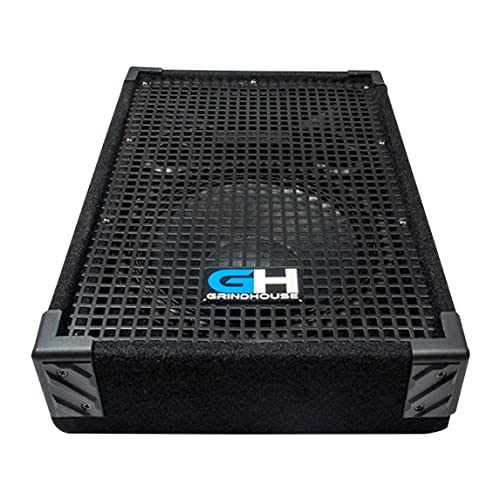
- 300W RMS, 600W peak handling
- 10-inch passive wedge monitor
- 8-ohm wired design
Best For: PA, DJ, karaoke, and live-sound systems with an amplifier
Personal Monitoring Option

- Compact 25W personal monitor
- 3-inch ceramic driver
- Stand/wall mount included
Best For: Personal monitoring and compact mounted installations
Tour-Ready Passive Wedge

- 10-inch, 150W RMS passive monitor
- Compression tweeter and 8-ohm load
- Parallel 1/4-inch jacks and recessed handle
Best For: Live sound, churches, bars, and portable PA systems
Best Value Wedge

- 10-inch two-way wedge monitor
- 150W RMS, 300W peak handling
- 1/4-inch and Speakon connections
Best For: Traditional wired PA monitoring
Best Heavy-Duty Monitor
multicomp PRO 10-Inch Floor Monitor

- Heavy-duty steel frame and grilles
- 110W RMS, 220W peak handling
- Recessed handles for carrying
Best For: Rugged live performance and DJ use
Best Compact Multimedia Monitor

- Compact 50W PA/monitor speaker
- USB MP3 playback and Bluetooth
- Three-channel mixer with three-band EQ
Best For: Small setups, presentations, and personal monitoring
Powerhouse Wedge
Rockville RSM15P 15-Inch Passive Monitor

- 1400-watt peak passive design
- 15-inch woofer with titanium driver
- Speakon and 1/4-inch connections
Best For: High-output DJ, band, and event monitoring
Best Heavy-Duty Pick
Gemini AS-2108P 8-Inch PA Monitor

- 300-watt powered monitor
- Only 11 pounds
- XLR, 1/4-inch, RCA, and AUX inputs
Best For: Portable rehearsal, church, and small-venue setups
Balanced Passive Value
Seismic Audio SA-10M.3 10-Inch Monitor

- 200-watt peak passive speaker
- 10-inch woofer and piezo horn
- Pole-mountable with dual 1/4-inch inputs
Best For: Small-to-medium PA, church, band, and DJ systems
Compact Powered Choice – Alto TX408
For shoppers comparing stage monitors under 200, the ALTO TX408 is a compact powered option with built-in amplification, Bluetooth, and a wedge-monitor design. Its 8-inch woofer, 350W Class-D amplification, and wide-dispersion horn suit smaller live setups, rehearsals, and presentations.
Best For: Small bands, DJs, home studios, presentations, and users who want an all-in-one powered monitor.
Pros:
- 350W bi-amplified output with an 8-inch LF driver and 1-inch titanium HF driver
- Built-in two-channel mixer with microphone, line-level, and Bluetooth inputs
- Bluetooth True Wireless Stereo, pole socket, ergonomic handles, and rugged metal grille
Cons:
- Requires corded power
- Not water resistant
- Designed for 100/120V power systems
The TX408 stands out when convenience matters: amplification, mixing, Bluetooth, and monitor positioning are integrated into one portable cabinet. It is a practical fit for intimate venues and small performances where a larger speaker would be excessive.
High-Headroom Passive Pick – Grindhouse GH10M
Among stage monitors under 200, the Grindhouse GH10M offers a straightforward passive wedge design with 300W RMS and 600W peak handling. Its 10-inch driver is suited to PA, DJ, live-sound, and karaoke systems that already include an amplifier.
Best For: PA operators, DJs, karaoke setups, and live performers who need a passive 10-inch floor monitor.
Pros:
- 300W RMS and 600W peak power ratings
- 10-inch monitor format with an approximately 20kHz frequency-response specification
- Floor-wedge enclosure with 8-ohm impedance and wired connections
Cons:
- Passive design requires a separate amplifier
- No wireless communication technology
- Not water resistant
The GH10M is a sensible choice for buyers building a traditional wired PA system. Its larger 10-inch format and substantial power handling provide useful headroom, provided your amplifier is matched to its 8-ohm passive load.
Personal Monitoring Option – Galaxy Audio NSPA Nano Spot
The Galaxy Audio NSPA takes a different approach to stage monitors under 200, using a compact 3-inch ceramic driver and 25W output for personal monitoring. Its included stand/wall-mount hardware makes it useful where a small, discreet monitor is more appropriate than a full-size floor wedge.
Best For: Personal monitoring, compact installations, restaurants, and spaces needing stand or wall mounting.
Pros:
- Compact 3-inch monitor with 25W output
- Stand/wall mount and rubber feet are included
- Includes a power supply and carries a three-year warranty
Cons:
- Lower output and smaller driver than conventional 8- or 10-inch stage monitors
- 150Hz–17kHz frequency-response specification limits low-end reach
- Requires corded power
The NSPA is best viewed as a near-field or personal monitor rather than a loud full-band wedge. Its small footprint and flexible mounting make it attractive for compact applications, but it is not the strongest choice when high stage volume is the priority.
Tour-Ready Passive Wedge – Sound Town METIS-10M
For stage monitors under 200, the Sound Town METIS-10M is a passive 10-inch floor monitor built for live sound, bars, churches, and portable PA systems. It combines 150W RMS/300W peak handling with a compression tweeter and parallel 1/4-inch jacks for straightforward system expansion.
Best For: Live performers, churches, bars, and portable PA users with a compatible amplifier.
Pros:
- 10-inch woofer and 1-inch compression tweeter
- 150W RMS and 300W peak handling at 8 ohms
- Parallel 1/4-inch jacks, metal grille and corners, carpet finish, and recessed side handle
Cons:
- Passive design requires a separate amplifier
- Not water resistant
- Less convenient than a powered monitor for quick plug-and-play setup
The METIS-10M is a practical wired wedge for users who already have amplification and want durable handling features. Its parallel inputs simplify daisy chaining, while the 10-inch woofer and compression driver provide a more conventional live-monitor format.
Best Value Wedge – Seismic Audio SA-10MTSingle
Seismic Audio - SA-10MTSingle - 10" Floor / Stage Monitor Wedge Style with Titanium Horn
Check Price On AmazonFor shoppers comparing stage monitors under 200, the Seismic Audio SA-10MTSingle offers a straightforward floor-wedge design with a 10-inch woofer, titanium compression horn, and 150 watts RMS power handling. Its 8-ohm impedance and wired 1/4-inch/Speakon connectivity suit conventional PA setups.
Best For: Vocalists, musicians, and small live-performance setups needing a traditional 10-inch floor monitor.
Pros:
- 10-inch two-way speaker with titanium horn driver
- 150 watts RMS and 300 watts peak power handling
- Includes both 1/4-inch and Speakon connectivity
- Stage-ready wedge enclosure with a 40-ounce woofer magnet
Cons:
- At 22 pounds, it is less portable than ultra-compact monitors
- Not water resistant
- Speaker-only design without built-in media playback or Bluetooth
The SA-10MTSingle is a practical choice when you want conventional wired connections and more output capacity than a compact personal monitor. Its 10-inch format makes it a solid fit for users prioritizing floor-monitor coverage over portability.
Best Heavy-Duty Monitor – multicomp PRO 10-Inch Floor Monitor
Among stage monitors under 200, the multicomp PRO 10-inch floor monitor stands out for its heavy-duty black steel frame, recessed handles, and metal grilles. It handles 110 watts RMS and 220 watts peak, with a 50Hz–20kHz frequency range for live performances, DJing, and parties.
Best For: DJs, performers, and event users who want a rugged 10-inch floor-standing monitor with built-in handling features.
Pros:
- Heavy-duty metal enclosure with metal grilles
- Recessed handles make transport easier
- 110 watts RMS and 220 watts peak power handling
- 50Hz–20kHz frequency response and 90dB SPL
Cons:
- Listed weight is 30 pounds, making it relatively heavy
- Not waterproof or water resistant
- Connectivity is wired rather than Bluetooth-based
The multicomp PRO emphasizes durability and physical protection rather than convenience features. Choose it when a sturdy enclosure and recessed handles matter more than low weight or wireless streaming.
Best Compact Multimedia Monitor – Behringer EUROLIVE B105D
For shoppers seeking stage monitors under 200 in a compact format, the Behringer EUROLIVE B105D combines a 50-watt PA monitor with a three-channel mixer, three-band EQ, USB MP3 playback, and Bluetooth audio streaming. Its 8.2-pound cabinet is easier to move than larger 10-inch wedges.
Best For: Vocal and keyboard monitoring, presentations, home recording, and small live-performance setups that benefit from media playback.
Pros:
- Compact 50-watt PA/monitor design weighing 8.2 pounds
- Built-in USB MP3 player and Bluetooth streaming
- Three-channel mixer with three-band EQ
- Class-D amplifier technology and stereo-pairing feature
Cons:
- 50 watts is less output than the larger 10-inch monitors listed here
- Uses a 5-inch speaker, limiting low-frequency scale
- Tabletop mounting rather than a traditional floor-wedge format
The B105D is best viewed as a flexible personal PA and monitoring solution rather than a high-output stage wedge. Its light weight, Bluetooth, and USB playback make it especially convenient for small venues, presentations, and practice spaces.
Powerhouse Wedge – Rockville RSM15P 15-Inch Passive Monitor
If you need stage monitors under 200 with substantial output, the Rockville RSM15P is a large passive wedge built around a 15-inch woofer and 1.75-inch titanium compression driver. Its angled enclosure, broad horn coverage, and pro-style connectors make it suitable for demanding PA and monitoring setups, provided you already have an amplifier.
Best For: DJs, live bands, and event setups that need high-output passive monitoring.
Pros:
- 1400-watt peak rating with a 15-inch woofer for powerful stage sound.
- 70-by-50-degree horn coverage helps distribute audio across the stage.
- Dual 1/4-inch and Speakon input/output connections support pro audio integration.
- Rugged MDF cabinet, steel grille, and carpet finish are suited to transport and touring.
Cons:
- At 54.9 pounds, it is considerably heavier than compact powered monitors.
- Passive operation requires a compatible amplifier and speaker cabling.
- The supplied notes list no warranty.
The RSM15P is a strong choice when output and low-frequency authority matter more than portability. Its passive design adds setup requirements, but the wedge shape and flexible connectors make it adaptable for stage or pole-mounted use.
Best Heavy-Duty Pick – Gemini AS-2108P 8-Inch PA Monitor
Among stage monitors under 200, the Gemini AS-2108P stands out for its compact, self-powered format. The 8-inch woofer, 300-watt output, built-in EQ, and multiple wired inputs make it a practical option when you want a monitor that does not require a separate amplifier.
Best For: Rehearsals, small venues, church services, and portable DJ or vocal setups.
Pros:
- Powered 300-watt design simplifies setup by eliminating a separate amplifier.
- At 11 pounds, the ABS cabinet is easy to carry between car, rehearsal space, and stage.
- Switchable XLR/1/4-inch inputs, RCA, AUX, and XLR mix output provide flexible wired connectivity.
- Onboard bass and treble controls allow quick tone adjustments.
Cons:
- The 8-inch woofer offers less low-end scale than larger 10- or 15-inch monitors.
- It has no wireless communication or Bluetooth capability.
- Its 60 Hz listed frequency response may not suit applications needing very deep bass.
The AS-2108P is a convenient all-in-one monitor for smaller spaces and mobile users. Choose it when low weight, straightforward wired connections, and built-in amplification are more important than maximum stage volume.
Balanced Passive Value – Seismic Audio SA-10M.3 10-Inch Monitor
The Seismic Audio SA-10M.3 is a straightforward choice among stage monitors under 200, pairing a 10-inch woofer with a piezo horn in a passive two-way cabinet. Its 200-watt peak rating, 8-ohm impedance, dual 1/4-inch inputs, and wedge-style construction suit bands, churches, DJs, and other basic PA applications.
Best For: Small-to-medium live music, church, party, and DJ systems using a separate amplifier.
Pros:
- 10-inch woofer with 100-watt RMS and 200-watt peak handling.
- Two-way design includes a 4-by-8-inch piezo horn tweeter.
- Dual 1/4-inch inputs and 8-ohm impedance fit common passive PA setups.
- Metal grille, corners, strap handles, and pole-mount capability add setup flexibility.
Cons:
- Passive operation requires an external amplifier.
- At 23 pounds, it is less portable than the compact Gemini model.
- The cabinet is not water resistant.
The SA-10M.3 offers a practical middle ground between compact portability and larger-monitor output. It is best suited to users who already have amplification and want a durable, uncomplicated wedge that can also serve as a main speaker.
How We Picked the Best Stage Monitors Under 200
We focused on practical value rather than headline wattage alone. Each model was evaluated by its speaker configuration, powered or passive design, monitor-friendly shape, portability, stated output, connectivity, and suitability for common live-sound applications. We also considered whether a speaker is better suited to vocals, instruments, DJ playback, rehearsals, or fixed installations.
Because specifications can vary between manufacturers, treat power ratings as a comparison point—not a guarantee of real-world volume. Your mixer, amplifier, room size, placement, and gain structure all affect performance.
Quick Comparison
| Type | Best For | Main Advantage | What to Check |
|---|---|---|---|
| Powered wedge | Simple live setups | Built-in amplification | Inputs, controls, and available output |
| Passive wedge | Systems with an existing amp | Flexible system matching | Impedance, sensitivity, and amplifier compatibility |
| Compact personal monitor | Individual performers | Small footprint | Coverage and maximum volume |
| Large 15-inch monitor | Bass-heavy playback | Greater low-frequency presence | Weight, space, and amplifier needs |
Key Buying Factors for Stage Monitors Under 200
Powered or Passive Design
Powered monitors are the easiest choice when you want to connect a mixer, microphone source, or playback device directly. Passive models can be a better fit if you already own a suitable amplifier or want to build a coordinated PA system. Never connect a passive speaker to an incompatible amplifier, and verify impedance before buying.
Speaker Size and Coverage
Eight-inch models are usually easier to carry and can work well for vocals, speech, acoustic instruments, and compact rooms. Ten-inch monitors offer a useful balance of vocal clarity and low-end response. Fifteen-inch models can provide more bass and headroom, but they are heavier and may be excessive for small stages.
Power, Sensitivity, and Headroom
Look beyond advertised watts. Sensitivity, cabinet efficiency, and distortion at higher volume also matter. Choose enough headroom to keep the monitor clear without operating it continuously at its limit. A monitor should be loud enough for the performer while minimizing feedback risk.
Inputs and Controls
Check whether you need XLR, quarter-inch, RCA, Bluetooth, or MP3 playback. A powered monitor with independent level controls can simplify setup, while a passive wedge typically requires external processing and amplification. If the speaker will be used on multiple stages, prioritize familiar connectors and accessible controls.
Feedback, Placement, and Durability
Point the wedge toward the performer’s ears and keep microphones behind the speaker’s main coverage area when possible. Metal grilles, reinforced corners, sturdy handles, and a stable cabinet angle are useful for frequent transport. No monitor eliminates feedback on its own, so placement and equalization remain important.
Who Should Buy Which Stage Monitors Under 200?
Choose a Compact Powered Monitor for Small Setups
Compact powered options suit solo performers, presenters, rehearsal spaces, and small venues where portability and quick setup matter most.
Choose a 10-Inch Wedge for General Live Sound
A 10-inch floor monitor is the most versatile choice for vocalists, bands, churches, DJs, and community events. It offers a practical compromise between size, output, and low-frequency response.
Choose a Passive Wedge for an Existing PA System
If you already have an amplifier or powered mixer, a passive monitor can add stage coverage without duplicating built-in amplification. Confirm the speaker’s impedance and power requirements first.
Choose a Larger Monitor for Bass and Playback
A 15-inch model makes more sense when performers need substantial low end or when the monitor also supports music playback. Make sure the stage, transport method, and amplifier can accommodate its added size.