A dependable hardware encoder can turn an HDMI or SDI video source into a stable livestream without tying up a computer. The best models under $500 support modern protocols, efficient H.265 compression, and practical output options for creators, churches, educators, and small production teams.
We selected 10 streaming encoders under $500 with different strengths, from compact HDMI appliances and PoE-powered network units to 4K-capable and NDI-ready designs. Use the guide below to match features, workflow, and connectivity to your setup.
Best 10 Streaming Encoders Under 500 Picks for 2026
Best PoE Streaming Encoder

- 4K60 input with lossless HDMI loop-out
- PoE single-cable power and data
- H.265/H.264 with broad protocol support
Best For: Installations needing PoE and flexible IP video distribution
Best Blackmagic Streaming Encoder

- SDI input with loop and monitor outputs
- Supports 1.5G through 12G SDI rates
- Includes power cord and 3-foot HDMI cable
Best For: SDI-based broadcast and presentation workflows
Best Multi-Platform Streaming Encoder

- 1080p60 HDMI-to-IP encoding
- Main stream plus three secondary streams
- Supports RTMP, SRT, WebRTC, HLS, and more
Best For: Churches, campuses, hotels, and IPTV networks
Best NDI Streaming Encoder

- 2-in-1 Full NDI encoder and decoder
- Under-60ms advertised latency
- PoE, HDMI loop-out, and PTZ features
Best For: Low-latency NDI live production systems
Best Portable Pick
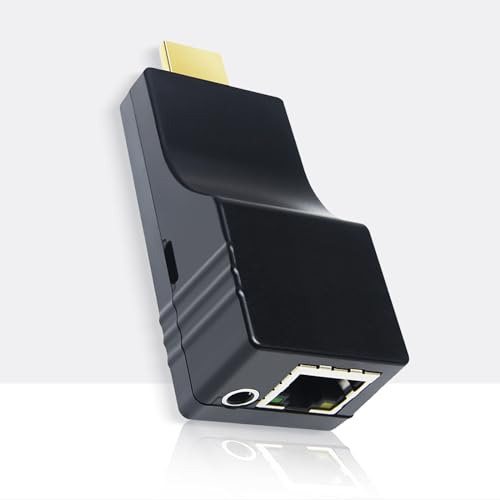
- 1080p60 H.264/H.265 encoding
- USB-powered, ultra-compact design
- SRT, RTSP, RTMP, and RTMPS support
Best For: Portable HDMI streaming and mobile setups
Best Broadcast-Ready Pick
Blackmagic Streaming Encoder 4K
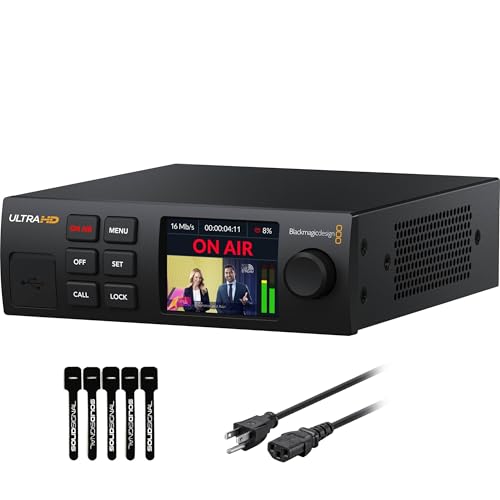
- 4K60 H.264/H.265 streaming
- 12G-SDI input with standards conversion
- Ethernet and mobile auto-failover
Best For: Professional SDI production and live events
Best AV-over-IP Pick
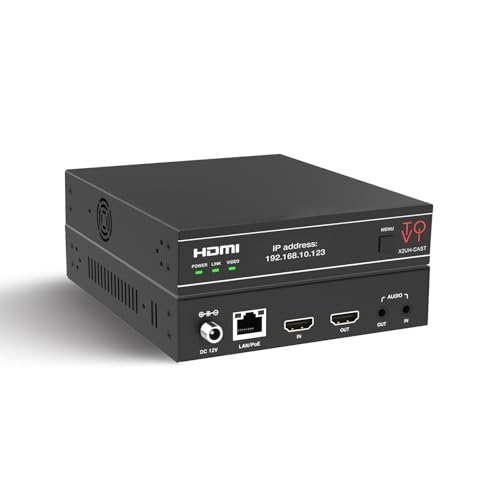
- 4K60 H.264/H.265 encoding
- Triple simultaneous stream outputs
- PoE, multicast, and analog audio embedding
Best For: Enterprise AV and IPTV distribution
Flexible 4K Streaming Hub
4K HDMI Encoder with 4-Channel Output

- Outputs 1×4K30 or 4×1080p30
- OLED display with HDMI loop-out
- Supports RTMP, SRT, RTSP, and more
Best For: Multi-output IPTV and live-production workflows
All-in-One Broadcast Workstation

- Encodes and decodes video up to 4K30
- Supports dual streams and many protocols
- Includes multi-view, OSD, and recording tools
Best For: IPTV, control-room, and 24/7 broadcast installations
Multi-Stream 1080p Specialist

- Sends two streams per HDMI input
- Supports RTMPS, SRT, HLS, WebRTC, and more
- Includes overlays and detailed stream controls
Best For: Flexible 1080p broadcasts and custom IPTV workflows
Best PoE Streaming Encoder – UNISHEEN 4K60 HDMI Encoder
For buyers comparing streaming encoders under 500, this UNISHEEN model stands out for combining 4K60 HDMI input, lossless loop-out, PoE power, and 1080p60 hardware encoding. Its broad protocol support makes it suitable for both online broadcasting and LAN video distribution.
Best For: Rack, wall, and on-location installations that need one-cable PoE wiring, high-quality monitoring, and flexible streaming protocols.
Pros:
- Accepts 4K60 HDMI and provides lossless loop-out while encoding 1080p60.
- PoE carries power and data over one Ethernet cable.
- Supports H.265/H.264 plus RTMP(S), SRT, RTSP, HLS, WebRTC, and other protocols.
- ONVIF support enables integration with compatible NVR systems.
Cons:
- Its output stream is limited to 1080p60 rather than 4K streaming.
- Setup may require network configuration through the web interface.
- Warranty information differs between the supplied bullets and product details.
This is a feature-rich choice when PoE, 4K pass-through, and professional network compatibility matter more than a basic plug-and-stream workflow.
Best Blackmagic Streaming Encoder – Web Presenter HD Bundle
Blackmagic Design Web Presenter HD Bundle with Power Cord and HDMI Cable with Ethernet, 3 Feet
Check Price On AmazonAmong streaming encoders under 500, the Blackmagic Design Web Presenter HD Bundle is a practical option for users who already work with SDI equipment and want a compact broadcast-oriented setup. This bundle adds a power cord and 3-foot HDMI cable.
Best For: Broadcast and presentation setups using SDI video, Ethernet connectivity, and USB-C webcam output.
Pros:
- Includes one SDI video input and one SDI loop output.
- Provides SDI support across 1.5G, 3G, 6G, and 12G rates.
- Includes SDI and HDMI monitoring outputs.
- USB-C webcam output supports computer-based workflows.
Cons:
- The supplied notes do not specify supported streaming protocols or output resolution.
- It may be less suitable for buyers seeking a straightforward HDMI-to-IP encoder.
- The included HDMI cable is only 3 feet long.
Choose this bundle when SDI compatibility and Blackmagic’s broadcast ecosystem are priorities; buyers needing detailed IP streaming specifications should verify the configuration before purchase.
Best Multi-Platform Streaming Encoder – Wilxisum 1080p60 HDMI Encoder
For shoppers seeking streaming encoders under 500, this Wilxisum HDMI-to-IP unit offers 1080p60 encoding without requiring a PC for continuous broadcasts. It supports several live-streaming and LAN playback formats, making it useful for churches, campuses, hotels, and IPTV deployments.
Best For: 24/7 HDMI broadcasts, simultaneous RTMP streaming, and local network playback through VLC, IPTV boxes, or compatible decoders.
Pros:
- Encodes 1080p60 HDMI signals into IP streams.
- Supports one main stream plus three secondary streams.
- Works with RTMP, RTMPS, RTSP, SRT, WebRTC, HLS, TS, FLV, and MP4.
- Includes a 2-year limited warranty and lifetime technical support.
Cons:
- Network setup may require changing the default IP address to match the local segment.
- Requires a 12V power connection rather than PoE.
- Configuration is handled through the encoder’s web interface.
This model offers strong protocol flexibility and multi-stream capability for fixed installations, especially where reliable LAN distribution is as important as public-platform streaming.
Best NDI Streaming Encoder – Full NDI HDMI Converter
For production teams comparing streaming encoders under 500, this Full NDI unit adds two-way flexibility: it can encode HDMI to NDI or decode NDI back to HDMI. PoE support, HDMI loop-out, and low-latency operation make it especially suited to live production networks.
Best For: Live events, conferences, and professional IP video workflows using Full NDI equipment and HDMI sources.
Pros:
- Switches between HDMI-to-Full-NDI encoding and NDI-to-HDMI decoding.
- Uses Full NDI rather than NDI HX for higher bitrate and lower-latency workflows.
- Advertised end-to-end latency is under 60ms.
- Supports PoE or USB-C power and includes HDMI loop-out, tally, PTZ control, and audio embed/de-embed features.
Cons:
- Its primary workflow depends on Full NDI-compatible equipment.
- Only 1080p60 operation is specified in the product title.
- The supplied details list a 1-year manufacturer warranty.
This is the most specialized option in the group, offering valuable encode/decode versatility for NDI production systems rather than general-purpose platform streaming.
Best Portable Pick – DDMALL CEV-2K HDMI Encoder
For shoppers comparing streaming encoders under 500, the DDMALL CEV-2K is a compact option for 1080p HDMI streaming. It supports H.264 and H.265 encoding, common streaming protocols, and USB-powered operation for mobile or space-constrained setups.
Best For: Portable HDMI streaming, mobile production, and low-power installations.
Pros:
- Supports up to 1080p60 input and output with bit rates up to 16Mbps.
- Works with SRT, RTSP, RTMP, RTMPS, TCP, and UDP protocols.
- Ultra-compact 75 x 32 x 22mm design and USB-powered operation.
- Offers real-time text, image, and logo overlays plus cloud-based control.
Cons:
- Limited to 1080p rather than 4K resolution.
- Its HDMI input makes it less suitable for SDI-based broadcast systems.
The CEV-2K is a practical choice when portability, low power use, and protocol flexibility matter more than 4K production. Its remote management and overlay tools add useful control for unattended or distributed streaming.
Best Broadcast-Ready Pick – Blackmagic Streaming Encoder 4K
Among streaming encoders under 500, the Blackmagic Streaming Encoder 4K stands out for production workflows that need 4K60 support, SDI connectivity, and failover options. It encodes H.264 or H.265 video and streams through SRT or RTMP without requiring a separate encoding computer.
Best For: Broadcast, live events, SDI camera systems, and professional streaming workflows.
Pros:
- Supports up to 2160p60 encoding in H.264 and H.265.
- Includes 12G-SDI input, loop output, and automatic standards conversion.
- Can use Gigabit Ethernet or USB-C-tethered 4G/5G mobile data with auto-failover.
- Adds closed captions, timecode, REST API control, tally, talkback, and webcam outputs.
Cons:
- SDI-focused connectivity may be excessive for simple HDMI streaming.
- Its professional feature set may require more setup than a basic encoder.
This model is designed for dependable, feature-rich production rather than casual streaming. Its standards conversion, mobile failover, and control-room functions make it especially compelling for users already working with Blackmagic or SDI equipment.
Best AV-over-IP Pick – ToVi X2 4K Network Streamer
For buyers seeking streaming encoders under 500 for AV-over-IP installations, the ToVi X2 network streamer combines 4K60 encoding with flexible network distribution. It supports H.264 and H.265, analog audio embedding, multiple protocols, and simultaneous output streams.
Best For: Enterprise AV, control rooms, IPTV systems, and continuous network video distribution.
Pros:
- Supports 4K at 60Hz with H.264 and H.265 encoding.
- Provides triple stream output at 4K60, 1080p30, and 720p5.
- Supports RTSP, RTP, TS, RTMP, RTMPS, unicast, and multicast workflows.
- Offers analog audio embedding, PoE support, EDID management, and 24/7-oriented protection features.
Cons:
- Its networking and control features may be more than basic streamers need.
- The supplied information identifies browser-based service support rather than a broad list of native platforms.
The ToVi X2 is best suited to installations where video must move reliably across a network and reach multiple destinations or stream profiles. PoE, multicast, audio embedding, and long-term operation make it a strong fit for structured AV environments.
Flexible 4K Streaming Hub – 4K HDMI Encoder with 4-Channel Output
For buyers comparing streaming encoders under 500, this ORIVISION model stands out for flexible output options. It can produce one 4K30 stream or four simultaneous 1080p30 streams, while its OLED display, HDMI loop-out, and broad protocol support simplify live-production monitoring.
Best For: IPTV, live events, digital signage, online education, and broadcast meetings needing flexible multi-output streaming.
Pros:
- Selectable 1×4K30 or 4×1080p30 output modes
- Supports H.265, H.264, and MJPEG encoding
- OLED status display and HDMI loop-out aid monitoring
- Works with RTMP, RTMPS, SRT, RTSP, HTTP, and UDP
Cons:
- 4K input must be enabled through the web interface because the default EDID is 1080p
- Only one HDMI input is provided
This is a practical choice when a compact encoder needs to serve several 1080p destinations or a single 4K workflow. Image overlays, flipping, audio-only encoding, and 1Gb Ethernet add useful production flexibility, though buyers should verify their preferred resolution and protocol setup before installation.
All-in-One Broadcast Workstation – 4K HDMI Encoder Decoder
Among streaming encoders under 500, this 4K model is aimed at more demanding installations. It combines HDMI encoding and decoding with dual-stream output, extensive network protocols, multi-view layouts, OSD tools, and recording to USB or network storage.
Best For: Churches, classrooms, IPTV systems, control rooms, digital signage, and continuous broadcast operations.
Pros:
- Encodes HDMI sources up to 4K30 using H.264 or H.265
- Supports RTMP, RTSP, SRT, HLS, FLV, TS, RTC, and UDP multicast
- Decodes network streams back to HDMI at up to 4K30
- Offers multi-view layouts, OSD overlays, and USB/NFS/CIFS recording
Cons:
- Its broad feature set may be more than a basic single-stream setup requires
- Warranty information is limited to a one-year manufacturer warranty
This is the most feature-heavy option in the group. The encoder-decoder design and multi-view support make it useful for centralized video distribution, while adjustable bitrate modes and two concurrent streams support more advanced delivery setups. Confirm compatibility with the intended storage and network environment before deployment.
Multi-Stream 1080p Specialist – Compact MPEG4/H.265 Encoder
For streaming encoders under 500 focused on 1080p distribution, the URayCoder UHE265-8 offers dual stream outputs from each HDMI input. It supports a wide range of delivery formats and lets users adjust overlays, bitrate, frame rate, cropping, rotation, and audio settings.
Best For: HDMI-based live streaming, YouTube and Facebook broadcasts, IPTV, NVR systems, and custom streaming integrations.
Pros:
- Outputs two configurable video streams per HDMI input
- Supports RTMPS, RTSP, SRT, HLS, UDP, RTP, MP4, FLV, WebRTC, and more
- Allows static or scrolling text, logos, and time overlays
- Includes lifetime technical support, warranty, and SDK/API documentation
Cons:
- Maximum listed video resolution is 1080p rather than 4K
- Its advanced configuration options may require more setup than a basic encoder
This compact aluminum encoder is a strong fit for users who prioritize protocol flexibility and simultaneous stream delivery over 4K resolution. The ability to send differently configured streams to separate servers is especially useful for mixed-platform workflows, while customization and developer documentation support more specialized deployments.
How We Picked the Best Streaming Encoders Under 500
We focused on hardware encoders that offer a useful combination of video quality, protocol support, networking, and setup flexibility at or below the $500 price range. Key considerations included maximum resolution and frame rate, HDMI or SDI input compatibility, H.264 and H.265 support, RTMP or RTMPS compatibility, SRT and RTSP availability, loop-through output, PoE support, and suitability for platforms such as YouTube and Twitch.
We also considered practical workflow details, including whether a unit supports NDI, multiple outputs, IPTV distribution, local network streaming, and low-latency applications. Product listings and included accessories can vary, so confirm the current specifications before purchasing.
Quick Comparison
| Need | Look For | Best-Fit Encoder Type |
|---|---|---|
| Simple online streaming | HDMI input, RTMP/RTMPS, easy web setup | Compact HDMI encoder |
| Higher-quality 1080p production | 1080p60, H.265, loop-out, SRT | Professional HDMI network encoder |
| 4K sources | 4K input, 4K streaming or downscaling | 4K HDMI encoder |
| Network video production | NDI, PoE, low latency, bidirectional conversion | NDI-capable encoder or decoder |
| Broadcast and SDI workflows | SDI input, SRT, Ethernet, mobile connectivity | Broadcast-oriented encoder |
Key Buying Factors for Streaming Encoders Under 500
Input, Resolution, and Frame Rate
Match the encoder to your source. HDMI is common for cameras, switchers, and computers, while SDI is better suited to longer cable runs and broadcast equipment. A 1080p60 encoder is usually the practical sweet spot for smooth sports, gaming, events, and presentations. Choose 4K support only when your camera, display workflow, bandwidth, and destination justify it.
Protocols and Platform Compatibility
RTMP remains widely supported, while RTMPS is preferable when a platform requires encrypted delivery. SRT helps maintain more reliable contribution feeds over unpredictable networks. RTSP, HLS, UDP, and WebRTC can be valuable for IPTV, monitoring, local distribution, and low-latency applications. Check that the encoder supports the exact protocol and authentication method your destination requires.
Network, Power, and Monitoring Features
Ethernet is generally more dependable than Wi-Fi for live production. PoE can simplify installation by carrying power and data over one cable, but it requires a compatible network switch or injector. HDMI loop-out is useful for sending the source to a local monitor without interrupting the stream. OLED displays, browser control, audio settings, and status indicators can also make troubleshooting easier.
Who Should Buy Which Streaming Encoders Under 500?
Content creators and small businesses: Choose a straightforward HDMI encoder with RTMP or RTMPS, browser configuration, and 1080p60 support.
Churches, schools, and event teams: Prioritize stable Ethernet, loop-through monitoring, H.265 efficiency, and SRT for dependable remote contribution.
IP video and IPTV operators: Look for RTSP, HLS, UDP multicast, multiple outputs, and compatibility with your existing network and management tools.
NDI production teams: Select an NDI-capable model with PoE and low-latency conversion when cameras, switchers, and displays share a managed production network.
4K camera owners: Buy a 4K-capable unit only if it preserves the required frame rate and offers the needed downscaling or streaming modes. For many platforms, a reliable 1080p60 workflow remains the better value.