SDI remains a dependable choice for cameras, switchers, and broadcast infrastructure, while IP streaming adds flexibility for platforms, remote contribution, and distribution. The best streaming encoders with SDI bridge those two workflows without forcing you to replace your existing production gear.
This roundup compares 10 options across input formats, codec support, streaming protocols, resolution, recording, and specialized features such as NDI, loop-through, dual-channel encoding, and multi-channel operation.
Best 10 Streaming Encoders with Sdi Picks for 2026
Best 4K All-in-One Pick

- HDMI and SDI input mixing
- 4K encoding with H.264 or HEVC
- Streams to six destinations and records simultaneously
Best For: Advanced live production and multi-source 4K workflows
Best Compact 1080p SDI Value
ISEEVY H.265/H.264 SDI Encoder

- Supports SDI up to 1080p60
- H.264 and H.265 encoding
- RTMP, SRT, RTSP, UDP, and HTTP support
Best For: Basic 1080p SDI streaming setups
Best Encoder-Recorder Combo

- HDMI and 3G-SDI at up to 1080p60
- Records to SD card or USB disk
- USB-C webcam capture and PoE networking
Best For: Portable streaming, recording, and computer capture
Best Multi-Stream SDI Encoder
ORIVISION ES901 HEVC SDI Encoder

- Outputs up to four streams at once
- Broad protocol support including SRT and RTMPS
- OLED status display and PoE support
Best For: Multi-platform SDI broadcast distribution
Versatile SDI Bridge
ZowieBox 3G SDI Encoder Decoder
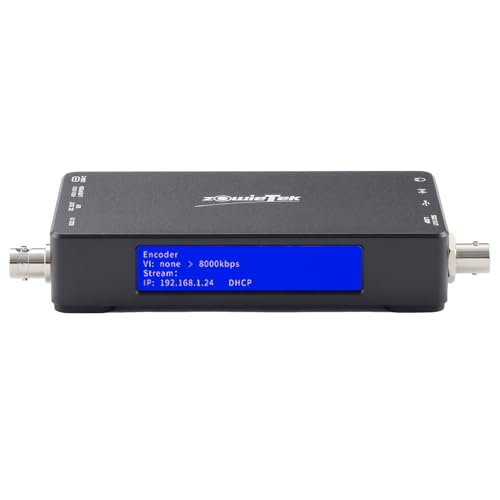
- SDI encoding to SRT, RTMP(S), and RTSP
- UVC conversion in both directions
- PoE, loopout, and standalone H.265/H.264
Best For: Portable HD events, webinars, and flexible SDI/IP workflows
4K Broadcast Workhorse
Blackmagic Streaming Encoder 4K
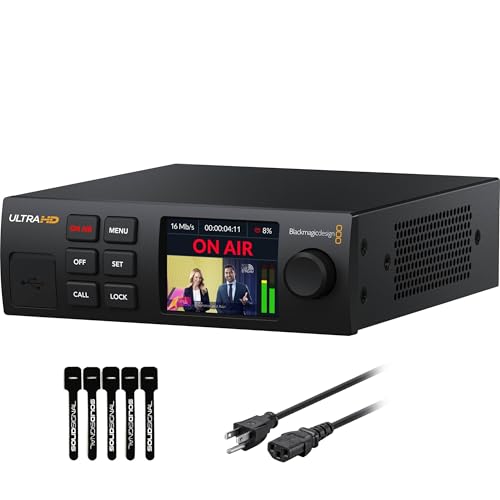
- 12G-SDI supports up to DCI 4K60
- H.264/H.265 streaming over SRT or RTMP
- Ethernet plus USB-C mobile auto-failover
Best For: Professional 4K broadcasts and resilient live-production workflows
Dual-Input HEVC Encoder

- 4K HDMI up to 3840x2160p30 plus 3G-SDI
- NDI HX3/HX2, SRT, and RTMP support
- Gigabit Ethernet with 802.3af PoE
Best For: Mixed HDMI/SDI productions and compact PoE installations
Best Compact SDI-to-NDI Bridge
ZowieBox 3G SDI NDI Encoder/Decoder

- Converts between SDI and NDI|HX workflows
- Supports PC-free SRT, RTMP(S), and RTSP streaming
- Compact design with PoE, USB-C power, and tripod mount
Best For: Mobile crews and compact SDI/NDI production setups
Best Multi-Protocol SDI Encoder
URayCoder H.265/H.264 SDI-to-IP Encoder

- Outputs up to four streams simultaneously
- Supports RTMP, SRT, HLS, UDP, RTSP, and more
- Provides adjustable video, audio, and overlay settings
Best For: Multi-platform streaming from a single SDI source
Best 4K Multi-Channel SDI Encoder
URayCoder 4K 3G/6G SDI-to-IP Encoder

- Handles 4K at up to 30 fps and lower resolutions up to 120 fps
- Supports 3G/6G SDI and H.265/H.264 encoding
- Outputs four protocol-configurable streams at once
Best For: Advanced 4K and multi-platform streaming workflows
Best 4K All-in-One Pick – Magewell Ultra Encode AIO
For demanding workflows involving streaming encoders with sdi, the Magewell Ultra Encode AIO stands out with HDMI and SDI inputs, 4K support, and extensive output options. It can combine both inputs, stream to multiple destinations, and record at the same time.
Best For: Live production teams needing 4K, flexible input mixing, multi-destination streaming, and onboard recording.
Pros:
- Supports HDMI up to 4K60 and SDI up to 4K30 with H.264 or HEVC.
- Streams to up to six destinations using protocols including RTMP, RTMPS, SRT, and NDI|HX.
- Combines HDMI and SDI sources with picture-in-picture or side-by-side layouts.
- Records to SD cards, USB storage, or network drives while streaming.
Cons:
- Its advanced feature set may be more than a basic single-camera stream requires.
- 4K SDI input support is listed up to 30 fps, rather than 60 fps.
The Ultra Encode AIO is the most capable and flexible option here, especially for studios and event crews that need professional routing, overlays, recording, and networking in one rack-mountable unit.
Best Compact 1080p SDI Value – ISEEVY H.265/H.264 SDI Encoder
ISEEVY H.265 H.264 SDI Video Encoder with Loopout Support RTMP RTMPS SRT RTSP UDP HTTP Protocols
Check Price On AmazonIf you need a straightforward option among streaming encoders with sdi, the ISEEVY encoder handles SDI video up to 1080p60 and supports both H.264 and H.265 compression. Its protocol selection covers common streaming and transport applications.
Best For: Users seeking a compact SDI encoder for 1080p60 streaming with broad protocol compatibility.
Pros:
- Accepts and encodes SDI video up to 1080p60.
- Supports H.264 and H.265 video encoding with AAC or MP3 audio.
- Works with RTMP, RTMPS, SRT, RTSP, UDP, and HTTP protocols.
- Includes text and image OSD management.
Cons:
- Its listed maximum resolution is 1080p, with no 4K support noted.
- The supplied specifications identify one channel and provide limited hardware detail.
This is a practical choice when you want SDI connectivity and modern streaming protocols without paying for the broader 4K production features found on larger units.
Best Encoder-Recorder Combo – LILLIPUT AVMATRIX SE2017
The LILLIPUT AVMATRIX SE2017 is a useful middle ground among streaming encoders with sdi, combining 3G-SDI and HDMI inputs with loop outputs, recording, and USB-C capture. It supports up to 1080p60 and can send streams to as many as six platforms simultaneously.
Best For: Portable productions, webinars, and creators who want streaming, local recording, and webcam capture in one unit.
Pros:
- Supports HDMI and 3G-SDI input and loop output at up to 1080p60.
- Records to SD cards or USB disks while offering multiple streaming protocols.
- USB-C capture output can function as a webcam with Linux or macOS computers.
- Provides PoE through its RJ45 port and includes an OLED screen with onboard controls.
Cons:
- Maximum video resolution is 1080p, not 4K.
- The supplied package information lists a 12V power supply but does not mention additional recording media.
With its loop outputs, local recording, USB-C capture, and portable form factor, the SE2017 is especially convenient for hybrid workflows that move between direct streaming and computer-based production.
Best Multi-Stream SDI Encoder – ORIVISION ES901 HEVC SDI Encoder
The ORIVISION ES901 focuses on flexible distribution for users comparing streaming encoders with sdi. It supports several transport protocols, can output up to four streams simultaneously, and uses an OLED display to show operating status during a broadcast.
Best For: SDI broadcasters sending one program to several platforms or destinations at once.
Pros:
- Outputs up to four video streams simultaneously.
- Supports HTTP, RTSP, UDP/RTP, RTMP, RTMPS, SRT, HLS, and FLV.
- OLED display provides real-time monitoring during streaming.
- Supports PoE and includes a stated three-year limited warranty with remote technical support.
Cons:
- The supplied notes do not specify a maximum video resolution or frame rate.
- The listing details only one connector port, so verify the physical I/O layout for your setup.
The ES901 is appealing when simultaneous distribution matters more than 4K production features. Its protocol range and four-stream output make it well suited to multi-platform broadcast delivery.
Versatile SDI Bridge – ZowieBox 3G SDI Encoder Decoder
For creators comparing streaming encoders with SDI, the ZowieBox stands out as a compact, multifunctional bridge between professional SDI gear, IP streams, and USB workflows. It supports SDI encoding to SRT, RTMP(S), and RTSP, plus decoding back to SDI.
Best For: Event productions, conferences, sports, webinars, and portable SDI-to-IP workflows.
Pros:
- Encodes SDI to SRT, RTMP(S), or RTSP and decodes those streams to SDI.
- Supports SDI-to-UVC and UVC-to-SDI conversion for computer and broadcast workflows.
- Offers SRT, H.265/H.264, SDI loopout, PoE, and multiple power options.
Cons:
- Limited to a single SDI channel.
- Its 3G-SDI design is aimed at HD workflows rather than 4K production.
The ZowieBox is a flexible choice when one device needs to cover encoding, decoding, webcam conversion, and portable deployment. Its broad protocol support and PoE capability are especially useful for distributed productions.
4K Broadcast Workhorse – Blackmagic Streaming Encoder 4K
Among streaming encoders with SDI, the Blackmagic Design Streaming Encoder 4K is built for higher-resolution production and broadcast integration. Its 12G-SDI input supports DCI 4K60, while built-in standards conversion helps accommodate different source and streaming formats.
Best For: Professional 4K live production, broadcast control rooms, mobile backup streaming, and standards-flexible SDI workflows.
Pros:
- Encodes HD and Ultra HD up to 2160p60 in H.264 or H.265.
- Includes 12G-SDI input, SDI loop output, HDMI and SDI monitor outputs, and standards conversion.
- Supports Ethernet, USB-C mobile failover, webcam output, captions, timecode, and REST API control.
Cons:
- Its professional feature set may be more than simple streaming setups require.
- Camera control, tally, and talkback features depend on compatible Blackmagic equipment.
This is the strongest fit for buyers who need 4K60 capability and broadcast-oriented control rather than a basic encoder. Ethernet and mobile auto-failover add resilience for productions where staying on air matters.
Dual-Input HEVC Encoder – Kiloview E3 4K HDMI/SDI
For buyers seeking streaming encoders with SDI and HDMI flexibility, the Kiloview E3 combines dual-channel connectivity with 4K HDMI and 3G-SDI inputs. It supports NDI HX3/HX2, SRT, and RTMP for low-latency network video delivery.
Best For: Productions that need both HDMI and SDI sources, PoE installation, and compact local control.
Pros:
- Supports 4K HDMI input up to 3840x2160p30 and 3G-SDI connectivity.
- Offers NDI HX3/HX2, SRT, and RTMP protocols for streaming flexibility.
- Gigabit Ethernet with 802.3af PoE can provide both network connectivity and power.
Cons:
- 4K input support is specified up to 30fps, not 4K60.
- The supplied notes do not identify supported streaming platforms or a detailed output format list.
The E3 is a practical middle ground for mixed HDMI/SDI installations. Its dual-channel design, PoE support, and front LCD with touch buttons make it well suited to compact production systems that value straightforward operation.
Best Compact SDI-to-NDI Bridge – ZowieBox 3G SDI NDI Encoder/Decoder
The Zowietek ZowieBox is a flexible choice among streaming encoders with SDI for compact productions that need SDI, NDI|HX, and network streaming options. It can encode SDI to NDI or decode NDI and supported IP streams to SDI, while also supporting standalone RTMP(S), RTSP, and SRT streaming.
Best For: Small studios, event setups, and mobile crews needing a compact SDI/NDI workflow device.
Pros:
- Supports SDI-to-NDI encoding and NDI-to-SDI decoding, including NDI|HX3, HX2, and HX.
- Can convert UVC camera output to SDI at up to 1080p60.
- Supports standalone streaming, PoE, USB-C power, tripod mounting, and SDI extension over LAN with a second unit.
Cons:
- It cannot encode and decode simultaneously; users must switch between modes.
- It supports NDI|HX formats, not full NDI|HB.
- USB capture-card functionality is not supported.
Choose this model when compact size and workflow flexibility matter more than simultaneous processing. Its combination of SDI, NDI|HX, UVC-to-SDI conversion, and PC-free streaming makes it particularly adaptable for distributed production setups.
Best Multi-Protocol SDI Encoder – URayCoder H.265/H.264 SDI-to-IP Encoder
The URayCoder USE265-1L is a practical option among streaming encoders with SDI for turning an SDI source into multiple network streams. Its H.265/H.264 encoding, broad protocol support, and ability to output four streams simultaneously suit broadcasters and organizations distributing video to different platforms or endpoints.
Best For: Broadcast and streaming workflows that need multiple protocol outputs from one SDI source.
Pros:
- Supports HTTP, RTSP, RTMP(S), SRT, HLS, UDP, RTP, Multicast, Unicast, FLV, and ONVIF.
- Can output up to four video streams simultaneously, with different protocols for each stream.
- Offers adjustable resolution, frame rate, bitrate, audio, cropping, rotation, mirroring, and overlays.
- Includes lifetime technical support, warranty, SDK/API materials, and CGI control documentation.
Cons:
- Provides one SDI port according to the supplied specifications.
- The listed power plug is Type I, which may require regional compatibility planning.
- Its larger aluminum enclosure is less compact than pocket-sized encoder designs.
This is a strong fit when protocol flexibility and simultaneous distribution are central requirements. It is less focused on SDI-to-NDI conversion, but its four-stream architecture and extensive configuration controls can simplify multi-platform delivery from a single SDI input.
Best 4K Multi-Channel SDI Encoder – URayCoder 4K 3G/6G SDI-to-IP Encoder
The URayCoder USE265-1 is designed for higher-resolution workflows and is one of the more capable streaming encoders with SDI in this group. It supports 4K input and output at up to 30 fps, lower-resolution frame rates up to 120 fps, and simultaneous multi-protocol streaming for platforms such as YouTube, Facebook, Twitch, and Vimeo.
Best For: Professional or advanced streaming setups that need 4K SDI handling and multiple network outputs.
Pros:
- Supports 4K UHD at up to 30 fps and up to 120 fps at 2K and lower resolutions.
- Supports 3G and 6G SDI workflows plus H.265/H.264 encoding.
- Can output four streams simultaneously using different protocols.
- Offers overlay tools, video adjustments, HDMI and line-in audio support, and browser-based status viewing.
Cons:
- The supplied notes describe HDMI HDCP 1.4 support in addition to SDI, so input requirements should be checked carefully.
- 4K operation is limited to 30 fps.
- Its multi-channel feature set may be more than necessary for simple single-stream broadcasts.
Select this encoder when 4K capability and simultaneous distribution justify a more advanced hardware setup. For basic HD streaming, a simpler model may be easier to deploy, but this unit offers more headroom for high-resolution sources and customized output workflows.
How We Picked the Best Streaming Encoders with Sdi
We focused on practical features that affect real-world live production rather than judging devices by headline resolution alone. Our comparison considers SDI format support, HDMI compatibility, maximum video resolution, H.264 or H.265 encoding, protocol coverage, audio handling, recording capability, and network connectivity.
We also looked for workflow flexibility. Some encoders are designed for straightforward RTMP delivery to platforms such as YouTube or Facebook, while others support SRT, RTSP, UDP, HLS, NDI, multicast, or decoder functions for more advanced broadcast and contribution setups. Because reliability depends on the entire signal chain, compatibility with your cameras, switcher, network, and destination should be part of the final decision.
Quick Comparison
- Best for broad production flexibility: Magewell Ultra Encode AIO, with multi-protocol streaming, recording, NDI|HX3, and dual-input mixing.
- Best for Blackmagic workflows: Blackmagic Design Streaming Encoder 4K, particularly for SDI-based 4K streaming with SRT and RTMP.
- Best for NDI users: Zowietek ZowieBox 3G SDI NDI or the Magewell model, depending on whether you need a dedicated SDI-to-NDI device or a broader feature set.
- Best for compact, straightforward setups: LILLIPUT AVMATRIX SE2017 or a single-channel H.264/H.265 SDI encoder.
- Best for larger or specialized systems: Dual-channel and multi-channel encoders that can handle several sources or simultaneous network outputs.
Key Buying Factors for Streaming Encoders with Sdi
SDI Format and Input Compatibility
Check whether the encoder supports SD-SDI, HD-SDI, 3G-SDI, 6G-SDI, or 12G-SDI, and confirm the exact frame rates used by your cameras. A 3G-SDI input may be sufficient for HD production but cannot replace 6G-SDI or 12G-SDI when you need higher-bandwidth 4K signals.
Resolution, Codec, and Bitrate Control
H.264 offers broad compatibility, while H.265/HEVC can deliver comparable quality at lower bitrates when the destination supports it. Confirm maximum input and output resolution, frame-rate limits, bitrate ranges, and whether the encoder can downscale for bandwidth-constrained connections.
Streaming Protocols and Network Options
RTMP or RTMPS is useful for common social and video platforms. SRT is usually preferable for unstable networks or remote contribution because it is designed for reliable, low-latency transport. RTSP, UDP, HLS, multicast, and NDI matter when the encoder must integrate with an IPTV, studio, monitoring, or campus network.
Recording, Loopout, and Redundancy
Built-in recording can provide a local backup or an immediate file for editing. SDI loopout is valuable when you need to send the same camera feed to a monitor, switcher, or backup recorder. Also check whether the unit supports dual network connections, cellular connectivity, or multiple simultaneous streams.
Who Should Buy Which Streaming Encoders with Sdi?
Choose an all-in-one encoder if you need one device for varied productions, recording, mixing, and multiple delivery methods. Choose a basic single-channel model for a fixed camera-to-platform workflow where simplicity and cost matter most. NDI-focused buyers should prioritize network discovery, NDI version support, and latency over extra consumer streaming features.
For broadcasters and event teams, prioritize protocol redundancy, SDI compatibility, remote management, and stable cooling. Multi-channel models make sense when several feeds must be encoded at once, but they may require more network bandwidth and configuration. Before buying, verify the exact SDI standard, destination protocol, audio format, power requirements, and management interface against your production plan.