The best streaming encoders convert HDMI or SDI video into dependable network streams for platforms, CDNs, IPTV systems, and private broadcasts. The right model can simplify a live workflow while preserving video quality and reducing computer load.
This roundup compares 10 streaming encoders across 4K support, codec options, input types, protocols, outputs, and production features, helping you choose hardware that fits your signal chain and streaming goals.
Best 10 Streaming Encoders Picks for 2026
Flexible 4K Streaming Encoder

- 4K30 encoding with H.265/H.264
- Up to four protocol outputs
- Built-in branding and video adjustments
Best For: HDMI-based multi-platform live streaming
Professional All-in-One Encoder

- HDMI and SDI inputs with source mixing
- Streams to up to six destinations
- Records while streaming to multiple storage options
Best For: Advanced broadcast and live-production workflows
Customizable HDMI IP Encoder
URayCoder 4K H.265/H.264 Encoder
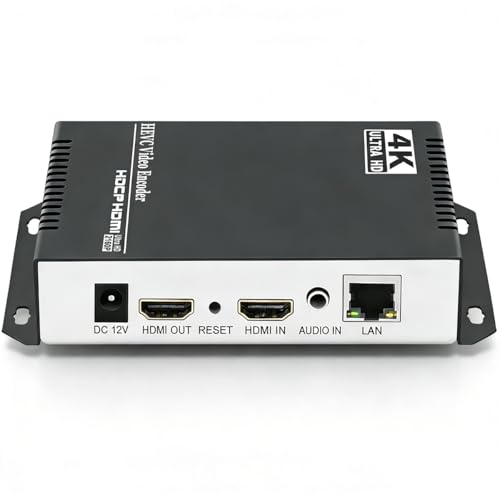
- 4K30 H.265/H.264 encoding
- Four simultaneous protocol outputs
- Overlay, audio, and image-adjustment controls
Best For: Flexible HDMI-to-IP streaming and OBS workflows
Broadcast-Ready 4K Encoder
Blackmagic Streaming Encoder 4K
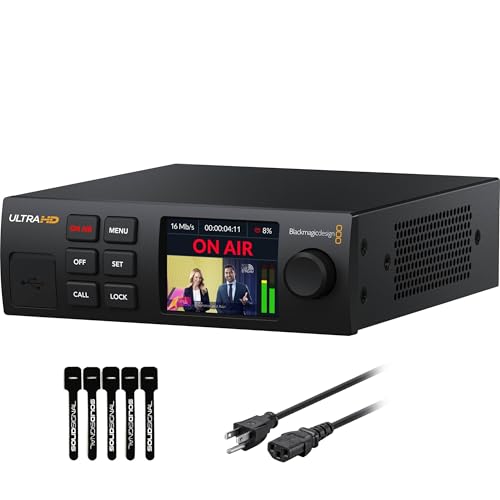
- 12G-SDI streaming up to 2160p60
- Ethernet and mobile auto-failover
- Standards conversion and broadcast controls
Best For: Professional SDI-based 4K live production
Best Multi-Protocol HDMI Pick
4K H.265/H.264 Network Encoder

- 4K input at 30fps with H.265/H.264 encoding
- Supports four streams and many protocols
- Includes overlays, audio controls, and lifetime support
Best For: Multi-platform HDMI streaming and IPTV workflows
Best for Monitoring
4K HDMI Encoder with OLED Display

- Offers 1×4K30 or 4×1080P30 modes
- OLED shows IP, resolution, and status
- Includes HDMI loop-out and broad protocol support
Best For: Broadcast and streaming setups needing easy status monitoring
Best SDI Option
HEVC H.265/H.264 SDI-to-IP Encoder

- Accepts SD, HD, and 3G-SDI sources
- Outputs up to four streams simultaneously
- Includes extensive protocols and stream customization
Best For: SDI-based broadcast, IPTV, and multi-destination streaming
Best Compact Encoder
UNISHEEN 1080P60 HDMI Streaming Encoder

- H.265/H.264 hardware encoding at 1080p60
- Broad RTMP, RTSP, SRT, HLS, and WebRTC support
- Browser-based setup with OSD overlays
Best For: Compact HD streaming, monitoring, and digital signage
Best Multi-Channel Encoder
ORIVISION 4-Channel 4K HDMI Encoder

- Four HDMI inputs for multi-source production
- Up to 16 simultaneous output feeds
- Supports two 4K30 and two 1080p60 channels
Best For: Multi-camera broadcasts, IPTV, and high-volume distribution
Best Customizable Encoder
URayCoder HEVC HDMI-to-IP Encoder

- 1080p60 H.265/H.264/MJPEG encoding
- Up to four protocol-based output streams
- Extensive overlays, audio, and video controls
Best For: Custom-branded HD streams, OBS, IPTV, and NVR workflows
Flexible 4K Streaming Encoder – URayCoder UHE265-1L-4K
For creators who need adaptable streaming encoders, the URayCoder UHE265-1L-4K combines 4K HDMI input, H.265/H.264 encoding, and broad network-protocol support in a compact box. It can send up to four streams using different protocols, making it useful for multi-platform live production.
Best For: Multi-platform streaming from a single HDMI source, especially when branding overlays and flexible protocol support matter.
Pros:
- Supports 4K at up to 30fps and up to 120fps at 2K or lower resolutions.
- Works with RTMP(S), RTSP, SRT, HLS, UDP, WebRTC, and other streaming protocols.
- Supports text, scrolling captions, logos, timestamps, cropping, and audio-source adjustments.
- Includes lifetime warranty and technical support according to the supplied product information.
Cons:
- HDMI-only input limits compatibility with SDI-based cameras and production systems.
- 4K capture is limited to 30fps.
This is a feature-rich choice for HDMI workflows that need simultaneous destinations and customization without adding a separate streaming computer. Confirm your required protocol and resolution before buying.
Professional All-in-One Encoder – Magewell Ultra Encode AIO
The Magewell Ultra Encode AIO is one of the most versatile streaming encoders in this group, combining HDMI and SDI connectivity with 4K encoding, dual-input layouts, recording, and multi-destination delivery. It is designed for more advanced live-production setups.
Best For: Broadcast, event, and production teams that need HDMI/SDI flexibility, simultaneous recording, overlays, and multiple delivery options.
Pros:
- Accepts HDMI or SDI and can combine both sources in picture-in-picture or side-by-side layouts.
- Supports 4K input, H.264 or HEVC encoding, and up to six simultaneous destinations.
- Can stream and record to SD cards, USB storage, or network drives at the same time.
- Offers PoE, Wi-Fi, 4G USB modem support, web control, API control, and front-panel monitoring.
Cons:
- Its professional feature set and rack-mount form factor may be more than casual streamers need.
- The supplied information lists a two-year manufacturer warranty rather than lifetime coverage.
Choose this model when your workflow extends beyond basic HDMI streaming. Its combination of source flexibility, recording, overlays, and network options makes it a strong fit for structured live productions.
Customizable HDMI IP Encoder – URayCoder 4K H.265/H.264 Encoder
This URayCoder model is a practical option among streaming encoders for turning an HDMI source into network video for YouTube, Facebook, OBS, and other services. It pairs 4K support with broad protocol compatibility and controls for tailoring the outgoing stream.
Best For: HDMI-equipped cameras, computers, and other sources that need customizable network streaming and simultaneous platform delivery.
Pros:
- Supports 4K input and output at up to 30fps, with higher frame rates available at 2K and lower resolutions.
- Can output up to four streams using different protocols, including RTMPS, SRT, HLS, UDP, and WebRTC.
- Offers overlays, logo placement, timestamps, cropping, rotation, mirroring, and bitrate controls.
- Supports embedded HDMI audio and line-in audio.
Cons:
- Requires an HDMI-output source and does not provide an SDI input.
- 4K operation is limited to 30fps.
Its broad protocol list and customization tools make it a capable HDMI-to-IP bridge for independent streamers and small production environments. It is particularly useful when one source needs to feed several online destinations.
Broadcast-Ready 4K Encoder – Blackmagic Streaming Encoder 4K
The Blackmagic Streaming Encoder 4K is built for broadcast-oriented streaming encoders workflows, with 12G-SDI input, H.264/H.265 support up to 2160p60, standards conversion, and Ethernet or mobile connectivity. It also adds monitoring, webcam output, and production-control features.
Best For: SDI-based live production, broadcast contribution, and operators who need 4K60 streaming with network failover and professional control features.
Pros:
- Supports H.264 and H.265 streaming up to 2160p60 through SRT or RTMP.
- 12G-SDI input accepts DCI 4K60 and includes standards conversion for flexible output formats.
- Ethernet and USB-C mobile connectivity provide automatic failover between connections.
- Includes SDI and HDMI monitoring outputs, closed-caption support, REST API control, and USB webcam outputs.
Cons:
- Its SDI-focused design is less suitable for simple HDMI-only setups.
- The supplied information lists a one-year manufacturer warranty.
This is the strongest fit here for professional SDI environments that require reliable 4K60 delivery and production integration. Its advanced controls are valuable for broadcast teams, though they may exceed the needs of basic streaming setups.
Best Multi-Protocol HDMI Pick – 4K H.265/H.264 Network Encoder
This URayCoder is a flexible choice among streaming encoders for creators and organizations that need to convert an HDMI source into network video. It accepts up to 4K input at 30fps, supports extensive streaming protocols, and can send up to four streams using different protocols.
Best For: Multi-platform live streaming, IPTV, OBS workflows, and customized branded broadcasts from HDMI equipment.
Pros:
- Supports 4K input, H.265/H.264 encoding, and up to 120fps at 2K or lower resolutions.
- Offers broad protocol support, including RTMP(S), SRT, HLS, WebRTC, ONVIF, and UDP.
- Includes overlays, logo and timestamp tools, audio options, and image adjustments.
- Provides lifetime warranty and technical support, with customization options for enterprise use.
Cons:
- 4K output is limited to 30fps.
- The extensive settings and protocol choices may be more than casual users need.
Choose this model when protocol flexibility and customization matter more than a simple plug-and-play setup. Its 4K support and four-stream capability make it particularly adaptable for professional or multi-platform production.
Best for Monitoring – 4K HDMI Encoder with OLED Display
This ORIVISION model is one of the more practical streaming encoders for live production setups that benefit from visible status information. It supports either one 4K30 stream or four simultaneous 1080p30 streams, while its OLED display shows the IP address, resolution, and encoding status.
Best For: Broadcast meetings, IPTV headends, digital signage, online education, and workflows needing local HDMI monitoring.
Pros:
- Selectable 1×4K30 or 4×1080P30 output modes provide workflow flexibility.
- OLED status display simplifies monitoring and troubleshooting.
- HDMI loop-out supports local monitoring, and the unit offers H.265, H.264, and MJPEG encoding.
- Supports RTMP(S), SRT, RTSP, HTTP, UDP, ONVIF, and common production software such as OBS and VLC.
Cons:
- 4K input requires selecting the 4K EDID option in the web interface; the factory default is 1080P.
- It has one HDMI input and does not provide four simultaneous 4K streams.
This is a strong fit when quick status checks and flexible output modes are priorities. The OLED display and loop-out connection add useful convenience for installations where monitoring and troubleshooting need to happen at the encoder.
Best SDI Option – HEVC H.265/H.264 SDI-to-IP Encoder
This URayCoder is designed for video professionals moving SD, HD, or 3G-SDI sources onto an IP network. Among streaming encoders, it stands out for protocol flexibility and simultaneous stream output, making it suitable for broadcast-oriented and IPTV applications.
Best For: SDI cameras, broadcast video, IPTV distribution, and live streaming systems that need multiple network outputs.
Pros:
- Supports SD, HD, and 3G-SDI input with H.265/H.264 encoding.
- Can output four video streams simultaneously, with different protocols for each stream.
- Offers HTTP, RTSP, RTMP(S), SRT, HLS, UDP, RTP, multicast, unicast, and ONVIF support.
- Provides text, logo, timestamp, cropping, rotation, flip, mirror, and adjustable audio controls.
Cons:
- Uses SDI rather than HDMI, so an SDI-output source is required.
- The supplied notes do not specify a 4K resolution mode.
- Its advanced stream configuration may be unnecessary for basic single-platform streaming.
For SDI-based production, this encoder offers the connectivity and stream-management features needed to bridge professional sources with varied IP destinations. It is especially compelling when one source must feed several servers or platforms at once.
Best Compact Encoder – UNISHEEN 1080P60 HDMI Streaming Encoder
This compact UNISHEEN model is one of the more approachable streaming encoders for converting an HDMI source into network video. It supports 1080p at 60 fps, H.265/H.264 compression, and browser-based configuration without requiring PC software.
Best For: Live events, remote monitoring, digital signage, and users who need a small encoder with broad protocol support.
Pros:
- Hardware H.265/H.264 encoding supports 1080p60 streaming.
- Works with RTSP, RTMP(S), SRT, HLS, WebRTC, UDP, and other protocols.
- Browser setup requires no drivers or dedicated software.
- Built-in OSD tools support text, logos, and timestamp overlays.
Cons:
- It is limited to a single HDMI input.
- Advanced configuration assumes basic networking knowledge.
- The 12V power supply is not included with a plug.
Choose this model when compact size and flexible IP distribution matter more than multi-channel production. Its 1080p60 limit makes it better suited to standard HD workflows than 4K sources.
Best Multi-Channel Encoder – ORIVISION 4-Channel 4K HDMI Encoder
The ORIVISION ZY-EH1304 is designed for more demanding streaming encoder setups, combining four HDMI inputs with multi-platform output. It can handle up to two 4K30 channels plus two 1080p60 channels, making it a fit for broadcasts that need several sources at once.
Best For: Multi-camera broadcasts, IPTV systems, CATV head-ends, hotels, and users distributing streams to multiple platforms.
Pros:
- Four HDMI inputs support larger production workflows.
- Can output to as many as 16 feeds simultaneously.
- Supports H.265, H.264, and MJPEG encoding.
- Includes an LCD screen for checking operating status and OSD controls for text, time, and image overlays.
Cons:
- Its 4K support is limited to 30 Hz, while 1080p supports 60 Hz.
- The multi-channel feature set may be excessive for a single-camera setup.
- Technical configuration and troubleshooting can require more networking knowledge.
This is the strongest choice here for scaling beyond one HDMI source. The LCD status display, multi-protocol output, and high feed count add flexibility, but the hardware is more specialized than a basic single-channel encoder.
Best Customizable Encoder – URayCoder HEVC HDMI-to-IP Encoder
This URayCoder unit is a flexible single-channel option among streaming encoders, with 1080p60 H.265/H.264 support and multiple network protocols. Its adjustable video controls, audio choices, overlays, and multi-stream output make it useful when a straightforward HDMI-to-IP workflow still needs customization.
Best For: YouTube, Facebook, Twitch, Vimeo, OBS, NVR, and IPTV users who want adjustable encoding and branding tools.
Pros:
- Supports 1080p60 encoding with H.265, H.264, and MJPEG formats.
- Can output up to four streams using different protocols.
- Offers text, scrolling captions, logos, timestamps, cropping, rotation, and mirroring.
- Accepts embedded HDMI audio or 3.5mm line-in audio.
Cons:
- It has only one HDMI channel, so it is not intended for multi-camera input.
- Its 6-by-5-by-1.5-inch enclosure is less compact than some single-channel alternatives.
- Advanced customization may take longer to configure than a basic encoder.
Consider this model when control over overlays, audio, and stream parameters is more important than 4K capability. It offers a broad feature set for HD streaming while remaining compatible with common platforms and management devices.
How We Picked These Streaming Encoders
We focused on hardware encoders that support widely used live-production workflows, including HDMI and SDI capture, H.264 or H.265 compression, Ethernet streaming, and protocols such as RTMP, RTMPS, RTSP, SRT, HLS, UDP, and WebRTC. We also considered resolution and frame-rate support, audio handling, recording, loop-through connections, multi-channel output, and compatibility with platforms such as YouTube Live, Facebook Live, IPTV systems, and private media servers.
Because these products span entry-level appliances and advanced production hardware, the best choice depends on your source equipment, required reliability, and distribution method—not simply the highest advertised resolution.
Quick Comparison
| Best For | Look For |
|---|---|
| Simple HDMI streaming | 1080p60, RTMP/RTMPS, and easy web configuration |
| 4K production | 4K input, HEVC, adequate bitrate control, and reliable cooling |
| Broadcast or long-distance links | SDI support and SRT with configurable latency |
| IPTV and custom delivery | RTSP, UDP, HLS, HTTP, and multiple output profiles |
| Multi-source workflows | Several inputs, channel management, and independent streams |
| Portable live production | Compact design, recording, network flexibility, and simple monitoring |
Key Buying Factors for Streaming Encoders
Inputs and Pass-Through
Match the encoder to your source. HDMI is common for cameras, laptops, and switchers, while SDI is preferable for professional cameras and longer cable runs. An HDMI loop-out is useful when you need to monitor or feed another display without interrupting the stream.
Resolution, Frame Rate, and Codec
Confirm whether 4K means input support, encoded output, or both. H.265 can deliver similar quality at lower bitrates than H.264, but H.264 remains more broadly compatible. For fast motion, verify the encoder’s maximum frame rate at the resolution you plan to use, especially 1080p60.
Protocols and Network Reliability
RTMP or RTMPS is usually the simplest choice for major social platforms. SRT is better suited to unpredictable networks and contribution feeds because it supports error recovery and configurable latency. RTSP, UDP, HLS, and WebRTC are valuable for surveillance, IPTV, low-latency browser delivery, and custom streaming systems. Wired Ethernet is generally more dependable than Wi-Fi.
Audio, Recording, and Management
Check embedded versus external audio support, audio delay controls, local recording, storage requirements, and whether configuration is available through a browser, display, or physical controls. Multi-channel models may require more setup but can reduce the need for separate hardware.
Who Should Buy Which Streaming Encoders?
Choose a straightforward HDMI 1080p encoder for occasional webinars, classrooms, presentations, and single-camera social streaming. A 4K HDMI model is a better fit for detailed demonstrations, events, and workflows where you want to preserve a high-resolution source. Pick an SDI-capable encoder for broadcast cameras, studios, venues, and long cable runs. Buyers building IPTV, security, or custom distribution systems should prioritize broad protocol support over platform-specific features. For professional live production, favor models with SRT, recording, monitoring, redundant outputs, and dependable configuration tools.