The best synthesizers for live performances balance immediate control, dependable connectivity, and sounds that hold up in a full mix. The right choice depends on whether you need hands-on synthesis, clip and sample control, or a portable all-in-one setup.
We selected 10 instruments and controllers across analog, digital, hybrid, and standalone workflows. Use the guide below to narrow the field by performance style, portability, sequencing needs, and budget.
Best 10 Synthesizers for Live Performances Picks for 2026
Best Hybrid Synth

- Wavetable and virtual analog engine
- Full-size keys with hands-on controls
- Motional Pad and built-in effects
Best For: Expressive live sound shaping and performance
Best Portable Groovebox

- Standalone battery-powered workflow
- 32 pads with polyphonic aftertouch
- Sampling and wireless Ableton integration
Best For: Untethered beat making and compact live sets
Best Sequencer Depth

- 16 tracks and 16-voice polyphony
- Four synth machines with deep modulation
- 128-step sequencer with parameter locks
Best For: Pattern-based electronic performance and sound design
Best Standalone Production Keyboard

- 37 keys plus 16 MPC performance pads
- Standalone MPC3 production workflow
- Sampling, sequencing, and DAW integration
Best For: Live producers who need keys, pads, and full-track creation
Analog Performance Pick

- Expressive 32-key analog monosynth
- Wavefolding oscillators and bass-compensated filter
- Sequencer, arpeggiator, CV, and MIDI connectivity
Best For: Live players wanting hands-on MOOG analog basses and leads
Portable Sampling Hub

- Standalone sampler with battery, speaker, and microphone
- 16 pads, chopping, resampling, and timestretching
- Onboard effects plus USB-C, MIDI, line, and sync I/O
Best For: DAWless performers building live sets from samples and beats
Ultra-Portable FM Option

- Six-operator FM engine with 32 algorithms
- Polyphony, arpeggiator, sequencer, and six effects
- 251 g body with Bluetooth MIDI and up to 12-hour battery
Best For: Guitarists and mobile performers needing compact FM synthesis
Compact Control

- 25 velocity-sensitive mini keys with arpeggiator
- Eight MPC pads and eight assignable knobs
- USB controller with included production software
Best For: Computer-based live rigs, beat making, and virtual synth control
Portable FM Power
M-VAVE Wireless FM Synthesizer

- Battery-powered design with built-in speaker
- Six-operator FM engine and 32 algorithms
- Effects, arpeggiator, sequencer, and multiple MIDI options
Best For: Portable, computer-free performance and mobile sound design
Clip Launching Hub
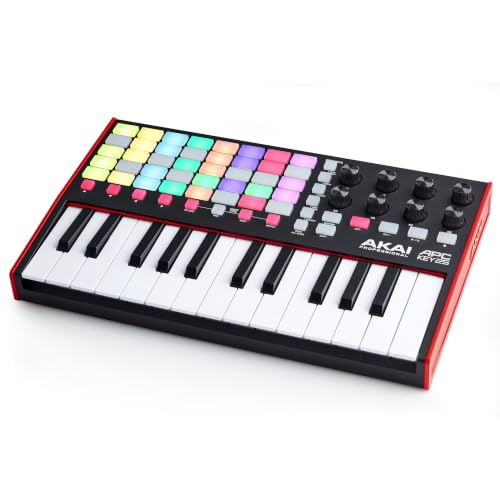
- 40 RGB pads for Ableton clip launching
- 25 velocity-sensitive keys and eight assignable knobs
- Pre-mapped Ableton Live integration with software included
Best For: Ableton Live performances using clips and software synthesizers
Best Hybrid Synth – Roland GAIA 2
For musicians seeking synthesizers for live performances, the Roland GAIA 2 combines wavetable and virtual analog synthesis in a hands-on instrument designed for quick sound shaping. Its full-size keys, logical panel, assignable modulation, and Motional Pad make it well suited to expressive stage playing.
Best For: Performers who want immediate control over hybrid synth sounds, effects, and modulation.
Pros:
- Hybrid wavetable and virtual analog sound engine
- Full-size keys and clearly arranged controls
- Motional Pad adds real-time movement and expression
- Built-in sequencer and extensive effects section
Cons:
- Focused on synthesis rather than sampling or workstation-style production
- At 10 pounds, it is less portable than compact grooveboxes
The GAIA 2 is a strong choice when live playability and hands-on sound design matter more than an all-in-one production workflow. Its dedicated controls and performance-oriented modulation features help keep adjustments accessible on stage.
Best Portable Groovebox – Ableton Move
The Ableton Move is a compact option among synthesizers for live performances, combining a rechargeable battery, speaker, microphone, pads, sequencing, sampling, and effects in a standalone instrument. It can sketch, build, and perform ideas without a computer while also integrating wirelessly with Ableton Live.
Best For: Mobile performers and creators who want an untethered groovebox for beats, samples, clips, and synth parts.
Pros:
- Built-in battery, speaker, microphone, and processor
- 32 velocity-sensitive pads with polyphonic aftertouch
- Four flexible tracks can handle drums, samples, or synthesis
- USB-C, Wi-Fi, Ableton Cloud, and Live integration
Cons:
- Four-track architecture is more limited than larger production instruments
- Ableton Live 12 Intro includes limited tracks, instruments, and effects
- Its pad-based design may not suit players who require a traditional keyboard
Move stands out for portability and fast idea capture. It is particularly practical for performers who value sampling, clip-based workflows, and hands-on beat making over a conventional keyboard layout.
Best Sequencer Depth – Elektron Digitone II
The Elektron Digitone II is a powerful choice for synthesizers for live performances when sequencing detail and sound flexibility are priorities. It offers 16 tracks, 16-voice polyphony, four synth machines, deep modulation, parameter locks, and a broad effects suite for building evolving electronic arrangements.
Best For: Electronic performers who want detailed sequencing, layered digital synthesis, and extensive pattern control.
Pros:
- Four synth machines available across 16 tracks
- 16-voice polyphony supports dense layered parts
- 128-step sequencer includes parameter locks, probability, and micro-timing
- Overbridge and class-compliant USB Audio support studio integration
Cons:
- Its deep feature set may require more learning than simpler performance instruments
- It does not provide a traditional keyboard for direct melodic playing
Digitone II is built for performers who want patterns to develop dynamically during a set. Its modulation, sequencing, MIDI, and effects capabilities make it a strong centerpiece for a hardware-focused electronic rig.
Best Standalone Production Keyboard – Akai MPC Key 37 G2
The Akai MPC Key 37 G2 brings keyboard playing, MPC pads, sampling, sequencing, and standalone production together for performers comparing synthesizers for live performances. Its 37-key keybed, pitch and mod wheels, touchscreen, and MPC3 workflow support both played parts and clip- or pad-based arrangements.
Best For: Producers and performers who want keys, pads, sampling, and full-track creation in one standalone workstation.
Pros:
- Combines a 37-key synth-action keybed with 16 MPC pads
- Standalone MPC3 workflow supports arranging without a computer
- Supports up to 16 stereo audio tracks and 32 plugin instruments per project
- USB-C provides multichannel audio and expanded MIDI connectivity
Cons:
- Larger and more production-focused than a minimal live-performance controller
- Its broad feature set may take time to master
- Some bundled software and content require downloads or external integration
The MPC Key 37 G2 is a versatile centerpiece for performers who need both traditional keyboard control and pad-driven production. It is especially compelling for complete standalone arrangements, sampling workflows, and transitions between hardware and DAW-based setups.
Analog Performance Pick – MOOG Messenger
For players seeking synthesizers for live performances, the MOOG Messenger combines a portable analog design with full-size expressive keys, hands-on controls, and extensive connectivity. Its two wavefolding oscillators, flexible filter, and performance-focused sequencing tools make it a strong choice for basses, leads, and evolving monophonic parts.
Best For: Keyboardists and producers who want classic MOOG-style analog sound with expressive control onstage.
Pros:
- 32 full-size semi-weighted keys with velocity and aftertouch
- Two variable-shape VCOs, sub-oscillator, and versatile ladder filter
- Built-in 64-step sequencer, arpeggiator, and 256 presets
- CV, MIDI DIN, USB-C MIDI, audio input, and pedal connections
Cons:
- Monophonic architecture limits simultaneous note playing
- At over 5 kg, it is less travel-friendly than compact battery-powered instruments
The Messenger is especially compelling when tactile control and expressive keyboard playing matter more than polyphony. Its sturdy metal construction and broad I/O also make it adaptable to studio and live setups.
Portable Sampling Hub – Akai MPC Sample
The Akai MPC Sample approaches synthesizers for live performances from a sample-based angle, pairing standalone sequencing with pads, effects, and portable recording. Its rechargeable battery, speaker, microphone, and storage support make it practical for creating and triggering grooves without a computer.
Best For: Beatmakers, DAWless performers, and live creators who build sets around samples, loops, and finger drumming.
Pros:
- Standalone, battery-powered operation with built-in speaker and microphone
- 16 responsive MPC pads, chopping tools, timestretching, and resampling
- Four onboard FX processors with 60 effect types
- Line, headphone, MIDI, sync, USB-C audio/MIDI, and microSD support
Cons:
- MIDI DIN connection requires an adapter, which is not included
- Its pad-and-sampler workflow is less suited to traditional keyboard synthesis
Choose the MPC Sample when live performance means launching samples, shaping beats, and manipulating effects in real time. It is compact and self-contained, while still offering connections for broader live and studio rigs.
Ultra-Portable FM Option – M-VAVE FM-1
For mobile setups and guitar-centered rigs, the M-VAVE FM-1 is one of the most compact synthesizers for live performances. Its six-operator FM engine, 12-voice polyphony, onboard effects, and multiple MIDI options provide a broad palette in a battery-powered instrument that weighs just 251 grams.
Best For: Guitarists, buskers, and performers who need lightweight FM sounds, MIDI flexibility, and long battery life.
Pros:
- Six-operator FM synthesis with 32 algorithms and 128 factory presets
- 12-voice polyphony, arpeggiator, 16-step sequencer, and six effects
- USB-C, Bluetooth BLE MIDI, and 3.5mm MIDI connectivity
- Rechargeable battery rated for up to 12 hours and built-in speaker
Cons:
- Its 27-key silicone keyboard may feel less conventional than full-size keys
- Small format may be less comfortable for extended traditional keyboard playing
The FM-1 stands out when portability is the priority. It can fit in a guitar case or backpack while still offering polyphonic FM tones, sequencing, and effects for rehearsals, busking, and live experimentation.
Compact Control – Akai MPK Mini MK3
The Akai Professional MPK Mini MK3 is a compact USB controller for producers who want hands-on control over virtual instruments and synthesizers for live performances. Its 25 velocity-sensitive mini keys, MPC-style pads, assignable knobs, pitch/modulation joystick, and built-in arpeggiator provide versatile control from a laptop-based setup.
Best For: Beat makers, home-studio users, and performers who need a lightweight controller for virtual synthesizers and DAW instruments.
Pros:
- Eight MPC-style velocity-sensitive pads support drum, sample, and synth triggering.
- Eight assignable knobs and a four-way joystick offer hands-on parameter control.
- Built-in arpeggiator and included software suite expand its out-of-the-box capabilities.
Cons:
- It requires a USB-connected computer or compatible device rather than operating as a standalone synthesizer.
- The 25 mini keys provide limited range compared with larger keyboards.
The MPK Mini MK3 is a practical choice when portability and flexible software control matter more than built-in sounds or standalone operation. For synthesizers for live performances, it works best as a compact controller in a computer-based rig.
Portable FM Power – M-VAVE Wireless FM Synthesizer
The M-VAVE FM Synthesizer is a standalone, battery-powered option for performers who want portable synthesizers for live performances. It combines a six-operator FM engine, built-in speaker, 128 presets, effects, arpeggiator, and sequencer in a compact unit with several MIDI connection options.
Best For: Mobile performers, experimental players, and musicians who want immediate sound creation without relying on a computer.
Pros:
- Battery operation and a built-in speaker support highly portable playing.
- Six operators and 32 algorithms provide hands-on FM sound design.
- Includes six effects, a 16-step sequencer, arpeggiator, and 128 factory presets.
- Supports USB MIDI, wireless Bluetooth MIDI, and 3.5mm MIDI input.
Cons:
- The 27 silicone keys may feel less like a traditional keyboard than full-size piano keys.
- Its compact controls and FM architecture may be less immediately accessible to beginners seeking simple subtractive synthesis.
With its internal sound engine, speaker, battery, and multiple MIDI interfaces, the M-VAVE is the most self-contained option in this group. It is especially appealing for spontaneous performances and portable setups where computer-free operation is valuable.
Clip Launching Hub – Akai APC Key 25 MK2
The Akai Professional APC Key 25 MK2 is a USB controller designed around Ableton Live, making it a strong choice for synthesizers for live performances built from clips, software instruments, and effects. Its 40-pad RGB matrix, velocity-sensitive keys, eight knobs, and dedicated navigation controls are geared toward launching and shaping live arrangements.
Best For: Ableton Live performers who launch clips while playing software synths, basslines, chords, or leads.
Pros:
- Forty RGB pads provide visual feedback for launching clips, loops, vocals, and samples.
- Pre-mapped 1:1 Ableton Live integration simplifies live navigation and control.
- Eight assignable knobs support volume, pan, sends, automation, and device macros.
- Includes Ableton Live Lite plus Hybrid 3, Mini Grand, and Velvet instruments.
Cons:
- Its deepest integration is focused on Ableton Live rather than broad standalone use.
- USB power means it needs a computer and does not operate as a standalone synthesizer.
The APC Key 25 MK2 is the most performance-oriented controller here for an Ableton-centered setup. Choose it when clip launching and visual feedback are as important as playing software synthesizers from a compact keyboard.
How We Picked the Best Synthesizers for Live Performances
We focused on instruments that can contribute meaningfully onstage rather than products designed only for studio programming. Our criteria included sound-generation flexibility, hands-on controls, sequencing or sampling capabilities, MIDI and audio connectivity, portability, and how quickly a performer can access useful sounds. We also considered different live workflows, including keyboard-led sets, electronic performance, hybrid DJ setups, and compact mobile rigs.
The selection includes true synthesizers, standalone production instruments, samplers, and MIDI controllers. Controllers do not generate sound by themselves, but they can be excellent live tools when paired with a laptop, hardware module, or performance software.
Quick Comparison
| Best For | Look For |
|---|---|
| Expressive sound design | Analog or hybrid synthesis with dedicated controls |
| Looping and arrangement | Standalone sequencing, clip launching, or pattern memory |
| Sample-based performance | Fast sampling, pads, effects, and reliable storage |
| Portable setups | Battery operation, built-in speakers, or compact dimensions |
| Computer-based rigs | USB MIDI, dependable mapping, and suitable software integration |
Key Buying Factors for Synthesizers for Live Performances
Sound Engine and Polyphony
Choose the synthesis type that matches your role. Analog and virtual-analog instruments are strong for basses, leads, and tactile tweaking, while wavetable and FM designs offer sharper digital textures and broader timbral variety. Polyphony matters for pads and chords; monophonic instruments are better suited to focused bass and lead parts.
Hands-On Control
Knobs, sliders, pads, keys, and performance modes reduce menu diving during a set. Prioritize controls for filter cutoff, resonance, envelopes, effects, pattern changes, and sound selection. A compact controller can be more useful than a larger keyboard if it gives direct access to the parameters you actually perform.
Sequencing, Sampling, and Connectivity
Standalone sequencers and grooveboxes can reduce dependence on a computer, but confirm track count, pattern chaining, sample memory, and export options. Check MIDI ports, USB behavior, audio outputs, headphone monitoring, and synchronization support. If you use a laptop, verify software compatibility and whether the device sends the MIDI messages your setup requires.
Portability and Reliability
For frequent gigs, weight, power requirements, build quality, and setup time are practical priorities. Battery-powered units are useful for mobile performances, while larger instruments may provide better controls and connectivity. Before buying, confirm that the power supply, cables, stand, and sustain or expression accessories fit your stage plan.
Who Should Buy Which Synthesizers for Live Performances?
Choose a hardware synth if you want immediate sound shaping and a self-contained instrument. Choose a groovebox or production keyboard if your performance includes sequencing, sampling, or complete song sections. Choose a controller if your sounds already live in a computer or another sound module and you need portable hands-on control.
For a compact electronic rig, prioritize battery life, pattern workflow, and quick sound recall. Keyboard players should favor comfortable keys, useful polyphony, and strong modulation control. Producers who perform full arrangements should look for standalone sequencing and sampling. Finally, confirm the unit’s output and synchronization options before purchase so it integrates cleanly with your mixer, interface, pedals, or PA system.