Choosing an audio interface for guitar and vocals means balancing clean preamps, useful inputs, easy monitoring, and compatibility with your recording setup. The right model can make a simple home studio feel capable without adding unnecessary complexity.
We’ve gathered 10 options spanning beginner-friendly interfaces, compact streaming tools, amp-modeling-focused gear, and higher-input systems for songwriting or small ensemble recording. Use the guide below to narrow the field by features, workflow, and budget.
Best 10 Audio Interface for Guitar and Vocals Picks for 2026
Best Beginner-Friendly Pick

- 24-bit/192kHz recording with 106dB dynamic range
- XLR mic and dedicated instrument input
- Direct monitoring, loopback, and multi-device support
Best For: Beginners recording guitar, vocals, podcasts, or streams
Best for Guitar Tone Shaping

- POD Farm includes extensive amp and effects modeling
- ToneDirect monitoring targets low-latency tracking
- Two guitar inputs plus two balanced XLR mic inputs
Best For: Guitarists recording modeled tones with vocal support
Best Overall Recording Upgrade
Focusrite Scarlett 2i2 4th Gen

- Two mic preamps and two Hi-Z instrument inputs
- 120dB dynamic range and 24-bit/192kHz recording
- Auto Gain, Clip Safe, Air mode, and software bundle
Best For: Home musicians seeking a capable two-input interface
Best Portable Value

- 2x2 USB-C interface with 24-bit/192kHz recording
- Combo inputs, Hi-Z guitar support, and 48V phantom power
- Bus-powered design with direct monitoring and 3.5mm headphones
Best For: Portable guitar and vocal recording on a simple setup
Top Studio-Ready Pick
Focusrite Scarlett Solo 4th Gen

- 120dB dynamic range with 24-bit/192kHz recording
- Air mode enhances vocal and guitar presence
- Includes major recording software and plugins
Best For: Songwriters seeking polished home recordings
Best Portable Fender Option
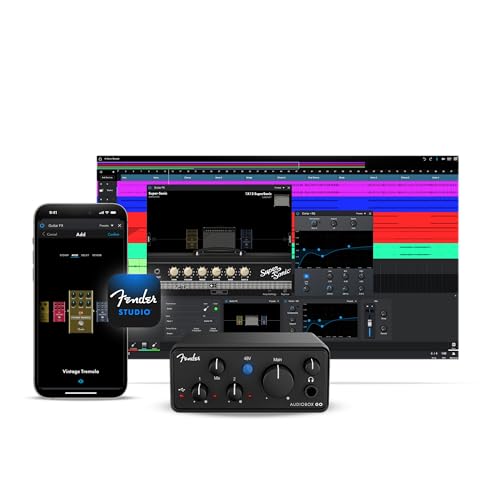
- Compact bus-powered USB-C interface
- Dedicated guitar input plus XLR mic input
- Includes Fender amp and effects software
Best For: Mobile guitarists and straightforward home recording
Best Value Recording Starter
Focusrite Scarlett Solo 3rd Gen
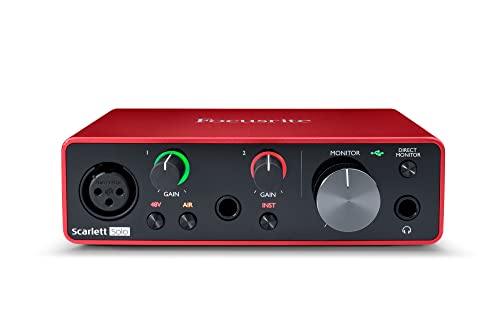
- 24-bit/192kHz recording capability
- Air mode adds clarity to vocals and acoustic instruments
- Includes software for recording and music production
Best For: Beginners recording one vocal and one instrument
Compact Starter Pick
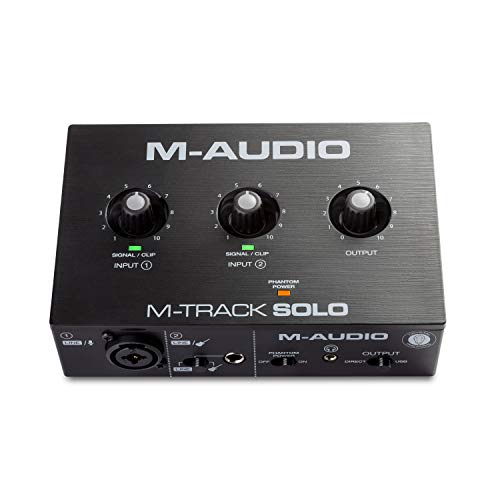
- Two-channel design for guitar and vocals
- Combo mic/line input plus dedicated instrument input
- Portable, with direct monitoring and included software
Best For: Beginners and compact home recording setups
Expandable Studio Hub
Focusrite Scarlett 16i16 4th Gen

- Two Hi-Z inputs and two mic preamps
- 16-in/16-out connectivity with ADAT, S/PDIF, and MIDI
- 24-bit/192kHz converters with Auto Gain and Clip Safe
Best For: Growing studios and producers needing extensive I/O
Balanced Home Studio Choice
Focusrite Scarlett 8i6 3rd Gen

- Two Hi-Z inputs for guitar and two mic preamps
- Six line inputs for additional recording sources
- High-resolution conversion and dual headphone outputs
Best For: Home studios, songwriting, and streaming
Best Beginner-Friendly Pick – MAONO PS22 Lite
If you want an approachable audio interface for guitar and vocals, the MAONO PS22 Lite combines dedicated instrument connectivity, XLR microphone support, and simple controls in a compact USB interface. Its 24-bit/192kHz recording, direct monitoring, and plug-and-play compatibility suit home recording and streaming setups.
Best For: Beginners, guitarists, vocalists, podcasters, and streamers who want flexible recording and broadcast features.
Pros:
- Records at up to 24-bit/192kHz with a stated 106dB dynamic range.
- Supports condenser and dynamic microphones with up to 56dB of preamp gain and 48V phantom power.
- Includes direct monitoring, virtual channels, loopback, and compatibility with Mac, Windows, and iPad.
Cons:
- Some routing features require the included ProStudio software.
- The compact design may provide fewer physical controls than larger interfaces.
The PS22 Lite is a versatile starting point when guitar, vocals, and streaming are all part of the plan. Its beginner-oriented modes and broad device compatibility make it especially practical for a first recording setup.
Best for Guitar Tone Shaping – Line 6 POD Studio UX2
The Line 6 POD Studio UX2 is a guitar-focused audio interface for guitar and vocals built around low-noise recording and extensive amp-and-effects modeling. It also provides two balanced XLR inputs with mic preamps, making it useful for recording vocals alongside guitar.
Best For: Guitarists who want integrated amp, cabinet, stompbox, and effects models while tracking guitar and vocals.
Pros:
- Includes POD Farm with guitar, bass, cabinet, stompbox, studio-effect, and mic-preamp models.
- ToneDirect monitoring is designed to minimize latency while monitoring processed tones.
- Offers two guitar inputs, two XLR mic inputs, phantom power, headphone output, line outs, and S/PDIF.
Cons:
- Its listed recording formats and sample-rate specifications are older than newer interfaces.
- The extensive modeling software may involve a steeper learning curve for beginners.
The UX2 makes the most sense for players who value ready-to-use guitar tones and software effects. Its multiple inputs also leave room for vocal recording, though its older specifications may be less appealing for buyers prioritizing the latest connectivity and resolution.
Best Overall Recording Upgrade – Focusrite Scarlett 2i2 4th Gen
The Focusrite Scarlett 2i2 4th Gen is a strong all-around audio interface for guitar and vocals, pairing two mic preamps and Hi-Z instrument inputs with 24-bit/192kHz recording. Auto Gain, Clip Safe, and Air mode help simplify level setting and add extra presence when tracking.
Best For: Home recordists who want a polished two-input interface for simultaneous or separate guitar and vocal sessions.
Pros:
- Provides 120dB dynamic range and recording up to 24-bit/192kHz.
- Auto Gain and Clip Safe can help set usable levels and reduce clipping problems.
- Includes Air mode plus Pro Tools Intro+, Ableton Live Lite, Cubase LE, and Hitmaker Expansion software.
Cons:
- It has two input channels, so larger ensemble recording requires a different interface.
- Its included software bundle may take time to install and learn.
For most home musicians, the Scarlett 2i2 4th Gen offers a particularly balanced feature set. It is straightforward enough for new users while adding practical safeguards and tone options for more confident recording.
Best Portable Value – PIYONE Q28 Alloy Red
The PIYONE Q28 is a compact 2×2 audio interface for guitar and vocals with USB-C connectivity, combo inputs, and class-compliant operation for Mac and PC. It supports 24-bit/192kHz recording, 48V phantom power, and direct monitoring for a simple mobile or home-studio workflow.
Best For: Mobile creators and home users who need a lightweight interface for a guitar, microphone, headphones, and computer.
Pros:
- Offers 24-bit/192kHz recording through two combo XLR/TRS inputs.
- Supports condenser microphones with integrated 48V phantom power and guitar connection through a Hi-Z input.
- USB-C bus power, driver-free class-compliant operation, and a built-in 3.5mm headphone jack simplify setup.
Cons:
- The supplied details list Windows support but do not confirm compatibility with every operating system.
- Its two-channel design is intended for smaller recording setups.
The Q28 focuses on portability and ease of use rather than an extensive feature set. It is a practical choice for recording guitar and vocals with minimal cabling, especially when illuminated controls and standard headphone connectivity are useful.
Top Studio-Ready Pick – Focusrite Scarlett Solo 4th Gen
If you need an audio interface for guitar and vocals with a polished, studio-focused feature set, the Focusrite Scarlett Solo 4th Gen is a strong choice. It pairs a 1 XLR mic preamp with a Hi-Z instrument input, 24-bit/192kHz recording, and a 120dB dynamic range.
Best For: Songwriters and home recordists who want high-resolution recording, vocal and guitar presence, and a generous software bundle.
Pros:
- 120dB dynamic range and converters shared with Focusrite’s flagship interfaces.
- Air mode adds presence and harmonic drive to vocals and guitars.
- Includes Pro Tools Intro+, Ableton Live Lite, Cubase LE, and Hitmaker Expansion.
- Compatible with Mac, Windows, and iOS devices.
Cons:
- Provides one XLR mic preamp, so simultaneous multi-microphone recording is limited.
- Its software features may be more than a beginner needs immediately.
The Solo 4th Gen stands out when recording quality and included production tools matter most. Its focused two-input layout is especially practical for one vocalist and one guitar.
Best Portable Fender Option – Fender AudioBox GO
The Fender AudioBox GO is a compact audio interface for guitar and vocals designed for straightforward mobile and desktop recording. It offers a dedicated guitar input, an XLR/line combo input with phantom power, and 24-bit/96kHz converters in a bus-powered package.
Best For: Guitarists, vocalists, and producers who prioritize portability, simple setup, and access to Fender amp and effects models.
Pros:
- Ultra-compact 2×2 USB-C design weighs just 8.16 ounces.
- Dedicated TS instrument input is optimized for guitar and bass.
- Fender Amp & FX Pack provides amp models and effects through the Fender Studio app.
- Zero-latency headphone monitoring includes a mix control.
Cons:
- Its maximum sample rate is 96kHz, below the two Focusrite options here.
- The Fender Amp & FX Pack requires registration and downloading through the Fender Studio app.
For creators who record in different locations, the AudioBox GO’s small, bus-powered design is a major advantage. Fender’s included software ecosystem also makes it appealing for guitar-focused tone shaping.
Best Value Recording Starter – Focusrite Scarlett Solo 3rd Gen
The Focusrite Scarlett Solo 3rd Gen remains a capable audio interface for guitar and vocals for musicians who want pro-oriented recording without a complex setup. It combines a mic preamp, Hi-Z instrument input, Air mode, and recording up to 24-bit/192kHz.
Best For: Beginners and home musicians who want clear guitar and vocal capture, simple monitoring, and a useful starter software bundle.
Pros:
- Records at up to 24-bit/192kHz with high-performance converters.
- Air mode can add clarity to vocals and acoustic instruments.
- Gain Halos help monitor input levels and reduce unwanted clipping.
- Includes Pro Tools Intro+, Ableton Live Lite, Cubase LE, and Hitmaker Expansion.
Cons:
- It is an older generation than the Scarlett Solo 4th Gen.
- Its single XLR mic preamp limits multi-microphone recording.
The 3rd Gen Solo is a practical entry point for recording one microphone and one instrument. Choose it for its familiar workflow and software bundle, especially when the newer generation’s refinements are not essential.
Compact Starter Pick – M-AUDIO M-Track Solo
The M-AUDIO M-Track Solo is a compact, straightforward audio interface for guitar and vocals. It combines a combo XLR/line input with phantom power, a dedicated instrument input, and 48kHz recording in a portable design that also suits podcasting and live streaming.
Best For: Beginners, home musicians, and creators who need an affordable two-channel interface for guitar, vocals, and basic recording.
Pros:
- Supports a microphone, guitar or line-level source through its flexible inputs.
- Crystal preamp with phantom power accommodates condenser microphones.
- USB/direct monitoring, headphone output, and RCA outputs provide practical monitoring options.
- Includes MPC Beats and support for Ableton Live Lite.
Cons:
- Maximum sample rate is 48kHz.
- Only two input channels are available.
- Monitoring outputs use RCA connections rather than balanced monitor outputs.
Choose the M-Track Solo when portability and simplicity matter more than extensive expansion. It covers the essential guitar-and-vocal setup without adding the connectivity or cost of a larger studio interface.
Expandable Studio Hub – Focusrite Scarlett 16i16 4th Gen
The Focusrite Scarlett 16i16 4th Gen is a powerful audio interface for guitar and vocals when a recording setup needs room to grow. It offers two mic preamps, two Hi-Z inputs, six line inputs, ADAT, S/PDIF, and MIDI, along with 24-bit/192kHz conversion for detailed studio recording.
Best For: Producers, multi-instrumentalists, and home studios that need extensive I/O and digital expansion.
Pros:
- Two Hi-Z inputs are well suited to direct guitar recording.
- Two mic preamps provide up to 69dB of gain for microphone sources.
- Offers 16 inputs and 16 outputs with ADAT, S/PDIF, and MIDI connectivity.
- Auto Gain and Clip Safe help simplify level setting and prevent clipping.
Cons:
- Its extensive feature set may be more than a simple guitar-and-vocal setup requires.
- Uses an external power supply.
- Its larger I/O count comes with a heavier 3.3-pound chassis.
The 16i16 is the strongest choice here for a growing production system. It gives guitarists and vocalists high-resolution recording today while leaving substantial room for additional instruments, outboard gear, and digital expansion.
Balanced Home Studio Choice – Focusrite Scarlett 8i6 3rd Gen
The Focusrite Scarlett 8i6 3rd Gen is a versatile audio interface for guitar and vocals, pairing two Hi-Z instrument inputs with two mic preamps and six line inputs. Its 24-bit/192kHz converters, Air mode, and low-latency drivers make it suitable for songwriting, recording, and streaming.
Best For: Home-studio musicians who want dedicated guitar inputs, multiple line connections, and flexible monitoring.
Pros:
- Two Hi-Z inputs help preserve the tone of electric guitars.
- Two mic preamps include Air mode for added presence and character.
- Six line inputs support additional hardware and instruments.
- Dual headphone outputs and low-noise speaker outputs offer flexible monitoring.
Cons:
- It is less expandable than the 16i16 because the supplied notes do not list ADAT, S/PDIF, or MIDI.
- Requires an external power supply.
- The 3rd-generation model has fewer current-generation workflow features than the 4th-generation Scarlett 16i16.
The Scarlett 8i6 strikes a useful middle ground for guitar-and-vocal recording. It provides more connection options than a basic two-input interface while keeping the workflow focused on home recording, songwriting, and streaming.
How We Picked the Best Audio Interface for Guitar and Vocals
We focused on the features that matter most for simultaneous or alternating guitar and vocal recording: microphone preamp quality, instrument input performance, available input and output connections, monitoring controls, software compatibility, and overall ease of use. We also considered whether each interface suits a particular workflow, such as mobile recording, streaming, amp modeling, overdubbing, or multitrack production.
The selection includes both two-input interfaces for individual creators and larger models for musicians who need multiple microphones, stereo sources, or room to expand. USB connectivity, direct monitoring, phantom power, and bundled software were also weighed because they can significantly affect setup time and long-term value.
Quick Comparison
| Best for | What to prioritize | Ideal interface type |
|---|---|---|
| Guitar and one vocal at once | Two quality inputs, phantom power, direct monitoring | 2×2 interface |
| Solo overdubbing | Low-latency monitoring and a good instrument input | Compact 1×2 or 2×2 model |
| Streaming and content creation | Simple controls, reliable USB operation, flexible monitoring | Beginner-friendly USB interface |
| Amp modeling and effects | Instrument-focused software and compatible inputs | Guitar-oriented interface |
| Multiple microphones or instruments | More preamps, line inputs, and outputs | Higher-count interface |
Key Buying Factors for an Audio Interface for Guitar and Vocals
Input Count and Connection Type
If you plan to record guitar and vocals at the same time, choose an interface with at least two independent inputs. XLR/TRS combo inputs offer flexibility for microphones, line-level equipment, and guitars, while a dedicated high-impedance instrument input is especially useful for direct electric guitar recording.
Microphone Preamps and Phantom Power
Clean preamps provide enough gain without excessive noise. Phantom power is essential for most condenser microphones, but it should be used carefully with compatible equipment. If you record quiet vocalists or dynamic microphones, generous gain range can be more important than headline sample-rate specifications.
Monitoring and Latency
Direct monitoring lets you hear the input signal with little or no computer delay, which is valuable when singing or playing through headphones. Look for a dedicated headphone output, an easy monitor mix control, and outputs that match your speakers or headphones.
Software, Compatibility, and Portability
Confirm that the interface works with your computer, tablet, or phone and supports your preferred recording software. Bundled DAWs, amp simulators, and effects can add value, particularly for beginners. A bus-powered, compact model is convenient for mobile recording, while larger interfaces may need more desk space or external power.
Who Should Buy Which Audio Interface for Guitar and Vocals?
Choose a compact two-input model if you mainly record one guitarist and one vocalist, make demos, or need a straightforward home setup. Choose a guitar-oriented option if amp modeling, effects, and quick tone shaping are central to your workflow. Choose an entry-level Solo-style interface for simple vocal or guitar overdubs and minimal equipment.
Step up to a 2×2 model with stronger monitoring controls if you regularly record both sources together or want more flexibility for streaming. Choose an 8i6- or 16i16-class interface if you use several microphones, external instruments, hardware effects, or expect your studio to grow. In every case, prioritize the inputs and monitoring features you will use now rather than paying for specifications that do not support your actual recording routine.