Recording a podcast to cassette can give interviews, field notes, and creative projects a distinctive analog character—but the right device depends on how you capture, monitor, and transfer audio.
These 10 picks range from simple portable recorders with built-in microphones to full-size cassette decks and digital-conversion models. Use the guide below to match features, portability, and workflow to your podcasting needs.
Best 10 Cassette Recorders for Podcasts Picks for 2026
Best Digital Upgrade

- 32-bit float/96kHz WAV recording
- Two locking XLR/TRS inputs
- OLED waveform display and 1TB SDXC support
Best For: Portable podcasting and interview setups
Best Cassette-to-MP3 Option

- Converts tapes to MP3
- Built-in microphone and speaker
- Includes 16GB card and rechargeable battery
Best For: Tape digitizing and casual voice recording
Best for Dual-Deck Workflows

- Dual cassette deck configuration
- USB connectivity
- Designed for stationary studio use
Best For: Cassette duplication and archival setups
Best Portable Tape Recorder
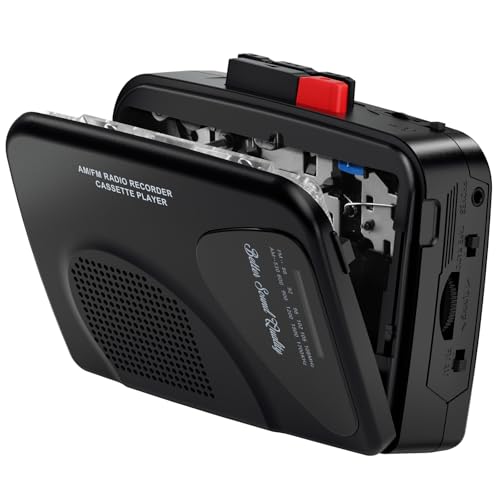
- Records sound and radio to cassette
- Voice activation recording
- Battery or 5V DC operation
Best For: Simple portable tape recording and radio capture
Simple Interview Recorder

- One-touch cassette recording
- Built-in and external microphone options
- Lightweight with AUX and headphone connectivity
Best For: Beginners recording interviews, classes, and spoken audio
Most Connected Option
QFX RETRO-39BT Cassette Recorder

- Records USB audio to cassette
- Records multiple sources to USB
- Adds Bluetooth, FM, MP3, and line-in playback
Best For: Flexible cassette and USB recording with multiple audio sources
Best for Digital Conversion
SEMIER Cassette-to-MP3 Recorder

- Converts cassettes to MP3
- Includes 16GB SD card and USB reader
- Compact USB-C or battery-powered design
Best For: Digitizing Type I tapes and storing recordings on SD card or computer
Best One-Touch Option
JENSEN MCR-100 Cassette Recorder

- One-touch recording with automatic level control
- Built-in mic plus auxiliary and external mic inputs
- Portable design with retractable handle
Best For: Beginners recording simple voice content
Best Simple Budget Pick

- Built-in microphone for voice notes and interviews
- Runs on AC power or four C batteries
- Simple controls with headphone and auxiliary connectivity
Best For: Accessible short-form voice recording
Best Accessory Bundle

- Includes external mic, aux cable, and AC adapter
- Records from mic or compatible auxiliary sources
- Built-in speaker and carrying handle add convenience
Best For: Ready-to-use lo-fi cassette recording projects
Best Digital Upgrade – Zoom H1 XLR Recorder
If you are shopping for cassette recorders for podcasts but want cleaner, more flexible digital production, the Zoom H1 XLR is a practical step up. It records WAV audio in 32-bit float and 96kHz, with two locking XLR/TRS inputs for microphones and other sources.
Best For: Podcasters, interviewers, and musicians who need versatile inputs and clip-resistant digital recording.
Pros:
- 32-bit float and 96kHz recording for detailed audio.
- Two XLR/TRS combo inputs support microphones and instruments.
- OLED waveform display helps monitor recording levels.
- Supports SDXC cards up to 1TB and includes 3.5mm input/output connectivity.
Cons:
- Requires two AA batteries.
- Records digitally rather than onto cassette tape.
Its 10-hour battery life, compact 6.4-ounce design, and USB-C interface make it well suited to portable podcast sessions, especially when you need more control than a basic cassette recorder provides.
Best Cassette-to-MP3 Option – KLIM K7 Cassette Player
For shoppers specifically comparing cassette recorders for podcasts, the KLIM K7 combines cassette playback with convenient digital storage. It converts tapes to MP3 on the included 16GB SD card and also records voice directly to the card using its built-in microphone.
Best For: Users digitizing cassette interviews, recording quick voice notes, and listening privately on the go.
Pros:
- Converts cassette tapes to MP3 without an app or additional device.
- Includes a 16GB SD card, card reader, earphones, and USB-C cable.
- Built-in microphone and speaker support simple voice recording and playback.
- Rechargeable 1000mAh battery needs about two hours to charge.
Cons:
- Does not record audio onto cassette tapes.
- MP3 recording may be less suitable for higher-end podcast production than a dedicated digital recorder.
The K7 is a useful bridge between older tape collections and modern files. Its lightweight design, 3.5mm headphone jack, and five-year assurance make it especially convenient for casual recording and tape archiving.
Best for Dual-Deck Workflows – Tascam 202MKVII Cassette Deck
Tascam 202MKVII Double Cassette Deck Recorder with USB Port, Dual Cassette Deck
Check Price On AmazonThe Tascam 202MKVII is a full-size option for buyers looking at cassette recorders for podcasts as part of a studio or tape-duplication setup. Its dual cassette decks and USB connectivity are designed for more involved cassette workflows than a handheld player.
Best For: Home studios, archival projects, and users who need a dual cassette deck with USB connectivity.
Pros:
- Dual cassette deck design supports two-tape workflows.
- Includes USB connectivity for compatible setups.
- Purpose-built as cassette recording equipment from Tascam.
Cons:
- Large and heavy at about 22 x 15 x 9 inches and 14.5 pounds.
- Less convenient for mobile podcast recording.
- The supplied notes do not specify microphones or portable battery operation.
This is better viewed as a stationary cassette-deck component than an all-in-one podcast recorder. Choose it when dual-deck functionality and USB connectivity matter more than portability.
Best Portable Tape Recorder – Mersoco AM/FM Cassette Player
If you want cassette recorders for podcasts in a simple, portable format, the Mersoco T201BUS offers tape recording alongside AM/FM radio playback. Its voice activation system can record external sounds or broadcasts to cassette, making it suitable for basic lectures, notes, and spoken-word projects.
Best For: Casual cassette recording, lectures, seminars, radio recording, and portable listening.
Pros:
- Records external sound and AM/FM broadcasts onto cassette.
- Voice activation system helps start recording when sound is detected.
- Portable design includes a built-in speaker and 3.5mm headphones.
- Runs on two AA batteries or a 5V DC power supply.
Cons:
- Basic cassette recording is less flexible for digital podcast editing.
- USB connection is for power rather than described digital audio transfer.
- AA batteries are not included.
The T201BUS is a straightforward choice when recording directly to physical tapes is the priority. Its compact body, radio tuner, and dual power options add flexibility, though serious podcast production will require a separate digitizing or editing workflow.
Simple Interview Recorder – Portable Cassette Recorder
PROSCAN Cassette Player & Recorder with Microphone, Headphone Jack, Aux in, Black
Check Price On AmazonFor shoppers comparing cassette recorders for podcasts, the PROSCAN offers a straightforward setup for recording interviews, classes, conferences, and other spoken audio. Its one-touch recording, built-in microphone, external microphone jack, and automatic level control make it practical for basic recording tasks.
Best For: Beginners who want a lightweight cassette recorder for interviews and spoken-word recordings.
Pros:
- One-touch recording is simple to operate.
- Includes a freestanding microphone and an external microphone jack.
- Automatic level control is designed to help produce crisp, clear recordings.
- Portable 1.8-pound design with a carry handle, headphone jack, and AUX input.
Cons:
- Uses analog cassette recording rather than built-in digital conversion.
- Plastic construction and a basic feature set may not suit advanced podcast workflows.
- AC/DC operation is provided, but the notes do not specify included battery details.
The PROSCAN is a sensible entry-level choice when ease of use matters more than digital connectivity. It is best suited to simple voice recording and cassette playback rather than editing or transferring recordings directly to a computer.
Most Connected Option – QFX RETRO-39BT Cassette Recorder
Among cassette recorders for podcasts, the QFX RETRO-39BT stands out for its broad connectivity. It can record USB audio to cassette, record cassette, Bluetooth, FM radio, microphone, or line-in audio to USB, and play MP3 files through its built-in speaker.
Best For: Users who want cassette recording alongside USB, Bluetooth, FM radio, and line-in features.
Pros:
- Supports USB-to-cassette recording.
- Can record from cassette, Bluetooth, FM radio, microphone, or line-in to USB.
- Includes external microphone support, USB, line-in/out, and a 3.5mm headphone jack.
- Portable swivel handle and AC or four C-battery power options.
Cons:
- Its 1.7-pound portable format includes a built-in 3.5-inch speaker rather than a podcast-focused monitoring system.
- Digital recording time is listed as 60 minutes, which may limit longer sessions.
- Four C batteries are required for battery operation and are not included.
The RETRO-39BT is the most versatile option in this group for moving audio between older and newer formats. Its USB recording and multiple inputs make it more adaptable than a basic cassette-only recorder, though podcast creators should still consider their editing and monitoring needs.
Best for Digital Conversion – SEMIER Cassette-to-MP3 Recorder
For cassette recorders for podcasts that also support digital archiving, the SEMIER combines cassette playback and recording with conversion to MP3. It can save converted audio to the included 16GB SD card or transfer it to a computer through USB with Audacity software.
Best For: Compact recording setups that need cassette-to-MP3 conversion and SD-card storage.
Pros:
- Converts cassette audio to MP3 on an SD card or computer.
- Includes a 16GB SD card, USB reader, software, and USB power cable.
- Compact 0.52-pound design with LCD navigation and a built-in 2W speaker.
- Supports recording through its built-in microphone and playback from an SD card.
Cons:
- Does not support Type IV or metal tapes.
- Its built-in microphone and 2W speaker are convenient but may be limited for more demanding podcast production.
- Computer conversion requires using the included USB connection and Audacity software.
The SEMIER is the strongest fit for shoppers who want to preserve cassette audio in a digital format while keeping the device portable. Its SD-card and USB workflows add useful flexibility, but the Type I tape limitation should be checked before purchase.
Best One-Touch Option – JENSEN MCR-100 Cassette Recorder
For shoppers comparing cassette recorders for podcasts, the JENSEN MCR-100 is a straightforward option for capturing spoken notes, interviews, or simple audio segments. Its one-touch recording, built-in condenser microphone, and automatic level control reduce setup work, while the auxiliary input adds flexibility for compatible audio sources.
Best For: Beginners who want simple voice recording with portable, flexible operation.
Pros:
- One-touch recording simplifies capturing lectures, interviews, music, or notes.
- Built-in condenser microphone and automatic level control support consistent recording levels.
- Auxiliary input, headphone jack, and external microphone jack offer multiple connection options.
- Retractable handle and shoebox-style design make it convenient to carry.
Cons:
- Records in mono, which may be limiting for stereo podcast production.
- Uses cassette media rather than providing a dedicated modern podcast workflow.
- The listed warranty is limited to 90 days.
The MCR-100 is best viewed as an easy analog recorder for rough interviews, field notes, or creative cassette-based podcast projects rather than a full studio setup.
Best Simple Budget Pick – Coby CVR-22 Cassette Recorder
The Coby CVR-22 suits buyers seeking uncomplicated cassette recorders for podcasts, voice notes, lectures, or interviews. Its built-in microphone and clearly labeled controls keep operation accessible, while battery or AC power supports use at a desk or away from an outlet.
Best For: Users who prioritize simple controls, built-in recording, and flexible power.
Pros:
- Combines cassette playback and recording in one compact device.
- Built-in microphone enables self-contained voice recording without extra equipment.
- Battery or AC operation supports portable and stationary use.
- Headphone jack, auxiliary input, and external-speaker compatibility provide listening flexibility.
Cons:
- Requires four C batteries for battery-powered operation.
- Its listed digital recording time is 90 minutes, so it is oriented toward short recordings.
- The supplied details do not specify advanced podcast-focused controls or recording features.
Choose the CVR-22 when ease of use matters more than extensive production controls. It can handle basic spoken recordings, but longer or more polished podcast sessions may require additional equipment and media planning.
Best Accessory Bundle – Deluxe Products DP-CASR-101
The Deluxe Products DP-CASR-101 stands out among cassette recorders for podcasts because it includes an external microphone, auxiliary cable, and AC adapter. It records to cassette from the microphone or compatible smartphone, laptop, or tablet output, making it useful for basic interviews, voice projects, and analog audio experiments.
Best For: Buyers who want a ready-to-use cassette recording kit with included accessories.
Pros:
- Includes an external microphone, auxiliary-in cable, and AC adapter.
- Can record to cassette through the microphone or auxiliary input.
- Built-in speaker supports convenient cassette playback.
- Carrying handle and optional four-C-battery operation add portability.
Cons:
- Battery operation requires four C batteries, which are not included.
- Auxiliary recording requires a source device with a headphone-out jack.
- The cassette-based workflow is less convenient for editing and publishing finished podcasts.
The DP-CASR-101 is a practical starter bundle for recording directly to cassette without immediately buying separate accessories. It is most suitable for simple, deliberately lo-fi projects rather than streamlined digital podcast production.
How We Picked the Best Cassette Recorders for Podcasts
We focused on recording flexibility, microphone and input options, portability, power requirements, playback features, and the ease of moving recordings into a modern editing workflow. Models with built-in microphones suit quick voice notes and informal interviews, while units with auxiliary, USB, SD, or computer-conversion features offer more control after recording.
Because cassette hardware varies widely, we also considered practical details such as monitoring through headphones, one-touch recording, speaker output, tape compatibility, and whether the design is better suited to field use or a stationary studio setup.
Quick Comparison
| Best For | Look For | Typical Advantage |
|---|---|---|
| Mobile interviews | Compact body, built-in mic, battery power | Easy to carry and set up |
| Analog podcast projects | Reliable cassette recording and playback | Distinctive tape-based workflow |
| Digital transfer | USB, SD, or cassette-to-MP3 conversion | Easier editing and archiving |
| Home recording | Auxiliary input, AC power, headphone output | More consistent studio use |
Key Buying Factors for Cassette Recorders for Podcasts
Recording Inputs and Microphone Quality
A built-in microphone is convenient, but it may pick up handling noise and room ambience. For interviews or scripted narration, prioritize a recorder with an auxiliary input or a compatible external microphone connection. Confirm the input type before buying; a basic mic jack is not the same as a balanced professional input.
Portability and Power
Battery-powered models are useful for street interviews, travel, and spontaneous recording. Check whether batteries are included, how many are required, and whether the unit also supports USB or DC power. Larger cassette decks generally work best in a fixed setup near an outlet.
Monitoring and Playback
Headphone output helps you check levels, tape transport, and background noise before committing to a recording. A built-in speaker is useful for playback, but it is not a substitute for headphones when evaluating speech clarity.
Digital Conversion
If the final podcast will be edited on a computer, cassette-to-MP3, USB, or SD recording features can simplify the transfer process. Conversion quality still depends on the tape, recording levels, and device electronics, so treat these features as workflow conveniences rather than guarantees of studio-grade sound.
Who Should Buy Which Cassette Recorders for Podcasts?
Choose a Portable Recorder for Field Interviews
Pick a compact cassette player-recorder with a built-in microphone, speaker, and battery operation if portability matters most. These are best for lo-fi interviews, documentary texture, rehearsal notes, and creative sampling.
Choose a Conversion Model for Hybrid Podcasts
If you want analog recording but plan to edit digitally, choose a model that transfers cassette audio to a computer, USB device, or SD card. This avoids relying on a separate deck and audio interface for basic archiving.
Choose a Cassette Deck for a Dedicated Setup
A full-size deck is the better choice for a home studio that needs stable AC operation, cleaner connections, and convenient tape playback. It is less practical for mobile recording but can fit a repeatable production workflow.
Choose a Simple Recorder for Beginners
For occasional use, a straightforward recorder with one-touch operation, a built-in microphone, and clear playback controls may be preferable to a feature-heavy unit. Before recording a full episode, test tape condition, microphone distance, battery life, and transfer requirements.