Choosing the right crossover can make a big difference in clarity, balance, and driver protection. The best passive audio crossovers help route highs, mids, and lows where they belong without adding complexity.
Below, we focus on options that suit car audio, DIY home speakers, and HiFi upgrades, with an emphasis on power handling, impedance match, and channel count.
Best 10 Passive Audio Crossovers Picks for 2026
Budget-Friendly 2-Way Car Audio Crossover
Compact Passive Speaker Splitter

- 2-way passive crossover for tweeters and mids/highs
- Gold-plated screw terminals and polymer capacitors
- 150W RMS / 300W peak rating
Best For: Affordable car audio installs that need simple 2-way splitting
Premium 3-Way Passive Crossover Pair

- 3-way passive crossover pair
- 12/12dB/oct design
- 300Hz-4kHz crossover range
Best For: Systems needing a dedicated 3-way crossover with defined crossover points
Universal 2-Way Speaker Divider
Heat-Dissipating Passive Crossover

- Universal 2-way design with easy connection
- Bass inductor, magnet, and overcurrent protection
- ABS housing with heat dissipation
Best For: Easy-to-wire installs that prioritize practical protection and sound accuracy
Adjustable 450W Speaker Crossover
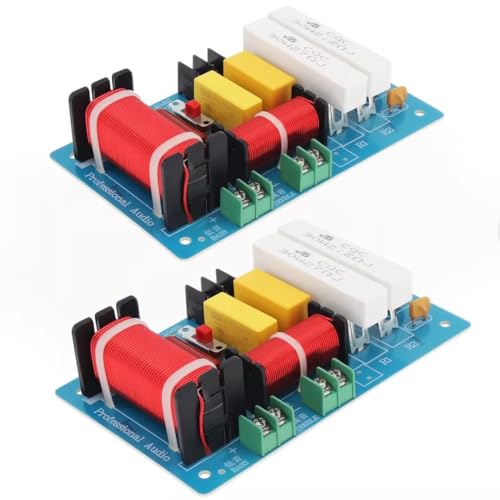
- 450W rating for car or home audio
- 2850/2900 adjustable crossover point
- Dual protection with capacitor and self-recovery fuse
Best For: Users wanting an adjustable 2-way crossover with easy installation
Adjustable HiFi Speaker Divider
2pcs 3 Way Crossover 400W 4-8 Ohm

- Adjustable 2550Hz-2600Hz crossover points
- 400W rating with 4-8 ohm support
- 8 solderless terminals for easier installation
Best For: DIY speaker projects that benefit from adjustable frequency tuning
Durable 2-Way Car Audio Splitter
300 Watts 2 Way Crossover for Tweeter & Speaker

- 2-way passive crossover for tweeter and speaker
- 300W max with 12V vehicle compatibility
- Over-current protection and heat-dissipating housing
Best For: 12V car or boat audio installs that need a rugged 2-way crossover
Adjustable Two-Way Pick
2-Way Adjustable Crossover for HiFi & Car Audio

- Four-speed adjustable high/low control
- Aims for cleaner treble and stronger bass
- Suitable for home audio or car audio DIY builds
Best For: DIY users tuning a simple 2-way speaker setup
Three-Way Home Upgrade
200W Passive 3-Way Speaker Crossover

- 3-way layout for bass, midrange, and tweeter
- Screw terminals simplify installation
- Includes 2 crossovers for stereo use
Best For: Home or car audio systems needing an easy-to-wire 3-way crossover
Balanced Sound Choice
120W 2-Way Speaker Frequency Divider

- 45Hz-20KHz response with 120W max power
- Plug-and-play harness and solderless terminals
- Overcurrent protection and bass-focused design
Best For: Car audio installs that need an easy-to-wire 2-way crossover
Budget-Friendly 2-Way Car Audio Crossover – Compact Passive Speaker Splitter
300 Watts 2 Way Crossover - (2 Pack) Passive Car Audio Speaker Tweeter Mids and Highs CRX-203
Check Price On AmazonIf you’re comparing passive audio crossovers for a simple 2-way car audio upgrade, this CRX-203 pair focuses on the basics: clean separation between tweeters and mids/highs, straightforward wiring, and enough power handling for common installs.
Best For: Car audio buyers who want an affordable 2-way passive crossover with easy screw-terminal installation.
Pros:
- 2-way passive design for tweeter and mid/high splitting
- Gold-plated screw terminals for secure connections
- 150 watts RMS / 300 watts peak rating
- High-grade polymer capacitors
Cons:
- Designed specifically as a 2-way crossover, not a 3-way solution
- Frequency ranges are fixed rather than adjustable
Overall, this is a practical pick if you want a no-frills crossover with clear component specs and a compact install-friendly layout. It leans more toward value and simplicity than advanced tuning.
Premium 3-Way Passive Crossover Pair – Focal A3-XO 3-Way Network
For buyers who need passive audio crossovers in a true 3-way setup, the Focal A3-XO is built around a defined 12/12dB/oct network and a 300Hz-4kHz crossover range. It’s a more specialized option for matching drivers in a structured speaker system.
Best For: Audio setups that need a dedicated 3-way passive crossover pair with specified crossover points.
Pros:
- 3-way passive crossover pair
- 12/12dB/oct crossover specification
- 300Hz-4kHz crossover range
Cons:
- More specialized than a basic 2-way crossover
- Best suited to systems built around the stated crossover range
This model makes sense when your system is already planned around a 3-way layout and you want a crossover with clearly defined behavior. It’s less about general-purpose versatility and more about matching a specific speaker design.
Universal 2-Way Speaker Divider – Heat-Dissipating Passive Crossover
300 Watts 2 Way Crossover, Car Audio Crossover Universal Heat Dissipation Speaker Frequency Divider
Check Price On AmazonIf you’re shopping passive audio crossovers for a straightforward 2-way speaker install, this universal divider emphasizes sound accuracy, bass improvement, and easy connection. The heat-dissipation ABS housing and built-in protection features make it aimed at practical daily use.
Best For: Users who want an easy-to-wire universal 2-way crossover with a focus on sound accuracy and basic protection.
Pros:
- Designed to improve sound accuracy
- Bass inductor and magnet for better bass response
- High-gloss double-layer ABS housing for heat dissipation
- Overcurrent protection and simple plug-in connection
Cons:
- Product notes do not list detailed frequency specs
- More focused on practical features than advanced tuning controls
As a universal 2-way crossover, this one is geared toward convenience and durability rather than highly technical adjustment. It’s a sensible option if you want an easy install with stated protection and housing benefits.
Adjustable 450W Speaker Crossover – 2-Way HiFi Frequency Divider
Among passive audio crossovers, this 2-way speaker divider stands out for its adjustable frequency point and higher power rating. It’s built for buyers who want a more tunable crossover with screw terminals, phase compensation, and protection features for demanding car or home audio use.
Best For: Car or home audio users who want an adjustable 2-way crossover with protection and easy installation.
Pros:
- 450W rating with 4-8 ohm compatibility
- Adjustable frequency division point: 2850 / 2900 switch
- High- and low-order filtering for cleaner sound separation
- Dual protection with capacitor and self-recovery fuse
Cons:
- Still limited to a 2-way layout
- Requires matching the system to the listed impedance range
This model is a strong fit if you want more control than a fixed-point crossover and value the added protection for higher-power use. The adjustable switch and screw-terminal design make it especially practical for straightforward installs.
Compact 3-Way Car Audio Tuning – 2 Pack 4 Ohm 3 Way Passive Crossover 300 Watts
If you’re building a car audio system around passive audio crossovers, this 3-way pair is aimed at clean driver separation in a straightforward, no-frills package. It supports a 300-watt max rating, uses high-grade polymer capacitors, and is designed for 4-ohm setups, making it a practical fit for common aftermarket car audio builds.
Best For: Car audio upgrades that need a 3-way passive crossover with simple compatibility and a 300W rating.
Pros:
- 3-way design separates woofer, midrange, and tweeter frequencies
- 300 watts max power supports many aftermarket car audio installs
- High-grade polymer capacitors and ferrite/air-cooled spools
- Sold as a 2-pack for matching left and right channels
Cons:
- Built for 4-ohm systems, so it may not suit every setup
- More of a basic passive solution than a fully adjustable crossover
This is a sensible pick if you want a conventional passive crossover for car audio with defined frequency ranges and a matched pair in the box. It’s best suited to users who value compatibility and core functionality over advanced tuning options.
Adjustable HiFi Speaker Divider – 2pcs 3 Way Crossover 400W 4-8 Ohm
For passive audio crossovers in a home or HiFi-style speaker build, this 3-way divider stands out for adjustability and easier installation. It’s rated for 400W, works across 4-8 ohms, and lets you fine-tune crossover points between 2550Hz and 2600Hz to better match your speakers.
Best For: DIY speaker builders who want an adjustable 3-way passive crossover with tool-free wiring.
Pros:
- Adjustable crossover point between 2550Hz and 2600Hz
- Works with 4-8 ohm speaker setups
- 400W power handling for higher-output systems
- 8 solderless terminals make installation easier
Cons:
- Specific adjustability may not be necessary for basic builds
- Designed around speaker wiring, so it’s less specialized for car-specific use
This model is a strong choice when you want more control over how the speakers blend, especially if you’re comfortable dialing in a sound profile. The solderless terminals also make it appealing for first-time builders who want less hassle during setup.
Durable 2-Way Car Audio Splitter – 300 Watts 2 Way Crossover for Tweeter & Speaker
If you want passive audio crossovers for a straightforward car audio upgrade, this 2-way model focuses on clean frequency routing and easy installation. It’s rated for 300 watts max, uses a heat-dissipating ABS and metal housing, and is built for 12V systems in cars, SUVs, trucks, and boats.
Best For: Car and marine-style 12V audio setups that need a durable 2-way passive crossover.
Pros:
- Designed for 12V systems across multiple vehicle types
- 300W max power with 100W RMS support
- Over-current protection adds a layer of safety
- Solderless plug-in sockets simplify installation
Cons:
- 2-way design is less flexible than a 3-way crossover
- Not intended for users needing advanced tuning controls
This crossover is a practical option if you want durability and simple setup rather than elaborate adjustment features. The protection and heat management details make it especially appealing for everyday high-volume listening in vehicle-based systems.
Adjustable Two-Way Pick – 2-Way Adjustable Crossover for HiFi & Car Audio
If you want a simple way to fine-tune a basic speaker setup, this passive audio crossover focuses on splitting high and low frequencies with adjustable control. It is aimed at DIY home audio and car audio builds where you want cleaner treble and stronger bass without adding active electronics.
Best For: DIY users who need a low-cost adjustable 2-way crossover for home or car speaker projects.
Pros:
- Four-speed adjustable high/low control for more flexible tuning.
- Designed for more precise distribution of high and low frequencies.
- Notes emphasize pure treble and strong, powerful bass.
- Works for both home audio and car audio use cases.
Cons:
- Only supports a 2-way design, so it is not suited to 3-driver systems.
- Best described as a DIY-oriented filter rather than a polished plug-and-play upgrade.
This is a practical pick if your goal is adjustable frequency splitting in a passive format. It is most appealing when you want straightforward tuning for a home or car speaker project.
Three-Way Home Upgrade – 200W Passive 3-Way Speaker Crossover
For buyers comparing passive audio crossovers for a fuller speaker setup, this 3-way model is built to split bass, midrange, and treble in home or car systems. The screw terminals and included 2-pack make it a convenient option when you want an installation-friendly crossover without soldering.
Best For: Home or car audio builds that need a 3-way passive crossover with simple screw-terminal installation.
Pros:
- 3-way design with frequency division points listed at 860Hz and 6000Hz.
- Rated at 200W peak and designed for 4-8 ohm systems.
- Screw terminals make installation easier and avoid soldering hassles.
- Includes two units, which is useful for stereo setups.
Cons:
- Requires a midrange speaker larger than 4.5 inches for best results.
- Installation-friendly, but still needs basic wiring knowledge.
This model makes sense if you need a passive crossover for a conventional 3-way speaker path. It stands out most for its practical terminal design and the included pair for matching left/right channels.
Balanced Sound Choice – 120W 2-Way Speaker Frequency Divider
If you are shopping for passive audio crossovers to improve a car speaker setup, this 2-way divider is built around clean frequency splitting and easy integration. Its notes point to balanced sound, enhanced bass performance, and a wiring-friendly design that suits straightforward upgrades.
Best For: Car audio users who want a 2-way passive crossover with simple wiring and balanced sound shaping.
Pros:
- 45Hz-20KHz response and 120W max power output.
- Uses larger 16mm capacitors and a 100V15μF high-frequency capacitor setup.
- Bass inductor and overcurrent protection support tighter low-end and safer operation.
- 6-position solderless terminal block and plug-and-play harness simplify installation.
Cons:
- Only a 2-way divider, so it is not intended for full 3-way speaker systems.
- Designed primarily with car audio integration in mind.
This is a solid choice when convenience matters as much as tuning. The combination of protection features, easier wiring, and broad impedance support makes it a practical car-audio crossover option.
How We Picked These Passive Audio Crossovers
We prioritized models that match common real-world builds: 2-way and 3-way speaker systems, car audio installs, and DIY home HiFi projects. Our shortlist favored sensible power ratings, clear impedance compatibility, and designs that are straightforward to install. We also considered whether a unit is adjustable, since that can help fine-tune the handoff between drivers.
Quick Comparison: What Matters Most
The fastest way to compare Passive Audio Crossovers is by system type. A 2-way design is usually best for tweeter-and-midbass setups, while 3-way units are better for builds that separate tweeters, mids, and woofers. Next, check wattage handling and impedance, especially if your speakers are 4 ohm, 6 ohm, or 8 ohm. Finally, look at the crossover’s physical size and wiring layout so it fits your enclosure or vehicle space.
Key Buying Factors for Passive Audio Crossovers
1. Match the Crossover to Your Speaker Layout
Passive Audio Crossovers must match the number of drivers in the system. Using a 2-way unit in a 3-way setup can leave gaps in the frequency range, while a 3-way model in a simple system may add unnecessary complexity.
2. Check Power Handling Realistically
Wattage ratings are only useful when they reflect your amplifier and speaker setup. Choose headroom above your typical listening level, but avoid oversizing so far that the crossover’s parts are stressed outside their intended range.
3. Confirm Impedance Compatibility
Impedance affects how the crossover behaves and how much load the amplifier sees. Many popular models are designed around 4 to 8 ohm speakers, which covers a lot of car audio and home audio installs.
4. Decide Whether Adjustability Matters
Adjustable crossovers can help tame bright tweeters or balance a system with uneven drivers. If you want a simple plug-and-play build, fixed crossovers are often easier.
5. Consider Build Quality and Heat Management
Look for solid components, secure terminals, and a layout that can dissipate heat. This is especially important in compact enclosures or vehicle installations where airflow is limited.
Who Should Buy Which Passive Audio Crossovers?
If you are building a straightforward car audio upgrade, a well-matched 2-way passive crossover is usually the best starting point. If you are running a more advanced system with separate tweeters, mids, and woofers, a 3-way crossover is the better fit. DIY home audio builders should pay extra attention to impedance and adjustability, since speaker sensitivity and cabinet design can vary more widely than in off-the-shelf systems.
In short, the best Passive Audio Crossovers are the ones that match your drivers, amplifier, and enclosure without forcing compromises. Focus on compatibility first, then choose the simplest design that gives you the balance and control you need.